
Every club show seems to have one Mustang II owner who has been told, more than once, that nobody bought these cars. The next time it happens, that owner should pull out the Mustang II production numbers. Ford built 1,107,718 of them across five model years, and the first year alone out-built every Mustang year that followed it until the end of the century. The car's reputation and its sales record point in opposite directions, and the record is the one with paperwork behind it. This piece goes year by year, body by body, and flags the places where the sources disagree. For the wider Mustang II story, including why Ford built it, start there.
Car Features
6 min read
Mustang II Production Numbers, Year by Year
Mustang II production numbers for 1974 to 1978 by body style: 1,107,718 built, the huge first year, and the disputed Cobra II and King Cobra counts.
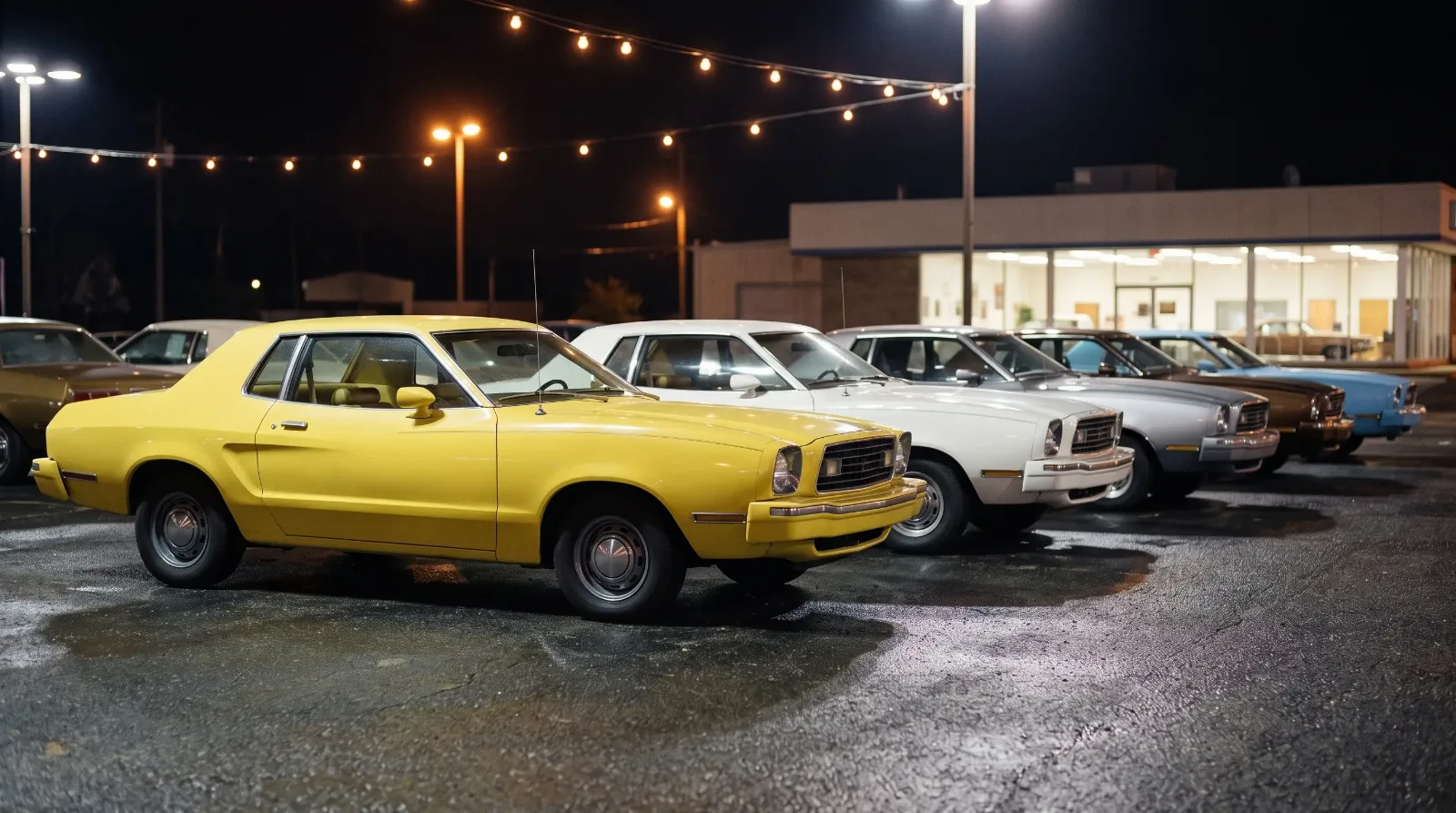
Mustang II production numbers by year and body
Here is the whole run in one table. These are model-year figures. Each year's body-style rows add up to the total, and the five totals add up to 1,107,718, which is why we trust them over the stray figures you'll see quoted elsewhere.
| Model year | Hardtop | 2+2 hatchback | Ghia | Mach 1 | Cobra II | Total |
|---|---|---|---|---|---|---|
| 1974 | 177,671 | 74,799 | 89,477 | 44,046 | none | 385,993 |
| 1975 | 85,155 | 30,038 | 52,320 | 21,062 | none | 188,575 |
| 1976 | 78,508 | 62,312 (incl. Cobra II) | 37,515 | 9,232 | 25,259 (within 2+2) | 187,567 |
| 1977 | 67,783 | 37,213 | 29,510 | 6,719 | 11,948 | 153,173 |
| 1978 | 81,304 | 60,399 | 34,730 | 7,968 | 8,009 (disputed) | 192,410 |
| Total | 1,107,718 |
Two patterns jump out. The notchback outsold the hatchback every single year, and the first year dwarfs the other four. Add the hardtop and the Ghia together for 1974 and you get 267,148 notchbacks against 118,845 hatchbacks. People remember the Mach 1 and the Cobra II. Most buyers took home a plain coupe or a Ghia.
1974: the year that made the numbers
The 1974 total of 385,993 is the one to remember. Set it against what came before: Ford built 149,678 Mustangs for 1971, 125,093 for 1972 and 134,867 for 1973. The small car nearly tripled the 1973 figure in its first year, at a moment when buyers were walking away from the big version of the pony car. Among all Mustang model years, only 1965, 1966 and 1967 beat it, and no model year from 1968 through 1999 matched it.
Here is where the paperwork gets interesting. One widely read reference prints 385,993 for 1974 and, on the same page, a second figure of 296,041. Only the first one reconciles with the body-style rows. So if somebody at a show tells you Ford built under 300,000 Mustang IIs that first year, they read the wrong line, and you can show them the arithmetic.
1975 to 1977: the slide
The 1975 total dropped to 188,575, roughly half of 1974. The V8 returned that year, and the catalytic converter arrived with it, but neither changed the trend. 1976 held almost dead level at 187,567, then 1977 fell to 153,173, the lowest year of the run.
The sources wobble on two of these. One reference gives 199,199 for 1975, with a "citation needed" flag attached, and 153,117 for 1977. The figures in our table, 188,575 and 153,173, are the ones whose body-style rows add up. That's my standard for every number in a club newsletter: if the parts don't sum to the whole, it doesn't go in. One more for the file: a popular 1975 table shows 51,320 Ghias, while the other sources we checked say 52,320. Only 52,320 makes the 1975 total work, so treat the other as a typo.
Inside those totals, the Mach 1 tells the sharpest story. It went from 44,046 in 1974 to 21,062, then 9,232, then 6,719 in 1977. The Ghia shrank more slowly, from 89,477 to 29,510. Meanwhile the Cobra II arrived for 1976 and sold 25,259 that year, counted inside the 62,312 hatchbacks, then 11,948 in 1977. The hatchback found a new reason to exist, and it had stripes.
1978 and the special editions
The last year bounced back to 192,410, more than 1975, 1976 or 1977. The hardtop recovered to 81,304, the 2+2 to 60,399, and the Mach 1 edged up to 7,968.
The special editions are where the counting gets argued about. The 1978 King Cobra is usually given as 4,313 built, a figure two well-used sources agree on. Old Cars Weekly says 4,960. One King Cobra reference splits production into 2,017 four-speeds and 2,289 automatics, which adds up to 4,306, seven short of its own total. The King Cobra was built from the first week of December 1977 to July 1978, at Dearborn and San Jose.
The 1978 Cobra II is messier still. The usual table says 8,009. Another listing and Old Cars Weekly give 4,049 Cobra IIs alongside 4,960 King Cobras. Ford never broke out Cobra II sales, so nobody has the factory document that settles it. When a seller tells you a 1978 Cobra II is "one of 4,049," ask which list they're reading from, and smile.
"I've heard a dozen stories about how rare a Mustang II is. The production table is the only one I'd put in the newsletter. It says a million and change were built, and it says the notchbacks won."
Wayne Coburn
Reading the paperwork on one car
Production totals tell you about the run. The VIN tells you about the car in your driveway, and Mustang II VINs carry more than most owners realize.
No factory production ledger for the Mustang II has surfaced in the sources we rely on, which is why the disputed figures above may never be settled. What isn't in dispute is the scale: more than 1.1 million cars in five years, and a first year that the next two decades never topped. That record is a big part of why owners now talk about the comeback with a straight face.
Sources and notes
- Ford Mustang (second generation), Wikipedia: yearly figures, the 296,041 and 199,199 entries, King Cobra count
- MustangSpecs: 1974 Ford Mustang production by body style
- MustangSpecs: 1977 Ford Mustang production table (153,173)
- ConceptCarz: Ford Mustang II production by year
- MustangSpecs: 1978 King Cobra production, build dates and buck tags
- Old Cars Weekly: 1978 Ford Mustang Cobra II (4,049 and 4,960 figures)
Related Reading
Have a
Ford Mustang
for Sale?
Reach thousands of serious classic car collectors across the US.
Sell It Here →
Selling a classic? Here's how: where to sell your classic car online
Are You a Classic Car Dealer?
List your full inventory and connect with targeted classic car buyers.
Join as a Dealer →

About the author
Wayne Coburn
Longtime Corvette owner, judge and club figure who knows the cars, the records and the people behind them.
Related Listings - Ford Mustang
Comments
Be the first to comment on this article.