
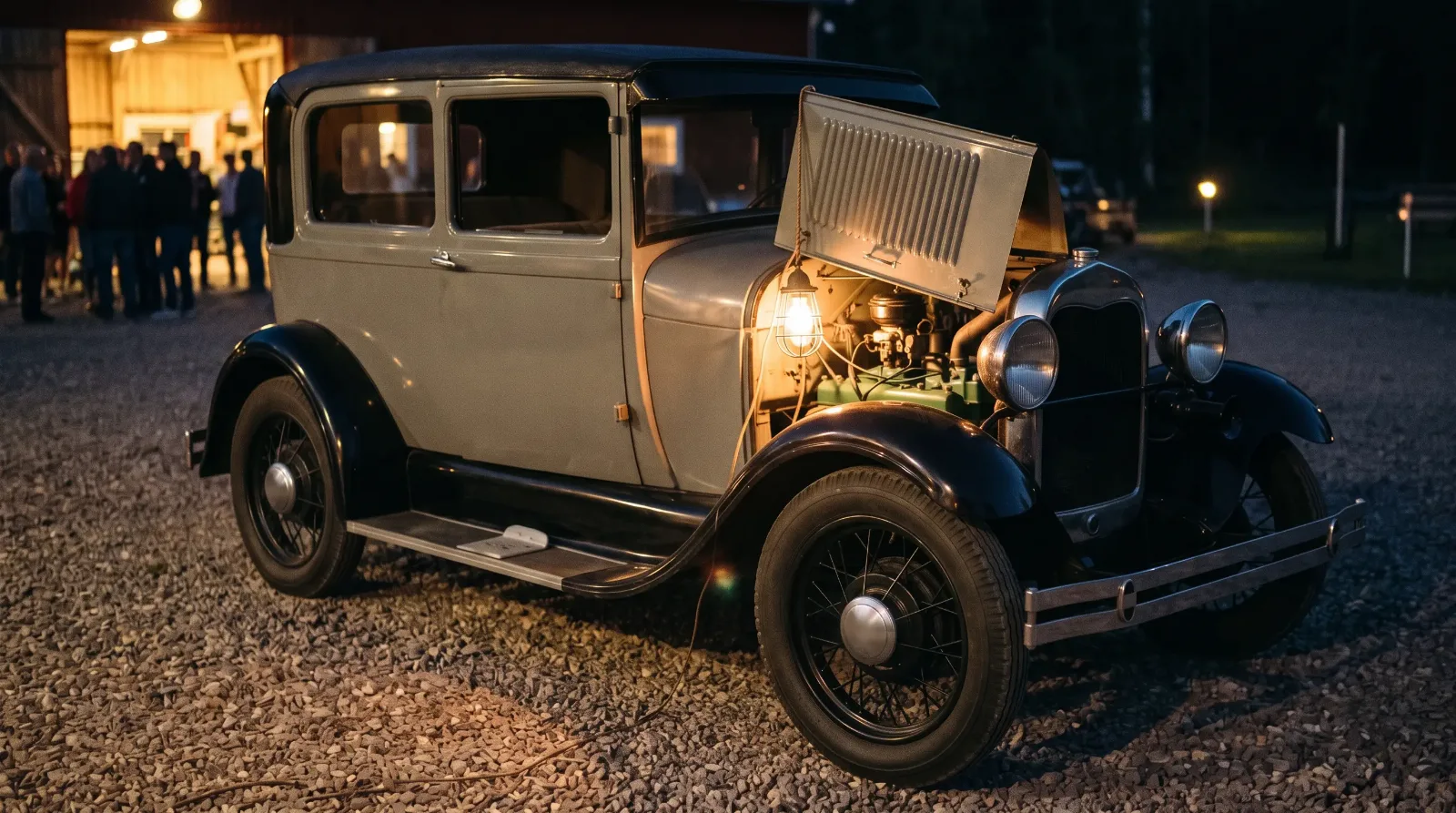
Crawl under a Model T or a Model A and the first odd thing you notice is that the springs run the wrong way. Most cars of the period hung each axle on two leaf springs running front to back, one per side. Ford used a single spring laid across the car, side to side, above each axle. The transverse leaf spring Ford fitted to the Model T in 1908 was still under the Model A in 1931, and in front it stayed in Ford's American cars until the late 1940s. This article looks at how the layout works, why it suited these two cars, and where it falls short.
Car Features
7 min read
Transverse Leaf Springs Under the Model T and Model A
One spring across each axle: how the transverse leaf spring on the Model T and Model A works, why it suited bad roads, and where it fell short.
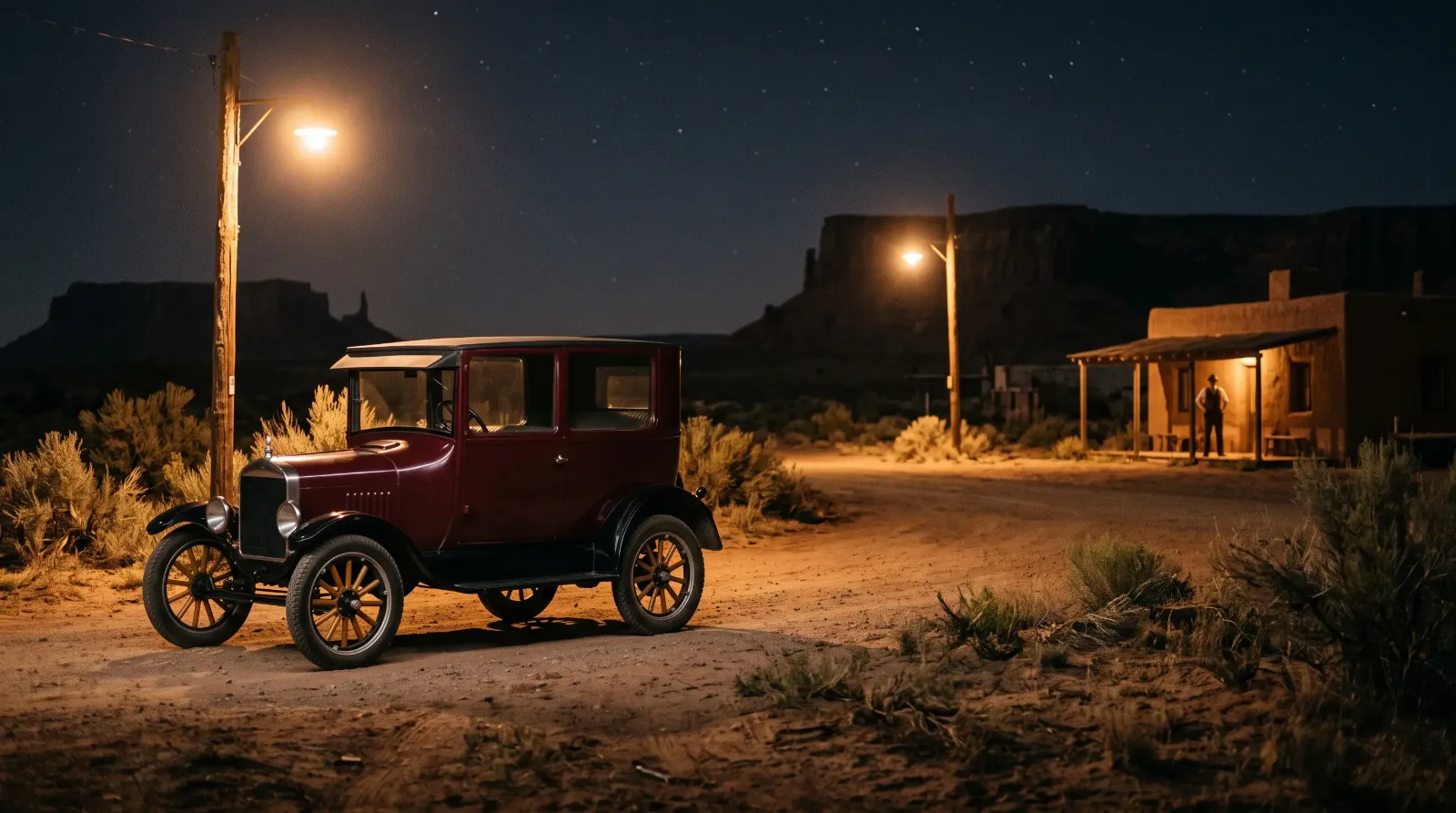
How a transverse leaf spring works
A leaf spring is a stack of flat steel strips of decreasing length, clamped together at the middle. Load it at the ends and the stack bends, each leaf sliding a little on the next. Ford's version is semi-elliptic, meaning the stack forms a shallow arch. On both the Model T and the Model A, one such spring sits across the front axle and another across the rear.
The geometry is simple. The center of the arch is clamped to the frame. Each end of the spring is linked to the axle near a wheel through a short swinging shackle, so the spring can lengthen and shorten as it flexes. When the left wheel hits a bump, that end of the spring rises and the arch flattens on that side. The frame, hanging from the middle, rises less than the wheel does. That is the whole job of a spring: let the wheel move more than the body.
What the spring does not do well is locate the axle. A longitudinal spring holds its axle fore and aft by its own stiffness. A transverse spring, lying across the car, offers little resistance to the axle swinging backward under braking or forward under drive. Ford handled that with separate locating members: triangulated radius rods, often called wishbones, at the front, and on the Model T a torque tube running from the transmission to the rear axle. The Model A kept torque-tube drive as well. The spring carries the weight; the rods and tubes keep the axles square.
| Item | Model T (1908 to 1927) | Model A (1928 to 1931) |
|---|---|---|
| Front spring | Transverse semi-elliptic leaf | Transverse leaf, 10 leaves |
| Rear spring | Transverse semi-elliptic leaf | Transverse leaf |
| Front axle | Beam, drop-forged vanadium steel | Beam |
| Factory shock absorbers | None | Houdaille double-acting hydraulic |
| Wheelbase | 100 in | 103.5 in |
| Curb weight | 1,200 to 1,650 lb | 2,265 to 2,465 lb |
Why the transverse leaf spring suited Ford
The case for the design is a list of things it saves. It is simple: one spring pack per axle instead of two, with fewer clamps, fewer shackles and fewer frame brackets. It is light and compact. It keeps unsprung weight low, which is the mass that moves up and down with the wheel and which the spring has to control. Lower unsprung mass lets the wheel follow a rough surface more closely.
That last point mattered on the roads the Model T was built for. Early American roads were mostly unpaved dirt, and the Model T's suspension was designed for them. The car's high road clearance was one of the reasons rural buyers liked it. A single spring across the axle also lets one wheel climb over a rut while the other stays down, with the arch flexing unevenly. On a rutted farm track that articulation keeps the tires on the ground.
There is a durability argument too. Because one pack carries both wheels, a single broken leaf usually leaves the rest of the stack holding the car up. A driver on a back road could limp home instead of sitting on the axle. For a car sold to people far from a garage, that was a useful failure mode.
What changed from Model T to Model A
The layout carried over; the parts did not. Ford said no parts carried over from the Model T to the Model A, and the suspension follows that rule: the concept of a transverse semi-elliptic spring front and rear is shared, but the springs, axles and mounts are new. The larger point is in the table above. The Model A was about 3.5 inches longer in wheelbase and, depending on body, several hundred pounds heavier than a Model T. Its engine, covered here, made about twice the power, and the car went faster.
More mass and more speed put more energy into the springs on every bump. A leaf spring has some built-in damping, because the leaves rub against each other, but that friction is crude and varies with dirt, rust and grease. The Model T relied on it. The Model A added Houdaille double-acting hydraulic shocks, which resist motion in both directions and control the spring's rebound. Ford called the windshield and the hydraulic shocks firsts for Ford and unheard of in the low-priced field. In engineering terms, the spring design was adequate; it was the damping that needed to grow up.
"A transverse spring is a good answer to a question about cost, weight and bad roads. It is a less good answer to a question about cornering. Ford asked the first question for forty years."
Emily Chen
The Model AA truck shows where Ford drew the line. The AA kept a transverse spring at the front but used longitudinal leaf springs at the rear, where the payload sat. Heavy, variable loads on one axle are exactly the case where two springs, one per side, earn their extra parts.
The weaknesses, and how long Ford kept it
A single spring across the car has a high, narrow effective mounting point. Because the frame hangs from the center of the spring, the body has little leverage against roll, and a softly sprung transverse car leans in corners more than a car on widely spaced longitudinal springs. Owners also find that the shackles wear, and worn shackles let the axle shift and wander. Both cars were designed for lubrication by hand, and the Model A came with a pressure grease gun as standard equipment. A dry shackle is the usual cause of squeaks and slop.
None of that persuaded Ford to change quickly. Transverse leaf front suspension stayed with Ford products from 1908 to 1948, and the British Ford Popular used it until 1959. Ford's American cars moved to independent front suspension for 1949. Through the 1930s, owners who bolted period speed parts onto a Model A engine still rode on the same two transverse springs unless they changed them, which is a reminder that the chassis was built for steady work, not for the extra pace.
Judged on its own terms, the transverse spring did what Ford needed: cheap to make, easy to fix, forgiving on bad roads and hard to kill. It aged badly as speeds rose and roads improved, which is why the Model A needed hydraulic shocks to make it work and why Ford eventually gave it up.
Sources and notes
Related Reading
Have a
Ford Model T
for Sale?
Reach thousands of serious classic car collectors across the US.
Sell It Here →
Selling a classic? Here's how: compare the places to sell classic cars
Are You a Classic Car Dealer?
List your full inventory and connect with targeted classic car buyers.
Join as a Dealer →

About the author
Emily Chen
Bay Area engineer with a deep focus on vintage Japanese and European performance cars. Approaches classic car research and restoration with an analytical eye.
Related Listings - Ford Model T


Comments
Be the first to comment on this article.