
Here is the short answer, and it saves people money at swap meets: almost nothing. Ford said that no parts carried over from the Model T to the Model A. Anyone hunting Model T and Model A parts in the same pile of boxes should go in assuming they will not swap. What did carry over was a set of ideas. The Model A kept the Model T's basic way of holding up a car, driving its rear wheels and feeding its engine fuel, and it threw away nearly every piece that did those jobs. This piece sorts the two lists out.
Car Features
7 min read
What Carried Over From the Model T to the Model A
Ford said no parts carried over from the Model T to the Model A. The ideas did: the L-head four, transverse springs, torque tube and gravity fuel.
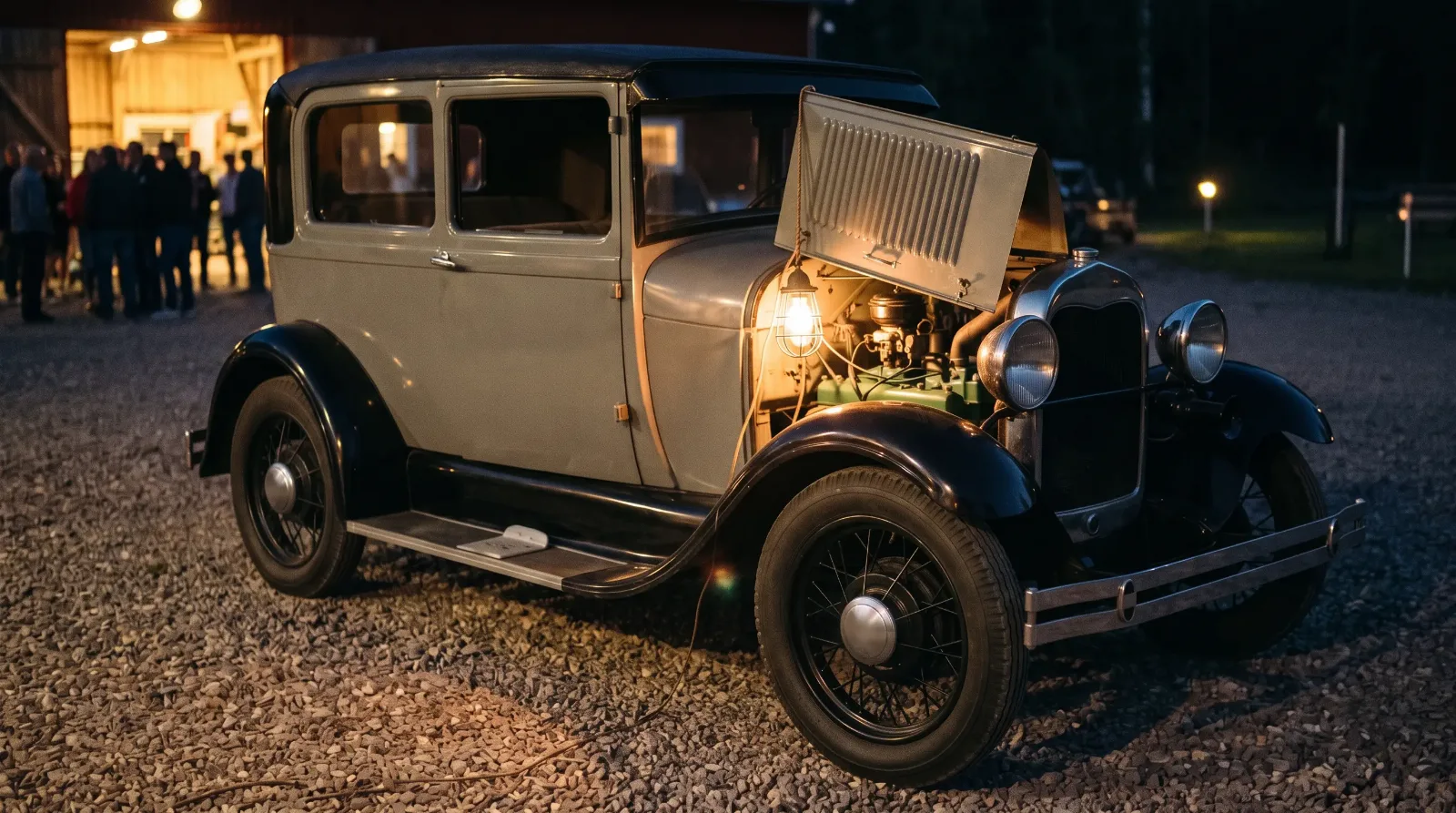
Ford's own line: no Model T and Model A parts in common
Start with the factory. When Ford described the new car, it listed what was new, including the Triplex shatterproof safety windshield, the hydraulic shocks and the blue oval, and it said the Model A had no parts carried over from the Model T. The engine sources agree. The Model A engine was considerably larger, and no engine parts interchange between the two.
The parts count tells the same story from another angle. A Model A had more than 6,800 parts. A Model T had about 5,000. You do not get from one number to the other by tweaking an old design. If you want the full list of what Ford changed and why, this piece lays it out spec by spec. Here the job is narrower: what survived the change, even in spirit.
| System | Model T | Model A | Carried over? |
|---|---|---|---|
| Engine layout | 177 cu in L-head inline four, 3 main bearings | 200.5 cu in L-head inline four, 3 main bearings | Layout yes, parts no |
| Springs | Transverse leaf, front and rear | Transverse leaf, front and rear | Concept only |
| Drive to rear axle | Torque tube, single U-joint | Torque tube | Concept only |
| Fuel feed | Gravity, cowl tank on most 1926 to 1927 cars | Gravity, cowl tank with gauge | Concept yes |
| Transmission | Two-speed planetary, pedals | Three-speed sliding gear | No |
| Brakes | Band in transmission; rear drums by hand lever | Four-wheel mechanical drums | No |
| Ignition | Flywheel magneto, trembler coils | Battery, distributor | No |
| Cooling | Thermosiphon, no pump | Thermosiphon plus water pump | Partly |
The engine: same recipe, different kitchen
On paper the two engines look like cousins. Both are side-valve (L-head) inline fours. The T's cylinders were cast as one block under a detachable head, and the A follows the same plan: a cast-iron monobloc with a detachable head. Both run on three main bearings. That is where it ends. The Model T displaced 177 cubic inches and made 20 hp. The Model A displaced 200.5 cubic inches and made 40 hp at 2,200 rpm. Bore, stroke, crank, rods, pistons, head, manifolds: all different.
Oiling changed too. The T had no oil pump and shared its oil with the transmission. The A used a pump to lift oil to the valve chamber, then let gravity feed the mains and splash do the rods. Cooling kept the T's thermosiphon idea but added a centrifugal water pump on the head. So you can say the cooling layout carried over, in the sense that the A still leans on hot water rising on its own. The pump is new, and so is everything it bolts to.
"Every few months somebody brings me a Model T part and asks if it fits his A. I tell him the same thing: it says Ford on the radiator, and that's about all the two have in common."
Mike Sullivan
Springs, torque tube and fuel: the ideas that stayed
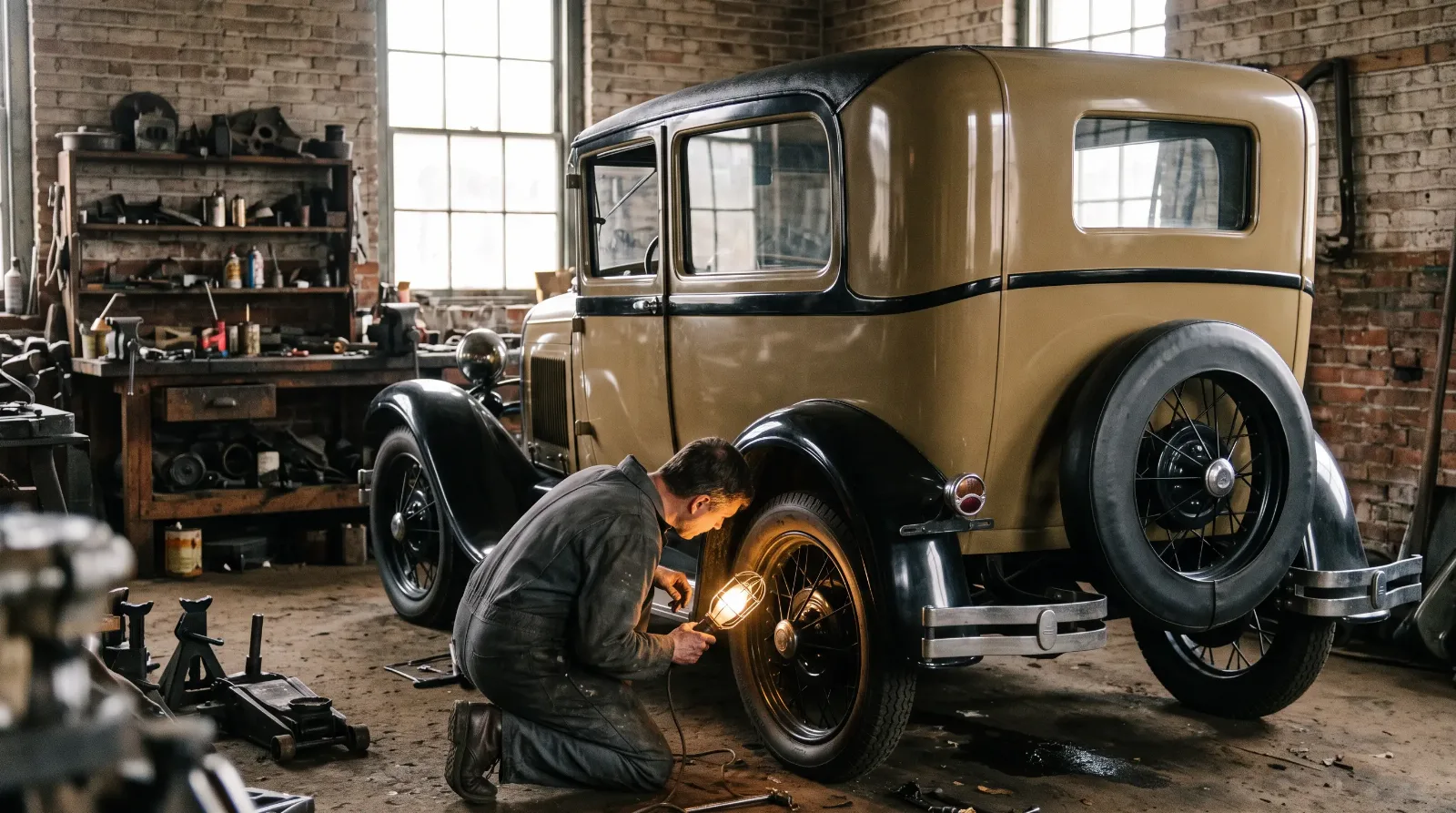
The clearest carryover is underneath. Both cars sit on a transverse semi-elliptic leaf spring at the front and another at the rear, one spring laid across each axle. That is the concept, not the part. The Model A springs, axles and mounts are new, and the A added Houdaille double-acting hydraulic shocks that the T never had from the factory. But slide under both cars and the family look is obvious.
The drive to the rear axle follows the same pattern. The Model T used a single universal joint and a torque tube to the rear axle. The Model A also used torque-tube drive. Forum restorers point out that the tubes and the ball joints at the front of them differ between the two cars, so do not expect to bolt one in place of the other.
Fuel is the third idea. Neither car has a fuel pump. The Model T carried a 10-gallon tank under the front seat and fed the carburetor by gravity; on most 1926 and 1927 cars, Ford moved the tank forward and up, under the cowl. The Model A kept gravity feed from a cowl tank, holding 10 gallons in 1928 and 1929 and 11 in 1930 and 1931, and added a gauge built into the tank itself. So the late T and the A share the location and the principle. The tank, gauge and lines are different.
Wheels, and the closest the two cars come
Wheels are where owners get their hopes up. The last Model Ts of 1926 and 1927 had steel-spoke wheels available, and their balloon tires were 4.40 x 21. The 1928 and 1929 Model A came with five steel-spoke wire wheels as standard on 4.50 x 21 tires. Same diameter, same general idea. That does not make the wheels, hubs or drums the same part, and nobody should assume they interchange. For 1930 the A went to 19-inch wheels with 4.75 tires, which ends the comparison for good.
The rest of the car moved further apart than people assume. The T's two-speed planetary gearbox, worked by pedals, gave way to a three-speed sliding-gear box with one reverse. The T had no service brakes at the wheels, just a band in the transmission and rear drums on the hand lever; the A got four-wheel mechanical drum brakes. That gap is the biggest thing you feel from the driver's seat, and the two cars on the road are compared in their own piece.
What this means at the parts counter
The electrics are a clean break too. The T made its spark from a magneto in the flywheel and trembler coils. The A used a 6-volt battery, a generator and a breaker-point distributor. If you need the wiring side in detail, the magneto-to-battery switch is the full story in its own right.
So what carried over from the Model T to the Model A? The thinking did: a light four-cylinder L-head, a spring across each axle, a torque tube to the back and gasoline that falls into the carburetor by gravity. The hardware did not. Ford built a new car on old principles, and it priced and tooled it as a new car. That is good news for anyone restoring either one, because it means the parts market for each car is its own world, and you only need to learn one of them at a time.
Sources and notes
Related Reading

Have a
Ford Model T
for Sale?
Reach thousands of serious classic car collectors across the US.
Sell It Here →
Selling a classic? Here's how: where to sell your classic car online
Are You a Classic Car Dealer?
List your full inventory and connect with targeted classic car buyers.
Join as a Dealer →

About the author
Mike Sullivan
Detroit-area muscle car enthusiast and restoration specialist with three decades of hands-on experience working on American iron.
Related Listings - Ford Model T

Comments
Be the first to comment on this article.