
Stand around a row of 1976 Mustangs long enough and somebody will point at a notchback with black trim and Stallion decals and call it a Cobra II that lost its stripes. The owner will set him straight, kindly, and then the two of them will spend twenty minutes arguing about what the Mustang II Stallion actually came with. I have listened to that conversation more than once. It always ends the same way: somebody goes to find the window sticker, because on a Mustang II the option sheet is where the real car lives.
Car Features
8 min read
Stallion, Rallye and the Mustang II Option Packages
The 1976 Mustang II Stallion was looks only; the Rallye package changed the suspension. How Ford built the Mustang II out of option groups.
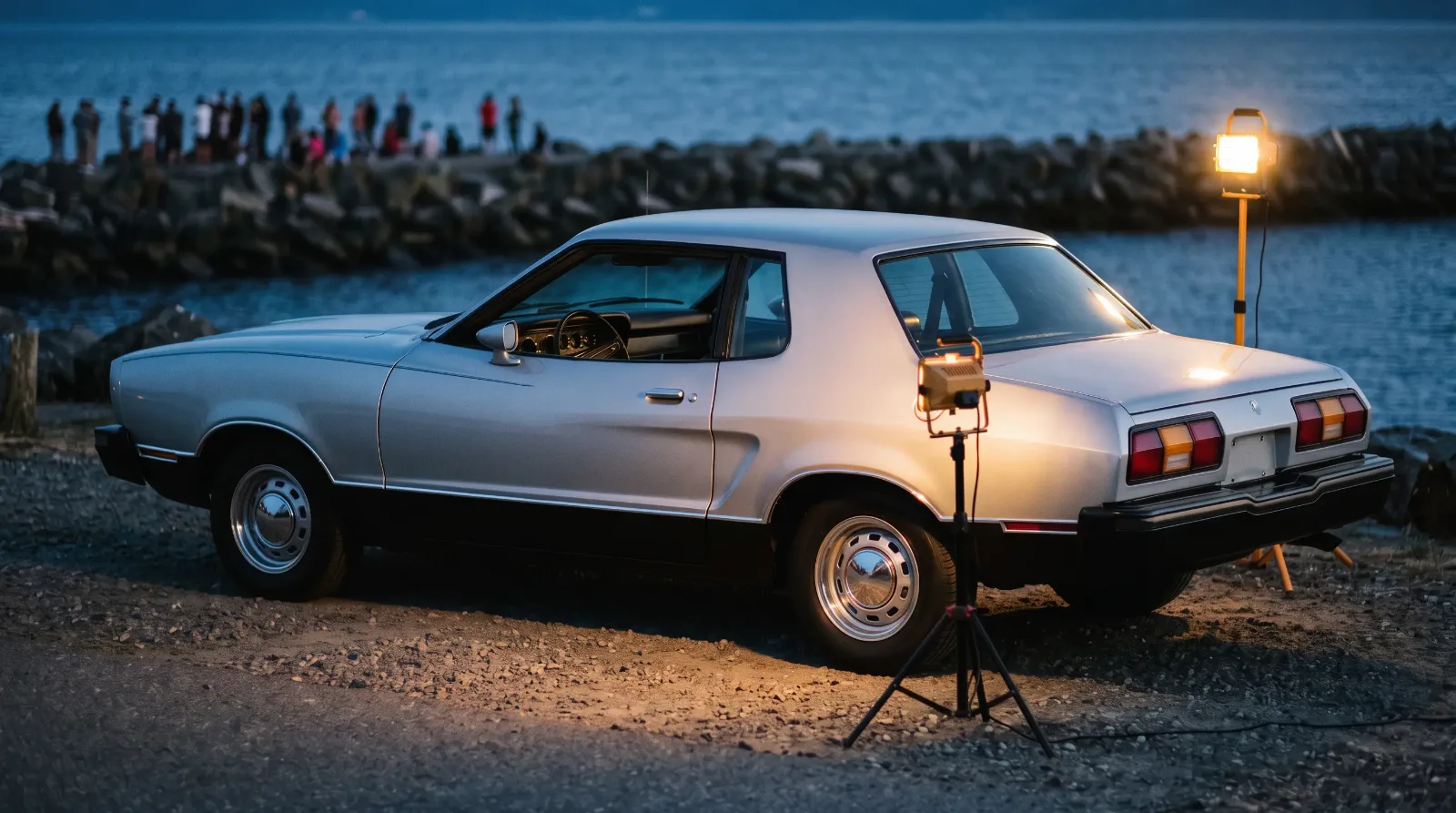
The full story of Ford's Mustang II, from Iacocca's small-car brief to the last 1978 cars, is told elsewhere. This one stays on the order form: the Stallion, the Rallye package and the other groups Ford used to turn one small car into several.
How Ford sold the Mustang II by the package
The Mustang II came as a two-door notchback or a three-door hatchback, and nothing else. There was no factory convertible. Ford built four models on those two bodies: the hardtop, the 2+2 hatchback, the luxury Ghia notchback and the Mach 1 hatchback. Everything after that was done with option groups.
That was a sensible way to run a small car. The groups cost Ford very little to build and gave the dealer something to talk about. In 1976 the Ghia was a $334 step up from the base notchback, and the Mach 1 carried a $4,209 base price, the highest in the line. In between sat a long list of packages that changed the paint, the trim, the interior or, now and then, the suspension. Production figures show the notchback coupe outselling the hatchback by a wide margin every year from 1974 to 1978, so a lot of those packages ended up on the formal-roof car.
The trouble, fifty years on, is that the names blur together. Some groups were pure appearance. A few changed how the car drove. The Stallion and the Rallye package sit on opposite sides of that line, which is exactly why people mix them up.
The 1976 Mustang II Stallion: a look, not a performance option
The Stallion was a 1976-only appearance group, offered on both the notchback and the hatchback. It blacked out the grille, the moldings and the lower body, added styled steel wheels and put Stallion decals on the car. That is the whole list. It did nothing under the hood or under the car, and the engine was whatever the buyer ordered with it.
Ford did not save the idea for the Mustang alone. The same Stallion treatment went on the Pinto and the Maverick that year, which tells you how Ford thought about it: a showroom look it could spread across its small cars, the way a club spreads one jacket design across a whole membership.
The Stallion is easy to confuse with the Cobra II, which arrived the same year with its own black grille. The difference is in the details. The Cobra II added a simulated hood scoop, front and rear spoilers, quarter-window louvers, dual stripes and cobra emblems, and it came on the hatchback only. Jim Wangers designed the look, and his Motortown company applied the parts for 1976. So a black-trimmed 1976 notchback with Stallion decals cannot be a Cobra II with the stripes missing. Ford never built a Cobra II notchback. That one fact settles most of the arguments I have heard about these cars.
What nobody has settled is how many Stallions Ford built, or what the group cost. I have not found a reliable production count or a confirmed price, and anyone who quotes you an exact Stallion total should be able to show you where the number came from.
What the Rallye package actually changed
Where the Stallion was all looks, the Rallye package was the hardware side of the option sheet. For 1976 Ford listed a Rallye Package alongside the Mach 1. By 1978, on the King Cobra, the Rallye content was spelled out as heavy-duty springs, adjustable shocks and a rear stabilizer bar. Those are parts you feel on a back road, not parts you see in a parking lot. Other write-ups fill in the rest of the list. MustangSpecs says the 1976 package included a Traction-Lok differential, and ConceptCarz, writing about the 1977 cars, gives the Rallye package as dual racing mirrors, heavy-duty springs and cooling, a rear stabilizer bar and adjustable shocks.
The word gets slippery after that. For 1977 Ford also offered a Rallye Appearance Package, a cosmetic group despite the name. It took the Stallion's place on the order form, went on the hatchback, and added gold accents: stripes, moldings, taillamp moldings and stripes in the bumper rub strips. So when an owner tells you his car "has the Rallye," the fair follow-up question is which one.
The other piece of hardware worth knowing about is the 1976 Sports Performance Package. In 1975 the returning 302 V8 came with an automatic only. For 1976 this package added a four-speed manual to the 302. Published ratings for that engine in 1976 run from 134 to 140 hp depending on whose table you read, which is a good reminder that Ford's mid-1970s figures were never as tidy as the brochures.
The other groups on the order form, 1975 to 1978
The Stallion and the Rallye were two entries on a crowded sheet. The table below gathers the groups that come up most often when owners compare cars. Prices are given where they are documented. Where they are not, I have left the box empty rather than guess.
| Package | Years | Body | What it added | Price |
|---|---|---|---|---|
| Silver Luxury Group (Ghia) | 1975 | Notchback | Silver half-vinyl roof, Cranberry cloth interior | Not documented |
| Stallion | 1976 only | Notchback or hatchback | Black grille, moldings and lower body; styled steel wheels; Stallion decals | Not documented |
| Rallye Package | 1976 to 1978 | Listed with the Mach 1 in 1976 | Heavy-duty springs, adjustable shocks, rear stabilizer (as listed for the 1978 King Cobra) | Not documented |
| Rallye Appearance Package | 1977 | Hatchback | Gold accent stripes, moldings, taillamp moldings, bumper rub-strip stripes; replaced the Stallion | Not documented |
| Sports Performance Package | 1976 | With the 302 V8 | Four-speed manual behind the 302 | Not documented |
| Cobra II | 1976 to 1978 | Hatchback only | Spoilers, hood scoop, quarter-window louvers, stripes, cobra emblems | $325 (1976), $535 (1977), $677 (1978) |
| Ghia Luxury Group / Ghia Sports Group | 1976 / 1977 | Ghia notchback | Luxury trim; 1977 Sports Group in black or tan | Not documented |
| T-roof | Mid-1977 to 1978 | Hatchback | Twin removable tinted glass panels | $629 on the 2+2, $587 on the Cobra II (1977) |
| King Cobra | 1978 | Hatchback, 302 V8 only | Air dam, spoiler, flares, reverse hood scoop, big hood decal, Rallye suspension | $1,277 (one MustangSpecs passage says $1,253) |
| Fashion Accessory Package | 1978 only | Notchback only | Appearance and convenience items | Not documented |
Read down the Body column and a pattern shows up. The groups with stripes and spoilers lived on the hatchback. The notchback got the luxury groups, the Stallion and, at the very end, the Fashion Accessory Package. Ford sold far more notchbacks, so it kept finding new ways to dress them.
Settling a Stallion or Rallye argument with paperwork
Here is where I always end up, because it is where the argument ends too. Some Mustang II packages left a mark on the car itself. The 1978 King Cobra, for example, carried "KC" on the buck tag at Dearborn and "KNG" at San Jose. I have not seen a documented body or VIN code that marks a Stallion or a Rallye car the same way, so for those two the window sticker, the dealer invoice or the original order is what proves the case. Decals can be bought. Paper is harder to fake.
The VIN still helps with the hardware side. On a Mustang II the fifth character is the engine: Y for the 2.3 four, Z for the 2.8 V6, F for the 302. A car sold to you as a 1976 Sports Performance car with a Z in that spot has a story that needs another look. If you are new to reading the tags, our decoding guide walks through where each code lives and what it can and cannot tell you.
"Every Stallion I have ever seen judged turned on the same question: was it born that way? The black paint and the decals tell you what somebody wanted the car to look like. The sticker in the glovebox tells you what Ford actually built, and that is the one I trust."
Wayne Coburn
The package system went out with the car. The Mustang II ended after 1978, and the Mach 1 name went with it when the Fox arrived. The Stallion, the Silver Luxury Group and the Fashion Accessory Package never came back. They are small entries on an old order form now, and that is exactly why the people who own them care so much about getting the details right.
Sources and notes
- MustangSpecs: 1976 Ford Mustang Stallion
- MustangSpecs: 1976 Ford Mustang (Ghia price, Mach 1, Rallye Package)
- MustangSpecs: 1978 Mustang King Cobra (package price, Rallye content, buck tags)
- ConceptCarz: Ford Mustang II history (Rallye and Rallye Appearance packages)
- Old Cars Weekly: Car of the Week, 1978 Ford Mustang Cobra II
- Wikipedia: Ford Mustang (second generation)
Related Reading
Have a
Ford Mustang
for Sale?
Reach thousands of serious classic car collectors across the US.
Sell It Here →
Selling a classic? Here's how: compare the places to sell classic cars
Are You a Classic Car Dealer?
List your full inventory and connect with targeted classic car buyers.
Join as a Dealer →
#Ford Mustang
#mustang ii
#cobra ii
#Rallye package
#Mustang II Stallion
#Mustang option packages
#1976 Mustang

About the author
Wayne Coburn
Longtime Corvette owner, judge and club figure who knows the cars, the records and the people behind them.
Related Listings - Ford Mustang




Comments
Be the first to comment on this article.