
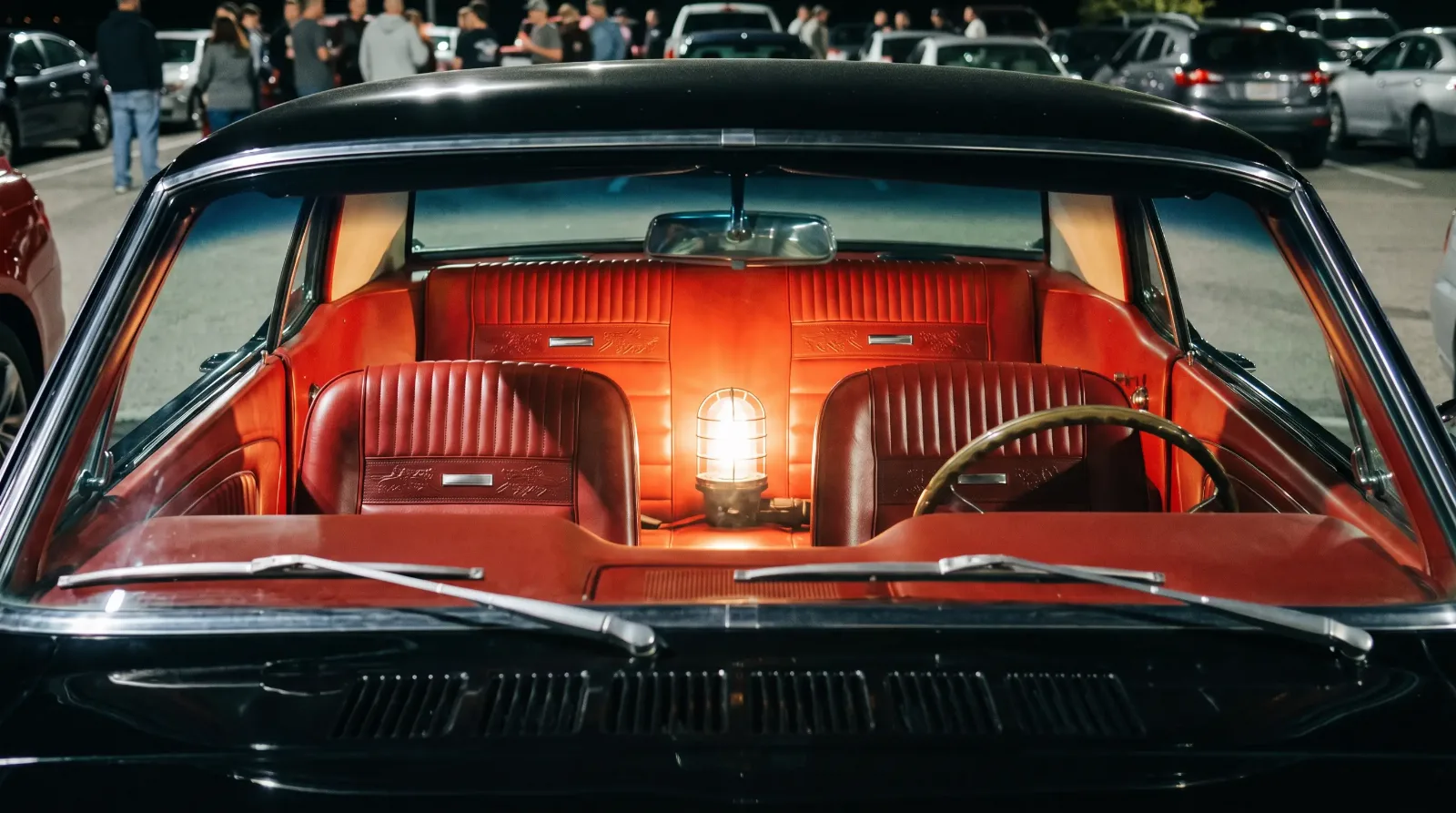
Watch people at a show when the owner of an early Mustang opens the driver's door. Nobody looks at the dash first. They look at the seats, and then somebody leans in close, as if the seatback had something written on it, and in a way it does: a small herd of horses pressed into the vinyl, running in a line across the back of the bucket. That is the Mustang Pony interior, and for a car sold on how it looked from the outside, it made a surprisingly strong case for the inside. It was also, on paper, an option with a plain corporate name that almost nobody uses anymore.
Car Features
7 min read
The Pony Interior: How the 1965 Decor Group Set the Tone
Running horses on the seatbacks, five round dials and molded door panels: the story of the 1965 Interior Decor Group and what it changed.
What the Mustang Pony interior actually was
Ford called it the Interior Decor Group. The hobby calls it the Pony interior, after those embossed running horses, and the nickname won so completely that the factory name now sounds like a footnote. It was the luxury interior, and it arrived partway through the 1965 model year rather than with the first cars; one source dates it to March 1965, though the exact month is still debated.
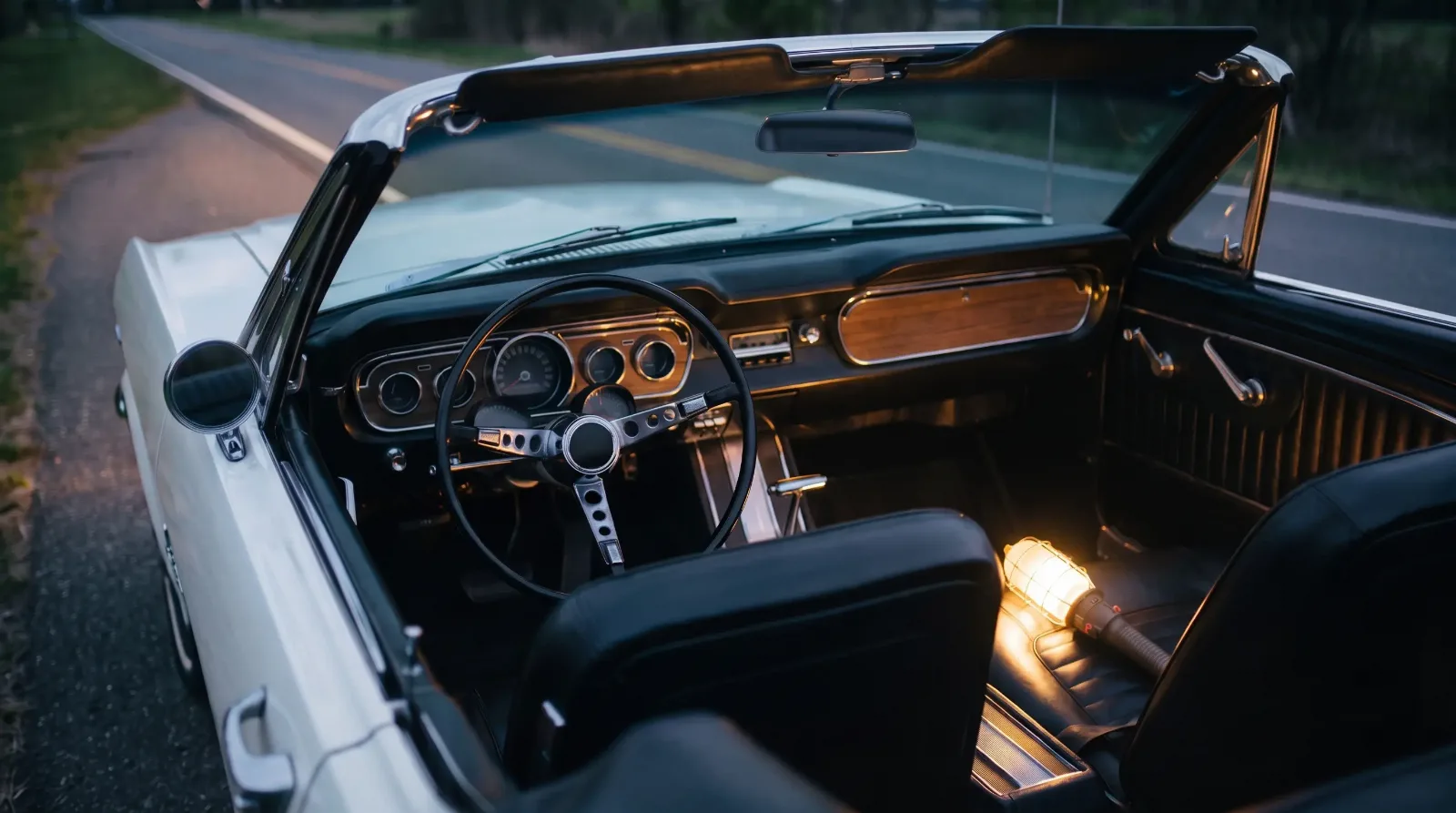
The package changed nearly everything a driver touched. The seatbacks carried the embossed ponies. The door panels were special to the group, with the armrests molded into them rather than bolted on as separate pieces. Wood-grain trim went onto the steering wheel, the instrument cluster surround and the glovebox door. And the instruments themselves were different, which turned out to matter more than the horses. If you want the wider picture of how the car's shape came together, the interior is only one chapter of how Ford styled it (more on that here).
What it was not, as far as the sources show, was a performance option. It did not touch the engine or the suspension. It was an option that existed purely to make the cabin a nicer place to sit, and that tells you something about who Ford thought would buy the car.
Five dials instead of a Falcon sweep
A standard 1965 Mustang had a dash borrowed in spirit from the Falcon: a horizontal sweep speedometer, the kind of instrument you would find in a sensible family sedan. It worked. It also looked exactly like what it was, an economy car's gauge in a car that was being sold as something more exciting.
The Pony interior replaced it with five round dials. So did the GT Equipment Group, and for the rest of the 1965 model year those two packages were the only way to get them. The round gauges sat inside the hooded shape of the twin-cowl dash, and they changed the feeling of the car from the driver's seat more than any single exterior detail did. Sitting in a standard car and then in a Pony car is a small lesson in how much a cluster of circles can do. One reads as transport. The other reads as a sports car, even when the engine under the hood is the six.
Who ordered it, by the numbers
Ford tracked the luxury interior through the body code, so the production figures survive in unusual detail. A Pony car carries a B in its body code on the door data plate: 65B for the hardtop, 76B for the convertible and 63B for the fastback. Standard cars are A, and the hardtops and convertibles with the bench seat are C.
| Body (data plate code) | 1965 luxury interior | 1965 body total | 1966 luxury interior | 1966 body total |
|---|---|---|---|---|
| Hardtop (65B) | 22,232 | 409,260 | 55,938 | 499,751 |
| Convertible (76B) | 5,338 | 73,112 | 12,520 | 72,119 |
| Fastback (63B) | 5,776 | 77,079 | 7,889 | 35,698 |
The 1965 figures add up to 33,346 cars, a small slice of a very large year, and the reason is mostly timing: the option arrived after a large share of that year's buyers had already ordered their cars. The convertibles are the rarest of the three, with about 5,300 built for 1965. In 1966, with a full year on the order sheet, the hardtop count more than doubled. The pattern in the table is a human one. People who chose the dressier bodies, the fastback especially, were more willing to spend a little more on the room they would actually sit in.
"The horses are what people photograph, but the door panel is what they touch. Every time an owner pulls the door shut on a Pony car, they are using the part of the option nobody talks about."
Nora Beckett
Reading a Pony interior today
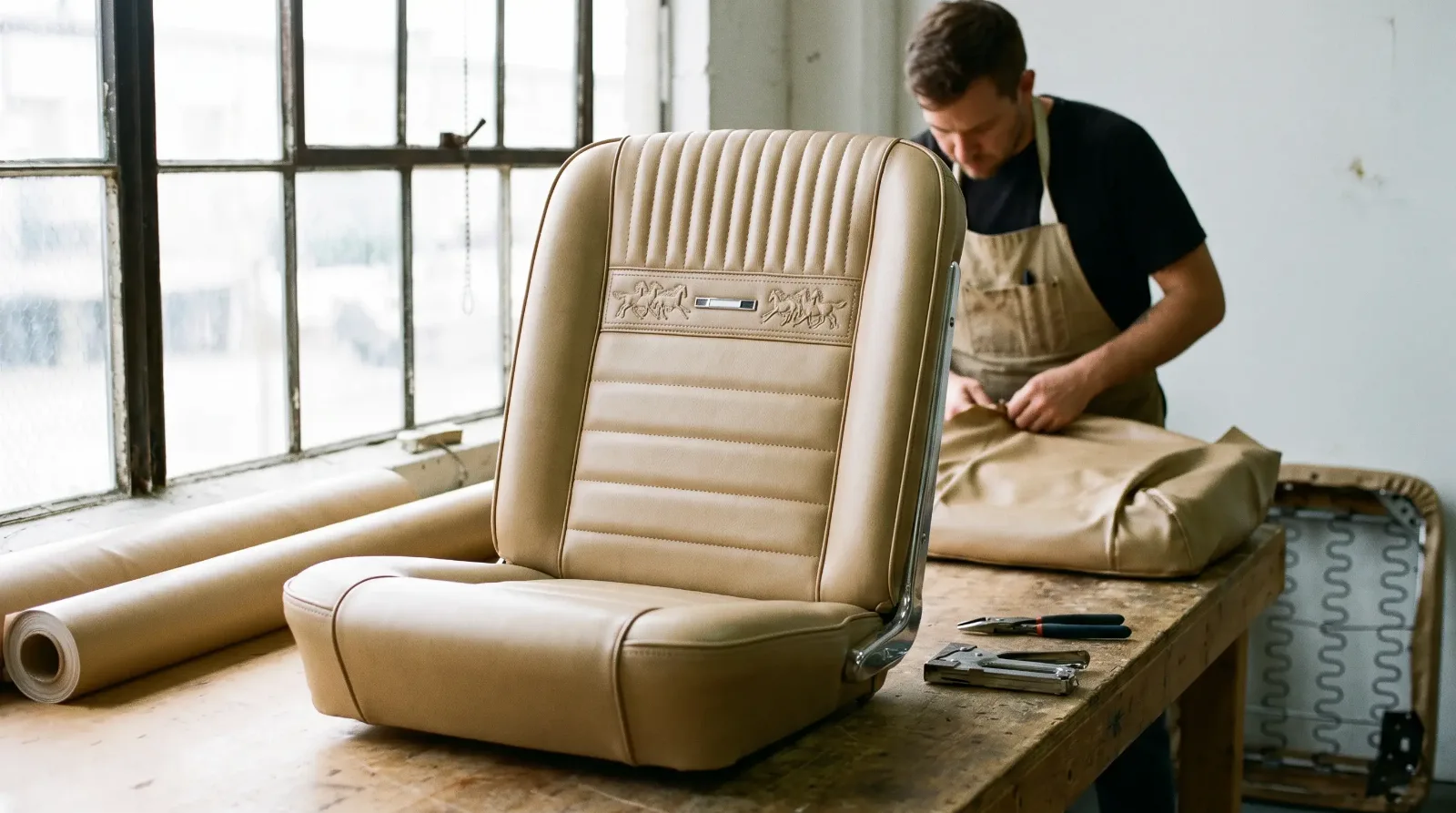
Here is the complication that comes with any well-loved option. Pony-style upholstery has been reproduced for decades, and a set of embossed seat covers fits a standard car just as well as a Decor Group one. So the seats alone prove very little. The data plate is the honest witness. A 1965 or 1966 hardtop with 65A on the plate left the factory with the standard interior, whatever is on the seats now, and that is not a mark against the car. It is simply a different story than a 65B.
The door panels and the round-dial cluster are the next clues on a 1965 car, since the standard car came with the Falcon-style sweep. On a 1966 car the cluster tells you nothing, for a reason that is the real point of this whole story. Anyone who owns or loves 1965 Mustangs learns to read these details the way you might read the inscription in a secondhand book: not to judge it, but to know whose it was first.
How the Decor Group set the tone
For 1966, Ford made the five-dial cluster standard on every Mustang and dropped the Falcon-type sweep, and padded sun visors came along with it. The most important piece of the Pony interior, the part that made the cabin feel like a sports car, had become the baseline. The luxury group still sold well that year, but what it offered on top of the standard car was now mostly texture: the horses, the wood grain, the molded doors.
Then the horses went. The embossed running-pony seat motif was dropped for 1967, when the car itself grew and changed shape. The idea behind it did not go anywhere. When Ford introduced the Grandé for 1969, its standard equipment read like a grown-up version of the same promise: Teakwood-grain trim, hopsack and vinyl buckets, an electric clock. By then the Mustang had a whole model built around the notion that the inside deserved as much attention as the outside, and you can trace that line back through the first-generation Mustang story to a mid-1965 option sheet.
That is the quiet achievement of the Interior Decor Group. It did not make the car faster or louder. It made the cabin a place people wanted to be, proved that buyers would pay for that, and then handed its best idea to every Mustang that followed. The horses on the seatbacks are only the part you can photograph.
Sources and notes
- Ford Mustang (first generation), Wikipedia: the Interior Decor Group and the 1966 changes
- Sports Car Market: the Pony interior, introduced in March 1965
- Classic Industries: 1964½ to 1966 Mustang data plate and body codes
- Conceptcarz: 1966 Mustang production by body style
- Champion Cooling: spotter's guide to the 1964½ to 1968 Mustang
- MustangSpecs: the 1969 Mustang Grandé
Related Reading
Have a
Ford Mustang
for Sale?
Reach thousands of serious classic car collectors across the US.
Sell It Here →
Selling a classic? Here's how: where to sell your classic car online
Are You a Classic Car Dealer?
List your full inventory and connect with targeted classic car buyers.
Join as a Dealer →
#1965 mustang
#Ford Mustang
#first generation Mustang
#mustang design
#1966 Mustang
#Mustang Pony interior
#Interior Decor Group
#Mustang data plate

About the author
Nora Beckett
Automotive features writer and photographer who tells the human stories behind the cars, from show fields to cross-country road trips.
Related Listings - Ford Mustang




Comments
Be the first to comment on this article.