
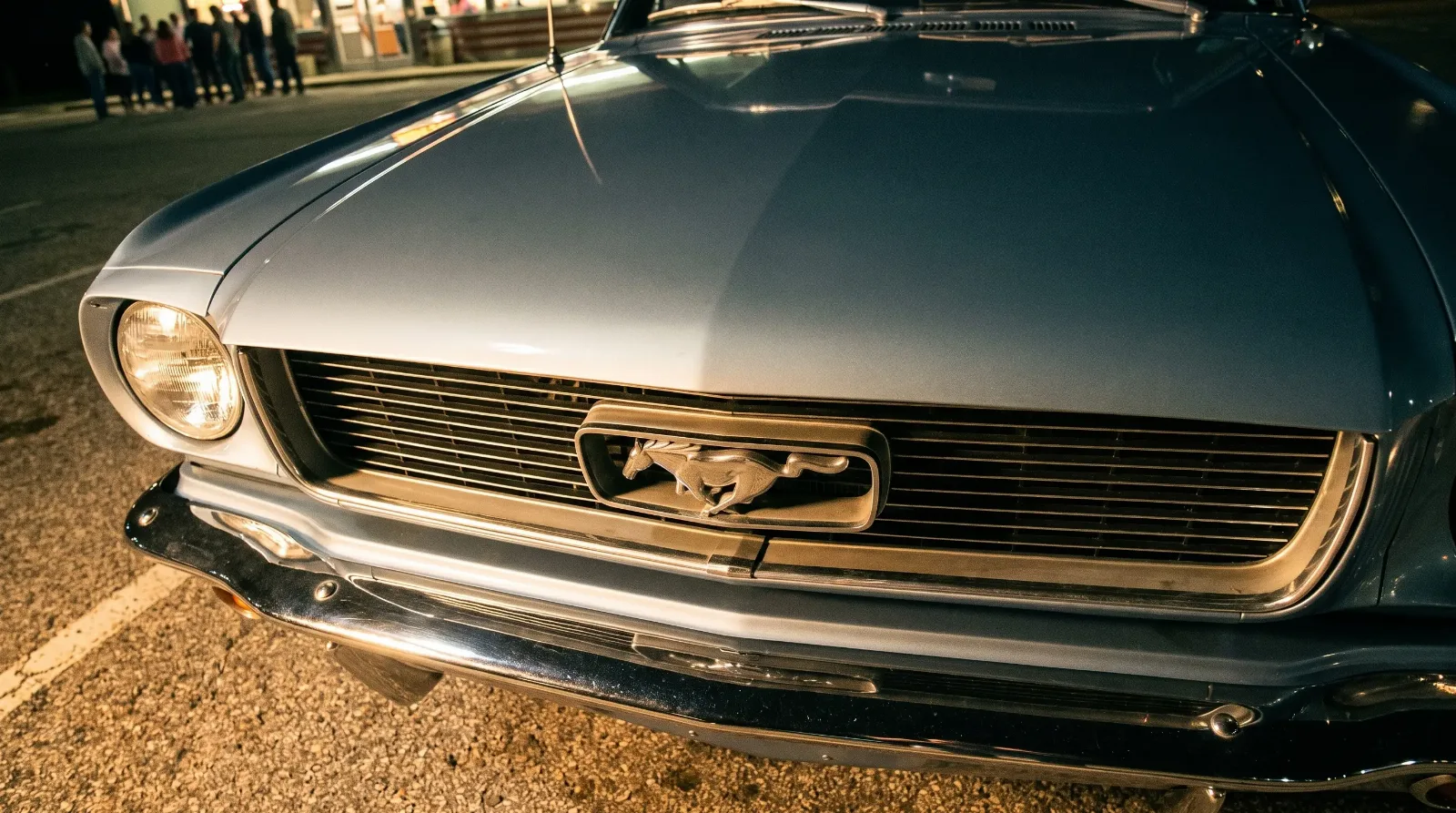
Stand in front of a first-generation Mustang and the grille tells you the model year faster than the VIN does. A honeycomb with bars, a floating horse in a slotted grille, a crossbar, a bright ring, a horse pushed off to one side: the classic Mustang grille emblems changed nearly every year between 1965 and 1970, and each change is documented well enough to be useful. That is the subject here. Not the logo as a brand, but the horse and its corral as a piece of hardware on the front of the car, and what each version tells you.
Car Features
8 min read
The Grille, the Corral and the Running Horse Up Front
From the Cougar clay's big cat to the 1970 centered pony: how the Mustang grille, corral and running horse changed year by year, 1965 to 1994.
The wider design story, from the clay models to the production body, is covered in how the Mustang was styled. This piece stays at the front bumper.
Before the horse, there was a cat
The grille emblem was not settled when the shape was. Gale Halderman's winning clay, the one that became the Mustang, was known inside Ford as the "Cougar," and it carried a stylized big cat in the grille. Production replaced the cat with a horse. It is worth remembering when people talk about the running horse as if it arrived with the car fully formed. It did not. It was a substitution.
The horse itself was drawn by Philip T. Clark, who lived from 1935 to 1968. Charles Keresztes, a sculptor (1925 to 1987), turned Clark's drawing into a three-dimensional form. That much is well documented. What happened next is less certain. Enthusiast sources say the early ponies were judged too tall to sit neatly inside the production grille corral, so the horse had to be carved again. Studio modelers Charles Keresztes and Waino Kangas were both given that job, and the sources split on whose carving went into production: one captions the final wooden grille pony as Kangas's work, another says Keresztes's design was chosen. I would treat the reason as plausible and the credit as open.
The horse faces left because that is how Clark drew it. You will hear that it runs west, toward the frontier, and that story has never been proven. The better-supported reading is that Lee Iacocca framed the horse as a wild animal, not a domesticated racer, which suits a car sold on freedom more than on the track.
Classic Mustang grille emblems, year by year
For 1965, the horse sat in a chrome rectangle, the corral, in the center of a honeycomb grille, with four thin bars running out from it, one from each side of the corral: left, right, top and bottom. For 1966, Ford took the bars away. The grille became a slotted design and the horse was left on its own in the middle, which is why owners call it the "floating" horse. If you only learn one first-generation spotting cue, learn that one. A 1964½ or 1965 car has the bars. A 1966 car does not.
The 1967 restyle brought a larger grille opening, and the corral emblem now sat with a horizontal crossbar. The 1968 grille dropped that look for a bright halo ring running around the opening. Enthusiast spotting guides add that the 1968 corral is thinner than the 1967 one and that the horizontal bars are gone, but the halo ring is the easiest cue to see, and it is the one I would point a new owner toward.
Then 1969 broke the pattern. It was the first Mustang with four headlamps, two inside the grille opening and two outside it, and the only year with four. The corral went away. In its place, a pony and tri-bar emblem sat off center on the driver's side of the grille. For 1970 Ford went back to two headlamps, placed them inside the grille opening, flanked them with simulated intakes, and moved the pony back to the center.
| Model year | Grille | Emblem | Quick cue |
|---|---|---|---|
| 1964½-1965 | Honeycomb | Horse in corral, centered | Four bars, one from each side of the corral |
| 1966 | Slotted | "Floating" horse, centered | No bars |
| 1967 | Larger opening | Corral horse | Horizontal crossbar |
| 1968 | Larger opening | Corral horse | Bright halo ring around the opening |
| 1969 | Quad headlamps, two inside the grille | Pony and tri-bar, off center, driver's side | No corral |
| 1970 | Two headlamps inside the grille, simulated intakes beside them | Pony, centered | Back to two lamps |
What the options did to the front end
The base grille was only half the picture. Options changed it, and an option that changed the grille is exactly the sort of detail that gets added or removed when a car is restored.
On the 1965 and 1966 cars, the GT Equipment Group put fog lamps in the grille, carried on a grille bar, along with its front disc brakes, quick-ratio steering, five-dial gauges and badges. The 1967 GT option kept fog lamps as part of its content. For 1968, the Sprint B package, a V8-only spring promotion, added grille fog lamps along with styled steel wheels. The 1968 California Special, a coupe-only package with Shelby-derived parts, used a blacked-out grille with fog lamps. And the 1970 Mach 1 got its own grille with two driving lamps.
The running horse was not only an exterior part, either. It was also embossed on the seatbacks of the Pony interior, the 1965 decor group that put the same animal inside the car. That seat motif was dropped in 1967, while the grille horse carried on.
The years the horse left the grille
First, though, the horse had one more stretch in the grille. On the 1971 and 1972 cars with the standard grille, it sat in a chrome corral again; restoration suppliers still sell that corral as a separate part. The Mach 1 used its own honeycomb grille with sport lamps, which some other models could also order. For 1973 Ford offered a base grille and a Mach 1 grille with different insert patterns. I have found no factory document that covers these years in the detail the earlier ones get, so I will leave it there.
The Fox body is the clean break. On the 1979 to 1993 cars, the running horse disappeared from the exterior entirely. For 1983 the Mustang got its first exterior Blue Oval, and for 1985 the nose went grille-less, with a slot intake doing the work. The horse survived only inside, as a small running-pony emblem on the dashboard of the last Fox cars.
It came back for 1994. The SN95 put a running horse in the grille again, and Ford counted it as a return after a 16-year absence. It came back without the tri-bar. Later SN95 changes kept the horse and changed what surrounded it: a honeycomb grille for 1996, and a larger grille opening on the 1997 Cobra. As an epilogue, Ford's own description of the 2005 car listed the galloping horse in the center of the grille among its heritage cues.
Reading a grille as evidence
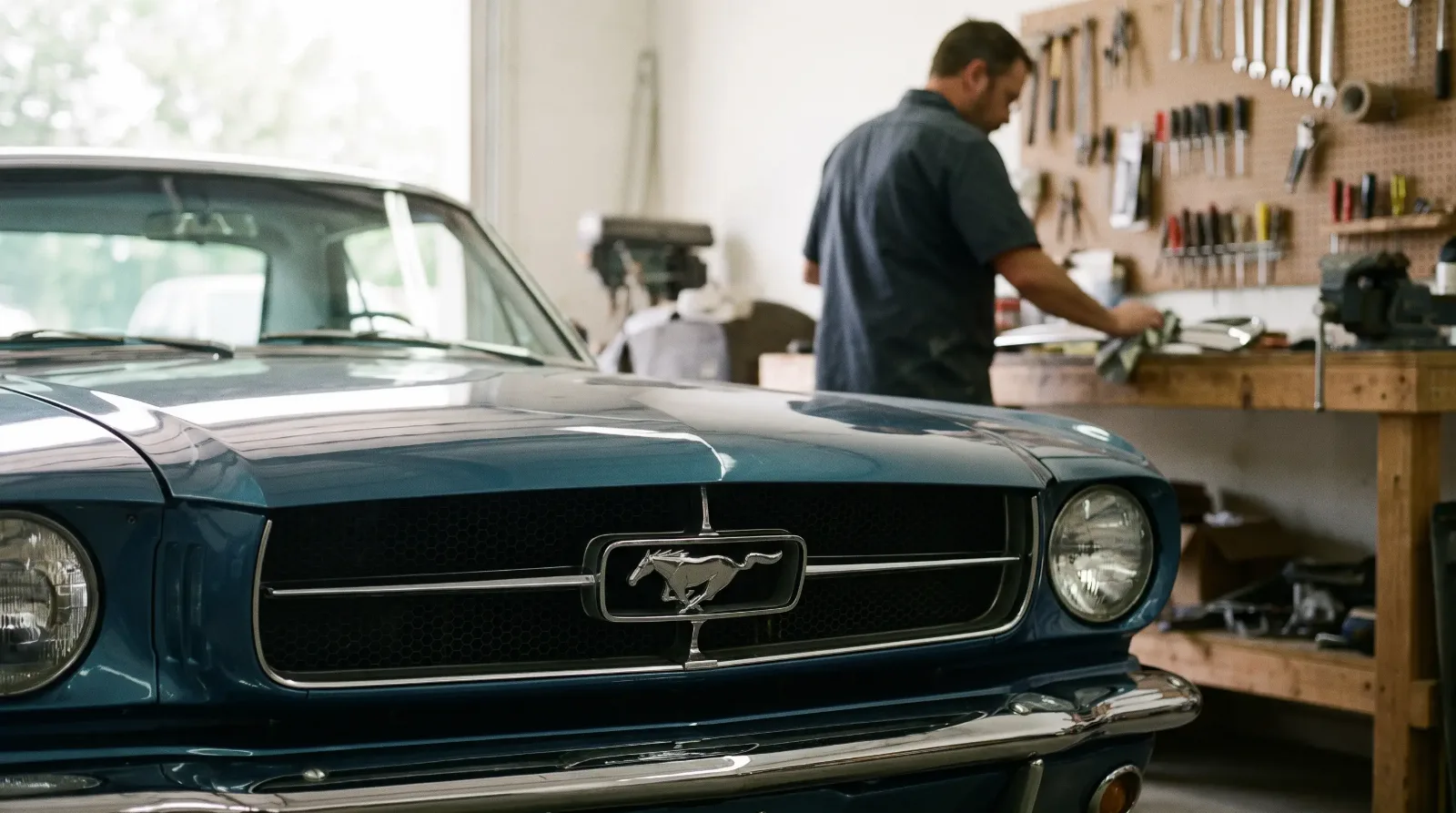
Here is the correction I find myself making most often. A grille is evidence of what is on the car now, not of what left the factory. Grilles, corrals and fog-lamp bars unbolt. The year cues in the table above are reliable for telling a correct 1965 grille from a correct 1966 grille. They are not reliable for telling you which grille a given car was built with.
"The grille is the quickest year check on a first-generation Mustang and the easiest part on the car to change. Read it as a clue, then go find the paperwork that confirms it."
Tom Ramirez
That cuts both ways. A 1966 car wearing a 1965 grille is not a fraud. It may just be a car that had a front-end repair decades ago with whatever parts were on the shelf. Fog lamps in a grille do not make a car a GT, and a car without them is not automatically a base model that someone has dressed up. The documentation decides those questions, and the grille only tells you which question to ask.
What the grille does well is show you how quickly Ford was willing to change the face of a car that was selling. Six model years, six distinct front ends, and the horse moved, floated, lost its corral and found its way back to center before the first generation ended. How those years fit into the rest of the car's life is in the Mustang's history.
Sources and notes
- Ford Mustang galloping horse emblem cast, c. 1963, The Henry Ford
- The Mustang emblem: sketch to production, Mustang Maniac
- The evolution of the Mustang's pony emblem, Ford Muscle
- Spotter's guide: identifying the 1964 1/2 to 1968 Mustang, Champion Cooling
- Ford Mustang (first generation), Wikipedia
- Designer of original Mustang dies at 87, Gardner Web
Related Reading
Have a
Ford Mustang
for Sale?
Reach thousands of serious classic car collectors across the US.
Sell It Here →
Selling a classic? Here's how: sell my classic car
Are You a Classic Car Dealer?
List your full inventory and connect with targeted classic car buyers.
Join as a Dealer →
#Ford Mustang
#first generation Mustang
#mustang emblem
#mustang design
#Mustang grille
#Mustang running horse
#Mustang corral

About the author
Tom Ramirez
Corvette researcher and historian based in Bowling Green, Kentucky. Two decades documenting Corvette production history from original factory records.
Related Listings - Ford Mustang




Comments
Be the first to comment on this article.