
Slide behind the wheel of an early Mustang and the first thing that tells you this is not a plain economy car is not under the hood. It is right in front of you. The dash pad rises into a hood over the gauges, then dips, then rises again over the passenger side, two humps for the two people up front. That shape is what the hobby calls the Mustang twin cowl dashboard, and on a car priced for young buyers it was pure theater. The second piece of theater came as an option: a little pod mounted on the steering column with a tachometer and a clock in it, sold as the Rally-Pac.
Car Features
7 min read
The Twin-Cowl Dash and the Rally-Pac
The hooded early Mustang dash, the Falcon and five-dial clusters under it, and the column-mounted Rally-Pac tach and clock of 1964 to 1966.
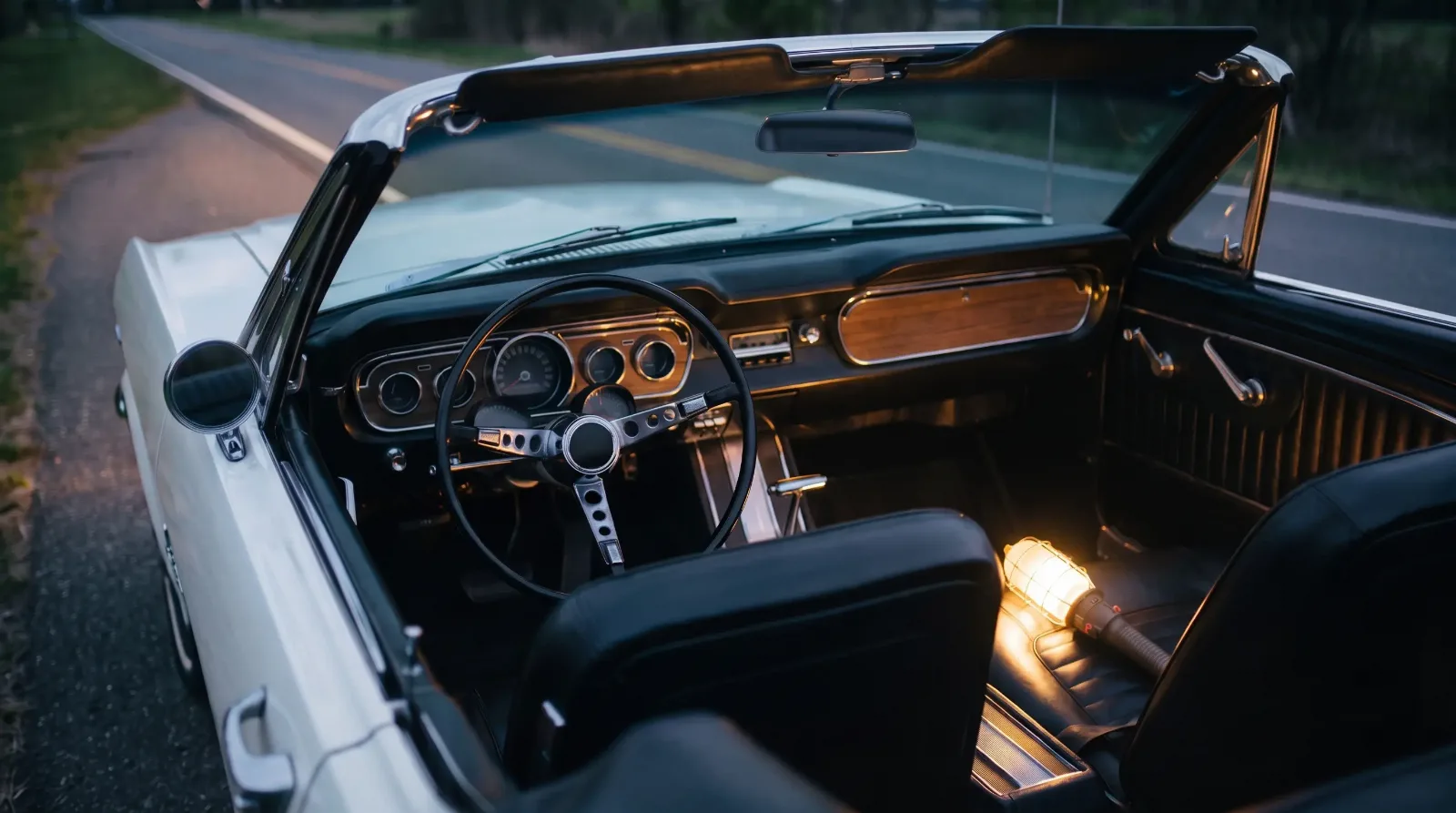
The broad strokes of the body, the long hood and the rest are covered in our Mustang design guide. This one stays inside the car, on the panel you stare at for every mile you drive.
What the Mustang twin cowl dashboard really is
Start with the name, because it causes arguments. "Twin cowl" is a hobby term. I have not seen it in a period Ford brochure or press release, and the research behind this piece did not turn one up either. Ford's own launch material talks about equipment, not styling vocabulary. So when somebody tells you Ford called it the twin-cowl dash in 1964, ask them for the paper.
The shape is real whatever you call it. A hood over the driver's instruments, a second hood across the car on the passenger side, and a lower run between them with the radio set in the panel below. It makes the cabin read as two cockpits sharing one car. That is a styling idea, not an engineering one. The passenger side hood does not house anything a passenger needs. It is there so the dash looks balanced from the back seat and so the person riding along feels like they got a cockpit too.
From a builder's chair, I respect that. The stylists fussed over the cabin the same way they fussed over the grille and the wheels, and they did it on a budget that did not leave room for fussing. Symmetry costs nothing on a steel stamping if you plan it from the start. Somebody planned it.
Two clusters under one hood
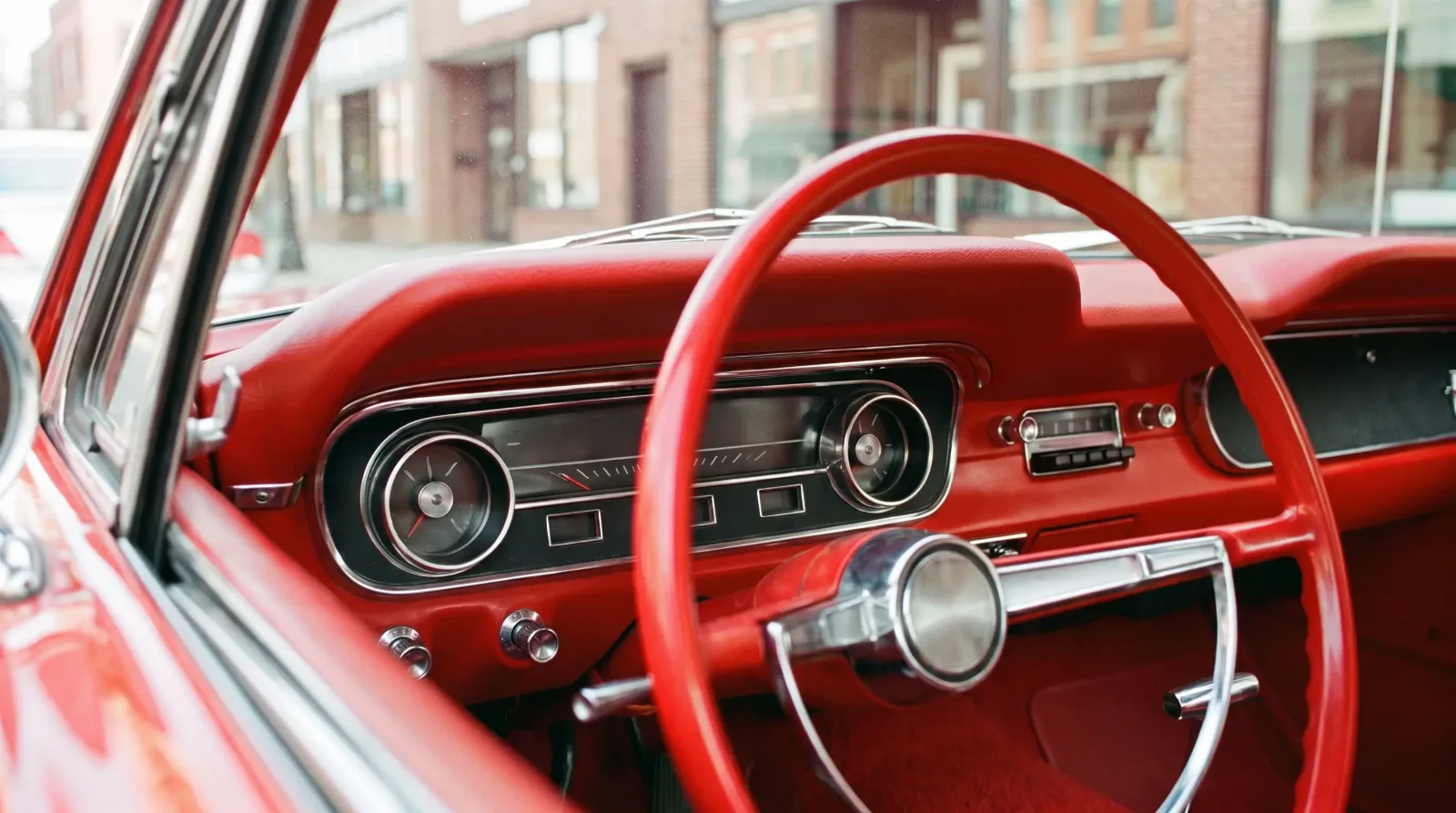
What sat under the driver's hood depended on the year and the order sheet. On the 1964½ and 1965 cars, the standard cluster was the Falcon-type sweep, a horizontal speedometer that looked like it came out of a family sedan, because in spirit it did. If you ordered the GT Equipment Group, offered from April 1965, or the Interior Decor Group that people now call the Pony interior, you got five round dials instead. For 1966 Ford made the five-dial cluster standard on every Mustang, along with padded visors, and the Falcon sweep was gone.
There is a small tell on those first cars, too. The warning light on a 1964½ dash reads "GEN." On a 1965 it reads "ALT." Parts got mixed at the changeover, so it is a clue and not a verdict, but it is the kind of detail a careful restorer gets right.
My opinion, and I hold it firmly: the five-dial cluster is the one that belongs under that hood. The round gauges match the round shapes of the hoods themselves. The Falcon sweep works fine, it reads fine, and it never looks like it was drawn for the room it lives in.
The Rally-Pac: a tach on the column
Neither 1965 cluster had a tachometer, and a car sold with a sporting image needed one. Ford's answer predated the Mustang. The Rally-Pac, a column-mounted tachometer and clock, was introduced in 1963 after Ford's success in that year's Monte Carlo Rally, and it was offered on the 1964 Falcon and Fairlane as well as the 1964½ Mustang. It was on the Mustang's option list from day one. Ford's launch press release, dated April 13, 1964, lists "Rally Pac (Tachometer and Clock)" among the extras.
In 1965 it cost $69.30 installed at the factory or $75.95 if the dealer put it on. Most cars got a tachometer reading to 6,000 rpm, which covered the six and the base V8. The rare one is the 8,000 rpm version built for the 271 hp K-code 289 High Performance V8, whose redline sat at 6,500 rpm. That is the unit people look for, and it is the unit you should be most suspicious of when it turns up on a car.
Is the Rally-Pac pretty? Honestly, it is a little awkward. It sits on the column like an afterthought, because it was one, and it blocks part of your view of the cluster depending on your seat height. But it looks like 1965 in a way nothing else in the cabin does. It says somebody at Ford was thinking about rallies in Europe while the rest of the car was being priced for the showroom. I like it for exactly that reason.
1967 and the end of the column pod
The Rally-Pac did not survive the first redesign. Ford dropped it at the end of the 1966 model year, and the dash was redone for 1967 with air conditioning integrated into it. The later clusters were built with provision for a tachometer in the dash itself, which is where it should have been all along. Once the tach moved behind the hood, there was no reason for the pod.
The two-hood idea carried on into the new dash, with the gauges set deeper in a recessed pod and a contoured cowl on the passenger side, and the clock moved inside too. By 1969 the Grande came with an electric clock as standard, set into a cabin trimmed in Teakwood-grain, a long way from a clock strapped to the steering column.
"The Rally-Pac was a hack, and I mean that as a compliment. Ford had a dash with no room for a tach and a car that needed one, so they bolted the answer to the column and called it a rally option. Good builders do that every day."
Jim Vasquez
Period-correct or poseur
Here is where I get opinionated. A Rally-Pac is one of the easiest ways to dress up an early Mustang, and that is exactly why so many cars wear one they never had. An 8,000 rpm unit on a six-cylinder coupe is a costume. A 1966 five-dial cluster in a 1965 car with the standard interior is a swap, and there is nothing wrong with a swap as long as nobody calls it original. Do whatever you want to your own car. Just be honest on the info sheet at the show.
The twin cowl shape itself never really went away. The SN95 Mustang of 1994 to 2004 came back with a dual-cockpit dash design. Later Mustangs kept the idea alive. Reviewers read the dual-hooded dash of the 2005 car as a nod to the 1967 and 1968 models, and the designers of the 2015 car set out to keep the double brow of a symmetrical instrument panel along with its round gauges. Ford kept coming back to it the same way it kept coming back to the running horse up front, and the grille has the longer story on that one.
Sit in a clean 1965 with the Rally-Pac ticking and the five dials glowing under that hood, and you understand why the shape stuck. It made two people feel like they were going somewhere, and most Mustang dashes since have had to answer to it.
Sources and notes
Related Reading
Have a
Ford Mustang
for Sale?
Reach thousands of serious classic car collectors across the US.
Sell It Here →
Selling a classic? Here's how: compare the places to sell classic cars
Are You a Classic Car Dealer?
List your full inventory and connect with targeted classic car buyers.
Join as a Dealer →
#1965 mustang
#Ford Mustang
#classic Mustang
#1966 Mustang
#Mustang interior
#Rally-Pac
#Mustang dashboard

About the author
Jim Vasquez
Southern California hot rod and custom car builder with roots in the traditional kustom kulture scene.
Related Listings - Ford Mustang




Comments
Be the first to comment on this article.