
The chevy ii four cylinder engine was Chevrolet's first production four-cylinder since the 1920s, and the company did not make a big deal about it. The 153 cubic inch four showed up in the 1962 Chevy II as the standard, no-cost engine, and it stuck around as a base option into the early Nova years. It is a small engine with a strange footnote attached to it, and that footnote is worth more attention than the engine usually gets.
Car Features
6 min read
The 153 Four-Cylinder Chevy II
The chevy ii four cylinder engine was Chevrolet's first four-cylinder in 34 years. It made 90 horsepower, cost less than anything else in the lineup, and disappeared almost without a trace.
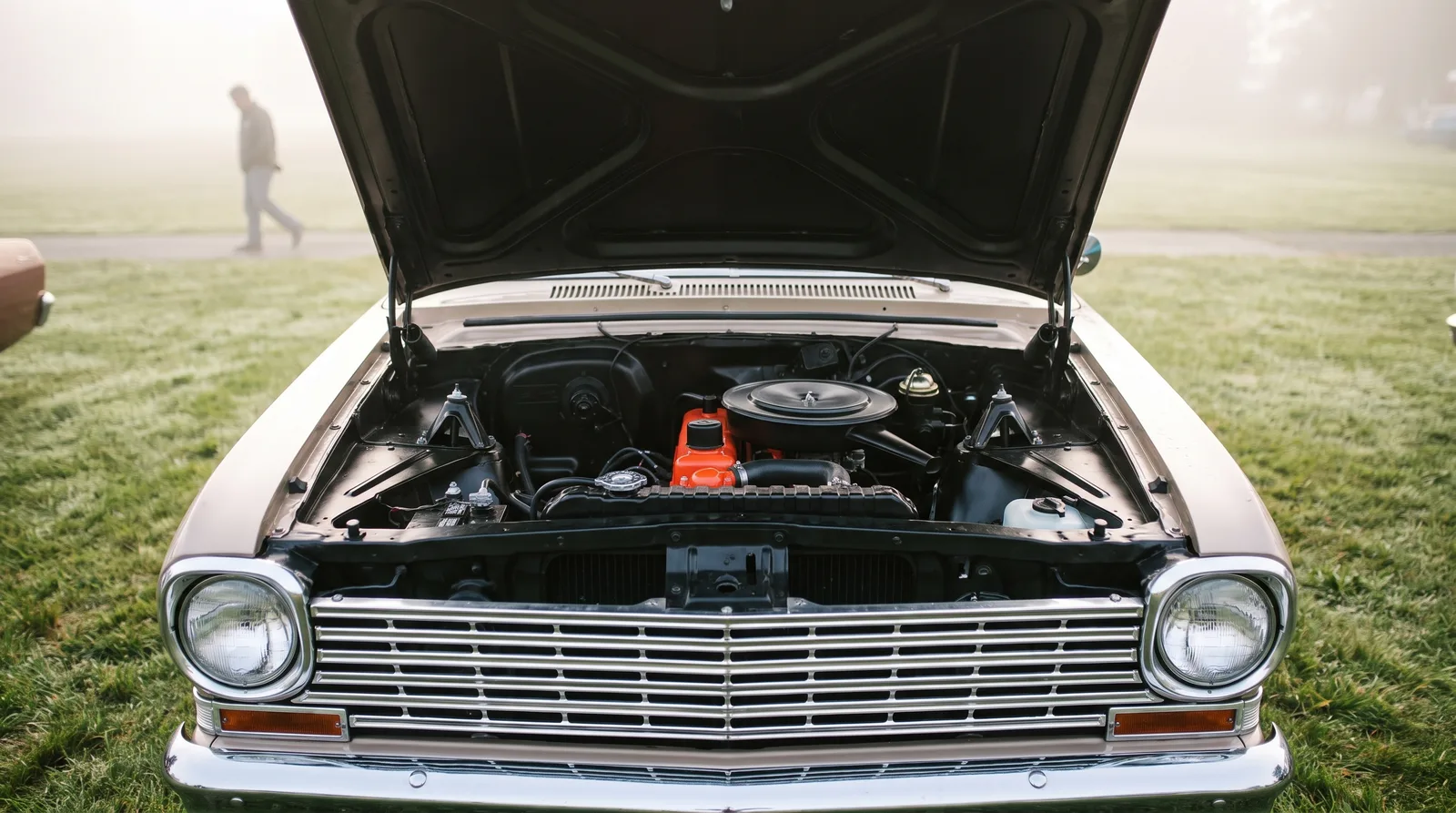
Half a six, built on purpose
The 153 shares its bore and stroke with the 230 cubic inch six that came later, 3.875 inches by 3.25 inches. That is not a coincidence. Chevrolet engineers built the four around the same basic cylinder dimensions as the six so tooling and parts could overlap where it mattered. Four cylinders instead of six, shorter block, lighter overall package. It was a practical decision, not a creative one.
Output on the 153 landed at 90 gross horsepower at 4,000 rpm, with 152 lb-ft of torque at 2,400 rpm. Those numbers will not impress anyone reading this in 2026. They were not supposed to. This was the engine for buyers who wanted a Chevy II that cost less to register, less to insure, and less to fill up than anything with a six or a V8 under the hood.
Why Chevrolet built a four at all
Chevrolet had not sold a four-cylinder passenger car since 1928, when the Series AB and AC cars carried Chevrolet's own overhead-valve four. That is a 34-year gap. The reason Chevrolet went back to a four in 1962 was simple: compact car buyers, chasing the Falcon and the Valiant, wanted a genuinely economical option, and a six-cylinder Chevy II did not compete on price or fuel use the way a four did.
The 153 answered that question directly. It was not meant to be exciting. It was meant to undercut the entry price of every other engine option in the lineup and give Chevrolet a real answer to Ford's compact-car pitch.
Where the 153 disappeared to
By 1968, most Nova trim levels had dropped the four entirely in favor of the 194 or 230 six as the standard engine, and V8 options were expanding fast. The four hung on in some fleet and taxi applications a bit longer, but for private buyers it had become a hard sell. A six cost only a little more, made noticeably more power, and rode smoother at highway speed. Once buyers had that comparison in front of them at the dealership, the four's days were numbered.
Part of the problem was refinement, not just power. A four-cylinder engine in a car this size, with the engine mounts and balance shafts of the era, vibrated more than a six at idle and under load. Buyers cross-shopping a Falcon or a Valiant noticed that difference immediately, and Chevrolet's own dealers had a hard time selling the four once the 194 six was sitting right next to it on the same order form for a modest price increase. The four never had a chance once buyers could feel the alternative.
Production numbers reflect that shift clearly. The 153 was the standard engine on the vast majority of 1962 Chevy IIs sold, but its take rate dropped every single year after that as buyers stepped up to the six almost automatically. By the time the Nova nameplate fully replaced the Chevy II name in the late 1960s, the four was effectively gone from the order sheet, a footnote that most Nova buyers never even saw as an option.
That shift says something bigger about how Chevrolet approached power ratings across this whole engine family, which is a subject I go into properly in a related deep-dive on gross versus net horsepower. The short version: the numbers on a 1962 window sticker and a 1972 window sticker are not measuring the same thing, and the 153 sits right at the start of that story.
"Ninety horsepower doesn't scare anybody. That was never the assignment. The assignment was getting a family to work and back on regular gas without a payment that hurt. The four did its job and nobody remembers it, which is honestly the highest compliment a base engine can get."
Dan Reeves
Finding one today
A surviving 153-powered Chevy II or early Nova is a genuinely uncommon find now. Most got scrapped, converted to six-cylinder or V8 power, or simply worn out and not rebuilt, since parts demand for this specific four never matched demand for the six or the small-block V8. If you do find one, verify the block casting numbers before assuming it is original. A lot of these cars picked up a 230 six or a 283 V8 somewhere along the way, and a swapped engine bay is common enough that you should not take a seller's word for it.
Rebuild parts for the 153 are thinner on the ground than parts for the six or the small-block V8, so budget extra time if you need a piston set, a head gasket, or a water pump. Some pieces cross over with other GM four-cylinder applications of the same period, but do not assume a parts counter clerk will know that off the top of their head. Bring the casting numbers with you and expect to do some of the sourcing legwork yourself, through swap meets and online parts networks built around this specific engine family.
For collectors chasing originality rather than performance, a documented 153-powered car is arguably a more interesting find today than another small-block Nova. Scarcity works in its favor even if horsepower does not, and a correctly restored base-engine Chevy II tells a more complete story about how this car actually sold in period than a numbers-matching V8 model ever will.
For the full picture of how Chevrolet built out this engine lineup across two decades, the engine chapter lays out the four, both sixes, and every V8 option side by side. The 153 is a small piece of that story, but it is the piece that explains why Chevrolet needed the rest of the lineup in the first place.
Sources and notes
Related Reading
Have a
Chevrolet Nova
for Sale?
Reach thousands of serious classic car collectors across the US.
Sell It Here →
Selling a classic? Here's how: sell my classic car
Are You a Classic Car Dealer?
List your full inventory and connect with targeted classic car buyers.
Join as a Dealer →

About the author
Dan Reeves
Performance engine builder from North Carolina's motorsports corridor, focused on swaps, forced induction and making real, repeatable power.
Related Listings - Chevrolet Nova


Comments
Be the first to comment on this article.