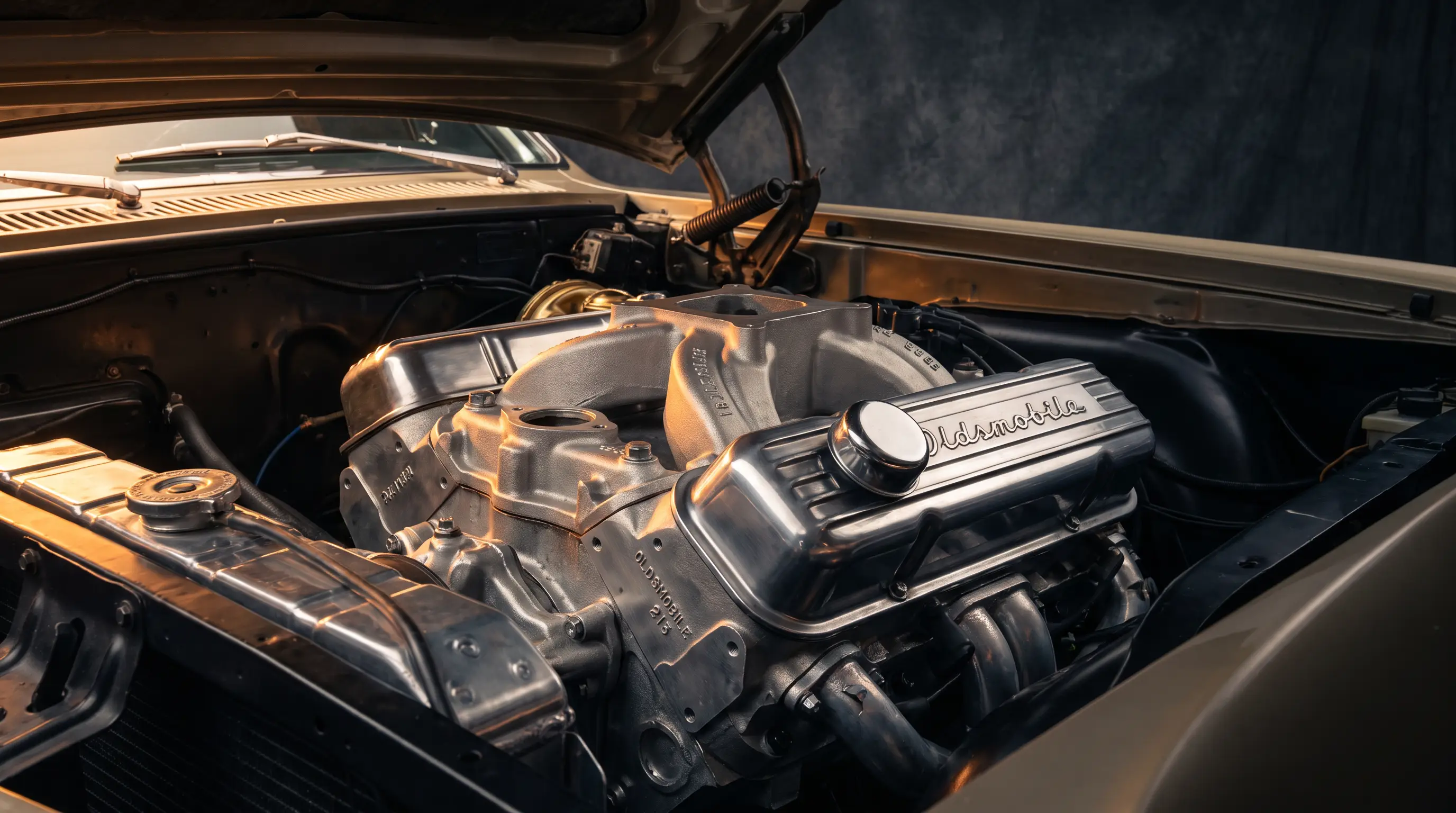
The oldsmobile 215 engine weighs about 318 pounds fully dressed. A cast-iron small-block of similar output runs 600 pounds or more. That single number, roughly half the weight of the iron engines it replaced, is the whole story of why this little aluminum V8 mattered, and why Oldsmobile only built it for three model years before walking away from it.
Oldsmobile needed a compact car engine for 1961 and needed it fast. GM's answer was a 215 cubic inch V8 cast in aluminum, shared across Buick, Oldsmobile, and Pontiac compact lines. In the Olds F-85 and the earliest Cutlass, it was the base performance option, and it is worth understanding on its own terms before the Cutlass engine story moves on to the bigger iron engines that followed it.
Why Oldsmobile went aluminum in 1961
Detroit's aluminum engine push wasn't a styling exercise. GM's compact cars for 1961, the Buick Special, Pontiac Tempest, and Olds F-85, needed real V8 power without the weight penalty that would ruin the handling and mileage those cars were built to deliver. Aluminum solved the weight problem directly. The 215 displaced 215 cubic inches from a 3.5-inch bore and 2.8-inch stroke, and in Oldsmobile trim it made 155 horsepower with a two-barrel carburetor, or 185 horsepower with the four-barrel option Oldsmobile called Cutlass power.
That second number is the reason the Cutlass name exists at all. Oldsmobile hung it on the high-output 215 package before it became a full model line. The 185-horsepower version used a 10.25:1 compression ratio, higher lift camshaft, and dual exhaust, respectable numbers for a compact in 1961. Buick ran the same basic casting through its own tune, and later added a turbocharged variant in the Skylark that pushed output past 200 horsepower, but that's a different engine's story.
What made it hard to build and worse to fix
Casting a V8 block, heads, and intake entirely in aluminum in 1961 was ambitious, and it showed. The 215 used steel cylinder liners pressed into the aluminum block, a setup that worked fine on the assembly line but created headaches in the field. Aluminum and steel expand at different rates as they heat up, and that mismatch led to head gasket failures and coolant leaks that dealers weren't always equipped to diagnose correctly. Owners accustomed to cast-iron small-blocks brought these cars in with symptoms nobody at the counter had seen before.
Cost was the other problem. Aluminum casting scrapped at a much higher rate than iron casting did in 1961, and every rejected block was expensive metal down the drain. Oldsmobile, Buick, and Pontiac were all paying that premium to build a compact-car engine, which is backward from how automakers usually think about margins on entry-level products. The math never got comfortable enough to justify a fourth model year.
The three-year run
| Year | Application | Output |
|---|---|---|
| 1961 | F-85 standard V8 | 155 hp (2bbl) |
| 1961-63 | Cutlass option (4bbl) | 185 hp |
| 1963 | Final Olds application | Replaced by 330 cid iron V8 for 1964 |
Why Oldsmobile dropped it for the 1964 Cutlass
When the Cutlass grew into its own model for 1964, Oldsmobile dropped the aluminum 215 entirely and replaced it with a conventional 330 cubic inch iron V8. The reasoning was simple. The new intermediate-size Cutlass no longer needed to hit the same weight targets as the tight little F-85 compact, and iron blocks were cheaper to cast, easier for dealers to service, and immune to the liner problems that had dogged the aluminum engine since day one. Bigger cubic inches sold better anyway, and 330 cubic inches of iron did that job without the scrap-rate headache.
General Motors didn't let the tooling go to waste. Rover bought the design outright in the mid-1960s and kept building it, in one form or another, into the 1990s and beyond, in everything from the Range Rover to the MGB GT V8. An engine Oldsmobile gave up on after three years ended up with one of the longest production runs of any V8 in automotive history, just not under an American hood.
"Every spec sheet says 155 or 185 horsepower and stops there. What the spec sheet doesn't say is that this engine weighs less than a modern V6. Oldsmobile solved the weight problem in 1961 and then walked away from the solution three years later because iron was cheaper to build. That's not a mystery, that's just Detroit math."
— Dan Reeves
How it compares to the iron engines that followed
Put the 215 next to the 330 that replaced it in 1964 and the contrast is stark. The 330 weighed roughly 600 pounds, nearly double the aluminum engine, and cost less per unit to cast despite the extra material. That's the trade Oldsmobile made: heavier iron in exchange for cheaper, more predictable manufacturing and a service network that already knew how to work on cast-iron blocks. The 215's weight advantage never disappeared, it just stopped being worth the manufacturing headache once the Cutlass grew into a bigger car that didn't need to shave every pound.
There's also a horsepower-per-pound argument worth making. At 185 horsepower and roughly 318 pounds, the high-output 215 produced power density numbers that a lot of period iron V8s couldn't match even at much larger displacement. Buick's turbocharged version of the same basic casting pushed that further, proving the design had headroom Oldsmobile never fully used before dropping it. That's part of why Rover kept developing it for so long after Detroit moved on.
What it means for buyers today
Surviving 1961-63 F-85 and early Cutlass cars with the factory aluminum 215 are rare, and most that remain have had liner or gasket work done at some point in their life. That's not a red flag by itself, it's just the maintenance reality of this specific engine, and any buyer looking at one should ask directly whether the liners have been addressed and by whom. A car with documented liner service is worth more trust than one with no paperwork at all.
For the rest of the powerplant lineup that followed the 215 through the Cutlass's history, from the 330 that replaced it to the big-block options of the muscle car years, keep reading the series for how Oldsmobile's engine choices kept evolving, sometimes for better and sometimes, as the next chapter shows, for much worse.