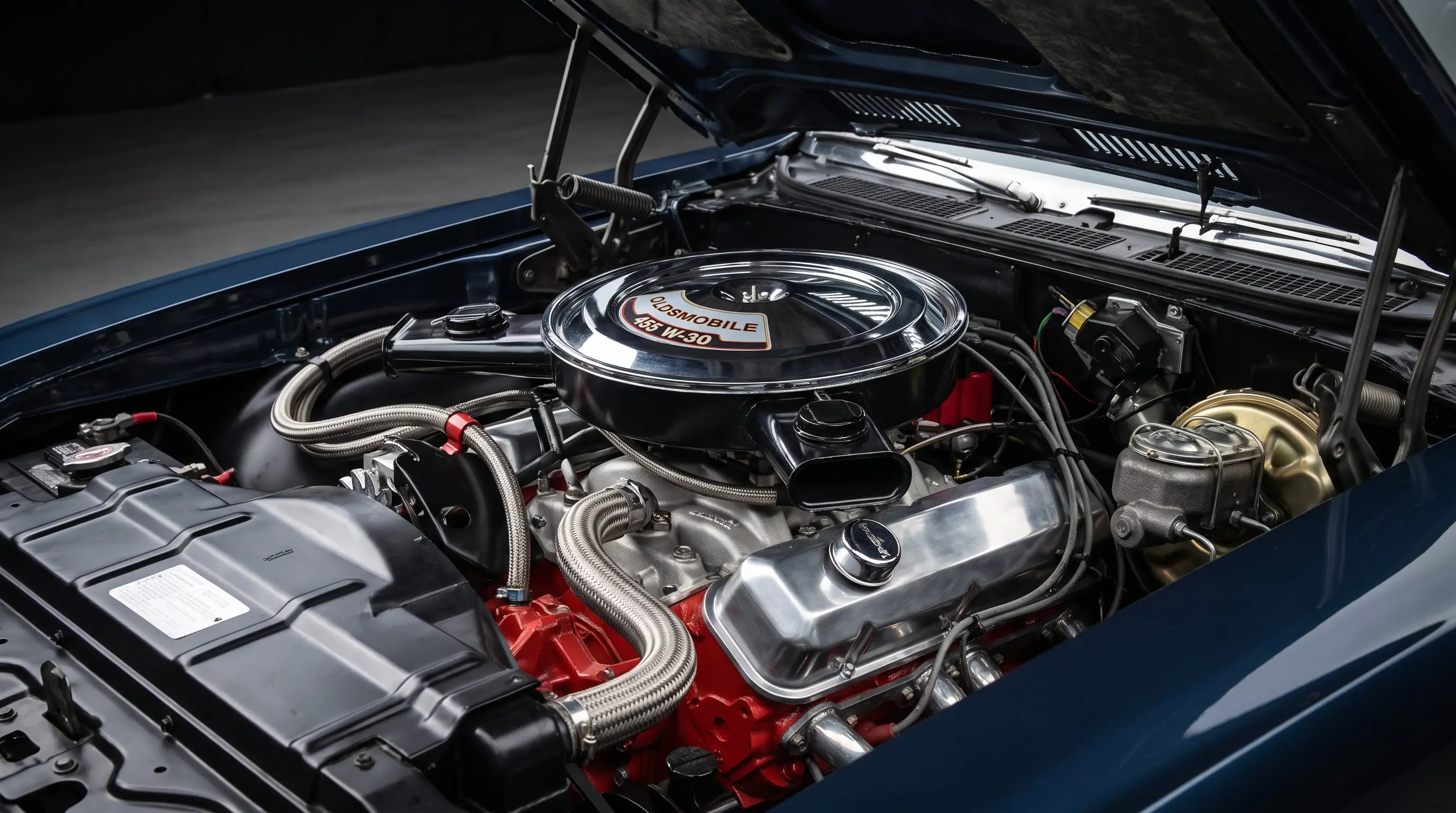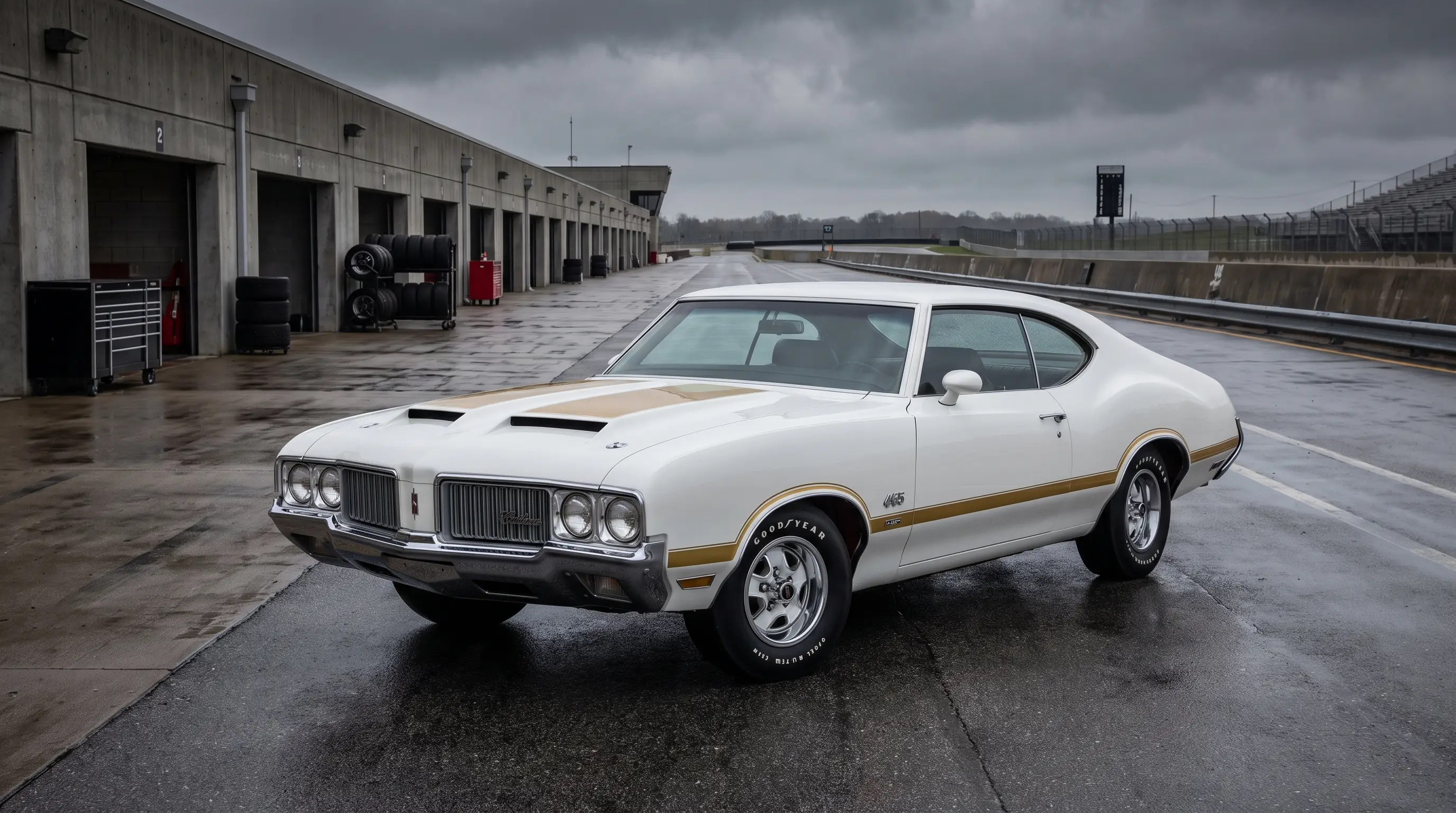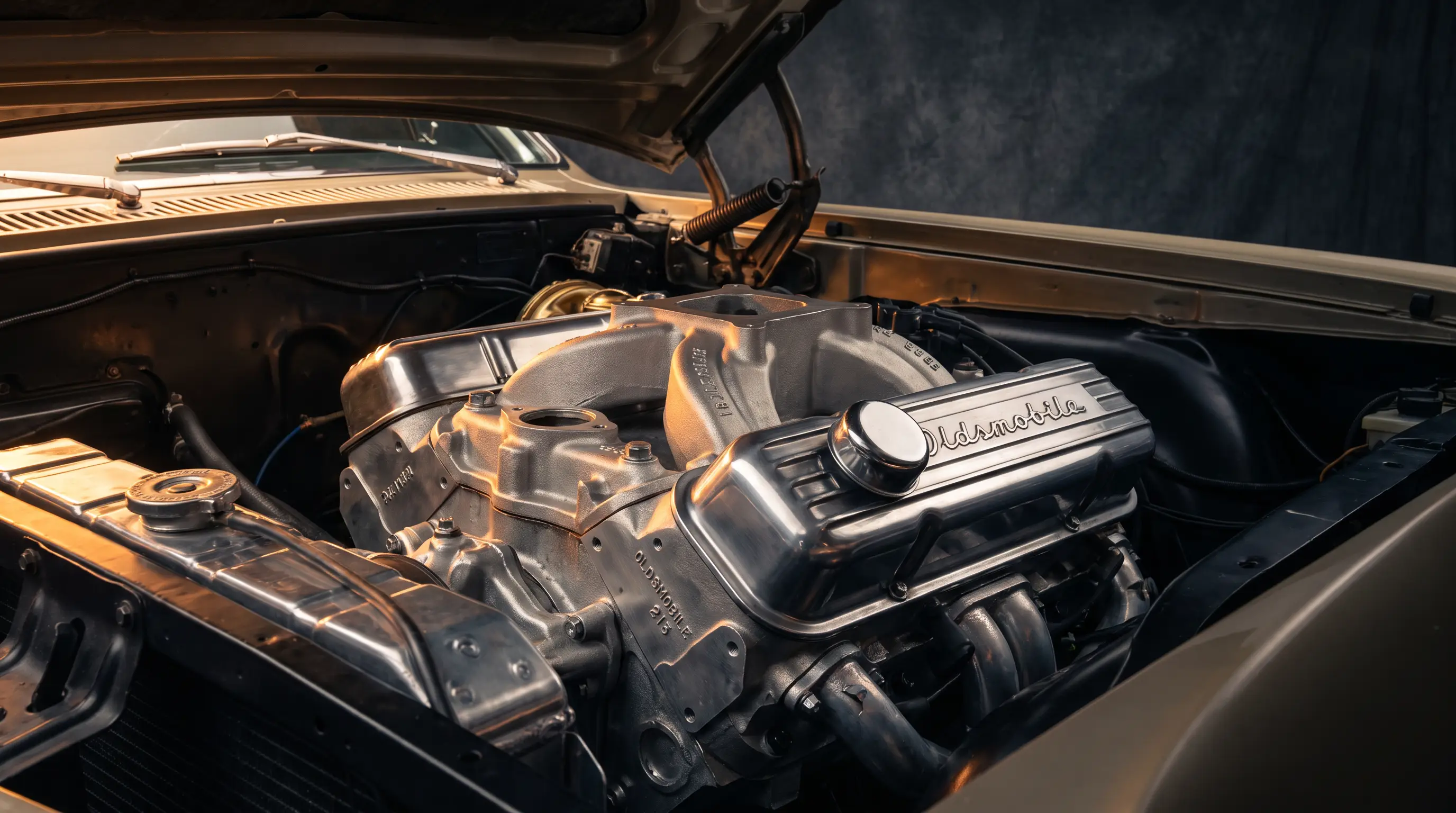
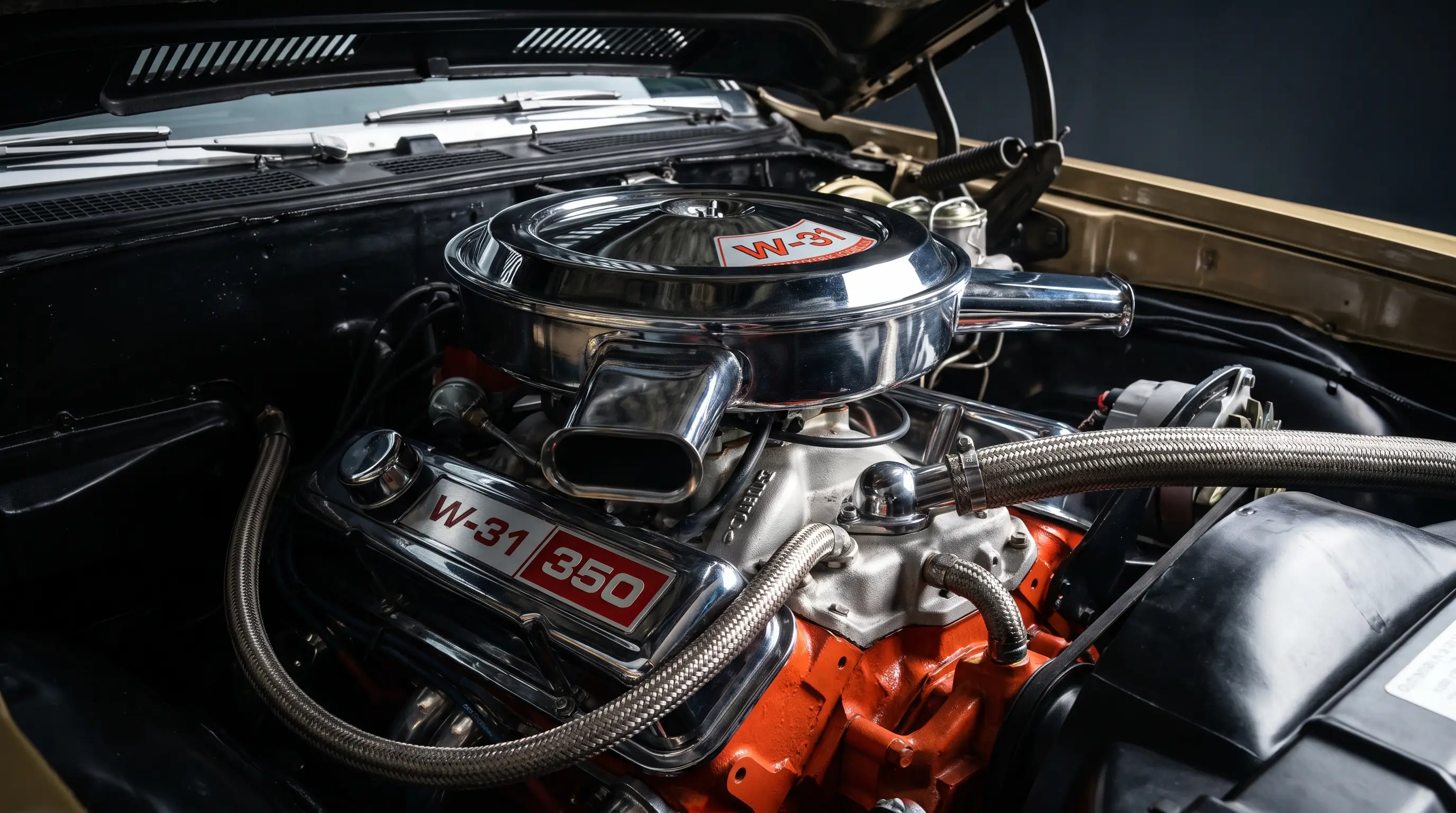
The W-31 350 is a small-block built to rev, not lug. That's the first thing to understand about it, and it's the thing most people get backwards. Oldsmobile's big-blocks made their money down low. The W-31 made its money up high, closer to 6,000 rpm than most factory engines from this era ever saw on a dyno sheet. Different tool, different job. Don't judge one by the other's numbers.
This engine was built for a different customer
By the late 1960s, Oldsmobile had a problem. Big-block 442s cost real money, weighed a lot up front, and drank gas nobody's insurance company liked pricing. The W-31 was the answer: a high-output 350 stuffed into a lighter car, aimed at a younger buyer who wanted to run with the big-blocks off the line without paying for one. Less weight over the front wheels, a nimbler car in the corners, and an engine tuned to make its power where the driver actually kept their foot down. That's not a compromise. That's a different design brief entirely, and it's worth remembering before anyone tells you the W-31 is "just a small-block."
Under the hood, Oldsmobile fitted a high-lift camshaft, better-flowing cylinder heads with bigger valves, and a high-rise intake manifold, all built to keep the engine breathing well past the rpm where a standard 350 signed off. Rated output landed at 325 gross horsepower at 5,400 rpm, and on paper that reads close to a base four-barrel 350. On the road it isn't close at all, because the W-31 kept pulling cleanly toward its 6,000 rpm redline while a standard 350 was already running out of breath.
The hood scoops did real work, same as always
Same story as the bigger W-30 package covered elsewhere: the fiberglass hood on a W-31 wasn't there to look tough in the school parking lot. It fed cold outside air straight to the carburetor. Cold air is denser air, denser air makes more power for a given tune, and an engine built to rev high needs every bit of that advantage more than a low-revving torque engine does. Check that the ductwork under the hood actually connects to the air cleaner before you believe a W-31 badge means anything. I've seen more than one "W-31" with a hood that doesn't feed a thing. Cosmetic hood, not a functional one. That's a $500 hood on a $30,000 story, and buyers get burned on it constantly.
Production numbers are the reason this one gets faked
Low production numbers on the W-31 mean documentation matters as much here as it does on any big-block option. Original build sheet, correct casting numbers on the block and heads, and a hood with real functioning ducts underneath. That's the checklist. Skip any one of those and you're buying a story, not a W-31. I tell people the same thing every time: a fender badge costs nothing to bolt on. A verified build sheet costs nothing to ask for. Ask for it before the money changes hands, not after.
Compression and emissions pressure hit the W-31 the same way it hit every other Oldsmobile V8 heading into the early 1970s. Ratios came down, output came down with them, and the high-revving character that made this engine what it was got dialed back along with everything else Detroit was building at the time. The W-31's window as a real factory performance option was short, and that short window is exactly why surviving examples get chased hard today.
Why a small-block buyer picked this over a big-block
I get this question in my own shop more than any other on these cars: why not just buy the 455 and skip the small-block altogether? Fair question. The answer is weight distribution and how a car actually feels in a corner, not just in a straight line. A 350 up front means less nose weight than a 455, and that changes how the car turns in, how it brakes, and how it feels at the limit on a back road. A W-31 Cutlass isn't trying to out-drag a 442 with a 455 under the hood. It's built to be quicker point to point on a road with more than one corner in it, and that's a real advantage a straight-line horsepower number never shows you.
Insurance was part of the calculation too. A car listed with a small-block on the paperwork often carried a lower premium than the same car with a big-block listed, regardless of what the small-block was actually capable of doing. For a younger buyer already stretching to afford a performance car, that difference on a monthly bill mattered as much as anything happening under the hood.
| Feature | Standard 350 | W-31 350 |
|---|---|---|
| Camshaft | Stock grind | High-lift performance cam |
| Cylinder heads | Standard valves | Larger valves, better flow |
| Intake | Cast iron | High-rise aluminum |
| Induction | Underhood air | Functional cold-air hood scoops |
| Power character | Low-rpm torque | High-rpm breathing |
"A fender badge costs nothing to bolt on. A build sheet costs nothing to ask for. Ask before the money changes hands, not after."
— Mike Sullivan
The W-31 350 gets overlooked because it never had the displacement number to grab attention the way a 455 does. That's a mistake. It did its job by revving where the big engines couldn't, in a car light enough to make that rpm range actually useful on the street. For where this engine sits inside Oldsmobile's broader V8 lineup, the engine chapter lays out how the W-31 fit alongside the standard 350 and the big-block options Oldsmobile offered the same buyer. And if the small-displacement, high-output idea interests you, keep reading the series for how Oldsmobile approached the same problem from the other end, with a much smaller engine built for a completely different reason.