
The Piquette Avenue plant in Detroit is where the Ford Model T was first built, and it holds the room where the car was first drawn. Ford's designers began work on the T in January 1907 in a secret experimental room at the back of the third floor. The first production Model T was completed here on September 27, 1908. Roughly 12,000 more followed before Ford moved out in 1910. For a historian of early Fords, few buildings carry as much original evidence.
Car Features
6 min read
Piquette Avenue: Where the Model T Was Born
The Detroit building where the Model T was designed in a secret room and first built in 1908, and how it survived to become a museum.
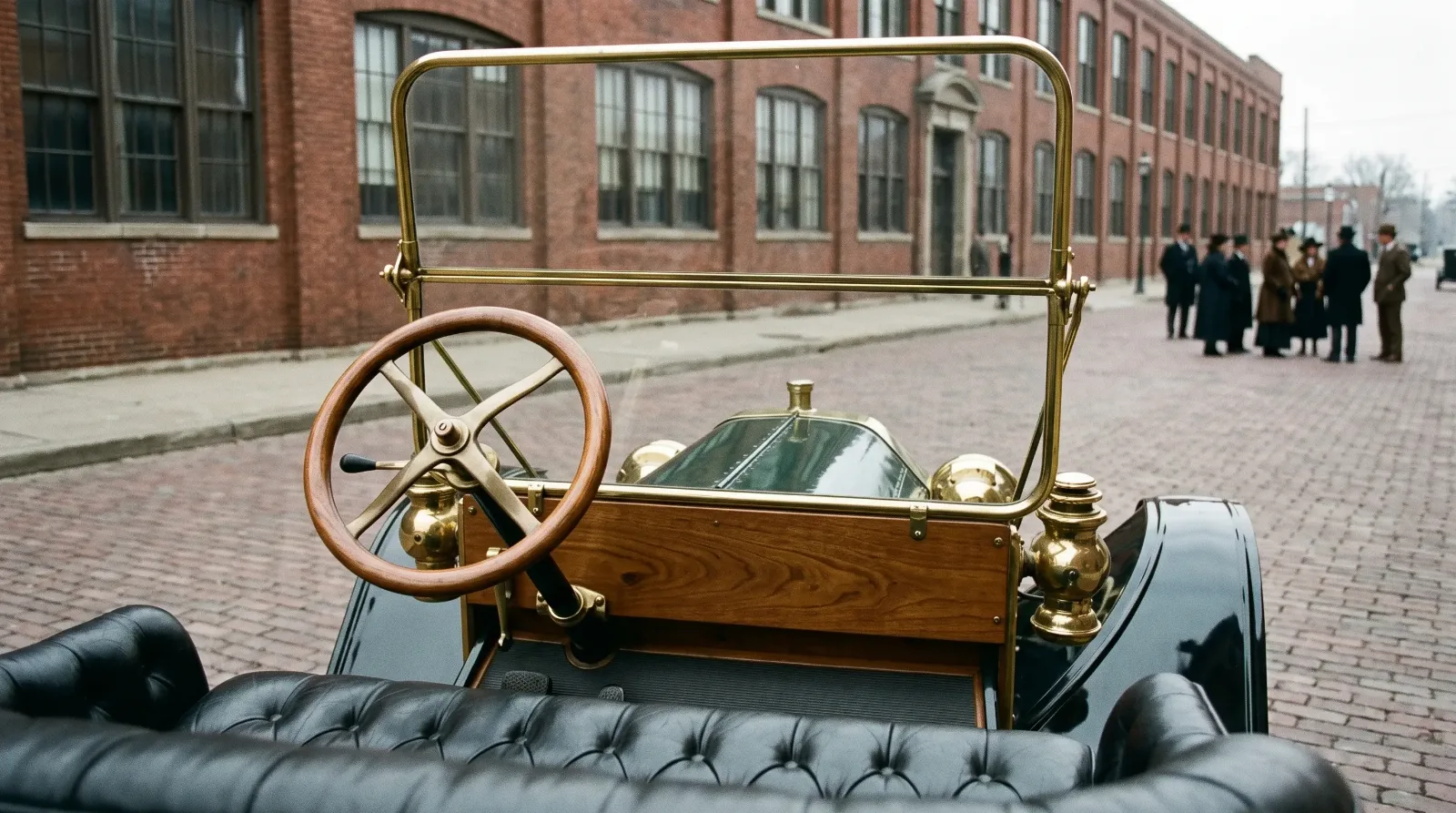
This article treats Piquette as an artifact: what the building is, what was built inside it, what the early cars made there look like against later ones, and how the structure survived. The moving assembly line came later, at another plant, and its development is covered in our main assembly-line article; read more here.
The building at 461 Piquette Avenue
Construction began on May 10, 1904, and Ford moved in that October. The company had outgrown its first home on Mack Avenue in Detroit, where the 1903 Model A (no relation to the 1928 Model A) had been assembled. Piquette was a step up in every dimension.
The design is credited to the Detroit firm Field, Hinchman & Smith. The building is three stories tall and measures 56 feet by 402 feet, a long, narrow plan. Its floors are maple, about 67,000 square feet of it. A narrow building with windows down both long walls let daylight reach the work, which mattered in a plant where much of the assembly was done by hand at fixed stations.
| Date | Event at Piquette Avenue |
|---|---|
| May 10, 1904 | Construction begins |
| October 1904 | Ford Motor Company moves in |
| January 1907 | Model T design work begins in a secret third-floor room |
| September 27, 1908 | First production Model T completed |
| January 1910 | Most production has moved to Highland Park |
| October 1910 | Ford fully vacates the building |
| January 1911 | Studebaker takes over the plant |
| 1936 | 3M becomes the owner |
| April 2000 | Bought by the Model T Automotive Heritage Complex |
| July 27, 2001 | Opens as a museum |
The cars before the T
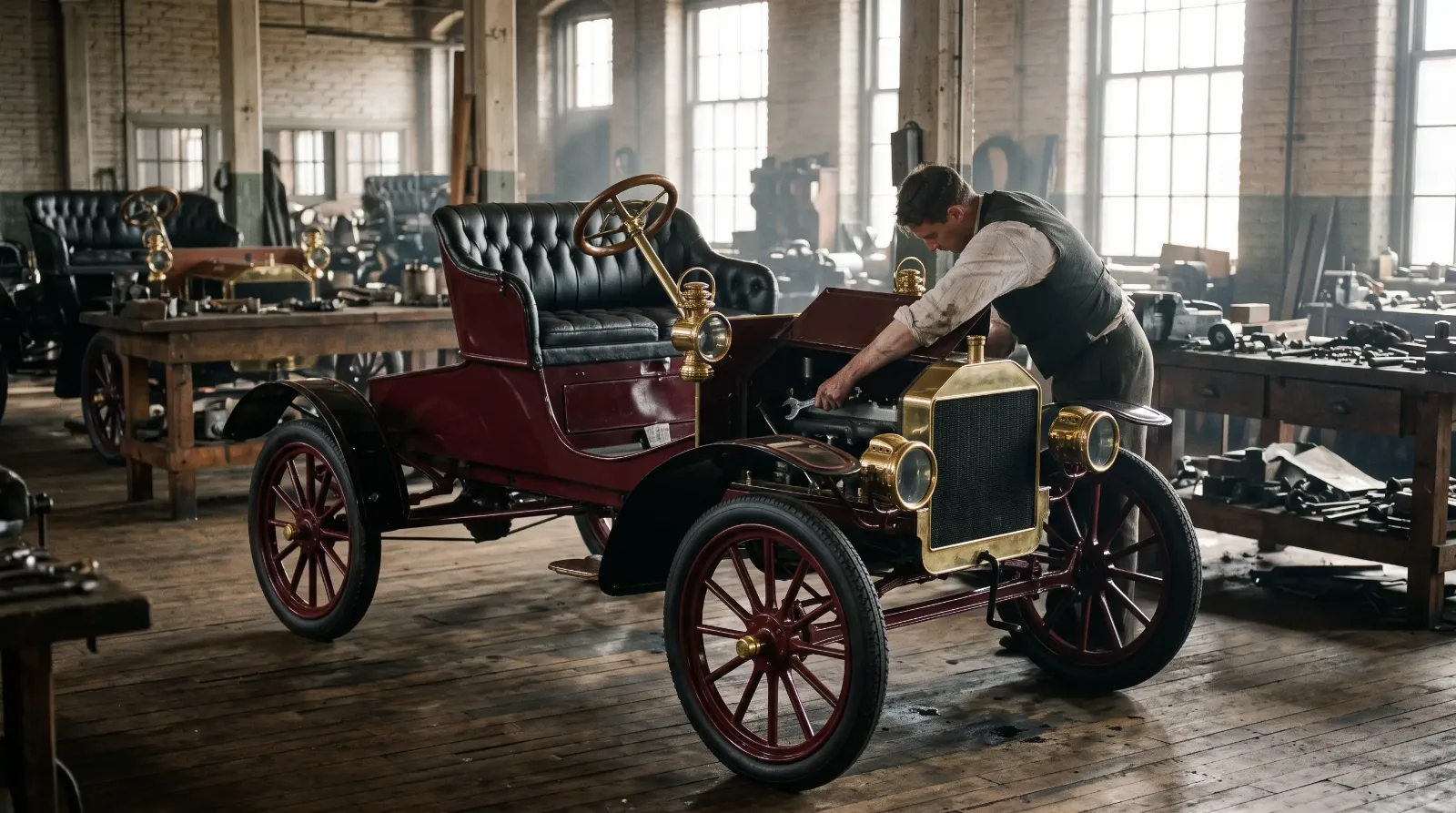
The Model T was not the first Ford built at the Piquette Avenue plant. Between October 1904 and 1910 the plant assembled Models B, C, F, K, N, R and S, as well as the T. Each one taught the company something about building cars in quantity.
The Model N matters most to the T's story. In 1906 Ford advertised that it made 10,000 of every part for the N, all exactly alike, a claim about interchangeability that would become the T's foundation. The Model N of 1907 is also where Ford first used vanadium steel, the alloy Childe Harold Wills tracked down a mill to produce. Both ideas were tested on earlier cars inside this building before the T was drawn.
The secret room on the third floor
In January 1907, Henry Ford set a small team to work in an experimental room in the back corner of the third floor. The design group is usually given as Joseph Galamb, the main engineer, with Childe Harold Wills and Eugene Farkas, and a wider circle that included Peter E. Martin and others. Who did what is a story for another article; what matters here is the place. The car that would sell more than 15 million copies started as drawings and test parts in one corner of this building.
The room is a reminder of the scale Ford was working at. There was no separate engineering center and no proving ground. The design office, the stockroom and the assembly floor shared one structure, and an idea could go from a drawing board to a workbench by walking down a flight of stairs.
Building the first Model Ts at the Piquette Avenue plant
The first production Model T was completed on September 27, 1908, and sold as a 1909 model; one source dates the build to August 12, with the car leaving the plant on September 27. Public introduction followed on October 1, 1908. The start was slow. In the first full month, October 1908, only 11 cars were built.
Assembly at Piquette was stationary. A car was built in place, with workers and parts brought to it. Charles E. Sorensen later recalled that the moving final assembly line was first conceived here in July 1908, during the last months of Model N production, with a group of employees trying out the idea. That account rests on his own memory, the museum's history page does not mention it, and the documented moving lines belong to Highland Park from 1913. If you want to compare the effort per car before and after that change, our article on the build time lays out the hours.
How many Model Ts left Piquette? The museum and most references say about 12,000. Wikipedia's article on the plant gives 14,000. I side with the museum, which has studied the building most closely, and treat the higher figure as unconfirmed.
"A Piquette-built Model T is a different object from a car built five years later. It comes from a plant where cars were assembled by hand at fixed stations, and owners of the earliest cars are right to document that history carefully."
Sarah Whitfield
For anyone researching an early car, that distinction counts. A 1909 Model T assembled here is an artifact of the hand-built period, and the claim that a particular car came out of Piquette rests on records, not on looks alone. Ask for documentation before accepting it.
Why the building survived
Ford left because the T outgrew the plant. Most production had moved to Highland Park by January 1910, and the company was fully out by October 1910. That could have been the end of the building's significance. Instead, it stayed in industrial use. Studebaker took it over in January 1911 and built cars there until 1933. 3M became the owner in 1936.
Decades of continuous industrial use kept the structure standing. In April 2000 the Model T Automotive Heritage Complex bought the building, and it opened as a museum on July 27, 2001. Formal recognition followed: the National Register of Historic Places in 2002, Michigan State Historic Site status in 2003, and National Historic Landmark designation in 2006.
For a researcher, Piquette's value is its authenticity. The building is the same one, on the same street, with the same third-floor corner where the T was drawn. Highland Park is where the Model T became a mass product. Piquette is where it became a car at all.
Sources and notes
Related Reading
Have a
Ford Model T
for Sale?
Reach thousands of serious classic car collectors across the US.
Sell It Here →
Selling a classic? Here's how: the best sites to sell a classic car
Are You a Classic Car Dealer?
List your full inventory and connect with targeted classic car buyers.
Join as a Dealer →

About the author
Sarah Whitfield
Third-generation classic car collector specializing in pre-war American and European coachbuilt automobiles. Researcher and concours enthusiast.
Related Listings - Ford Model T
Comments
Be the first to comment on this article.