
The number that matters most in Pontiac GTO history isn't 1964. It's 389. That's the cubic-inch displacement of the V8 that John DeLorean and his engineering team dropped into a mid-size Tempest and turned into the car that started the muscle car era, or at least got most of the credit for it. Before there was a Judge, before there was Ram Air, before anybody argued about gross versus net horsepower, there was a 389 under the hood and a decision to stuff a big engine into a car that wasn't supposed to have one.
Car Features
7 min read
The Pontiac 389: The V8 That Started It All
The 389 wasn't invented for the GTO, but it's the engine that made the GTO possible. Here's what made it work and what to watch for today.
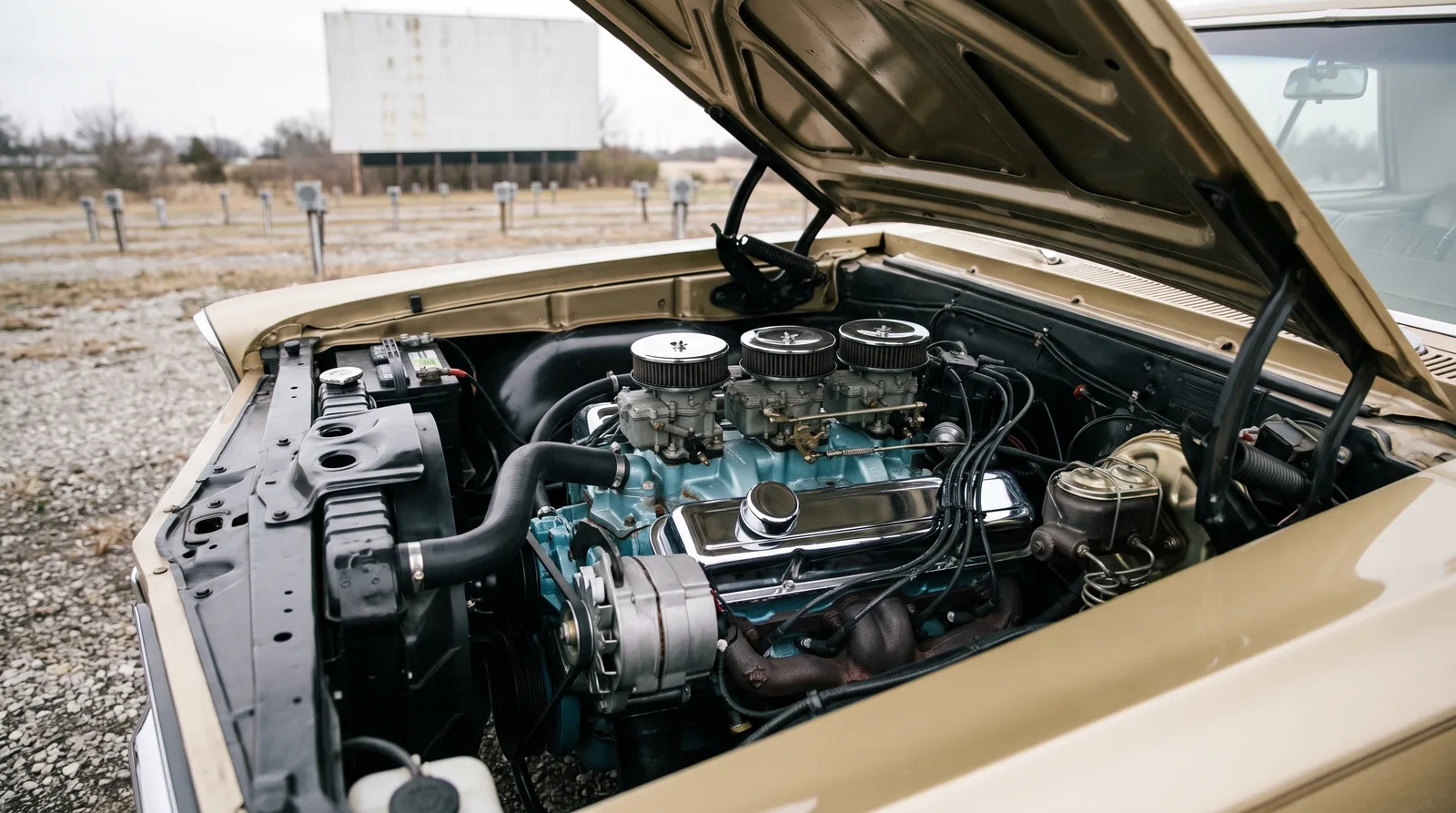
Pontiac's corporate bosses had a rule against big engines in intermediate cars. GM's policy at the time capped engine size in the A-body lineup, a holdover from a different era of the company's thinking about what a family-sized car should carry. DeLorean's team found the loophole: the rule applied to standard equipment, not options. So the GTO package launched as an option on the 1964 Tempest LeMans, and the 389 came along for the ride. For a deeper look at how that decision played out, the Pontiac GTO story covers the politics in full. Here, the focus stays on the engine itself.
Where the 389 came from
The 389 wasn't invented for the GTO. Pontiac had been building this basic V8 architecture since the late 1950s, and by 1964 the 389 was already a known quantity, used across the Pontiac lineup in cars far tamer than the GTO. What made it work in the GTO wasn't novelty. It was that Pontiac already had a strong, over-square V8 design with room to grow, and the engineering team knew how to extract performance from it without reinventing the block.
Bore and stroke sat at 4.0625 x 3.75 inches, giving the 389 its displacement with a design that favored higher-rpm breathing over low-end torque compared to some of the era's larger, longer-stroke engines. That's part of why the 389 could rev and make noise in a way that felt different from a garden-variety big American V8. It wasn't subtle, and it wasn't meant to be.
The base engine and the options above it
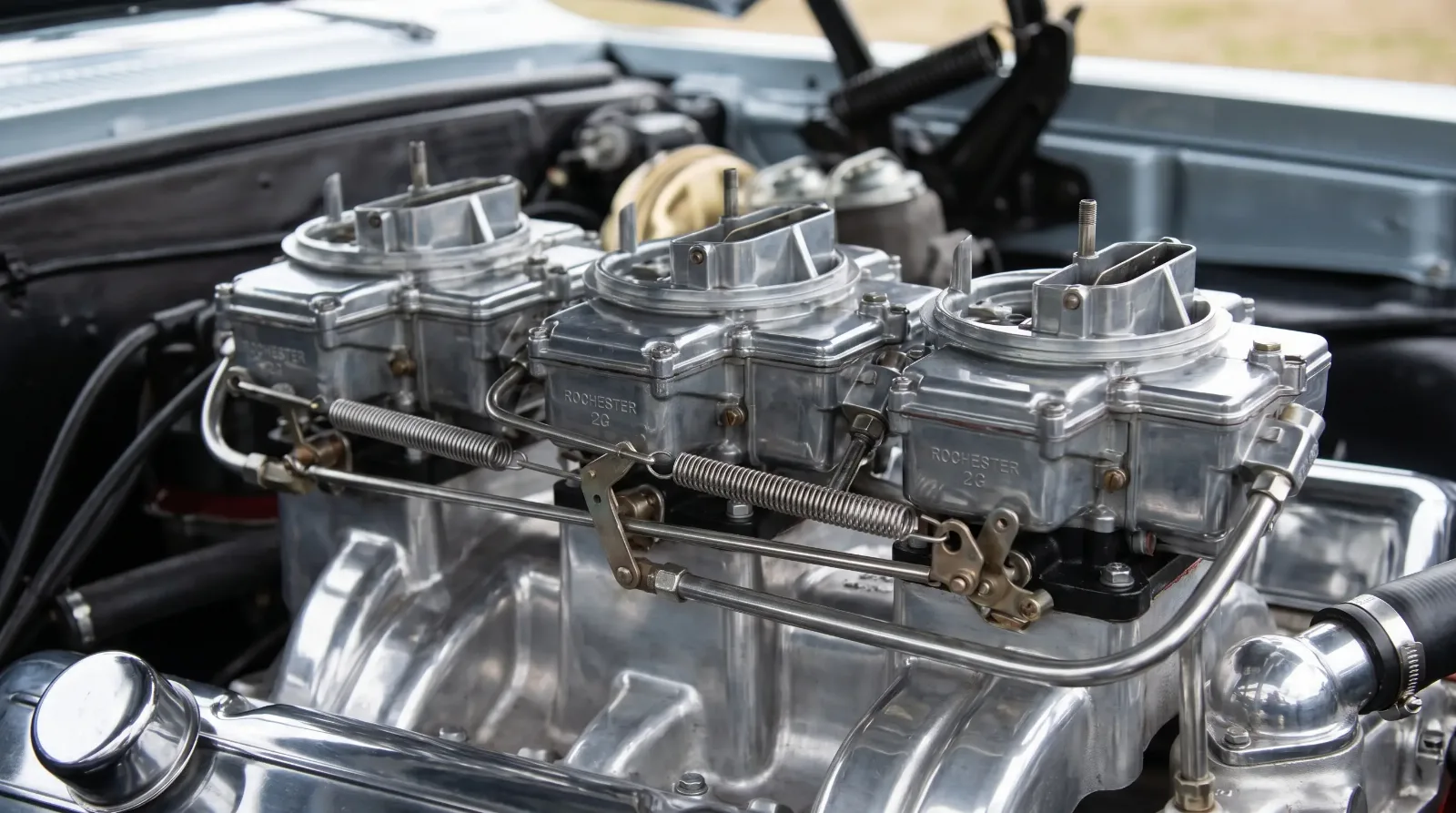
In 1964, GTO buyers picked from two 389 configurations. The base engine, running a single Carter four-barrel carburetor, made a stated 325 horsepower at 4,800 rpm with 428 lb-ft of torque at 3,200 rpm. Step up to the Tri-Power option, three two-barrel carburetors instead of one four-barrel, and the rating climbed to 348 horsepower. That's a meaningful jump on paper, and the on-road difference was real too. The middle carburetor did the daily driving work, and the two outer carbs opened under hard throttle, giving the engine a second wind that a single four-barrel setup couldn't match in the same way. For 1965 and 1966, revised cylinder heads and intake manifolds pushed the base engine to 335 horsepower and the Tri-Power to 360 horsepower, the peak of the 389's run before GM's ban on multiple carburetors killed Tri-Power after 1966. If you want the full breakdown of how that triple-carb system worked and why it mattered so much to buyers, read on.
| Configuration | Carburetion | Horsepower | Torque |
|---|---|---|---|
| 389 (1964) | Single 4-barrel | 325 hp | ~428 lb-ft |
| 389 Tri-Power (1964) | Triple 2-barrel | 348 hp | ~428 lb-ft |
| 389 (1965-66) | Single 4-barrel | 335 hp | ~431 lb-ft |
| 389 Tri-Power (1965-66) | Triple 2-barrel | 360 hp | ~424 lb-ft |
Compression ratio moved around depending on the year and the specific build, generally sitting in the neighborhood of 10.75:1 for the higher-output versions, which meant these engines wanted premium fuel and didn't love sitting at idle in traffic for long stretches. That's a real ownership consideration even today. A numbers-matching 389 Tri-Power car with low compression run on modern pump gas behaves differently than one built to the original spec, and buyers doing their homework need to know which they're looking at.
What the 389 feels like from behind the wheel
Numbers on a spec sheet only tell part of the story. What actually separated the 389 from a lot of the competition's big-inch engines was how it delivered power. It wasn't a lazy torque monster that just shoved the car forward from idle. It liked to be worked. Get it past 3,000 rpm and the whole character of the car changes, especially with Tri-Power breathing through it. That's not universal praise, either. Cold mornings could be rough with three carburetors to synchronize, and a neglected Tri-Power setup runs worse than a well-tuned single four-barrel every time.
"People talk about the GTO's power numbers like they tell the whole story, but the 389 is a driver's engine. You had to know how to use it. Short-shift it and it feels ordinary. Wind it out and it comes alive."
Dan Reeves
Reliability and what breaks
The 389 has a reputation as a genuinely tough engine block, and that reputation is mostly earned. The bottom end holds up well under normal use, and a stock 389 in good tune with regular oil changes will run for a long time without drama. Where owners run into trouble is almost always in the details: worn valve guides leading to oil consumption, a Tri-Power linkage that's out of adjustment causing rough idle and poor fuel distribution, and rust in the water jackets on cars that sat outside for decades before restoration. None of these are engine-killers. They're maintenance items that catch up with cars that were neglected rather than cars that were driven.
Rebuilding a 389 today isn't the parts nightmare it might be for something more obscure. The aftermarket support for these Pontiac big-block-adjacent V8s is solid, thanks in large part to how many GTOs and full-size Pontiacs used variations of the same basic architecture. Finding a shop that actually understands Tri-Power tuning, though, is a smaller pool than finding one that can rebuild a Chevy small-block. That's worth factoring into a purchase decision if the Tri-Power setup isn't already sorted.
Why the 389 still matters to the GTO story
Every GTO that came after 1965 moved further from the original engine, first to the 400 in 1967, then eventually to the 455 by the early 1970s. But the 389 is the engine that proved the concept. It's the reason the GTO existed at all, the reason DeLorean's team bothered fighting the corporate rulebook in the first place. A 1964 or 1965 GTO with its original 389, especially a documented Tri-Power car, sits near the top of what collectors want from this era, and the engine is a big part of why. For the complete picture of how this engine fits into the broader arc of GTO powertrains across the model's run, the GTO engine story walks through every generation from here forward.
Anyone shopping for an early GTO owes it to themselves to get the engine's numbers checked against the car's documentation before writing a check. Matching-numbers 389s, especially Tri-Power cars, carry a real premium, and there are enough non-original replacement engines out there that skipping this step is a mistake buyers make more often than they should.
Sources and notes
Related Reading
Have a
Pontiac GTO
for Sale?
Reach thousands of serious classic car collectors across the US.
Sell It Here →
Are You a Classic Car Dealer?
List your full inventory and connect with targeted classic car buyers.
Join as a Dealer →

About the author
Dan Reeves
Performance engine builder from North Carolina's motorsports corridor, focused on swaps, forced induction and making real, repeatable power.
Related Listings - Pontiac GTO




Comments (1)
S
Steve Macaluso
1 month ago
The insurance section is worth a separate article. A lot of people reach claim time before realizing agreed value coverage is completely different from what they bought.