
Four-bolt main caps on a Pontiac big block. That's the detail that tells you the Super Duty 455 wasn't a trim package or a hood decal. The pontiac sd455 block was a genuinely different casting from the standard 455, built to survive abuse the emissions-era engines around it were never asked to take, and it arrived in 1973 right when the rest of the muscle car world was quietly giving up.
Car Features
6 min read
The SD455's Special Block
The Super Duty 455's four-bolt main block and forged rods were built for a durability target the production camshaft never fully used, making the SD455 a bottom end that outran its own horsepower rating.
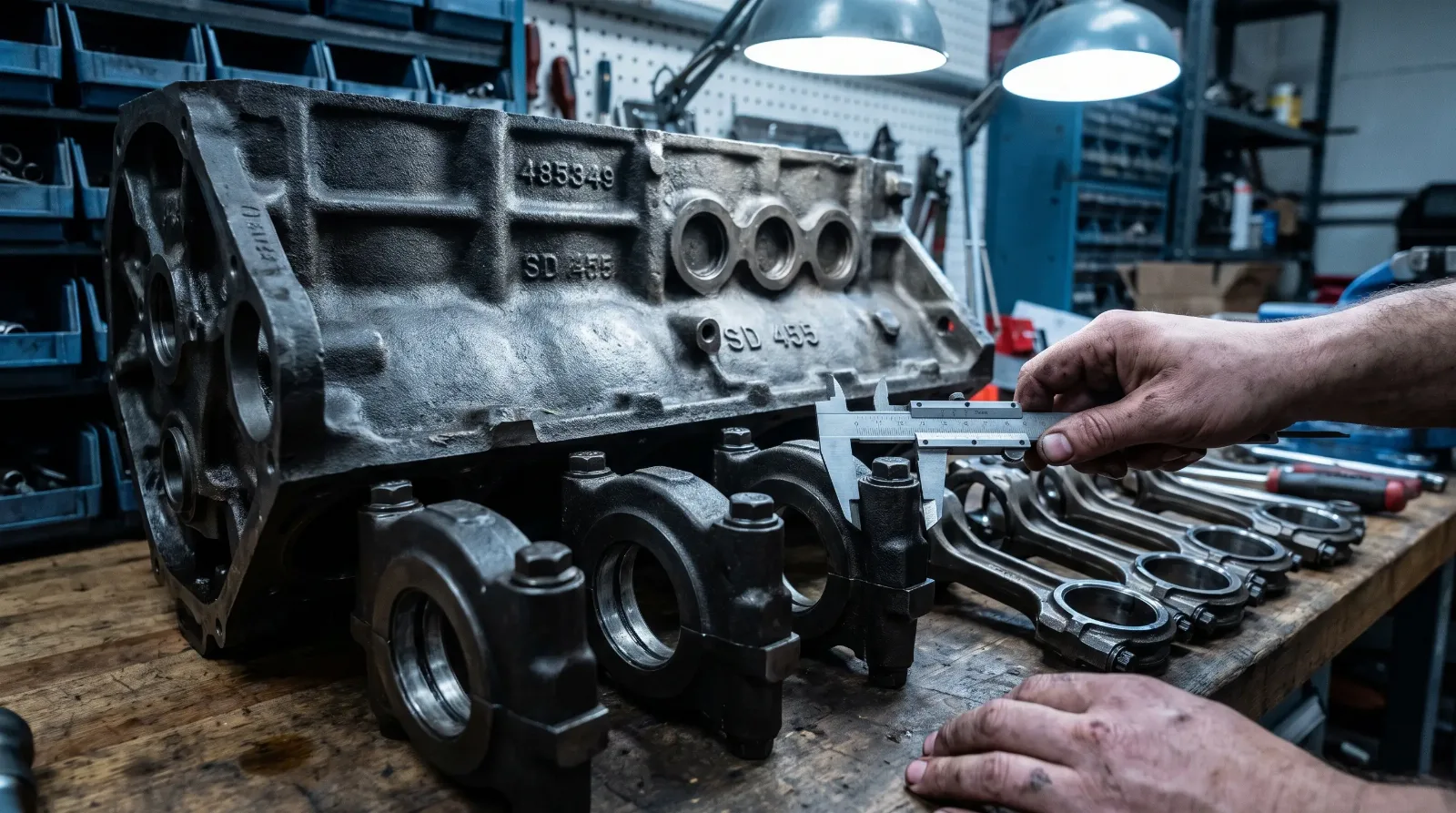
Everything else Pontiac sold that year was retreating. Compression ratios kept falling, catalytic converters were coming, and horsepower numbers on window stickers had been sliding for three straight seasons. The SD455 was the one engine that read like nobody had told the engineering department the party was over.
Why the block itself was different
The standard 455 used two-bolt main bearing caps, adequate for a torque-focused street engine but not built for sustained high rpm under load. The SD455 block moved to four-bolt mains on the center three journals, a change that had nothing to do with everyday driving and everything to do with keeping the crankshaft located under real stress. Pontiac also revised the block's oiling passages and reinforced the webbing around the main caps, changes aimed squarely at durability rather than a horsepower number on a sheet.
The connecting rods were forged rather than cast, wider at the beam than the standard 455 rod, again a durability change more than a raw power move. None of these updates show up in a horsepower rating. They show up when an engine gets run hard for years instead of pampered for a Sunday drive.
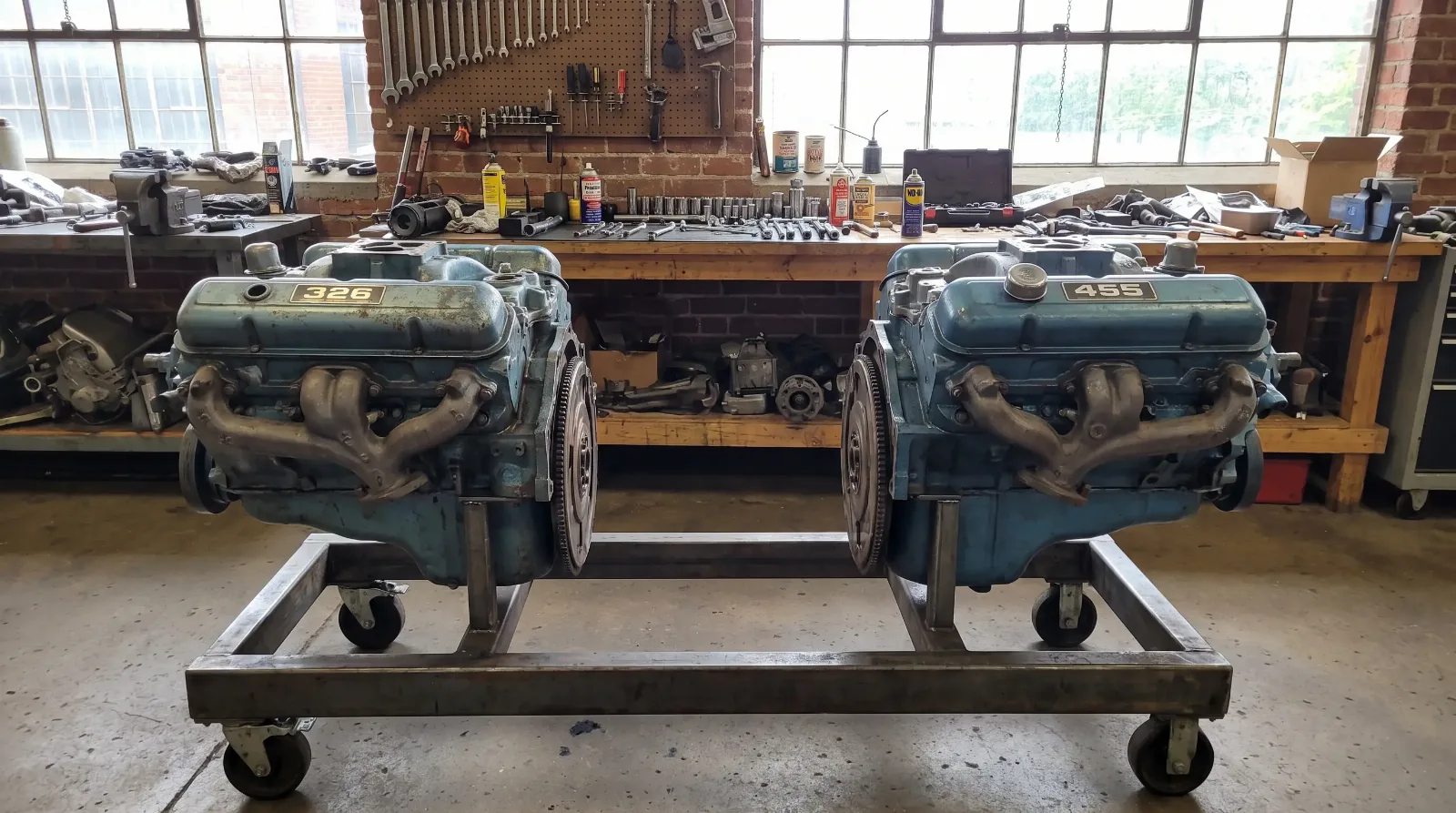
None of this cost Pontiac much on the assembly line, since the SD455 still fit inside the same basic external envelope as every other Pontiac V8 of the era. Motor mounts, bellhousing pattern, and overall dimensions stayed familiar. Pontiac strengthened the parts that needed strengthening without redesigning the engine from scratch, which kept tooling and production costs from spiraling the way a genuinely new architecture would have.
The engine that almost happened as planned
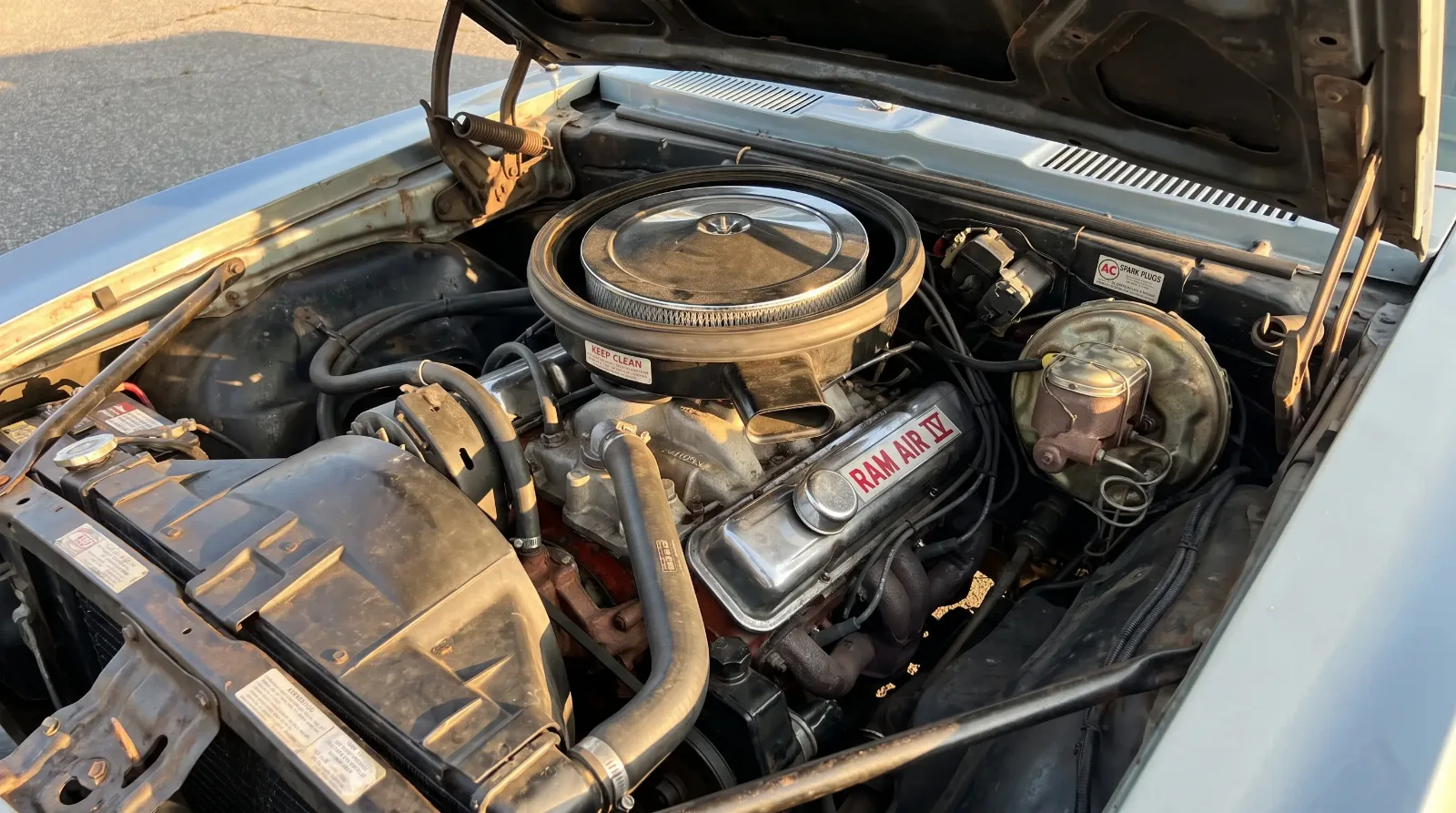
Pontiac's original SD455 development target aimed considerably higher than what reached showrooms. Early pre-production test cars ran a more aggressive cam grind closely related to the Ram Air IV's, and Pontiac initially rated that combination at 310 net horsepower and 390 lb-ft of torque. By the time the engine reached production for the 1973 model year, GM's internal emissions standard forced Pontiac to switch to a milder hydraulic cam, dropping the production rating to 290 hp net, with torque actually rising slightly to 395 lb-ft. That's still a real number for 1973, comfortably ahead of anything else in the Firebird lineup that year, but it's a step down from what the block itself was capable of supporting.
| Spec | SD455 (production) |
|---|---|
| Displacement | 455 cu in (7.5L) |
| Main caps | Four-bolt (center three) |
| Connecting rods | Forged, wide-beam |
| Camshaft | Hydraulic (production) |
| Horsepower rating | 290 hp (net) |
| Model years | 1973-1974 |
"Nobody buys a four-bolt main block because they plan to baby it. Pontiac built a bottom end that could take more than the cam on top of it was ever going to ask for. That mismatch is the whole story of the SD455."
Dan Reeves
Identifying a real SD455 block
The block casting number is the starting point, and it's non-negotiable if you're paying a premium for an SD455 car. A quick visual check on the main caps themselves, four bolts on the center three journals instead of two, confirms the durability upgrade before you even look at a casting number. Beyond that, the SD455 used its own specific cylinder head casting, and matching that casting number against known SD455 references is the difference between confirming a real engine and taking a seller's word for it.
Because the SD455 shares its external dimensions with every other Pontiac V8 of the era, swapping heads, intakes, and even short blocks between a standard 455 and an SD455 is mechanically easy, which is exactly why documentation matters so much here. A numbers-matching SD455 Trans Am commands a real premium over a car with a standard 455 wearing SD455 badging and a set of period-correct-looking decals. Pontiac Historical Services documentation, broadcast sheets, and confirmed casting numbers are the only reliable way to separate the two.
Production numbers on the SD455 were low across both model years it was offered, and that scarcity is a big part of why fakes exist in the first place. A seller with a standard 455 car and a set of decals has a real financial incentive to blur the line, and buyers who skip the casting number check are the ones who end up paying SD455 money for a standard rebuild. Take the time to verify before the money changes hands, not after.
Why the block matters more than the horsepower number
Judging the SD455 purely on its horsepower rating misses the point. A 1973 Trans Am with an SD455 is not a faster car on paper than some Ram Air III cars from four years earlier, but it's built on a stronger foundation, and that foundation is exactly why so many SD455 blocks survived hard use, engine swaps, and decades of amateur mechanics without cracking a main cap. The engineering decisions that went into the pontiac sd455 block reflect a design philosophy that treated durability as separate from horsepower ratings, an approach you can trace further back through a companion piece on how Pontiac's V8 family thought about strength versus output more broadly.
The SD455 sits at the tail end of the Pontiac engine story, the last engine in the Firebird's classic era that got real internal attention rather than just another compression drop. Shoppers looking at an SD455 car today should care less about the 290 hp sticker figure and more about the fact that the bottom end under it was engineered for a job the rating never fully describes.
Sources and notes
- PontiacV8.com: The Elusive Super Duty 455 308/320 "K" Camshaft
- Street Muscle: Muscle Cars You Should Know, Pontiac Firebird SD-455
- HotCars: What SD-455 Truly Meant During Pontiac's Stealth Muscle Era
- DrivingLine: The Pontiac 455 V8 Was the GTO and Firebird Brand's Last Big Block
- Automobile-Catalog: 1973 Pontiac SD-455 Horsepower/Torque Curve
- BangShift: The Secrets of the SD-455 Revealed
Related Reading
Have a
Pontiac Firebird
for Sale?
Reach thousands of serious classic car collectors across the US.
Sell It Here →
Are You a Classic Car Dealer?
List your full inventory and connect with targeted classic car buyers.
Join as a Dealer →

About the author
Dan Reeves
Performance engine builder from North Carolina's motorsports corridor, focused on swaps, forced induction and making real, repeatable power.
Related Listings - Pontiac Firebird



Comments
Be the first to comment on this article.