
Every muscle car era has a handful of parts that got built for one year, got quietly dropped, and then got forgotten by everybody except the guys who build engines for a living. The Vacuum Operated Exhaust system on the 1970 GTO is one of those parts. It lasted about three months on the order sheet, not even a full model year, and most people who own one of these cars today don't even know it's back there under the trunk.
Car Features
8 min read
The Vacuum-Operated Exhaust: Pontiac's One-Year Wonder
A vacuum-actuated exhaust valve appeared on 1970 Ram Air GTOs, opening under load and closing at cruise, then disappeared after a single model year.

What the system actually did
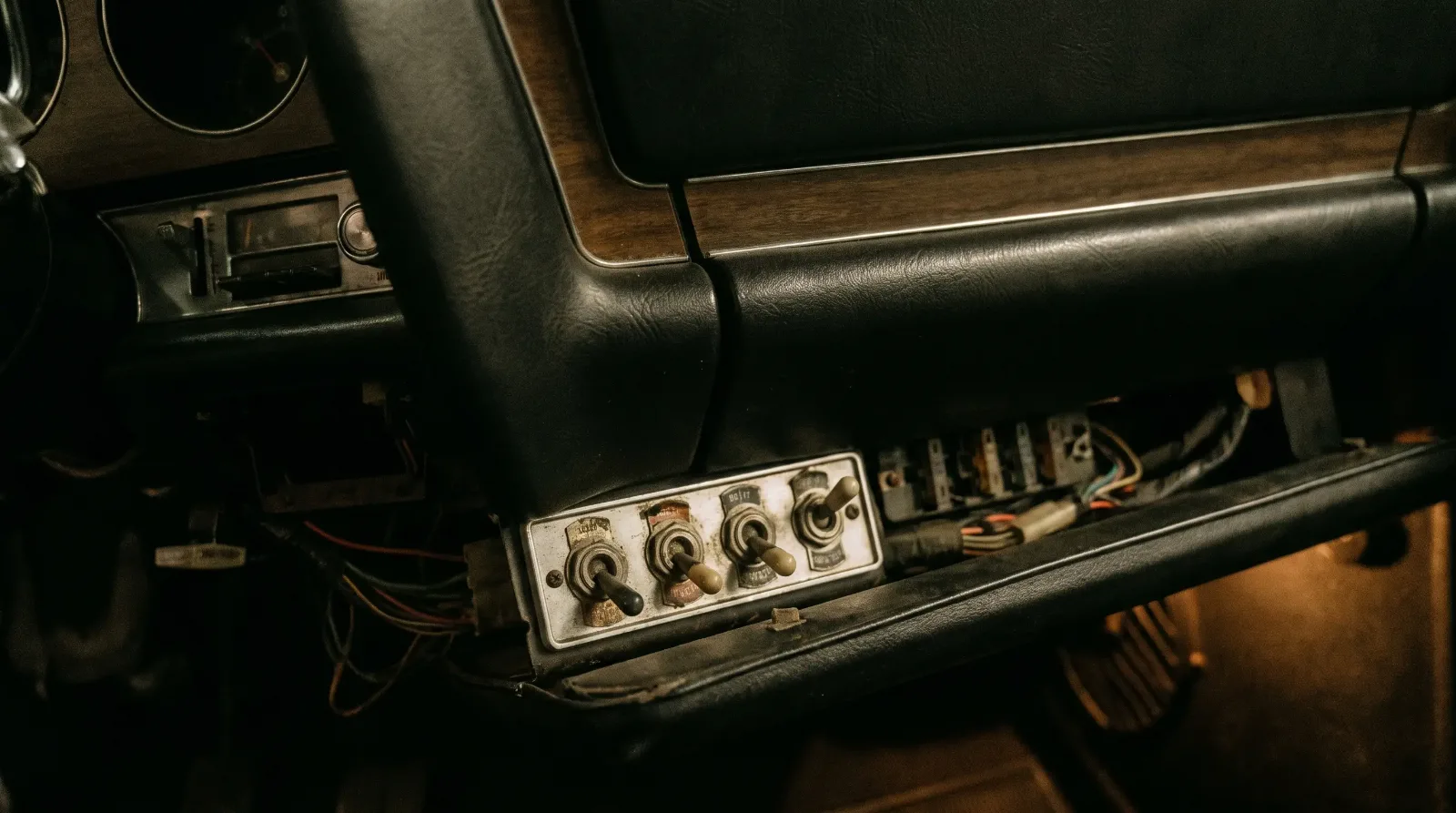
The VOE setup was a driver-controlled exhaust bypass, not an automatic system reacting to throttle position on its own. Pull a lever mounted under the dash, marked "exhaust," and vacuum actuated flaps in both mufflers that opened a less restrictive path, cutting backpressure and roughly doubling the exhaust note on demand. Leave the lever alone and the car ran through the stock, quieter exhaust routing. That's the whole idea in one sentence: quiet by default, loud and freer-flowing the moment you reached under the dash and asked for it. It's a crude, mechanical ancestor of the driver-selectable exhaust modes that show up on modern performance cars with electronically controlled valves, except Pontiac built this one with a vacuum diaphragm, dash lever, and mechanical linkage in 1970.
One detail that trips people up: this wasn't a Ram Air option. The radical cam profile in the Ram Air III and Ram Air IV engines didn't generate enough manifold vacuum to reliably actuate the system, so VOE was paired with the base 400 running 350 hp, and possibly the 455, not the high-output Ram Air motors most people associate with a hot 1970 GTO.
I look at systems like this the way I look at every piece of hardware that claims to add performance: what does the number actually say. A restricted exhaust costs you power, full stop. Every engine builder knows this. Backpressure past a certain point chokes an engine's ability to scavenge cylinders on the exhaust stroke, and horsepower drops as a direct result. So the question with VOE isn't whether the concept made sense on paper, it clearly did. The question is how much it actually moved the needle in real-world use, and that's where things get murkier than the marketing copy from 1970 would have you believe.
| Lever position | Valve position | Effect |
|---|---|---|
| Off (default) | Restricted, stock routing | Quieter exhaust note, standard flow |
| Pulled / engaged | Open bypass | Reduced backpressure, roughly double the exhaust volume |
Why it only lasted one year
Here's the part that matters more than the engineering. VOE was offered for about three months, November 1969 through January 1970, and only around 233 GTOs were built with it, 212 hardtop coupes and 21 convertibles. It didn't get killed by a slow rollout into 1971 emissions rules. It got killed almost overnight, on direct orders from GM's upper management, after Pontiac ran a television commercial nicknamed "The Humbler" that leaned hard into the loud-exhaust angle and aired during Super Bowl IV on January 11, 1970. GM brass wasn't thrilled about a division advertising a driver-actuated loud-exhaust switch to a national audience in an era when automakers were already under scrutiny over noise and emissions, and both the option and the ad campaign got pulled soon after. That's the fuller story behind why this piece of hardware only shows up on a small handful of very early 1970 GTOs.
I've had guys ask me if VOE was worth real horsepower, and my honest answer is that I haven't seen a controlled back-to-back dyno comparison of a 1970 GTO with the system engaged versus disabled that I'd trust enough to print a number from. Most of what circulates online about a specific horsepower gain is estimation dressed up as data, so I'm not going to repeat a figure I can't stand behind. What I can tell you with confidence is the mechanism itself: reduced backpressure under load is a real, measurable performance lever on any engine, and Pontiac's engineers weren't inventing a benefit that didn't exist. They were solving a real problem. Whether the specific vacuum-actuated implementation on the 1970 GTO delivered a number worth bragging about is a separate question from whether the underlying physics were sound.
Where this fits in Pontiac's bigger engineering playbook
Pontiac wasn't a stranger to clever, complicated hardware in this era. The division had a habit of chasing small mechanical advantages through hardware nobody else in Detroit was bothering with, and VOE fits that pattern. Think about it in the context of everything else Pontiac was doing under the hood in 1970: functional hood scoops with vacuum-operated flaps that opened under hard acceleration to feed cold air directly into the carburetor, ram air induction systems that used the car's own forward motion as a supercharging effect of sorts, and now a driver-actuated exhaust bypass working the opposite end of the same engine. All of it shares a philosophy. Use manifold vacuum, a resource the engine already generates for free, to actuate a mechanical advantage on demand. That's smart, efficient engineering thinking even if any single piece of it turns out to deliver a modest real-world gain rather than a dramatic one, and it's part of why VOE still made national headlines through the commercial built around it, even after GM shut the option down.
The problem, and this is true of most one-year-only hardware from any manufacturer in any era, is that clever engineering doesn't automatically translate into a system worth the added manufacturing cost and warranty risk once a company is under pressure to simplify. I've watched plenty of niche performance hardware get value-engineered out of a lineup not because it didn't work, but because a bean counter somewhere ran the numbers on cost-per-unit against the marginal performance benefit and decided the juice wasn't worth the squeeze. VOE reads to me like exactly that kind of casualty. It's a legitimate piece of engineering that got caught in a broader cost and complexity crunch right as Pontiac was reorganizing its whole approach to performance for the emissions era ahead.
Finding and diagnosing a VOE system today
If you're working on a 1970 GTO restoration and you're trying to figure out whether your car should have this system, the honest answer is that with roughly 233 cars built with it, the odds are against you. It was tied to the base 400 engine, and possibly the 455, built in that narrow November 1969 to January 1970 window, not the Ram Air III or IV cars most restorers chase. If you're evaluating a car that's claimed to have it, verify against documentation before you assume the dash lever, vacuum actuator, and linkage are correct rather than added later.
🔧 Inspection Priorities
- Confirm actual fitment for your specific engine and build. VOE was a rare, narrow-window option on base 400 and possibly 455 cars, not a Ram Air feature; verify against your car's documented build.
- Check vacuum line integrity to the actuator. A cracked or missing vacuum line will leave the flaps stuck in one position, which changes both sound and how the engine behaves under load.
- Inspect the dash lever and linkage for function. Fifty-plus years of road grime and rust can lock these mechanisms in place; a stuck bypass isn't doing its job either direction.
"I don't care how clever a piece of hardware sounds on paper. I want to see the number on the dyno sheet before I tell a customer it's worth chasing down a fifty-year-old vacuum valve for their exhaust. Sometimes the story is more interesting than the actual horsepower gain, and that's fine, it's still worth understanding what you've got."
Dan Reeves
This little piece of hardware only makes sense in the context of the bigger engineering story happening across the peak-power years at Pontiac, when the division was throwing every trick it had at the wall before emissions regulations forced a different approach entirely. There's a whole other side of 1970 Pontiac marketing worth knowing too, including one of the more aggressive ad campaigns the division ever ran for the GTO, and the fallout from it. Read on for that story.
Sources and notes
- Fox News (Hagerty) - the Humbler, 1970 GTO's vacuum-operated exhaust
- Autoevolution - the story of the 1970 GTO Humbler that angered GM management
- Barn Finds - the Humbler, 1970 Pontiac GTO convertible
- Just A Car Guy - the GTO vacuum operated exhaust cutouts
- GTO Forum - VOE exhaust discussion thread
- Wikipedia - Pontiac GTO
Related Reading

Have a
Pontiac GTO
for Sale?
Reach thousands of serious classic car collectors across the US.
Sell It Here →
Are You a Classic Car Dealer?
List your full inventory and connect with targeted classic car buyers.
Join as a Dealer →

About the author
Dan Reeves
Performance engine builder from North Carolina's motorsports corridor, focused on swaps, forced induction and making real, repeatable power.
Related Listings - Pontiac GTO




Comments
Be the first to comment on this article.