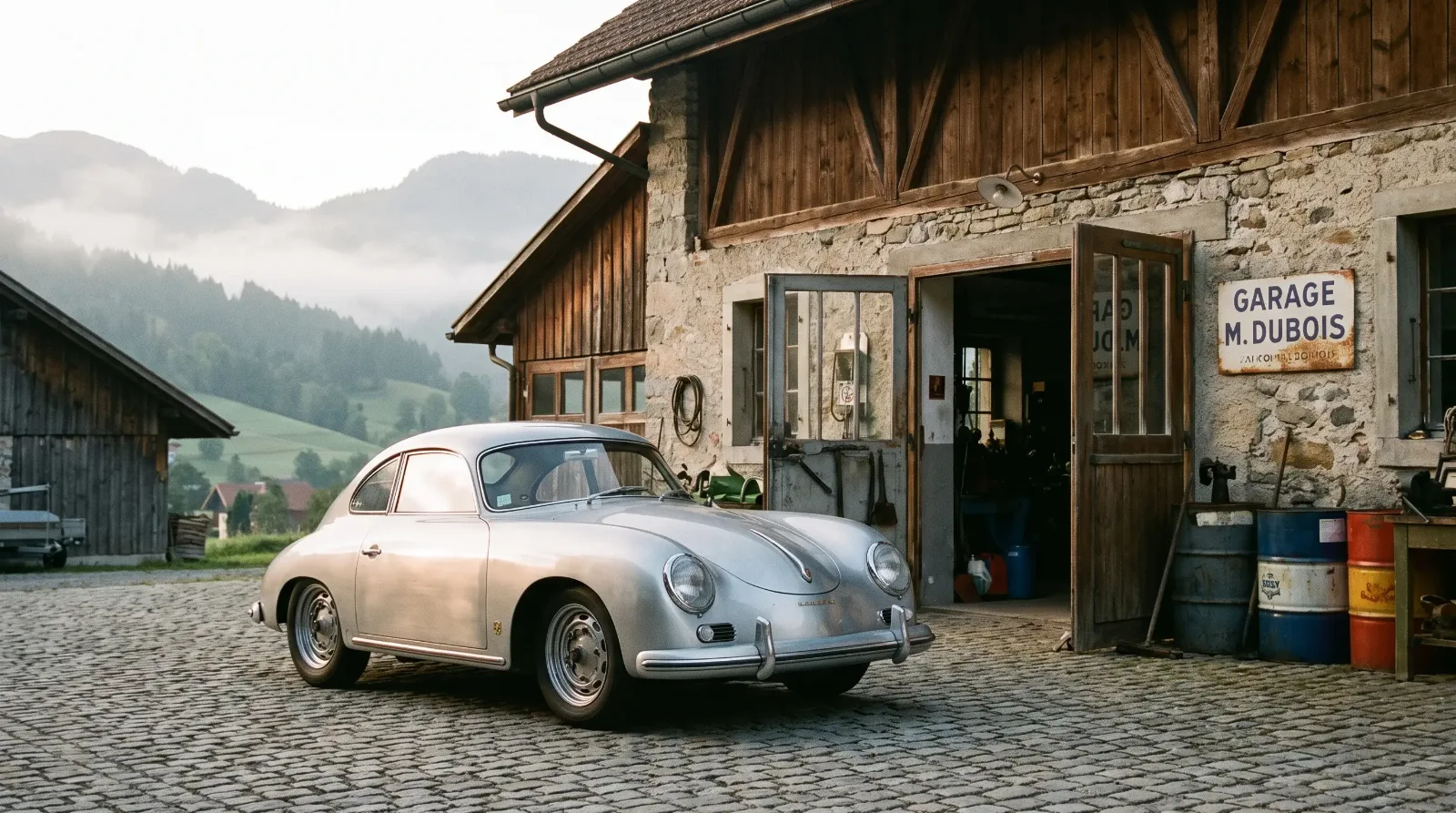
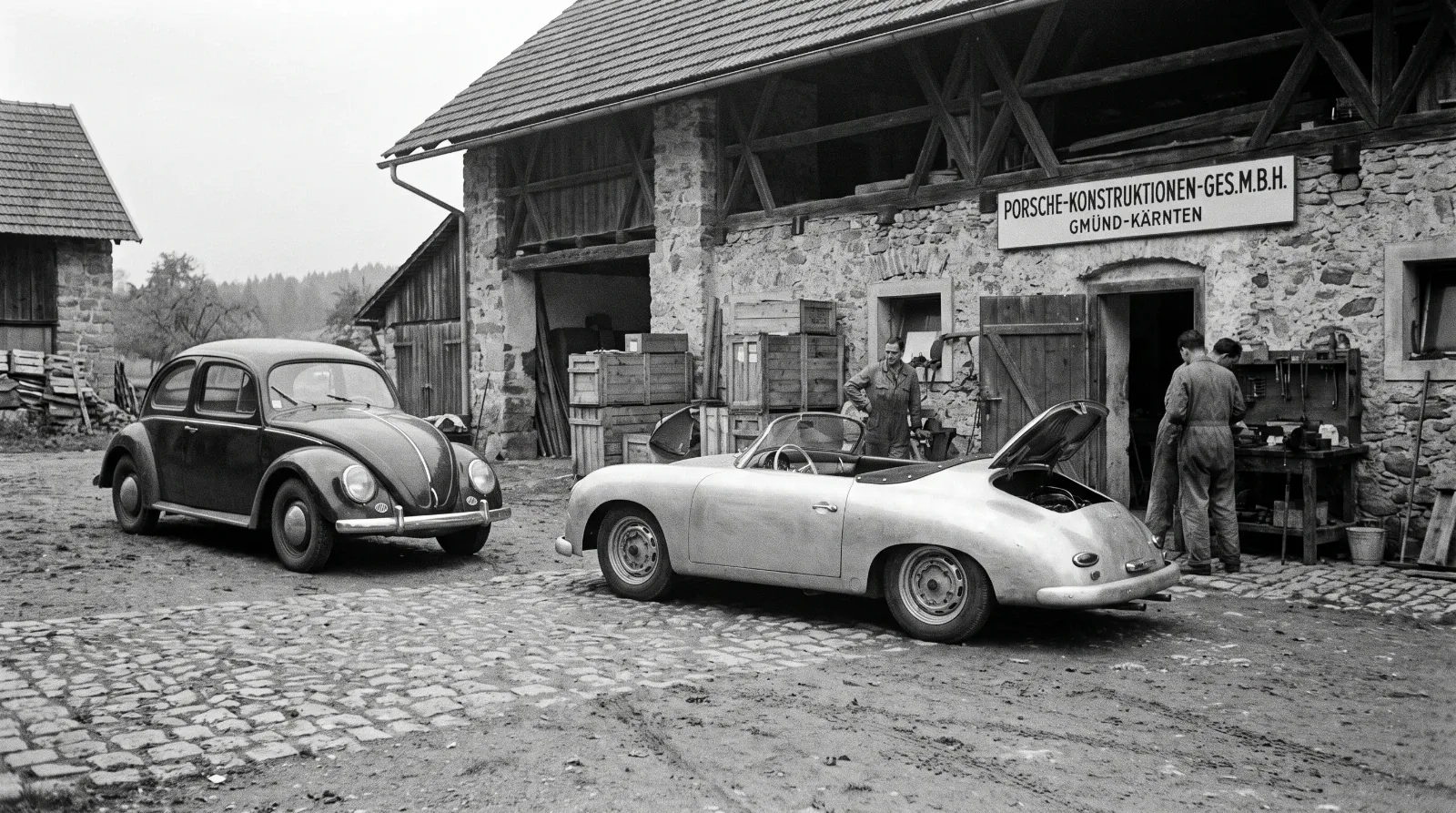
Cataloguers of early Porsche history run into an uncomfortable fact almost immediately: the Porsche 356 volkswagen beetle relationship is not a marketing footnote, it is the chassis under the car. Ferdinand Porsche designed the KdF-Wagen, the vehicle that became the Volkswagen Beetle, years before his design office turned its attention to a sports car bearing the family name. When Ferry Porsche and his small team built the first 356 prototypes at Gmund in 1948, they did not start from a blank sheet. They started from the Beetle's platform, its air-cooled flat-four engine layout, and its torsion-bar suspension, because that is what the design office had already proven and what postwar Austria could actually source. As an artifact of engineering lineage, the 356 belongs as much to the Beetle's family tree as to any independent sports-car concept, and treating that as a curiosity rather than a foundation misreads the object.
One design office, two very different briefs
Ferdinand Porsche's engineering consultancy had been developing the Volkswagen concept since the mid-1930s under commission from the German state, aiming for an affordable, durable people's car. The result, refined through prototypes and wartime production of the military Kubelwagen and Schwimmwagen variants, was an air-cooled rear-engine platform built for simplicity and low cost. By 1948, with the family firm needing a product of its own and postwar materials scarce, that same platform logic, air-cooled flat engine at the rear, torsion-bar suspension front and rear, a simple steel backbone, was the only realistic starting point for a small independent car company. The 356 prototype, chassis number 356-001, was a mid-engine roadster built largely from Volkswagen-sourced running gear. Production cars that followed moved the engine to the rear, closer to the Beetle's own layout, and used Volkswagen-derived suspension components and gearbox internals in the earliest examples.
What Porsche actually changed, and what it kept
It would be wrong to describe the 356 as a Beetle in a different suit. Porsche's engineers reworked the cylinder heads, increased compression, retuned the carburetion, and eventually developed their own engine cases as volume grew, extracting meaningfully more power from the same basic air-cooled architecture. The body, built independently of Volkswagen's tooling by outside coachbuilders, gave the car a low, aerodynamic profile that owed nothing to the Beetle's upright shape. Suspension geometry was retuned for handling rather than ride comfort and load capacity. What stayed close to the Beetle, particularly in the earliest cars, was the fundamental mechanical layout: torsion bars, trailing arms, a transaxle gearbox, and the air-cooled flat-four itself. The 356 No. 1 prototype ran a mid-mounted 1,131cc version of that engine, initially rated around 25bhp before reworked valves and higher compression brought it to roughly 35bhp, and the Gmund production cars that followed carried the same 1,131cc displacement forward.
A commercial arrangement, not just a shared bloodline
The connection was contractual as well as technical. Porsche's design office had an ongoing consulting relationship with Volkswagen, and early 356 production leaned on Volkswagen's parts supply and dealer network in ways that mattered enormously to a company with almost no capital of its own in 1948 and 1949. That commercial dependence faded as Porsche's own production volume grew through the 1950s and its engineering diverged further from Volkswagen practice, but the starting point was unmistakably a shared parts bin and a shared design lineage, not a coincidence of similar ideas arrived at independently. Documenting this clearly matters for how the 356 gets read as a historical object. A car built to showcase what a lightweight air-cooled platform could do when tuned for performance rather than economy is a different kind of achievement than a car invented from nothing, and arguably a more interesting one: it says something about what Porsche's team saw in that architecture that Volkswagen's own engineers, focused on a different brief, had not pursued.
| Feature | KdF-Wagen / early Beetle | Porsche 356 (early production) |
|---|---|---|
| Engine layout | Rear-mounted, air-cooled flat-four | Rear-mounted, air-cooled flat-four (shared architecture) |
| Displacement | Approx. 1131cc (early) | 1086cc, 1131cc (early production, tuned) |
| Suspension | Torsion bar front and rear | Torsion bar front and rear, retuned for handling |
| Body construction | Volkswagen in-house tooling | Independent coachbuilders (Reutter, Karmann) |
"When you put an early 356 chassis next to a period Beetle chassis, you are not looking at two competing philosophies. You are looking at one philosophy applied to two different jobs, and the 356 is what happens when that architecture gets asked to be quick instead of just cheap and durable."
— Sarah Whitfield
The Gmund cars: where the borrowing was most visible
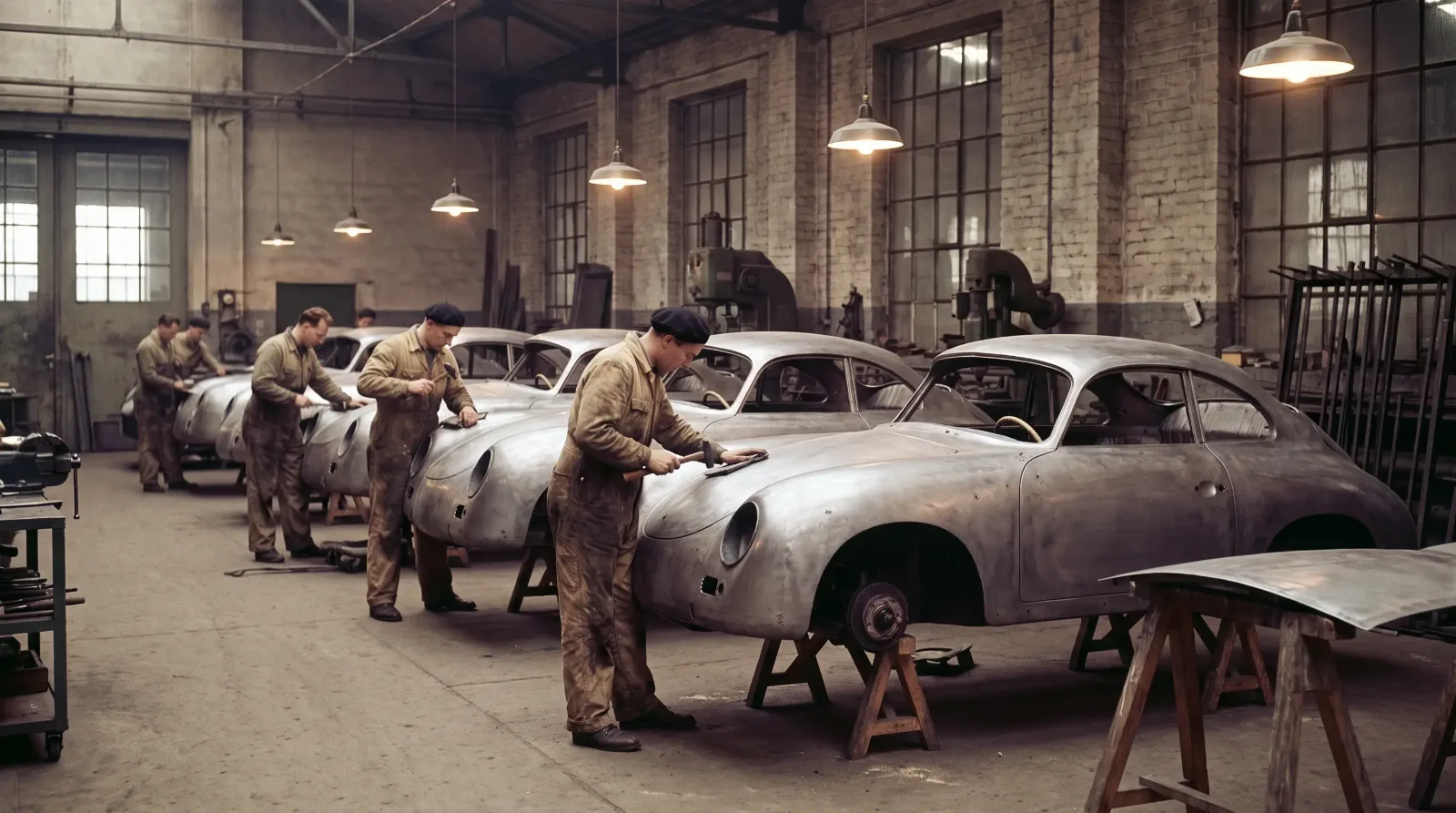
The clearest window into how much the 356 leaned on Volkswagen parts comes from the small run of aluminum-bodied cars built at Gmund, Austria, between 1948 and 1950, before Porsche moved production to Zuffenhausen. Materials were scarce, capital was scarcer, and the Gmund shop built each body largely by hand over a simple ladder-type chassis derived from the prototype. Roughly fifty of these cars were completed, and their mechanical specification leaned even more heavily on Volkswagen-sourced components than the Zuffenhausen production cars that followed, simply because there was no alternative supply chain available to a firm with no factory of its own and no meaningful line of credit. Surviving Gmund cars are treated today as the purest link between the Beetle's platform and Porsche's first independent product, and their scarcity, combined with hand-built aluminum bodywork, makes them the most valuable 356s in existence. That value is not despite the Volkswagen connection. It is partly because of it: a Gmund car is the clearest physical evidence of how Porsche's engineers took an existing, unglamorous platform and proved a sports car could be built from it with almost no independent tooling of their own.
Why this history still shapes how the 356 is judged today
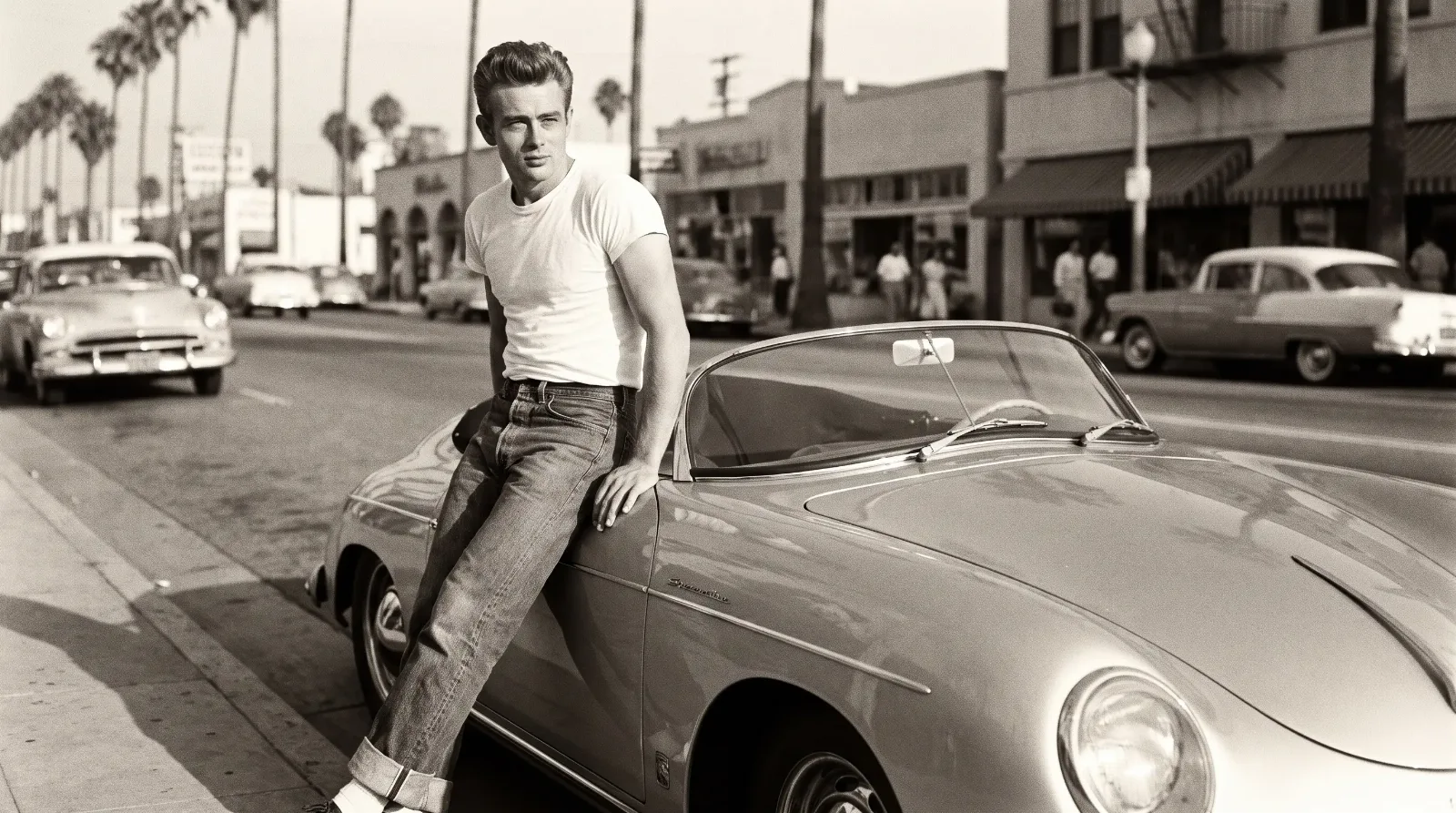
Collectors and researchers who treat the Beetle connection as a piece of trivia miss the point of studying provenance at all. It explains why the earliest 356s feel mechanically familiar to anyone who has driven a period Volkswagen, and why the divergence, more power, sharper handling, purpose-built coachwork, reads as a genuine engineering achievement rather than a simple badge exercise. This is the same throughline explored in the 356 story, which traces how a small, undercapitalized firm turned a shared parts bin into an independent identity within a decade. For readers tracing this lineage forward into the culture the 356 eventually created, including the people who made the car famous well beyond engineering circles, more from this chapter picks up that thread directly.