
The Porsche 356 Gmünd cars are the least seen and most argued-over chapter of the model's early history. Before Zuffenhausen, before the coupes rolled off anything resembling an assembly line, a small crew of engineers and panel beaters built the first 356s by hand in a converted sawmill in the Austrian town of Gmünd. Fewer than sixty of these cars exist in any documented form, and no two are quite identical. That inconsistency is not a flaw. It is the record of a company that had no factory, no tooling budget, and no choice but to improvise.
Car Features
7 min read
The Gmünd 356: Hand-Built Beginnings in Austria
Before Zuffenhausen, the first Porsche 356s were hand-built with aluminum bodies in a converted Austrian sawmill. Here is what survives of that fragile, two-year chapter.
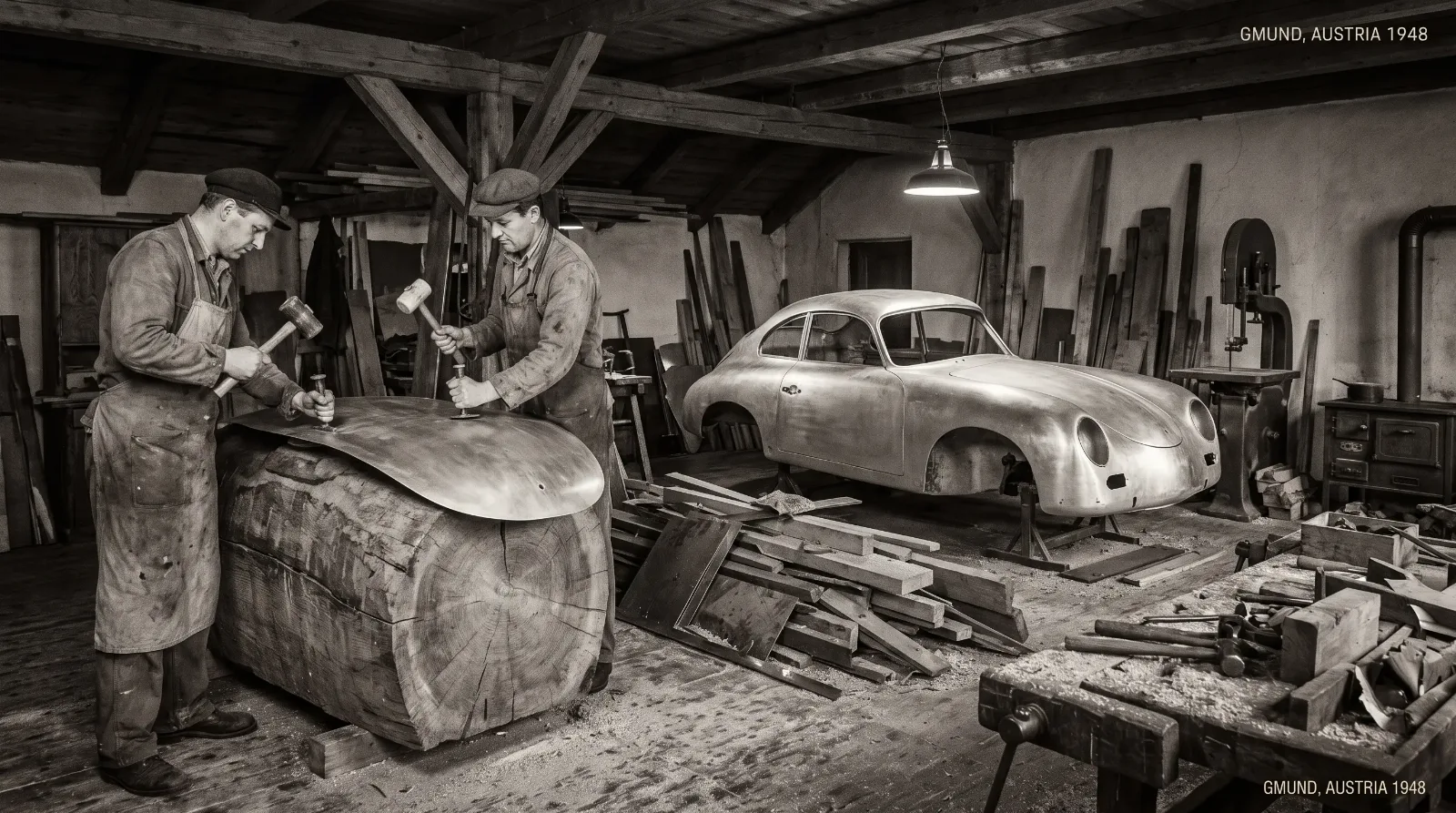
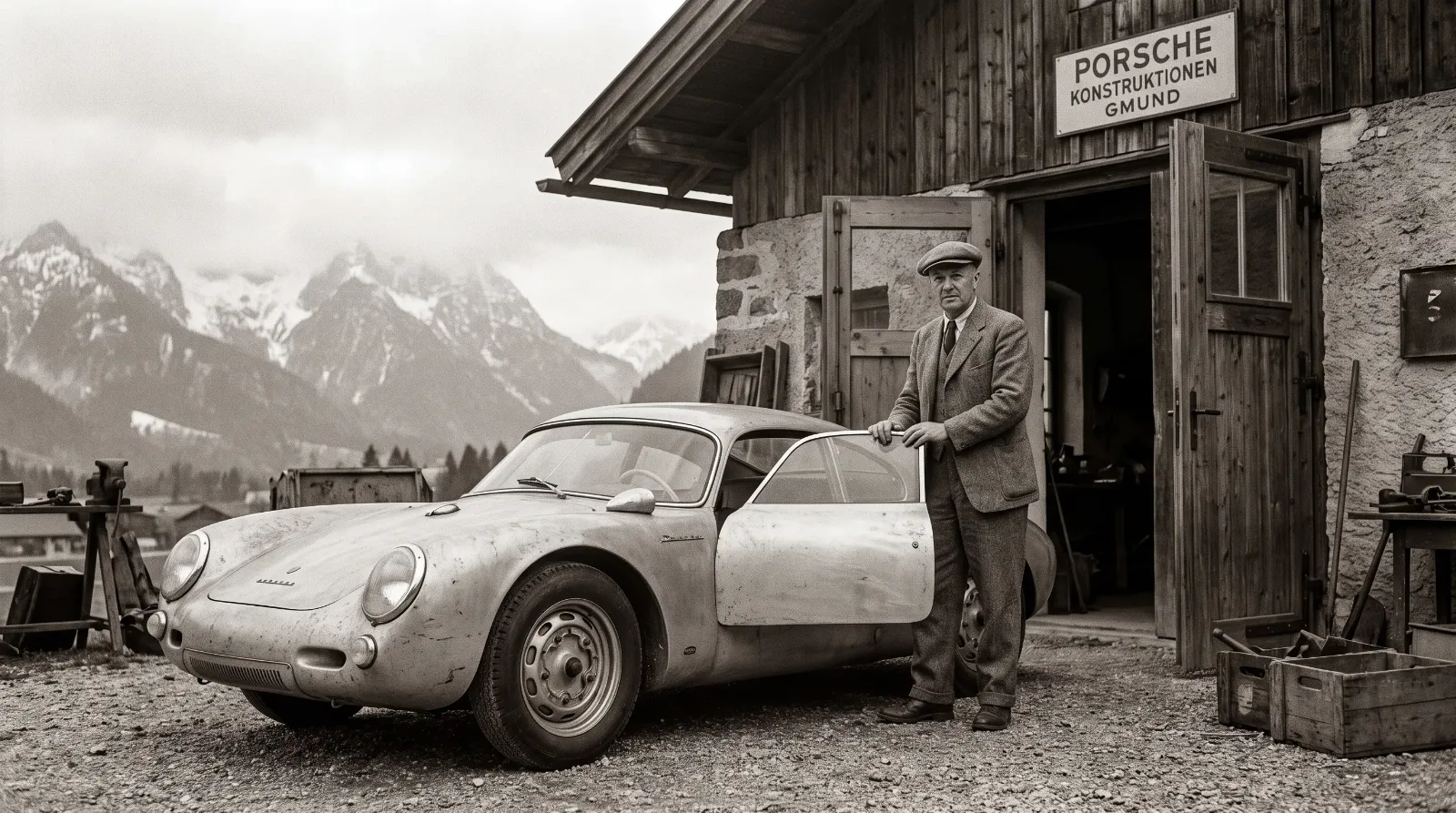
Ferry Porsche's design office had relocated to Gmünd during the war years, away from the bombing raids on Stuttgart, and it stayed there through the difficult postwar period when Germany's automotive industry was effectively frozen. The site was modest: a former sawmill repurposed for engineering work, with no stamping presses and no supplier network to draw on. Whatever the team needed, it built or sourced from what was locally available, largely Volkswagen parts scavenged and adapted under license arrangements that were still being negotiated with the occupying authorities.
A sawmill in Carinthia
Gmünd sits in Carinthia, in the south of Austria, a region chosen more for wartime safety than industrial convenience. By the time Ferry Porsche and his small design team turned their attention to building a car under the Porsche name rather than simply consulting for others, the facility was already years old and never intended for volume production. The workshop had a handful of skilled machinists, a paint booth improvised from what materials were on hand, and a workforce that measured output in single digits per month rather than per day.
This was not a company hiding its limitations. Sarah Whitfield has spent enough time with surviving build sheets and chassis logs to say plainly that the Gmünd operation reads more like a coachbuilder's atelier than a car manufacturer, and that comparison is deliberate. The methods used, hand-formed aluminum over a tube or ladder frame, English wheel work, hammer-and-dolly finishing, are the same techniques period coachbuilders like Reutter and Gläser used on one-off bodies for other marques. Porsche simply had no other option available to it in 1948.
The No. 1 prototype and its mid-engine layout
The car that started it all, chassis 356-001, was completed in June 1948 and differed from every 356 that followed it in one significant way: the engine sat ahead of the rear axle rather than behind it, in a mid-engine configuration borrowed conceptually from Porsche's prewar racing work. That layout never reached production. By the time the Gmünd cars entered anything resembling series construction, Porsche had settled on the rear-engine layout that would define the model for its entire run, using a VW-derived flat-four displacing roughly 1.1 liters and producing somewhere in the neighborhood of 35 to 40 hp.
The distinction matters to anyone researching the car's lineage because No. 1 is frequently, and incorrectly, described as representative of the early production cars. It was not. It was a proof of concept, built to demonstrate that a lightweight sports car built around Volkswagen mechanicals could work, and it did its job convincingly enough that Ferry Porsche committed the company's limited resources to building more.
Hand-formed aluminum: building without a factory
Production Gmünd cars used aluminum bodywork, a material choice driven as much by necessity as design intent. Steel was scarce and rationed in postwar Austria, while aluminum, thanks to the region's wartime aircraft industry, was comparatively easier to source. The panels were shaped by hand over wooden or plaster bucks, a slow and skilled process that meant each car carries slightly different panel gaps, slightly different curvature, and in some cases visibly different proportions from its siblings.
Erwin Komenda, who had already shaped several prewar Porsche-designed cars, drew the body lines that would carry through into the Zuffenhausen production 356. But drawing a shape and hand-forming it in aluminum without stamping dies are very different disciplines, and the Gmünd cars show the seams of that gap between design intent and workshop execution. Collectors who have handled original Gmünd bodywork describe a thinness and lightness to the panels that later steel-bodied cars never replicated, along with a rivet and seam pattern that varies from car to car in ways no factory production line would tolerate.
From Gmünd to Zuffenhausen
The move back to Germany came in 1950, once Porsche secured space at the former Reutter coachworks in Zuffenhausen, a facility with actual production tooling and a supply chain that Gmünd could never offer. The switch to steel bodywork and proper stamped panels marked the real beginning of the 356 as a production car rather than a hand-built curiosity, and it is the point where the 356 chapter most people know actually starts to look like a factory story rather than a workshop one.
That transition also explains why Gmünd cars occupy such a specific place in Porsche history today. They are not simply early 356s. They are artifacts of a company operating under conditions no automaker would tolerate today, built by people who treated each car as an individual object rather than a unit on a line. The aluminum body, the mixed parts sourcing, the visible hand-finishing, all of it points to a production philosophy closer to prewar coachbuilding than postwar manufacturing.
| Detail | Gmünd era (1948 to 1950) |
|---|---|
| Body material | Hand-formed aluminum |
| Engine layout | No. 1 prototype: mid-engine; production cars: rear-engine |
| Engine source | Volkswagen-derived flat-four |
| Approximate output | 35 to 40 hp, displacement near 1.1 liters |
| Estimated total built | 52 cars (44 coupes, 8 cabriolets) |
| Production location | Gmünd, Carinthia, Austria |
Why the Gmünd cars command a different kind of attention today
Surviving Gmünd 356s rarely go through a conventional sale process. Most are known individually, tracked by chassis number through decades of ownership, and treated by their custodians less as usable sports cars and more as pieces of industrial history that happen to run. Restorations, where they occur, tend to be slow and conservative, favoring preservation of original aluminum over the kind of refinishing that would erase the hand-built character in the first place.
"What strikes me handling a Gmünd body panel isn't how crude it looks next to a Zuffenhausen steel panel. It's how deliberate the shaping is, given that whoever did it had a hammer, a wooden buck, and no safety net if they got it wrong."
Sarah Whitfield
Documentation is the deciding factor in how these cars are valued and understood. A chassis number that can be traced to an original Gmünd build sheet, however sparse, carries weight that a car with an assumed or disputed origin simply cannot match. That emphasis on paper trail over polish is consistent with how the wider 356 story gets told, and readers who want the fuller arc, from that first Austrian workshop through to the cars most people picture when they hear the model name, should keep reading the series to see how the design settled into the shape that carried Porsche for the next two decades.
The Gmünd period lasted barely two years, yet it set the template for everything that followed: a lightweight body, a rear-mounted flat-four, and a company willing to build exactly what it could manage rather than what a marketing plan demanded. That constraint, more than any single design decision, is what makes these cars worth the attention collectors and historians still give them.
Sources and notes
Related Reading
Have a
Porsche
for Sale?
Reach thousands of serious classic car collectors across the US.
Sell It Here →
Are You a Classic Car Dealer?
List your full inventory and connect with targeted classic car buyers.
Join as a Dealer →
#coachbuilt cars
#classic porsche
#porsche 356
#Porsche history
#Porsche 356 Gmund
#Austrian automotive history

About the author
Sarah Whitfield
Third-generation classic car collector specializing in pre-war American and European coachbuilt automobiles. Researcher and concours enthusiast.
Related Listings - Porsche
Comments
Be the first to comment on this article.