
Ask a Porsche 356 owner which car they have and a surprising number will answer with a letter before they answer with a year. Pre-A, A, B, or C, said almost as a shorthand for personality as much as chronology. The Porsche 356 A B C designations cover fifteen years of steady, occasionally stubborn refinement, from a car still wearing its Volkswagen ancestry openly to one that shared brake technology with contemporary racing machinery. None of it happened as a single redesign. It happened in increments, most of them small enough that period buyers barely noticed at the time.
Car Features
6 min read
Pre-A, A, B, C: The 356 Evolution
From the split-window Pre-A to the disc-braked 356 C, here is how Porsche's original sports car evolved in careful, incremental steps over fifteen years.
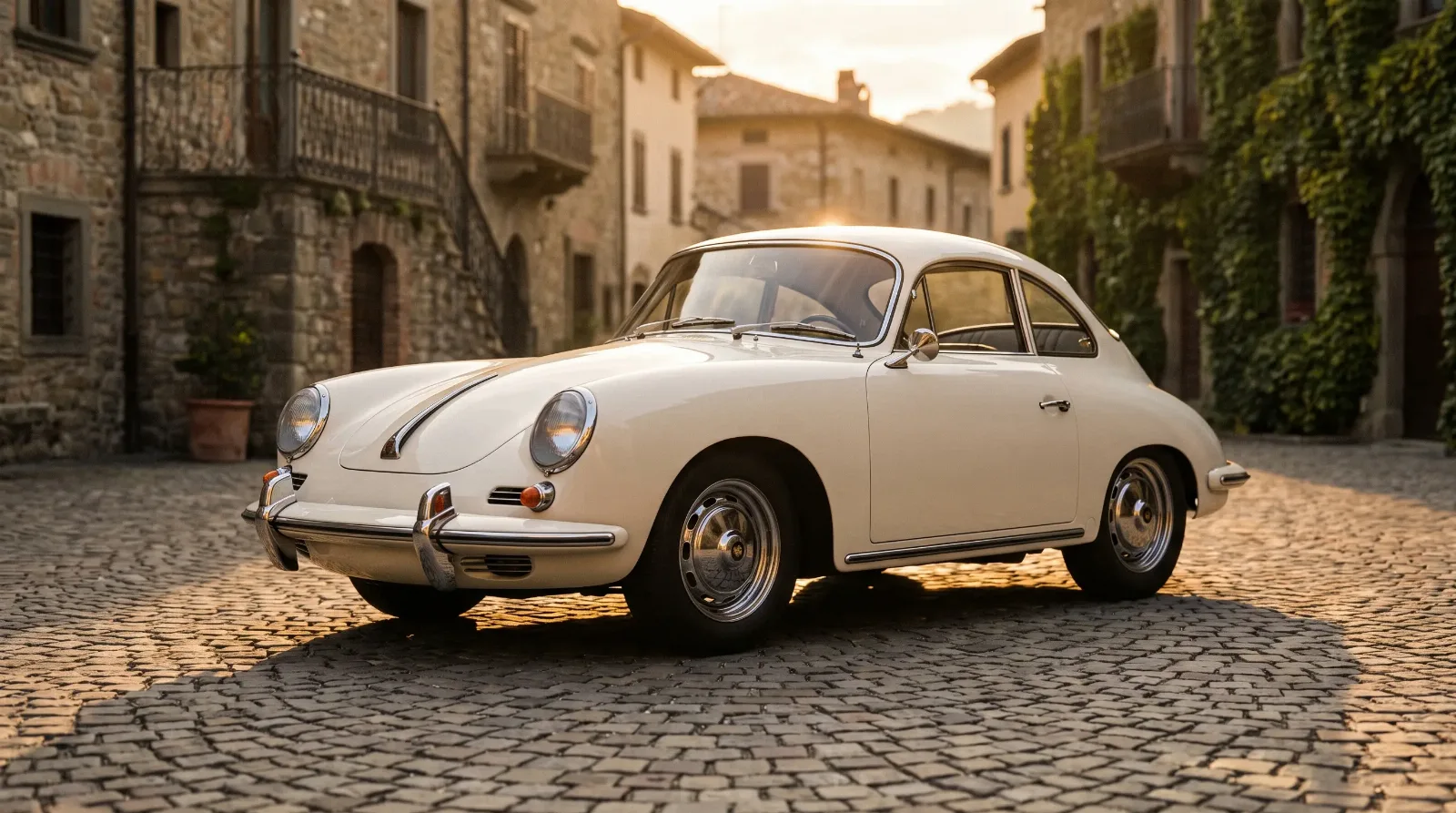
Pre-A: the split-window cars that started production
The earliest Zuffenhausen-built 356s, produced from 1950 through 1955 and generally grouped under the unofficial "Pre-A" label, are recognizable by their two-piece, split windshield, a feature carried over largely because Porsche lacked the tooling to bend a single curved pane at the scale it needed. Engines in this period grew from an original 1.1 liter unit through 1.3 liter and eventually 1.5 liter displacements, still built around the Volkswagen-derived flat-four architecture but increasingly reworked by Porsche's own engineers.
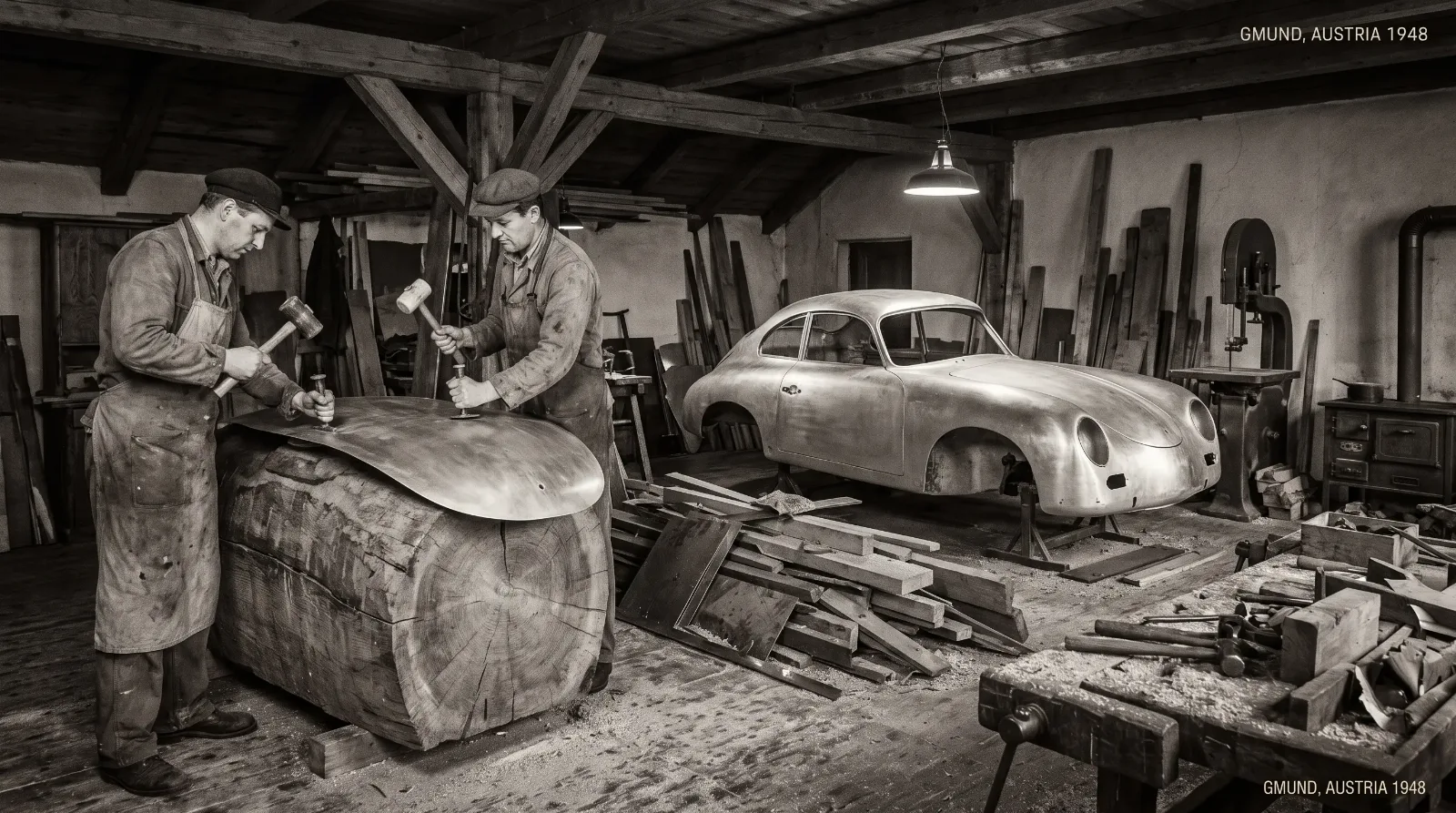
Bodies in this era came from Reutter, the coachbuilder whose Zuffenhausen facility Porsche had taken over space in after leaving Gmünd, and the fit and finish reflect a company still learning to run volume production rather than hand-build individual cars. Pre-A cars are the clearest link back to the Gmünd cars in terms of mechanical philosophy, even though the switch to steel bodywork already marked a decisive break from that earlier hand-formed aluminum period.
356 A: the curved windshield and the first real Carrera engine
The 356 A arrived in 1955 with a one-piece, curved windshield, the most visually obvious change of the entire model run and one that owners at the time actually noticed. Underneath, the platform picked up a wider track, a slightly softened ride, and by 1957 the option of a genuinely different engine: the four-cam unit developed for the Carrera GS, an engine with roller bearings and dry-sump lubrication that had almost nothing in common with the pushrod flat-four fitted to standard cars.
Most 356 A cars sold with the ordinary pushrod engine, now displacing 1.6 liters in its later form, because the four-cam Carrera option was expensive, temperamental, and demanding of maintenance most owners were not prepared to commit to. The A series is generally split by researchers into T1 and T2 body designations, reflecting minor trim and mechanical revisions partway through the run, though the changes are subtle enough that they rarely register with anyone outside serious documentation circles.
356 B: taller, safer, and less delicate to live with
By 1959 the 356 B introduced raised headlights and higher bumpers, changes driven largely by new American safety and lighting regulations that Porsche's export market could not ignore. The B series also brought the T5 and later T6 body updates, with the T6 adding a larger rear window and, on some variants, an external decklid release that earlier cars lacked entirely.
Mechanically the B series carried forward the 1.6 liter pushrod engine in various states of tune, alongside a notchback coupe body style that gave the range its first genuine variation from the familiar fastback silhouette. None of this reads as dramatic today, but for a company still selling a fundamentally 1948 concept into the early 1960s, each revision mattered to keeping the car saleable against newer competition.
356 C: the last of the line and the most capable to drive
The final iteration, the 356 C, ran from 1963 to 1965 and is generally regarded by researchers and long-time owners as the most complete version of the original concept. Disc brakes became standard across the range, a genuine improvement over the drum brakes every earlier 356 relied on, and the top-spec SC engine pushed output to 95 hp in its most common tune. By the time production ended in 1965, the 356 C had been in showrooms alongside its eventual successor, the 911, for nearly two years, and Porsche allowed the older car to close out its run rather than cutting it off abruptly.
| Generation | Years | Key identifying feature |
|---|---|---|
| Pre-A | 1950 to 1955 | Split, two-piece windshield |
| 356 A | 1955 to 1959 | Curved one-piece windshield; optional four-cam Carrera engine from 1957 |
| 356 B | 1959 to 1963 | Raised headlights, higher bumpers, T5/T6 body updates |
| 356 C | 1963 to 1965 | Standard disc brakes, top SC engine tune |
Reading the letters correctly when you are looking at a real car
None of these designations were painted on the car at the factory the way a model year is stamped today. Pre-A, A, B, and C are researcher and enthusiast shorthand applied after the fact to describe genuine engineering distinctions, which is exactly why getting them right matters when documenting a specific chassis. A car's engine number, body number, and equipment list together tell a more reliable story than its general appearance alone, particularly once you account for how many 356s have been re-engined or had panels replaced over sixty-plus years of ownership.
"The letter tells you roughly when the car left the factory. It does not tell you what is actually bolted to it today. I have seen more than one 'B' with a C-spec brake conversion done decades ago, and the paperwork is the only thing that sorts out which is original."
Sarah Whitfield
Understanding the Pre-A through C sequence is really understanding a company incrementally solving problems it could not afford to solve all at once: tooling limitations first, then safety regulations, then braking performance, each addressed in the order Porsche's resources allowed. For the fuller context on how this fifteen-year evolution actually began, where Porsche began lays out the earliest chapter this sequence builds directly on top of, and from there it is worth following the line forward to see how the open-top variants developed alongside the coupes. Keep reading the series for that next stage of the story.
Sources and notes
Related Reading
Have a
Porsche
for Sale?
Reach thousands of serious classic car collectors across the US.
Sell It Here →
Are You a Classic Car Dealer?
List your full inventory and connect with targeted classic car buyers.
Join as a Dealer →

About the author
Sarah Whitfield
Third-generation classic car collector specializing in pre-war American and European coachbuilt automobiles. Researcher and concours enthusiast.
Related Listings - Porsche




Comments
Be the first to comment on this article.