
Down at a Porsche club meet outside Nashville a few summers back, a fellow named Carl parked his 1980 911 SC between a row of newer GT cars and just stood next to it, arms crossed, grinning like he'd won something. He had, in a way. He'd owned the car since 1994, driven it through three states' worth of winters and two engine rebuilds, and he still called it the best money he ever spent. That is the quiet reputation the Porsche 911 SC carries in enthusiast circles: not the flashiest 911, not the one that shows up on posters, but the one people actually drive, actually trust, and actually keep.
Car Features
7 min read
Porsche 911 SC: The Everyman Air-Cooled Icon
The Porsche 911 SC arrived as a stopgap while Porsche tried to retire the 911 altogether, and ended up becoming the most dependable air-cooled 911 of its era.
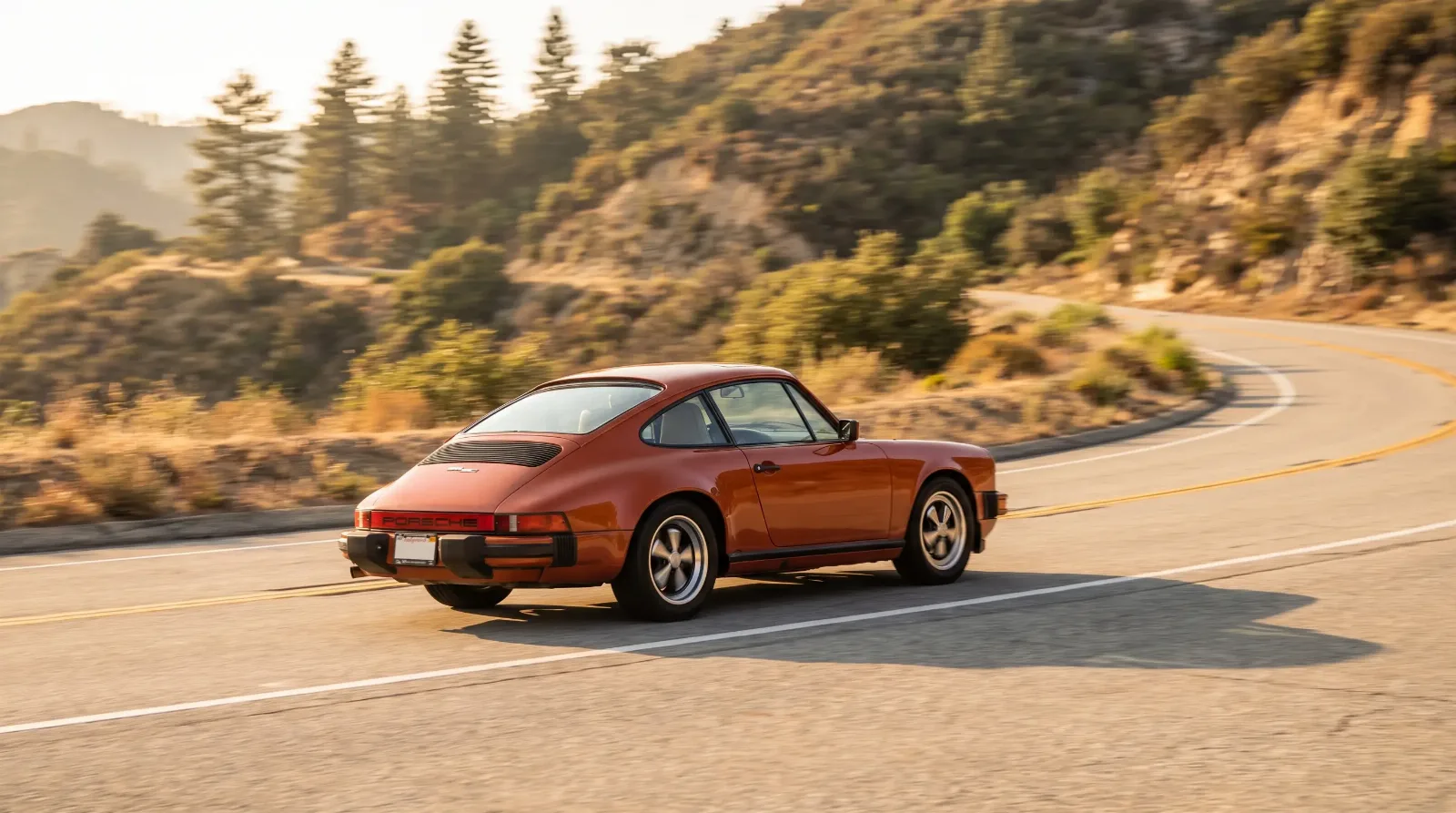
The SC came along at a strange moment for Porsche. It was 1978, and the company had just spent years telling the world the 911 was on its way out, replaced by the front-engined 928. Buyers did not agree. So Porsche kept building the car everyone actually wanted, gave it a bigger engine, called it the SC for "Super Carrera," and quietly turned it into one of the most dependable sports cars of the era.
Why the SC exists at all
By the mid-1970s, Porsche's official line was that the 911 had run its course. The 928 was supposed to be the future: a V8, a transaxle, a grand tourer for a company that wanted to grow up. Porsche even trimmed the 911 lineup down to a single model for 1978, folding the old base Carrera, the S, and the outgoing 930-adjacent trims into one car. That car was the SC.
It is worth saying plainly: the 911 SC is the car that outlived its own retirement plan. Engineers kept refining it, dealers kept selling it, and by the time the SC's run ended in 1983, it had quietly outsold every 911 variant that came before it. Porsche's own management team spent those years arguing about whether the air-cooled car had a future. The buyers had already answered.
The engine, and why it needed fixing twice
The SC arrived with a 3.0 liter flat six, up from the 2.7 liter unit in the last of the Carreras, producing around 180 hp in both early European and standard US tune, with California-emissions cars restricted to closer to 172 hp. That is not a huge number by modern standards, but the engine's character mattered more than its peak output. It pulled cleanly from low in the rev range, something the earlier high-strung Carrera engines were not always praised for, and it was built to survive daily use rather than just track days.
Early SC engines, built through about 1980, had a real weakness: the case halves were prone to cracking around the head studs, particularly in cars driven hard before a proper warm-up. Porsche revised the alloy and the case design partway through production, and cars from roughly 1981 onward are generally considered the more robust versions. Anyone shopping an early SC today should ask, specifically, whether the case has been inspected or already replaced. It is the single most consequential mechanical question in the entire ownership story.
| Model year | Engine output (approx.) | Notable change |
|---|---|---|
| 1978 | ~180 hp (Euro/US) / ~172 hp (California) | 3.0 liter engine introduced, single-trim lineup |
| 1980 | ~180-188 hp depending on market | Revised head stud and case hardware addresses early stud-cracking issue |
| 1981-1983 | ~180-204 hp depending on market | Non-US power rises to 204 hp by 1983; US cars hold at 180 hp |
The unglamorous virtue: rust protection
Here is something that rarely makes it into the romantic version of this story. Starting in 1976, Porsche began galvanizing 911 body panels, and by the SC years that protection had matured into a genuinely effective system. Cars built earlier in the 911's history rusted the way most 1970s European cars rusted, which is to say badly and often invisibly until it was too late. SC-era cars, particularly those built from 1980 onward, hold up dramatically better. That single manufacturing decision is a large part of why so many SCs have survived into daily driver condition fifty years on, while earlier 911s more often exist as restoration projects.
None of that means an SC is bulletproof. Door bottoms, floor pans near the battery tray, and the leading edge of the front trunk are all places where moisture collects and older galvanizing has occasionally been compromised by a poor prior repair. But compared to what came before, the SC represents Porsche actually learning from its own mistakes.
Driving one today, and what it actually costs
What strikes most people the first time they drive an SC is how unintimidating it is compared to its reputation. This is not the widowmaker turbo car people warn you about. The SC's power delivery is linear, the five-speed gearbox is mechanical in a way that rewards a deliberate hand, and the steering, unassisted, talks to you constantly about what the front tires are doing. It rewards smoothness over aggression, and it is entirely happy being driven to the grocery store on a Tuesday and to a mountain road on a Saturday.
Prices have moved steadily upward over the last decade as buyers who once dismissed the SC as the "affordable" air-cooled 911 came to appreciate what it actually offers. A driver-quality SC with some cosmetic wear and honest mechanical history generally lands somewhere in the mid five figures, while a well-documented, rust-free example with service records can push well past that, particularly in less common colors or with the sunroof delete option that collectors have started to chase. Prices vary enough by region and condition that anyone serious about buying should treat a specific number as a starting point for negotiation, not gospel.
"I've talked to a lot of first-time air-cooled buyers who go looking for a 930 because that's the name they know, and I always ask them the same thing: have you actually driven an SC first? Half the time that's the car they end up buying, and they don't regret it."
Patrick Walsh
Where the SC sits in the story
The SC does not get the magazine covers the way the Carrera 2.7 RS does, and it does not carry the outlaw mystique of the 930 Turbo. What it has instead is a kind of quiet completeness: a car that solved the problems of the cars before it, built the foundation for the cars that came after, and asked very little of the people who owned it in between. If you want the fuller arc of how this shape and this engine layout became one of the defining sports cars of the twentieth century, the air-cooled 911 story covers that ground from the beginning.
The SC's own successor, the Carrera 3.2, picked up almost exactly where this car left off, refining the formula rather than reinventing it. If this one has you curious about what came next, keep reading the series for the next chapter. Carl, back at that Nashville meet, would probably tell you it does not matter which one you buy first. He'd just tell you to buy one, and drive it.
Sources and notes
- Stuttcars: Porsche 911 SC (G-Series), 1978-1983
- Porsche Club of America: Model Guide, 911 SC
- RennDriver: Porsche 911 SC, the Super Carrera that saved the 911
- Klassik ATS: The 911 head stud
- Porsche Club of America: Tech Q&A, 1978 911SC purchase
- American Collectors Insurance: A guide to the Porsche 911SC
Related Reading
Have a
Porsche
for Sale?
Reach thousands of serious classic car collectors across the US.
Sell It Here →
Are You a Classic Car Dealer?
List your full inventory and connect with targeted classic car buyers.
Join as a Dealer →

About the author
Patrick Walsh
Automotive journalist covering classic car shows, events, and the enthusiast community across North America.
Related Listings - Porsche




Comments
Be the first to comment on this article.