
Somewhere in a Zuffenhausen planning meeting in 1972, a Porsche engineer had to explain to management why the company needed to build at least 500 nearly identical road cars just to go racing. That kind of arithmetic sounds backward to anyone outside motorsport, but it's exactly how the porsche 911 2.7 rs came to exist, as a homologation requirement first and a road car second, even though it ended up being remembered mostly for the second part. The car built to satisfy Group 4 racing rules turned into one of the most consequential 911s Porsche ever released, and it's worth separating from the air-cooled 911 story long enough to see exactly why.
Car Features
6 min read
The 1973 Carrera RS 2.7: The 911 That Changed Everything
Built to clear a 500-unit racing homologation rule, the porsche 911 2.7 RS became a stripped, ducktail-spoilered legend that defined every RS Porsche has built since.
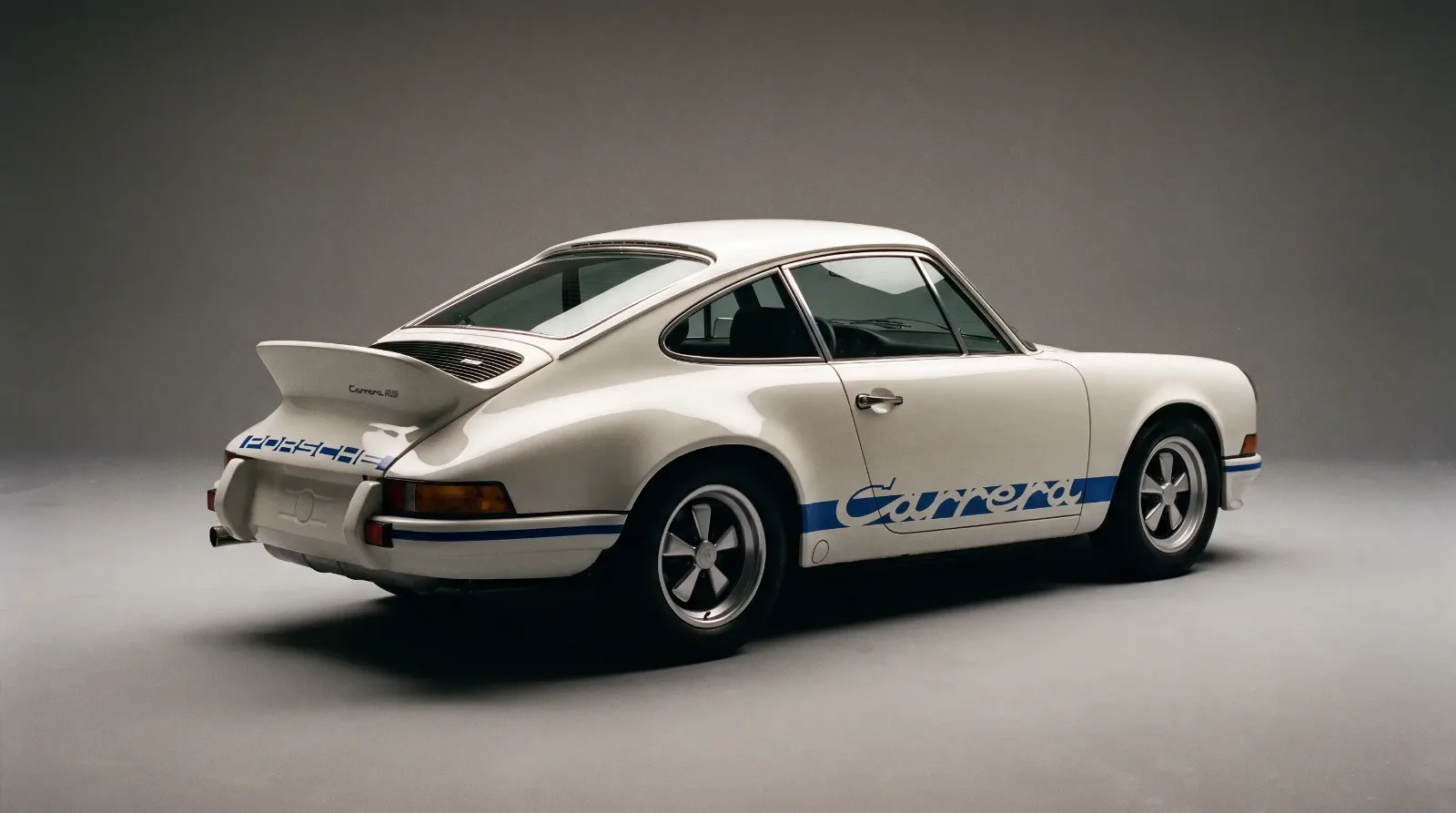
A homologation special born from a rule book
International Group 4 rules required a manufacturer to build a minimum production run before a car qualified as a genuine road car for racing purposes, and Porsche's target was 500 units. That number wasn't Porsche being generous with performance parts. It was the floor the rule book demanded before the company's competition department could legally campaign a 911-based racer built to these specifications. The plan, as far as anyone in Stuttgart expected going in, was to build just enough cars to clear that bar and move on.
What made the RS 2.7 different from a typical homologation exercise was how little Porsche compromised to hit the weight and performance targets that mattered on track. Rather than building 500 watered-down road cars with a few token upgrades, the engineering team built a genuinely stripped, lightened, quicker version of the standard car and let the road-going buyer experience nearly the same thing the race version would run.
Ducktail, decals, and losing weight everywhere else
The most visible change was the small upswept rear spoiler, nicknamed the ducktail or "Bürzel" back home, which improved rear-axle stability at speed by managing airflow over the engine deck. It looked almost like an afterthought bolted onto a road car, and that's part of why it became so recognizable. Underneath the visual signature, Porsche cut weight everywhere it reasonably could: thinner-gauge steel body panels in places, lighter bumpers, reduced sound deadening, and lighter glass on some variants, all aimed at getting the car as close to the competition weight target as a road-legal machine could get.
Porsche also grew the flat-six from the outgoing 2.4 liter unit to 2.7 liters, using a Nikasil coating on the cylinder walls to control wear at higher outputs without simply adding mass through thicker iron liners. Output landed at 210 horsepower DIN, enough to make the RS meaningfully quicker than the standard 911S it was based on, and light enough that the power advantage translated directly into the way the car actually moved.
Lightweight versus Touring, two cars wearing one badge
Porsche didn't sell the RS 2.7 as a single specification. Buyers could choose the Sport version, commonly known by its internal option code M471 and today called the Lightweight, which kept the stripped-down philosophy closest to the homologation intent with thinner glass, minimal trim, and reduced sound insulation. The alternative, coded M472 and generally referred to as the Touring, softened those choices with a more complete interior and more of the comfort equipment ordinary 911 buyers expected, aimed at customers who wanted the performance and the look without living with a stripped cabin every day.
| Version | Common name | Character |
|---|---|---|
| M471 | Sport / Lightweight | Reduced insulation and trim, closest to the homologation intent |
| M472 | Touring | Fuller interior and comfort equipment, same engine and spoiler |
The number that Porsche didn't expect to build
Porsche's original 500-unit target turned out to badly underestimate demand. Word spread quickly that this was the quickest, most focused 911 the factory had ever sold to the public, and orders kept coming well past the homologation minimum. Production ultimately ran to about 1,580 total cars, roughly 1,308 Touring examples and 200 Lightweights along with a run of RSR competition versions, a number nobody in that original planning meeting had budgeted for.
That overrun mattered beyond bragging rights. It meant the RS 2.7 wasn't a rare curiosity built strictly to satisfy a rulebook and then forgotten. It became a real, if still exclusive, model in its own right, one that buyers actively sought out rather than one racing teams merely tolerated as a paperwork requirement.
It also meant Porsche's sales and production planners had to keep adjusting supply targets mid-run, something homologation programs rarely require. Dealers who had expected to sell a handful of specialist cars to serious club racers found themselves fielding orders from customers who simply wanted the fastest, most direct 911 available that year, regardless of whether they ever intended to enter a race. That shift, from a competition tool to a genuine customer favorite, is the part of the RS 2.7's story that later RS models never had to earn from scratch. Porsche already knew there was an appetite for it.
"Porsche built the RS 2.7 to get past a rulebook, and it ended up defining what an RS badge is supposed to mean for the next fifty years. That's not marketing working backward. That's a company accidentally building its own legend while trying to satisfy a homologation clerk."
Patrick Walsh
Why the RS badge never really went away
Every subsequent Porsche RS, across generations of the 911 and beyond, traces its intent back to this car: strip weight, add just enough power, and keep the road version close enough to the track version that owners feel the connection every time they drive it. The 2.7 wasn't the first fast 911, and it wasn't even the most powerful car in Porsche's lineup by the mid-1970s once turbocharging arrived. It mattered because it proved a lighter, more focused 911 could sell in real numbers to real customers, not just to a handful of racing teams filling a paperwork quota. To see where the factory took that formula once regulations and turbocharging reshaped the lineup again, keep reading the series. And for the full arc of how Porsche got to this point in the first place, how Porsche's legend began is the place to start.
Sources and notes
- Supercars.net: Porsche 911 Carrera RS 2.7 Ultimate Guide
- RennDriver: Porsche 911 Carrera RS 2.7 history and specs
- Classic Motorsports: In 1973, Porsche built something very special
- Porsche Knowledge: Carrera 2.7 RS Touring (M472)
- StuttCars: Porsche 911 Carrera RS 2.7 Lightweight
- The Autosport Forums: Carrera RS 2.7 production archive
Related Reading
Have a
Porsche
for Sale?
Reach thousands of serious classic car collectors across the US.
Sell It Here →
Are You a Classic Car Dealer?
List your full inventory and connect with targeted classic car buyers.
Join as a Dealer →
#classic porsche
#porsche 911
#carrera rs 2.7
#air-cooled Porsche
#Porsche homologation
#ducktail spoiler

About the author
Patrick Walsh
Automotive journalist covering classic car shows, events, and the enthusiast community across North America.
Related Listings - Porsche
Comments
Be the first to comment on this article.