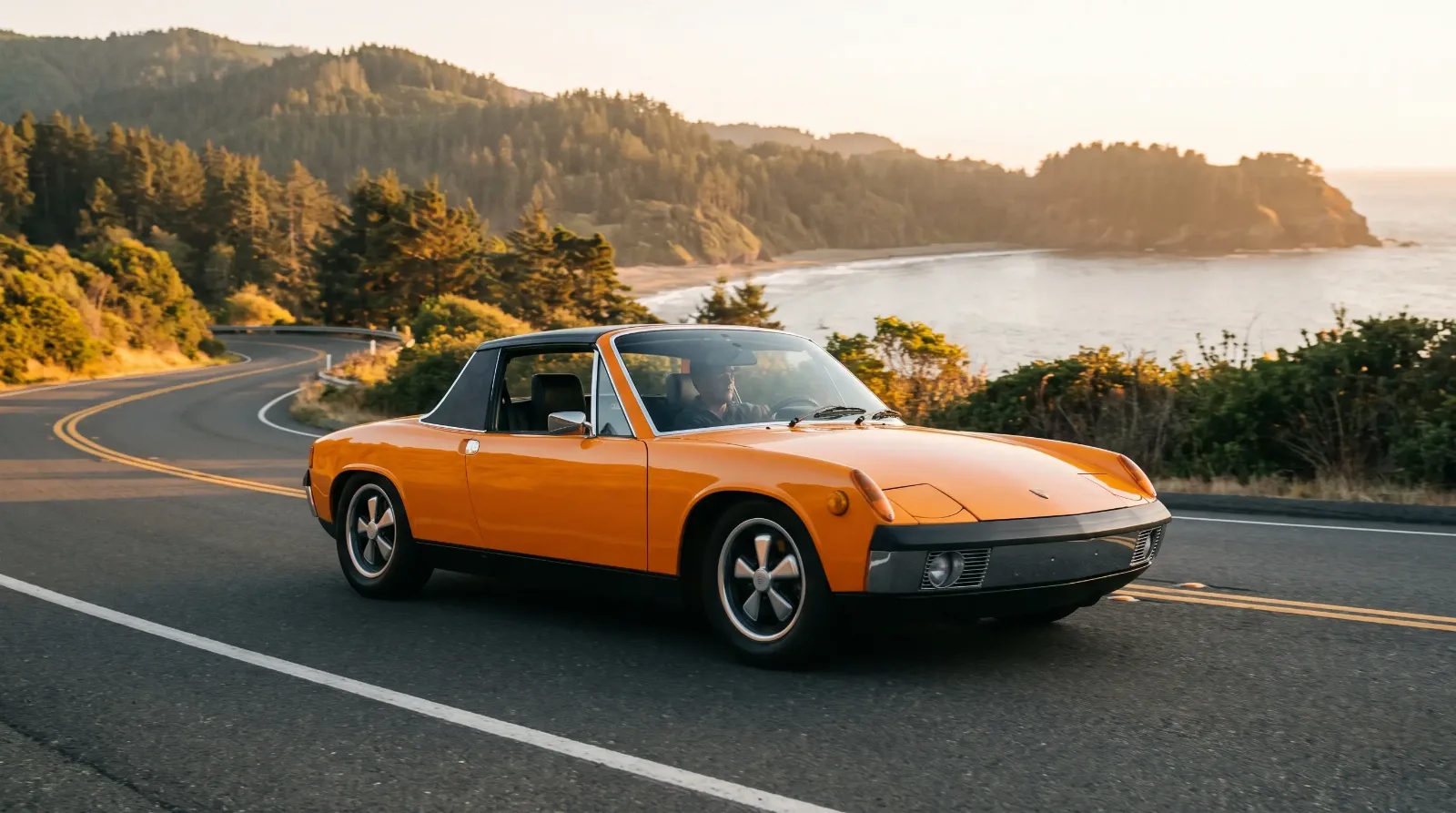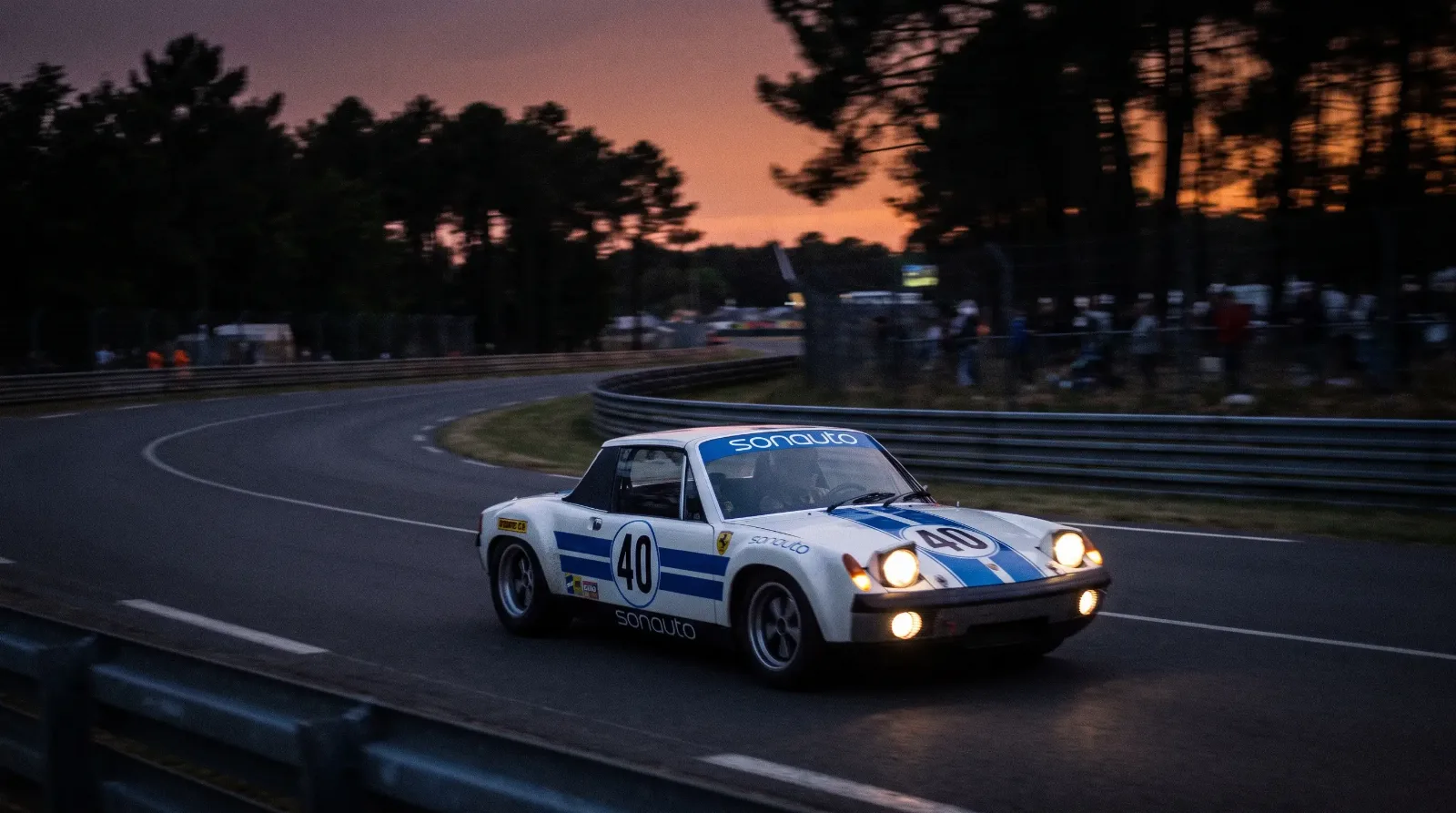
The Porsche 914's mid engine design is the single most important engineering decision in the car's story, and it is also the one most often skipped over in favor of arguing about badges and price points. Putting the engine behind the seats but ahead of the rear axle was not a styling choice. It was a weight distribution decision, and understanding it explains why the 914 drives the way it does, for better and worse, compared with the front-engine 912 it effectively replaced in the lineup.
Why mid-engine at all
A front-engine car concentrates mass over the front axle. A rear-engine car, like the contemporary 911, concentrates it behind the rear axle, which creates a well-documented tendency toward snap oversteer when a driver lifts off the throttle mid-corner. Mid-engine placement solves this by keeping the heaviest single component, the engine and transmission assembly, close to the car's center of mass rather than hanging it off either end. The result is a polar moment of inertia that is genuinely lower than either alternative, meaning the car changes direction with less resistance and more predictability at the limit.
This is not a new idea. Racing constructors had already worked out the benefits of mid-engine layout for open-wheel and sports prototype cars by the early 1960s. What made the 914 notable was bringing that layout to a mass-production road car at a price point regular buyers could afford, years before mid-engine architecture became common in anything outside the exotic segment.
The packaging problem nobody talks about
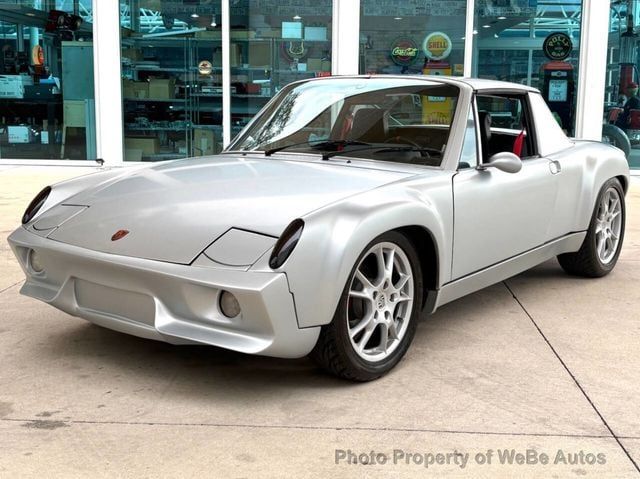
Here is the part that gets glossed over: mid-engine layout is easy to draw and hard to build cheaply. The engine has to go somewhere between the passenger compartment and the rear axle, which means it competes for space with the fuel tank, the spare wheel, and any usable luggage capacity. The 914 solved this with a flat engine, either the VW-sourced flat four or the Porsche flat six, because a flat configuration keeps the overall height low enough to sit under a reasonably sized trunk floor without forcing an awkward high beltline. In the 914 chapter, we cover how that packaging decision shaped the rest of the car's proportions, including the distinctive targa bar that also served as a structural element compensating for the lack of a conventional roof.
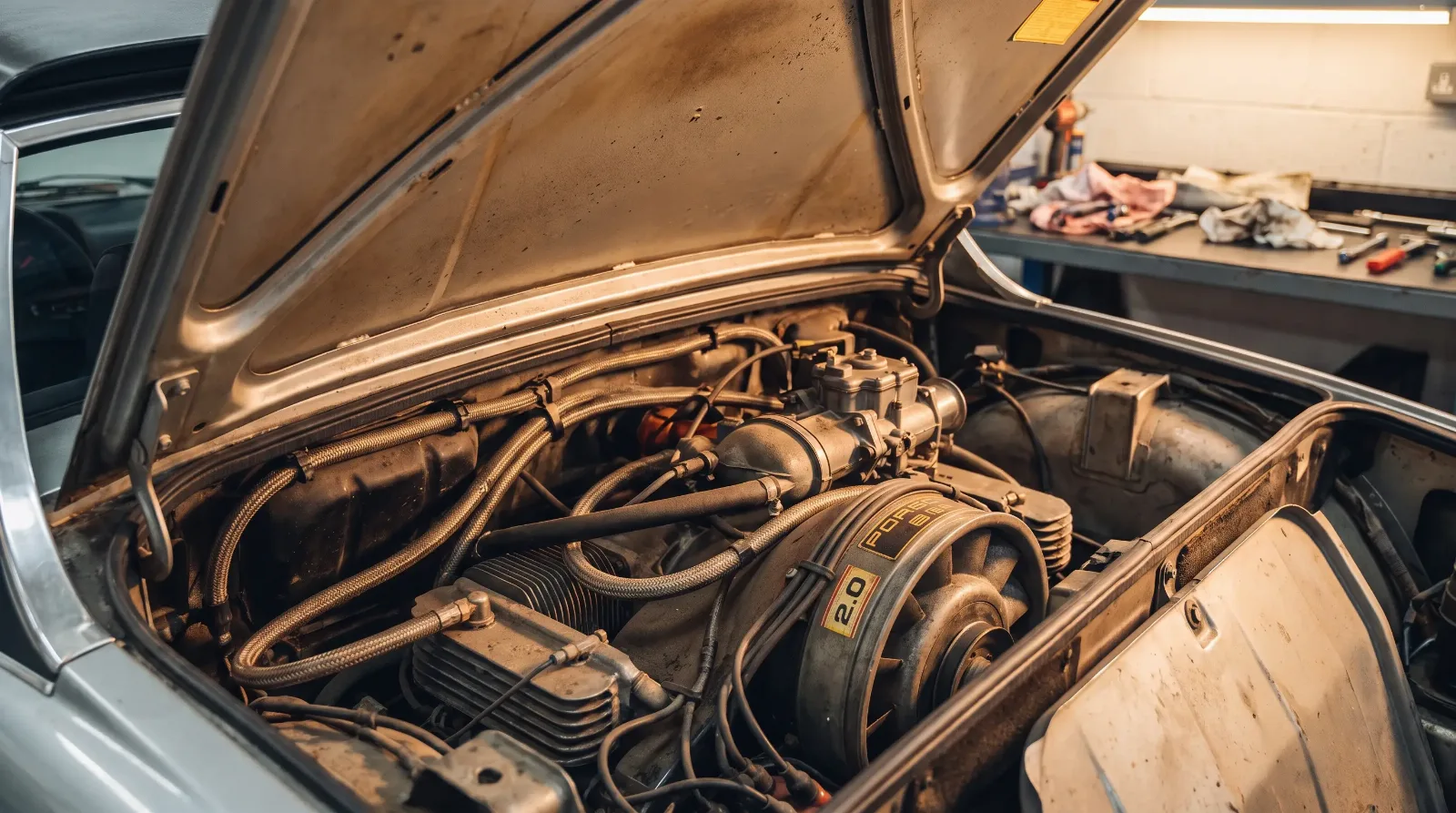
The tradeoff was serviceability. Reaching certain accessory components on the flat six variant required more disassembly than an owner working on a conventional front-engine car would expect, and that has stayed a fair criticism of the layout through to today's ownership community.
| Layout factor | Front-engine (912) | Mid-engine (914) |
|---|---|---|
| Weight distribution | Front-biased | Near even, engine central |
| Polar moment of inertia | Higher | Lower |
| Trunk space | Front trunk only | Front and rear trunk |
| Service access | Conventional | More disassembly required |
| Handling character | Predictable understeer bias | Neutral, sensitive to setup |
How it actually drives
A well-set-up 914 rotates into a corner with less drama than a 911 of the same era, because there is simply less mass swinging outside the wheelbase to fight. That neutrality cuts both ways. Drivers used to a front-engine car's built-in understeer margin sometimes find the 914 twitchy on initial turn-in, not because the chassis is unstable but because it responds honestly to inputs a less balanced car would simply absorb. Both the 914/4 and the 914/6 achieved a weight distribution close to an even 50:50 split front to rear, a figure period and modern sources agree on even though exact percentages varied slightly by trim and equipment. Get the tire pressures, alignment, and anti-roll bar settings right, and the car rewards a driver who trusts it. Get them wrong, and the same neutrality turns unforgiving.
Suspension tuning around a fixed constraint
Placing the engine mid-chassis also changed what the suspension engineers had to work with. Spring rates, anti-roll bar sizing, and damper valving all had to be calibrated around a known, fixed weight distribution rather than the more forgiving front-heavy setup that lets a chassis engineer mask small suspension errors with built-in understeer. On the 914, there was no such cushion. A softer front anti-roll bar than the chassis actually needed would show up immediately as vague turn-in, and a rear bar sized even slightly wrong would show up as snap oversteer on trailing throttle. That sensitivity is why period road tests describe the 914 as a car that rewards careful setup far more than either the 911 or the 912 did.
It also explains why aftermarket suspension tuning for the 914 developed such a devoted following decades later. Because the chassis responds so directly and predictably to changes in spring rate and bar stiffness, small adjustments produce noticeably different handling characters, which makes the car a favorite platform for owners who enjoy iterative setup work rather than a car that stays static regardless of what is bolted underneath it.
Why the layout outlasted the car
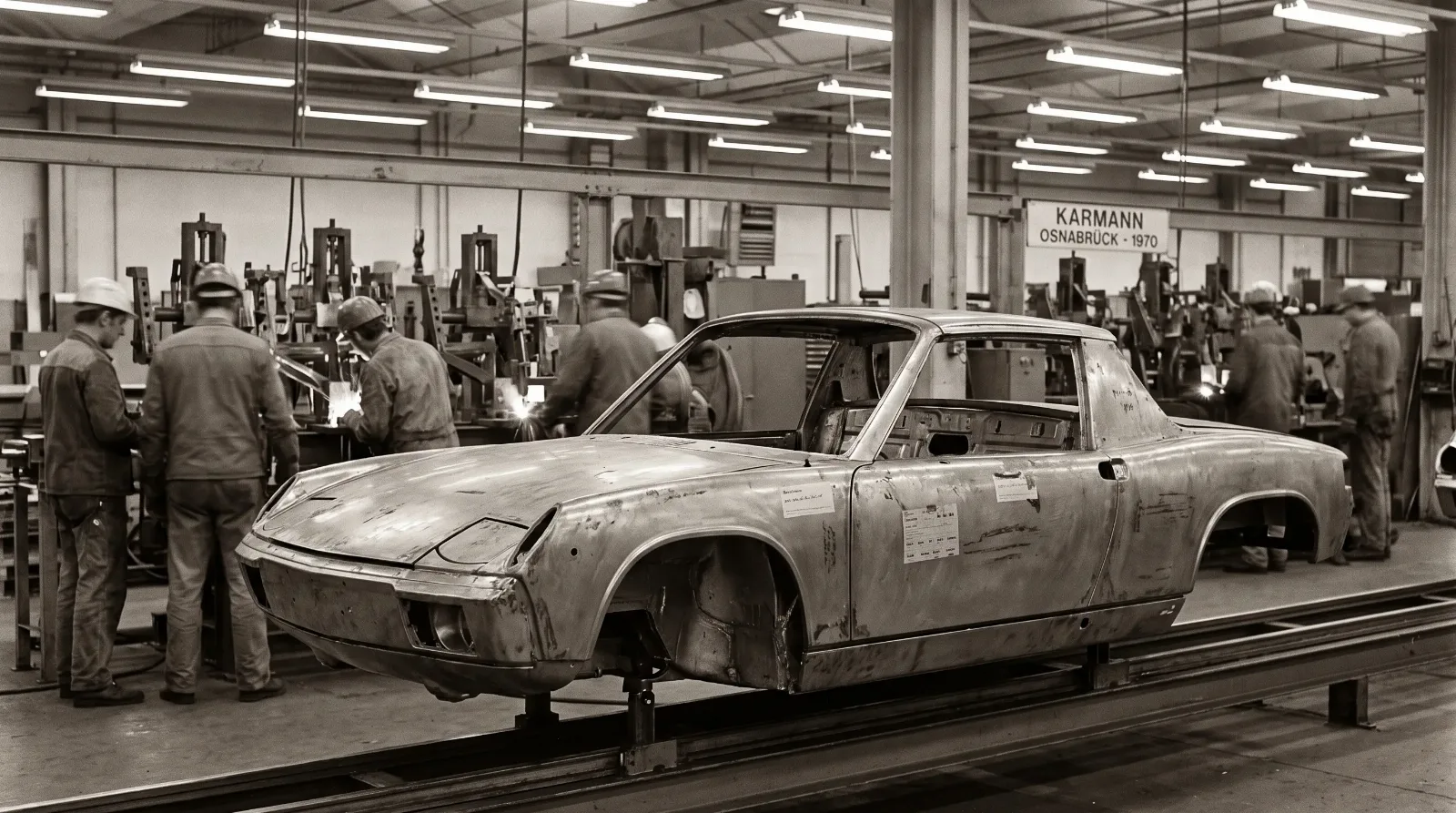
Porsche did not abandon mid-engine thinking after the 914 went out of production. The layout reappeared in later Porsche mid-engine cars because the engineering case for it never went away, only the packaging solutions improved. In more from this chapter, we get into how the body that housed this layout actually got built, which matters because the chassis engineering and the manufacturing process were never fully separable decisions. A mid-engine car only works if the body structure around it is stiff enough to make the layout's theoretical handling advantage real on the road, and that stiffness had to be engineered into the shared VW-Porsche shell from the first sketch.
"People treat the mid engine layout like it was a compromise forced by the VW partnership. It wasn't. It was the correct engineering answer to a handling problem, and Porsche knew it before the joint venture ever got signed. The 914 just happened to be the car built cheap enough to prove the point to a wider audience."
— Emily Chen
The mid engine 914 design deserves to be read on its own terms rather than as a footnote to the 911 story. It solved a real engineering problem, it did so at a price ordinary buyers could reach, and the handling case it made has outlived every argument about badges and provenance that has followed the car since.