
Pull the two latches on a Porsche 914 and the roof panel comes off in one piece, light enough to carry with one hand, small enough to slide into the bag mounted behind the seats. That is the entire ritual. No folding fabric, no hydraulic pump, no motor whining under the trunk floor. The porsche 914 targa top is a single fiberglass-reinforced panel, and the simplicity of removing it is one of the most underrated things about a car that spent decades being underrated for almost everything else.
Car Features
6 min read
Targa Freedom: The 914's Removable Roof
The porsche 914 targa top looks like a simple convenience feature, but the fixed bar behind the seats is doing real structural work that most owners never think about.
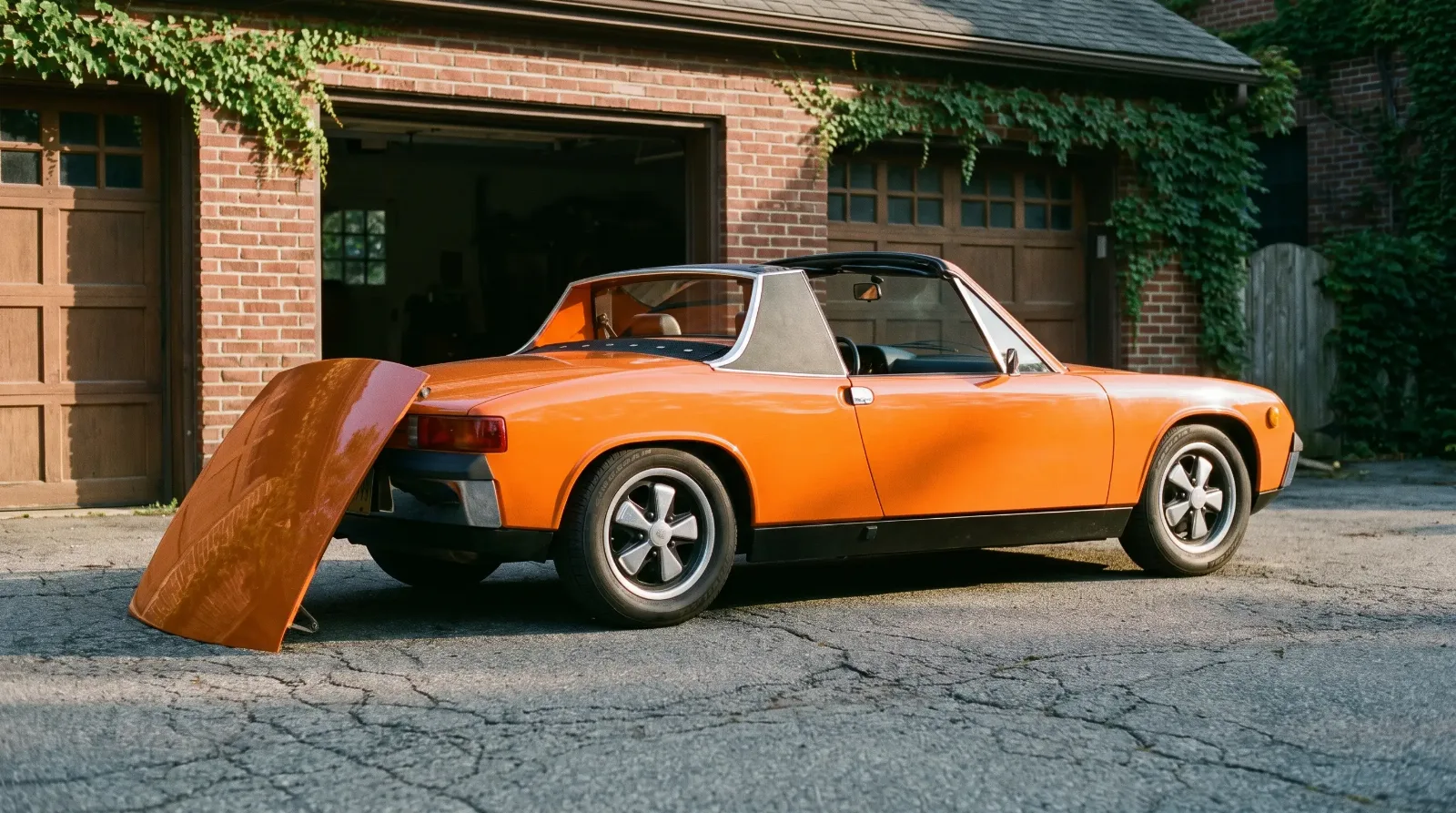
Porsche did not invent this layout for the 914. The 911 got a targa roof first, in 1967, largely in response to rumors that the United States was about to ban true convertibles over rollover safety concerns. Those rumors never became law, but Porsche kept building targa-roofed cars anyway, because the format solved a real engineering problem: how to give a mid-engine sports car open-air motoring without compromising the structural rigidity a unibody convertible loses the moment you cut the roof off entirely.
A fixed bar doing the roof's structural job
The 914's targa bar is not decoration. It is a structural hoop running behind the seats, tying the windshield frame to the rear bodywork, and it is doing work that a conventional convertible would ask of a much heavier, much more complex reinforced floor pan. Remove the roof panel and the bar stays in place, still carrying load, still protecting the cabin in a rollover. That is the entire logic of the targa format: give the driver open sky without asking the chassis to give up its spine.
On the 914 specifically, that bar also does something the 911's targa hoop does not have to worry about as much, because the 914 is mid-engine. The engine sits behind the cabin and ahead of the rear axle, and the targa bar helps manage the load path between the front structure and the rear subframe carrying that engine and transmission. Pull the roof off a 914 and you are not weakening the car's ability to keep the engine's weight properly located. You are removing a panel that was never carrying that load to begin with.
"People assume a removable roof means a compromised chassis. On the 914 it is almost the opposite. The targa bar is doing more structural work than most owners realize, and the roof panel itself was never part of that equation. Once you understand that, the whole design stops looking like a shortcut and starts looking like exactly what it is, which is a very deliberate piece of engineering."
Emily Chen
Living with the roof, day to day
The panel itself is light enough that one person lifts it off without straining anything, and it stores in a canvas or vinyl bag strapped inside the rear trunk area behind the engine. That storage location matters more than it sounds like it should. Owners who leave the bag loose, or who use a bag with worn straps, end up with a roof panel sliding around near the engine bay on rough roads, which is not a design flaw so much as a maintenance item nobody thinks about until it happens.
Weatherstripping is the other place where the targa top actually reveals its age. The rubber seals around the panel's edges and along the targa bar itself harden over decades, and a hardened seal is the single most common source of wind noise and water intrusion on an original, unrestored 914. This is not exotic knowledge. It is the same failure mode every removable-roof car eventually has, and it is also the cheapest, most satisfying fix available to a new owner, because fresh seals transform how the car feels on the highway almost immediately.
What to check before you buy one
Roof condition is worth inspecting before anything mechanical, honestly, because it tells you how the car was stored. A targa panel with a cloudy or crazed surface has likely spent real time outdoors, and that same sun exposure is doing things to interior plastics and the fiberglass body panels that a quick test drive will not reveal. Check that the panel seats flush against both the windshield header and the targa bar with the latches fully engaged. Gaps in either location usually mean the panel has warped slightly, which happens more often on cars that sat with the roof off for long stretches in direct sun.
| Check | What it tells you |
|---|---|
| Panel fit at both latch points | Warping from sun exposure or improper storage |
| Weatherstrip flexibility | Age and likely wind noise or leak points |
| Storage bag condition | Whether the panel has been secured properly in transit |
| Targa bar corrosion | Structural concern, not cosmetic, given its load-bearing role |
None of this is unique to the 914, but the car's low production numbers and long stretch as an unloved, undervalued Porsche mean a higher share of surviving examples went through years of casual ownership before anyone treated them as collectible. That history is worth understanding before you commit to a purchase, and it is a big part of what the 914 chapter in this series covers in full.
Why the layout still holds up
Modern convertibles chase silence and complexity, folding hardtops with a dozen moving parts and motors that eventually fail on a schedule nobody can predict. The 914's targa top does one thing, does it with a single panel and two latches, and asks almost nothing of the owner beyond fresh seals every so often and a dry place to store the roof when it is off. That kind of restraint reads as primitive to people comparing spec sheets. It reads as correct to anyone who has actually owned one through a few Ohio winters and a few Arizona summers, because the parts that can fail are so few that most of them simply do not.
For readers tracking the rest of this car's story, from the variants Porsche never sold in numbers to the swaps enthusiasts still argue about, it is worth continuing to keep reading the series, since the targa roof turns out to be one of the more straightforward chapters in a car whose reputation took decades to catch up with its engineering.
Sources and notes
- Porsche Newsroom: 60 Years of the Porsche 911 Targa
- Motor Authority: The Porsche 911 Targa Was Created Because the US Wanted to Ban Convertibles
- Porsche Heritage Parts Centre: Evolution of the Porsche Targa
- Stuttcars: Porsche 914 Ultimate Model Guide
- Supercars.net: Porsche 914 Ultimate Guide
- Wikipedia: Porsche 914
Related Reading
Have a
Porsche
for Sale?
Reach thousands of serious classic car collectors across the US.
Sell It Here →
Are You a Classic Car Dealer?
List your full inventory and connect with targeted classic car buyers.
Join as a Dealer →

About the author
Emily Chen
Bay Area engineer with a deep focus on vintage Japanese and European performance cars. Approaches classic car research and restoration with an analytical eye.
Related Listings - Porsche




Comments
Be the first to comment on this article.