
The Porsche 914 is usually described as a joint venture. That word does a lot of quiet work. What actually happened between 1965 and 1969 was closer to a corporate custody battle, and the car that came out the other end carried the scars of it. Understanding the porsche 914 volkswagen collaboration means understanding two companies that needed each other, resented needing each other, and built a car around that tension.
Car Features
6 min read
The VW-Porsche Politics That Nearly Sank the 914
The Porsche 914 was born from a corporate dispute between Porsche and Volkswagen, not a shared vision, and that fight shaped the car's badging, pricing, and reputation for decades.
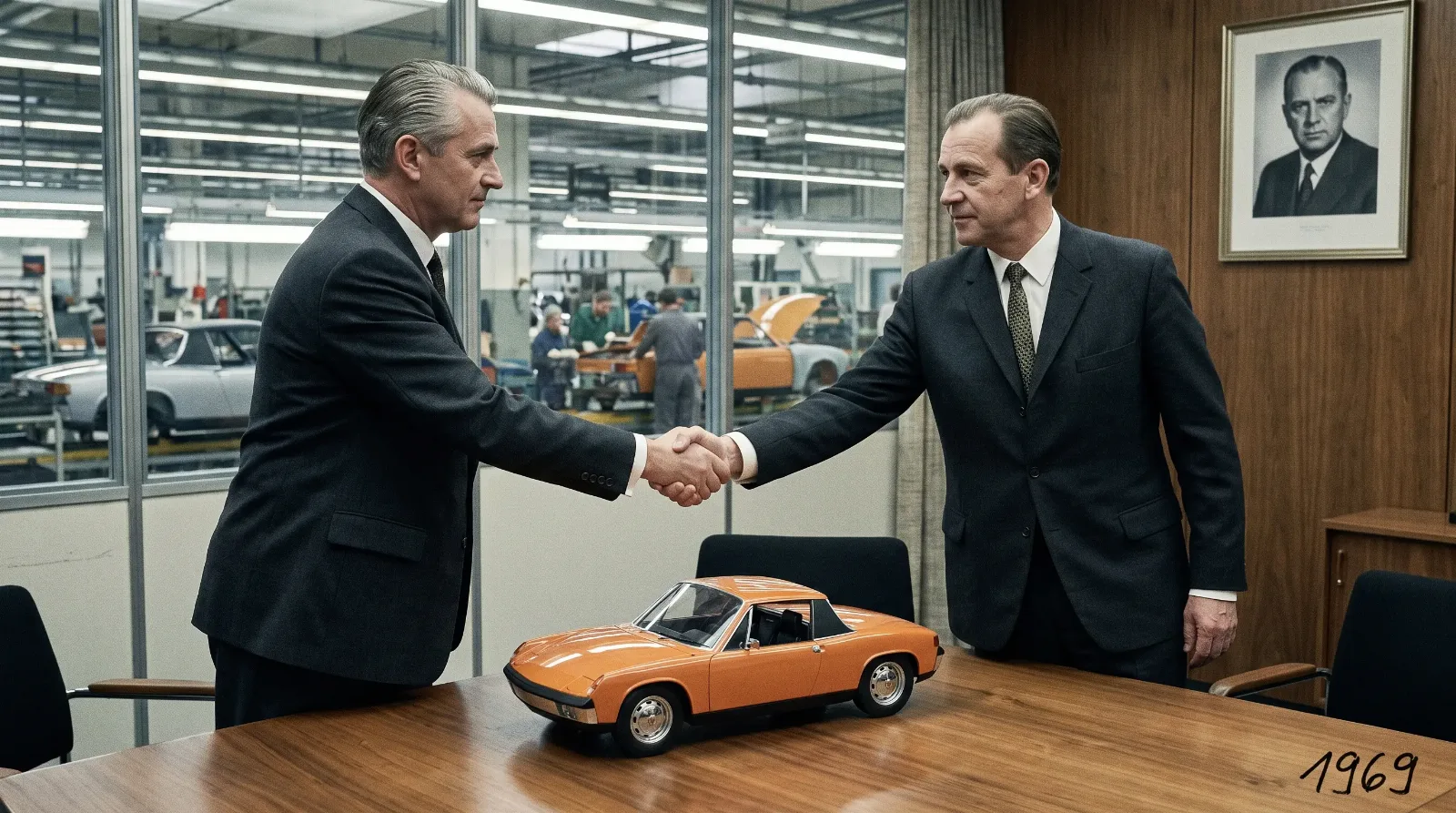
Two companies, one gap in the lineup
By the mid-1960s Porsche had a problem that had nothing to do with engineering. The 356 was aging out, the 911 was expensive to build and expensive to buy, and there was no entry point underneath it. Volkswagen had the opposite problem: a strong dealer network, no sporting image to speak of, and an aging Karmann Ghia that nobody mistook for a sports car.
Ferry Porsche and Volkswagen's Heinrich Nordhoff had informally discussed a shared small sports car before, but the project only got real traction once both sides had something concrete to gain. Porsche needed a cheaper model to replace the 356 without diverting engineering resources from the 911. Volkswagen needed a way to sell something with sporting credibility through its network. On paper, that is a clean trade. In practice, it created a car with two owners and no single line of authority, which is the root of almost every problem the 914 program had.
The deal that got complicated by a death
The arrangement was a handshake deal between Ferry Porsche and Nordhoff, structured around Karmann handling assembly in Osnabrück while Porsche handled the sports car engineering. The plan assumed VW would sell a four-cylinder version as a Volkswagen-Porsche, and Porsche would sell a six-cylinder version under its own badge, mostly for the US market.
Then Nordhoff died on April 12, 1968, and the informal understanding he had with Ferry Porsche died with him. His successor, Kurt Lotz, had no personal stake in a handshake deal between two men who were no longer both alive to explain it. Lotz argued that Volkswagen held the rights to the car outright unless Porsche shared in the tooling costs, and he raised the price Porsche had to pay Volkswagen per body shell. Porsche had already committed resources on the assumption of the earlier, cheaper terms, and the renegotiated cost pushed the six-cylinder 914's price uncomfortably close to Porsche's own 911T.
Two badges for two markets, and neither side fully happy
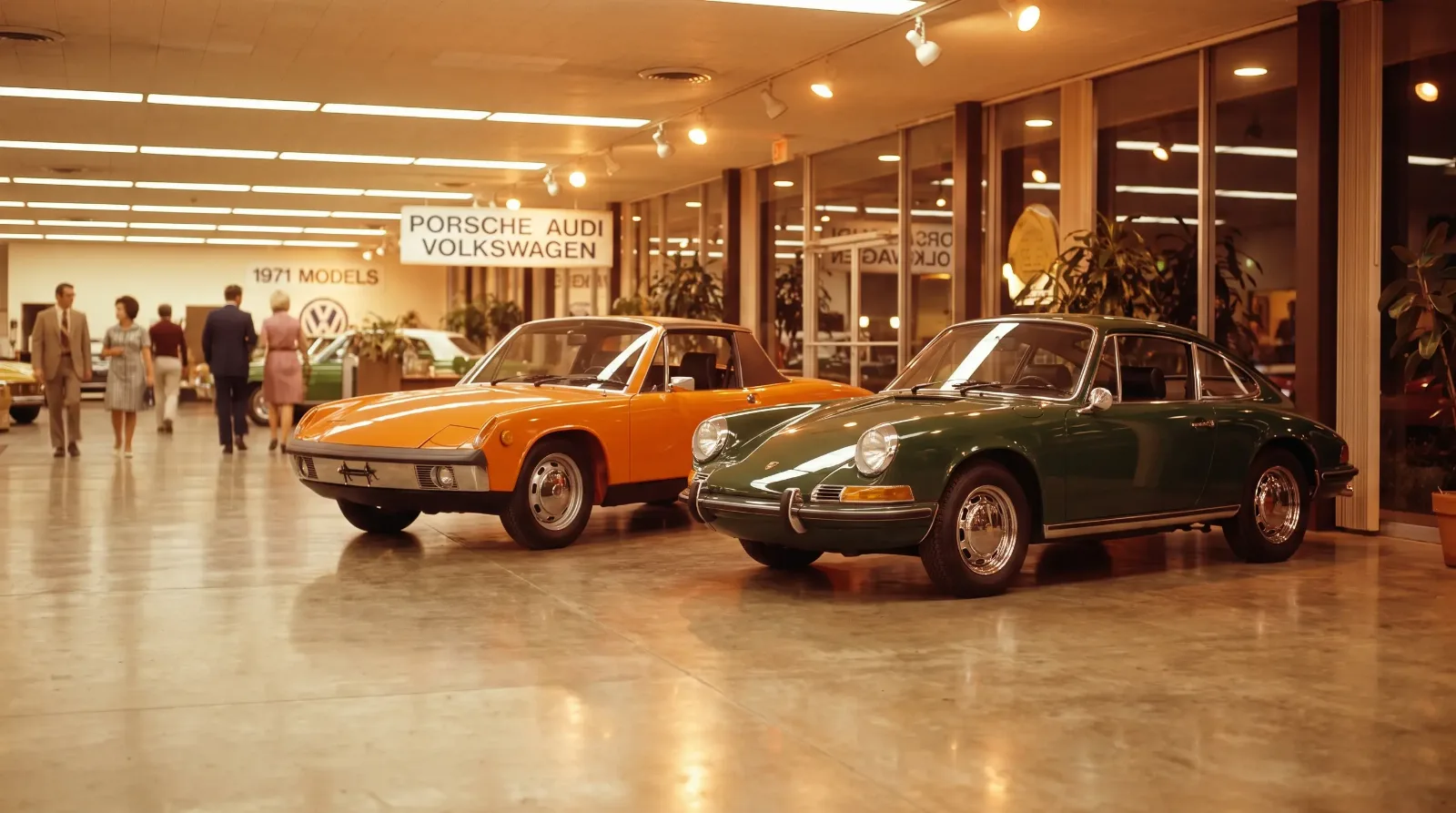
The compromise that emerged explains why the 914 looks the way it does in different markets. In Europe, the four-cylinder car was sold as the Volkswagen-Porsche 914, through VW dealers, at a price meant to undercut a proper sports car. In the United States, Volkswagen had no dealer network built for a sports-car buyer, so every 914 sold there, four-cylinder included, wore Porsche badges and went through Porsche's US distribution.
That single decision created a lasting identity problem. American buyers got a car with a Porsche crest and a Volkswagen-derived engine, and plenty of them assumed they were buying a real Porsche in the same sense a 911 was a real Porsche. Enthusiast press at the time was not shy about pointing out the difference, and the 914 has spent decades fighting a reputation it partly earned honestly and partly inherited from marketing decisions made in a corporate dispute it had no part in.
Why the politics still show up in the spec sheet
Every 914 quirk that owners debate today traces back to this split parentage. The four-cylinder cars used a Volkswagen Type 4 engine, chosen because VW was paying for a large share of development and wanted its own hardware in the car it was funding. The six-cylinder car, covered in detail in keep reading the series, used a detuned version of the 911's flat-six, and its higher price reflected Porsche paying full freight on genuinely Porsche hardware rather than shared VW tooling.
The pricing outcome nobody fully planned for was that the six-cylinder 914 ended up priced close enough to an entry-level 911 that it undercut its own reason to exist. That is a direct, traceable consequence of the corporate compromise: neither company was willing to subsidize the other's version of the car, so each variant had to carry its own real costs, and the math on the six-cylinder never worked in Porsche's favor.
"The 914 gets criticized as a car with an identity crisis, but the identity crisis was structural. It was designed by a partnership that stopped agreeing on terms halfway through the project."
Emily Chen
What the dispute actually settled
By 1969 the two companies had worked out a functional, if not warm, arrangement: Volkswagen owned the tooling and production rights for the four-cylinder car, Porsche controlled its own six-cylinder variant and all US distribution, and Karmann built both on the same line in Osnabrück. It was a workable solution, but it was a negotiated settlement between two boards, not a shared vision of what the 914 should be.
The practical effect on assembly was that Karmann effectively ran two parallel micro-programs under one roof. Bodies came off a shared line, but engines, badging, and final trim diverged depending on which company the car belonged to on paper. Quality control complaints from the era sometimes blamed "the 914" as a single entity, when in fact a four-cylinder European car and a six-cylinder US-market car could have different suppliers behind seemingly identical parts. An owner troubleshooting a 914 today still has to ask which side of that split their particular car came from before assuming a repair procedure applies.
The table below is a rough summary of how the split actually worked in practice, market by market.
| Variant | Primary market | Badge used | Controlling company |
|---|---|---|---|
| 914 (four-cylinder) | Europe | Volkswagen-Porsche | Volkswagen |
| 914 (four-cylinder) | United States | Porsche | Porsche (distribution only) |
| 914/6 (six-cylinder) | US and Europe | Porsche | Porsche |
That is worth remembering whenever someone frames the 914 as a design failure. Read the 914 chapter for the full production history, but the short version is that most of what people call design compromises were commercial compromises first. The car's identity problems, its awkward badge situation in different markets, even its pricing structure, all trace back to a corporate relationship that had to be renegotiated mid-project after the one man who had brokered the original deal was no longer there to defend it. For the fuller context of how this fits into Porsche's history as a company, the broader Porsche saga covers the years surrounding this period in more depth.
Sources and notes
Related Reading
Have a
Porsche
for Sale?
Reach thousands of serious classic car collectors across the US.
Sell It Here →
Are You a Classic Car Dealer?
List your full inventory and connect with targeted classic car buyers.
Join as a Dealer →

About the author
Emily Chen
Bay Area engineer with a deep focus on vintage Japanese and European performance cars. Approaches classic car research and restoration with an analytical eye.
Related Listings - Porsche




Comments
Be the first to comment on this article.