
The Porsche 914/6 should have been the easy sell of the range: a real Porsche flat-six in the same body as the four-cylinder car, at a lower price than a 911. Instead it became a case study in how pricing, not engineering, kills a good product. The porsche 914 6 is mechanically sound and genuinely quick for its era. Commercially, it never worked, and the numbers explain exactly why.
Car Features
6 min read
Porsche 914/6: The Six-Cylinder That Cost Too Much
The Porsche 914/6 was engineered right and priced wrong, landing too close to a 911T to sell in volume, which is exactly why it is scarce and valuable today.
What made the 6 different under the skin
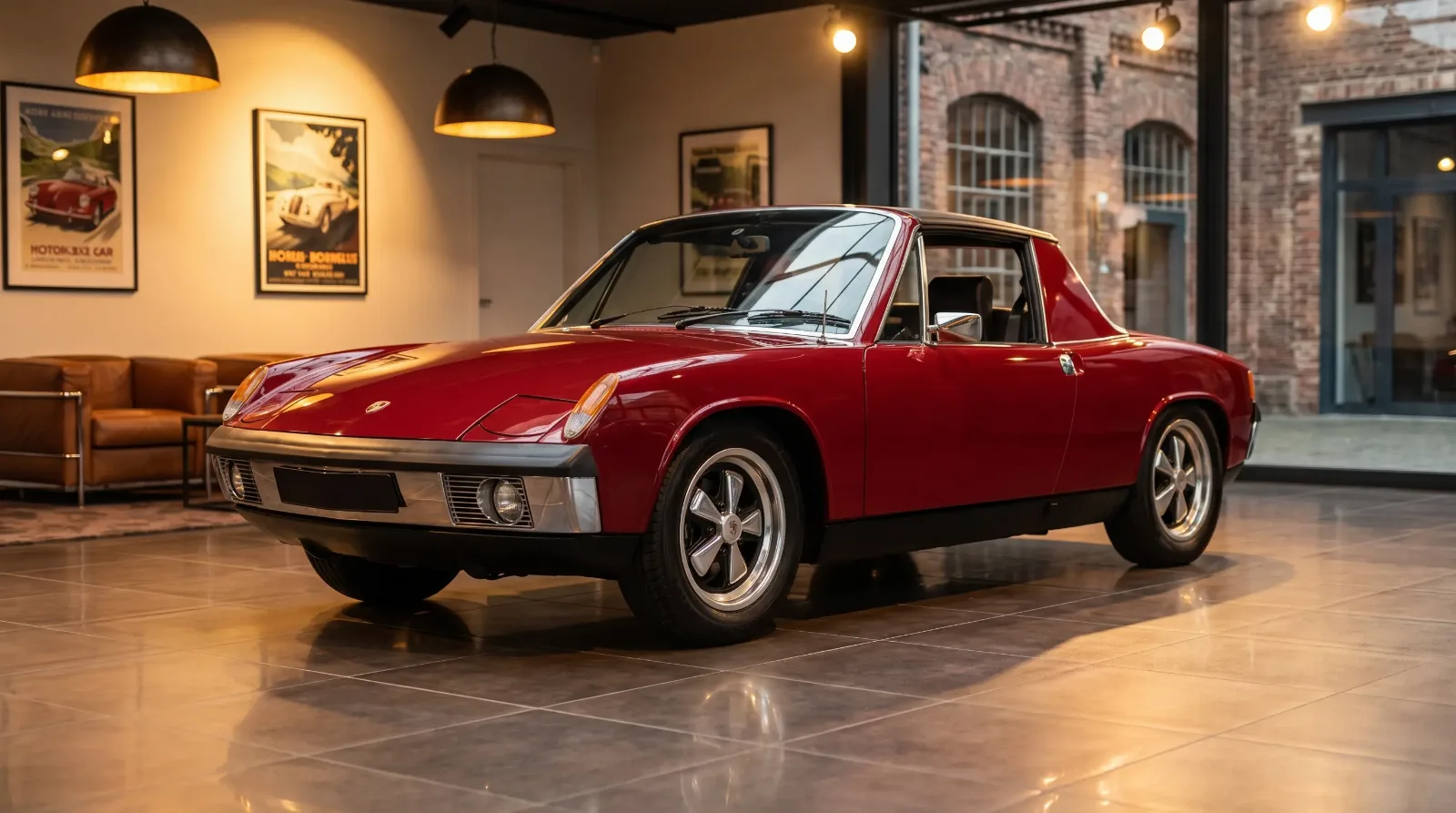
The 914/6 used a 2.0-liter flat-six derived from the 911T, producing 110 hp DIN, mounted mid-ship in the same targa-top body Porsche shared with Volkswagen for the four-cylinder car. The engine placement was a genuine engineering advantage: a mid-mounted six gave the 914/6 a lower polar moment of inertia than the front-engine 356 it replaced, and better weight distribution than the rear-engine 911 it was priced against.
Porsche also upgraded the chassis to handle the extra power, fitting larger brakes, a stiffer suspension setup, and a five-speed transmission as standard where the four-cylinder car made do with four speeds in its early years. On a spec sheet, the 914/6 reads like a serious sports car built with no shortcuts. That is precisely the problem.
The number that killed it: price
Porsche built the 914/6 as a proper Porsche product, using Porsche's own engine family and Porsche-grade components rather than the shared Volkswagen tooling that kept the four-cylinder car cheap. That decision meant the 914/6 could not be priced like a Volkswagen-Porsche joint venture car. It had to be priced like what it was: a Porsche.
The result was a car that landed within a few hundred dollars of a base 911T in the US market, with the 1970 914/6 priced around $6,099 against a 911T starting near $6,435. For a buyer comparing the two side by side, the calculation was not close. A 911T carried the badge prestige of the range-topping model, a proven four-cam-free flat-six lineage buyers already trusted, and the same general performance envelope. The 914/6 offered a mid-engine handling advantage that most showroom customers were not equipped to evaluate, wrapped in a body shared with a cheaper Volkswagen-badged car. Enthusiasts who understood chassis dynamics saw the appeal. Most buyers walking into a dealership did not, and they bought the 911.
Production numbers tell the same story twice
Porsche built the 914/6 for roughly three years, from 1969 to 1972, and total production landed at approximately 3,350 units, a fraction of the four-cylinder 914's output over the same run. That is not a niche-product number. That is a number that says the market looked at the price and the badge situation and mostly passed.
Porsche discontinued the 914/6 in 1972 and replaced it with a four-cylinder 914 fitted with a larger 2.0-liter engine, which delivered most of the performance improvement buyers wanted without the six-cylinder price tag. That substitution is itself evidence: Porsche's own internal read on the 914/6's failure was that displacement and marketing mattered more to buyers than cylinder count and mid-engine balance.
It is worth being precise about what "failure" means here, because the 914/6 was not a bad product in any engineering sense. It met its performance targets, it handled better than the car it was priced against, and it did not suffer unusual reliability problems relative to other Porsches of the period. The failure was entirely commercial: a pricing and positioning decision that put a six-cylinder Porsche next to another six-cylinder Porsche and asked buyers to choose based on chassis layout alone. Most buyers are not equipped to make that choice on a showroom floor, and Porsche's own sales figures confirm it.
| Spec | 914/6 | Contemporary 911T |
|---|---|---|
| Engine | 2.0L flat-six | 2.2L flat-six |
| Power | 110 hp DIN | 125 hp DIN |
| Layout | Mid-engine | Rear-engine |
| Production run | 1969-1972 | 1968-1973 |
Why that failure matters now
The 914/6's commercial failure is exactly why it is scarce and desirable today. Low production numbers plus genuine Porsche mechanicals plus a chassis that modern drivers actually praise for its balance add up to a car that collectors now value well above the four-cylinder 914, sometimes by a wide margin. The same pricing math that killed it in 1970 works in reverse for buyers now: it was expensive to build then, and that expense shows up as scarcity and specification quality that a four-cylinder car simply cannot match.
What a buyer actually deals with today
Owning a 914/6 now is a different exercise than owning a four-cylinder car. Parts commonality with the 911T helps on engine internals, since much of that supply chain still exists for the more numerous 911. Where it gets harder is body panels and trim specific to the six-cylinder version, since so few were built that reproduction parts are limited and used parts cars are rare by definition. A prospective buyer needs to verify engine numbers against the chassis, because the 914/6's value premium has made it a target for four-cylinder cars retrofitted with six-cylinder engines and sold as something they are not.
That verification is not optional. A correctly numbers-matching 914/6 with documentation can be worth several times what a visually similar car with a transplanted engine commands, and the gap has only widened as the model's reputation has caught up with its engineering. Anyone shopping this market should budget time and money for a Porsche marque specialist to confirm authenticity before money changes hands, not after.
"The 914/6 is the rare car where the commercial failure and the engineering success are the same story told from two directions. It cost too much because it was built right, and it is worth a lot now for the same reason."
Emily Chen
If you want the fuller context on how the six-cylinder variant fits into the 914's development, the 914 chapter covers the whole program in more detail, and our Porsche retrospective places the 914/6 within the company's broader history. Buyers who want to see what a well-documented example costs today can browse a classic Porsche 914 for sale to get a current sense of the market, and the next piece in this series, keep reading the series, covers the even rarer prototype Porsche built to push the platform further still.
Sources and notes
Related Reading
Have a
Porsche
for Sale?
Reach thousands of serious classic car collectors across the US.
Sell It Here →
Are You a Classic Car Dealer?
List your full inventory and connect with targeted classic car buyers.
Join as a Dealer →

About the author
Emily Chen
Bay Area engineer with a deep focus on vintage Japanese and European performance cars. Approaches classic car research and restoration with an analytical eye.
Related Listings - Porsche
Comments
Be the first to comment on this article.