
The porsche 916 prototype is the version of the 914 that Porsche's own engineers actually wanted to build. It shared the 914's targa-derived body and mid-engine layout, then discarded almost everything about the compromise that made the production car affordable. What resulted was faster, stiffer, and more expensive to build than a 911, and that combination is exactly why it never reached a showroom.
Car Features
6 min read
The 916 Prototype: The 914 That Never Was
Porsche built a handful of 916 prototypes to test how far the 914 chassis could go with a 911S engine and a stiffened body, and the results never reached production.
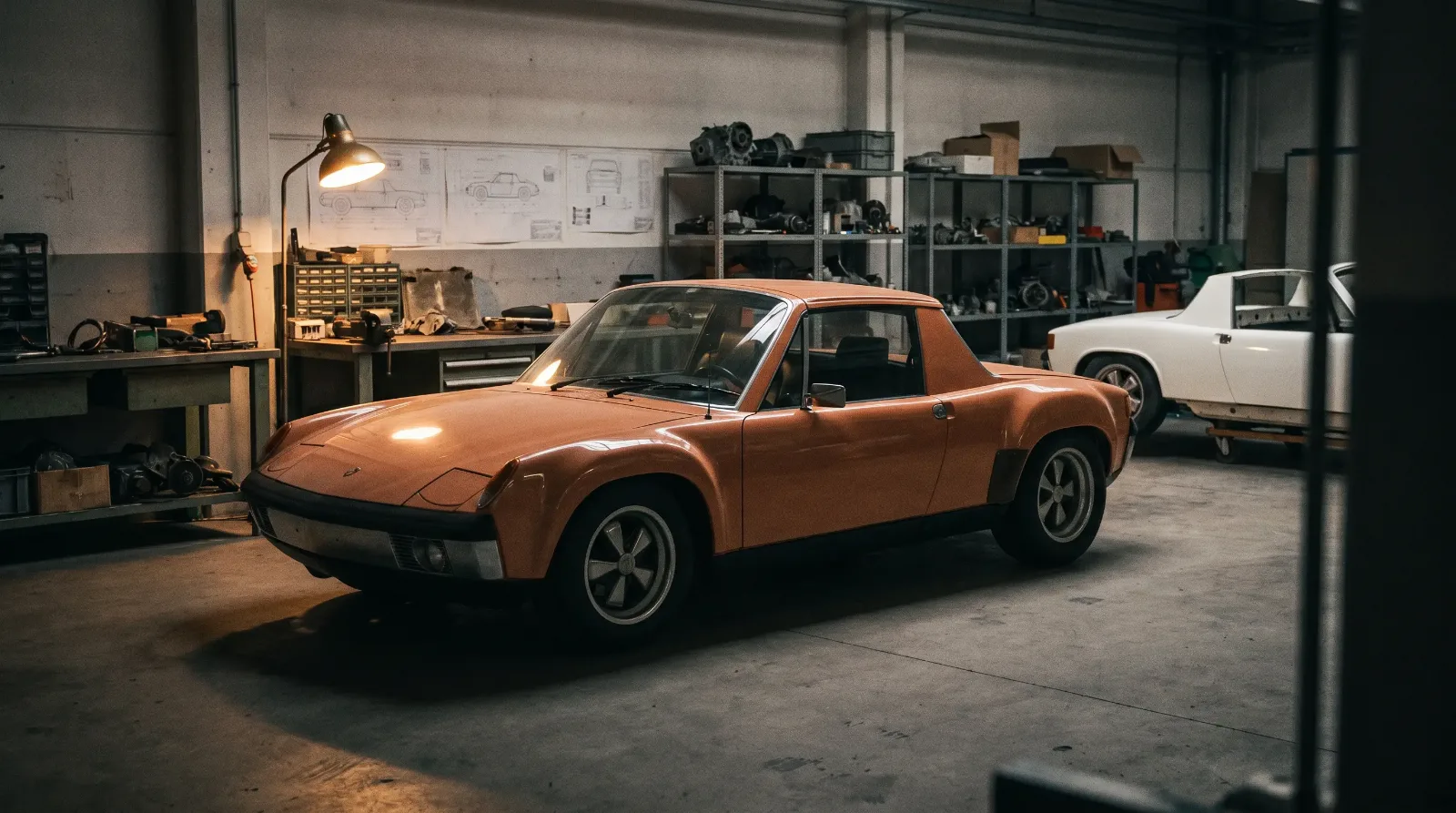
Same shape, different intent entirely
Where the 914/6 used a 911T-derived flat-six in an otherwise standard 914 body, the 916 went further. Porsche fitted a 911S-specification engine, widened the body with flared fenders to cover wider wheels and tires, and reworked the suspension and brakes to match. The roll-back Targa roof of the standard 914 was replaced with a fixed steel roof, which stiffened the chassis considerably and improved the car's handling limits, at the cost of the open-air feature that gave the 914 part of its identity.
The result behaved less like an upgraded 914 and more like a mid-engine alternative to the 911S, built on 914 architecture because that architecture already existed and did not need to be engineered from scratch. Porsche's engineers were, in effect, asking whether the 914 platform could be pushed to genuine 911S performance without abandoning the mid-engine layout that made the 914/6 handle so well in the first place.
Why so few were built
Porsche built the 916 in extremely limited numbers, eleven complete prototype cars in all, mostly as engineering exercises rather than a planned production run. The car was never given a real chance at volume production, and the reasons come back to the same commercial math that killed the standard 914/6.
A 916 with a 911S engine, flared bodywork, and a stiffened chassis cost more to build than the 914/6 it was based on, and the 914/6 was already priced uncomfortably close to a real 911. Building a 916 in volume would have meant selling a mid-engine car at or above 911S money, competing directly against Porsche's own flagship rather than complementing it. Given the corporate politics already straining the relationship between Porsche and Volkswagen over the standard 914, discussed in the mid-engine 914, there was little appetite inside Porsche to greenlight a variant that would cannibalize 911 sales on top of everything else.
What the 916 proves about the platform
Set aside the commercial reasoning and the 916 tells you something useful about the 914 chassis itself: it had real headroom. A production car criticized for being underpowered in four-cylinder form, and merely adequate in 914/6 form, could absorb a 911S engine and the wider tires and brakes needed to use it, without requiring a fundamentally different structure. That is not a small thing. Most mid-engine chassis of the era were purpose-built around a specific power band, and pushing them meaningfully past their design target usually meant new subframes, new mounting points, and new suspension geometry from scratch.
The 916 needed flared fenders and revised suspension tuning, not a new architecture. That speaks well of the original engineering brief for the 914 platform, even if the production car sold with a Volkswagen-sourced four-cylinder engine never got to show it.
| Spec | Production 914/6 | 916 prototype |
|---|---|---|
| Engine | 2.0L flat-six (911T-based) | 2.4L flat-six (911S-based) |
| Roof | Removable Targa | Fixed steel roof |
| Body width | Standard 914 | Flared, wider track |
| Units built | ~3,350 | 11 |
"The 916 answers a question nobody asked commercially but every engineer working on the 914 was curious about: how far could this chassis actually go. The answer was further than the production car ever got to show."
Emily Chen
Driving one, and the reality of ownership
Anyone who has driven both a standard 914/6 and a 916 back to back describes a similar pattern: the extra structural stiffness from the fixed roof is noticeable immediately, well before the extra power comes into play. Removing the Targa panel option cost the car some of its everyday appeal but bought real chassis rigidity, and that rigidity is what let the wider tires and stiffer suspension actually work as intended rather than fighting a body that was flexing under load.
Ownership of a genuine 916 is its own specialized field. With so few built and most tracked individually by marque historians, a car presented for sale as a 916 needs documentation that traces back to Porsche's own records, not just a period-correct badge or a matching engine casting number. Values for confirmed examples sit well above even a well-documented 914/6, reflecting both the rarity and the fact that most surviving cars are known individually rather than existing as an anonymous production run. A buyer without access to a Porsche historian familiar with this specific model should treat any unverified 916 claim with real skepticism.
The mechanical case for caution goes beyond fraud risk. A 916's stiffened chassis and flared bodywork are not simple bolt-on upgrades a restorer can replicate casually decades later; the fixed roof structure in particular changes how the whole car reacts to load, and a poorly executed replica can end up with the worst of both worlds, extra weight without the intended rigidity. Anyone restoring a car toward 916 specification, rather than buying a documented original, should treat it as a distinct engineering exercise rather than a cosmetic upgrade to a standard 914/6.
Where it fits in the story
The 916 is best understood as a data point rather than a missed opportunity. Porsche was not sitting on a shelved bestseller; it was testing the outer limits of a platform it had already committed to selling at a specific price point for specific commercial reasons. For readers who want another angle on the same car, the appreciation piece covers how that platform's reputation has shifted decades later. The full arc of how the 914 program developed, including the corporate pressures that shaped every variant from the base car to this prototype, is covered in our Porsche history feature, and buyers curious about the more attainable end of this lineage can look at a classic Porsche 914 for sale to see what the production cars actually cost today.
Sources and notes
Related Reading
Have a
Porsche
for Sale?
Reach thousands of serious classic car collectors across the US.
Sell It Here →
Are You a Classic Car Dealer?
List your full inventory and connect with targeted classic car buyers.
Join as a Dealer →

About the author
Emily Chen
Bay Area engineer with a deep focus on vintage Japanese and European performance cars. Approaches classic car research and restoration with an analytical eye.
Related Listings - Porsche
Comments (1)
J
Jimmy Borowski
2 months ago
Classic car community is generally helpful. Marque-specific forums are where the real knowledge lives — find the dedicated one before you buy.