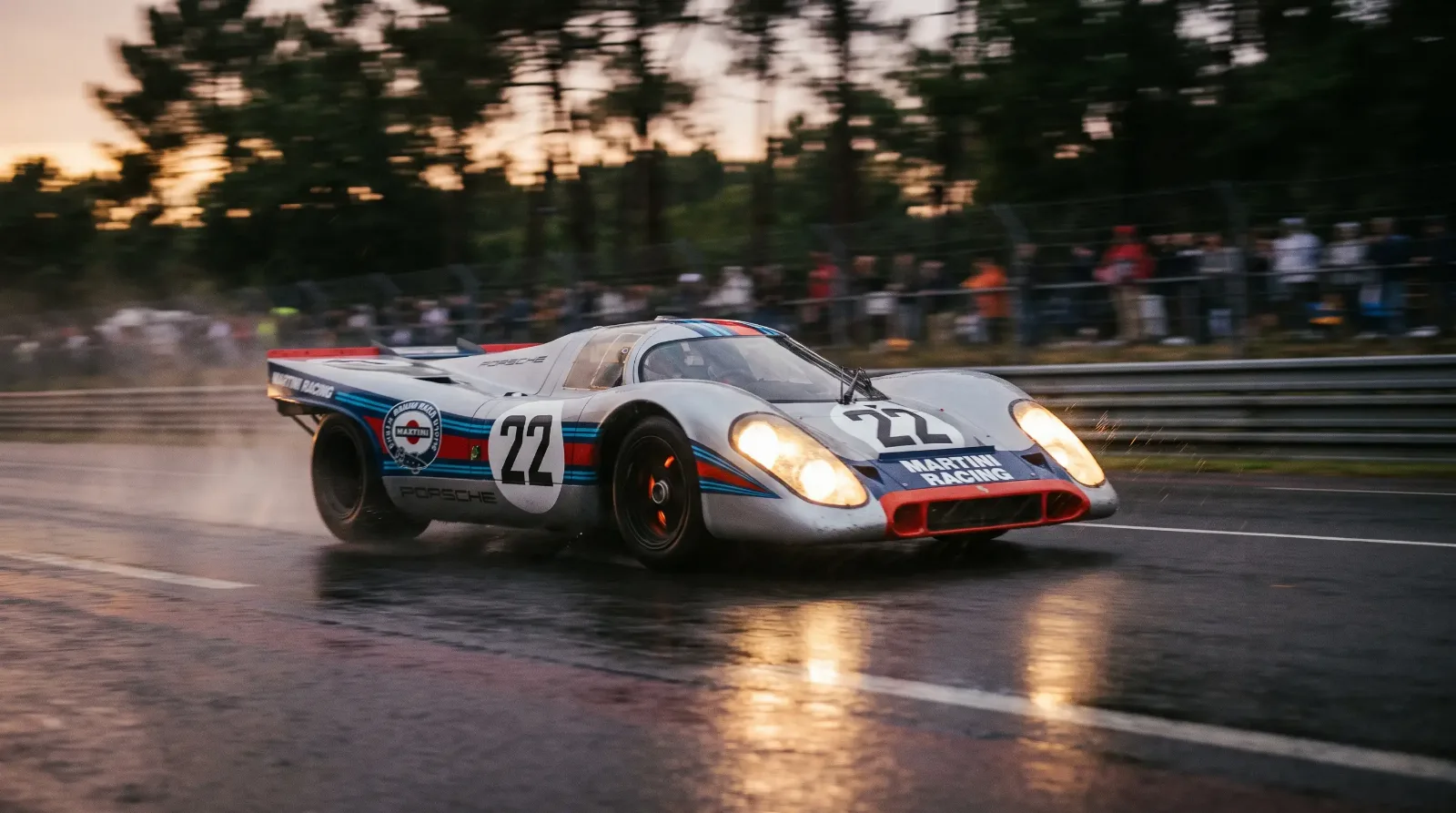
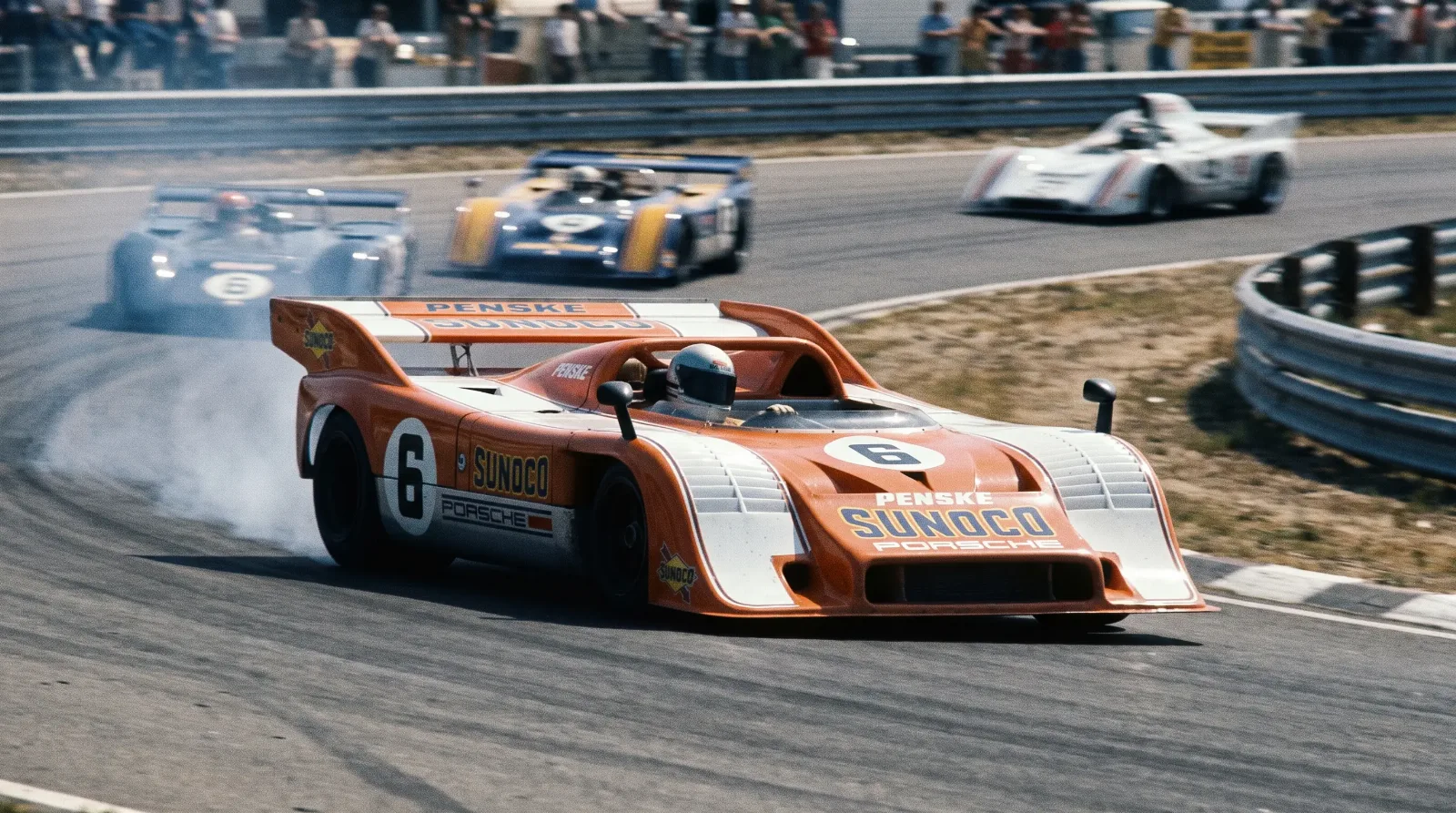
Mark Donohue climbed out of the cockpit at Road Atlanta in the fall of 1973 and, according to people who were standing near the timing stand, said almost nothing. There wasn't much to say. He had just lapped the field in a car so far beyond anything else on the grid that the Sports Car Club of America would spend the following winter rewriting its rulebook specifically because of it. The car was the Porsche 917/30, and it remains the most powerful factory racing Porsche ever built for a closed circuit.
The 917/30 didn't arrive out of nowhere. It grew out of Porsche's long-tail 917, the car that had already won Le Mans twice and terrified a generation of drivers, and it grew because Roger Penske asked for something that could beat McLaren at its own game in the Canadian-American Challenge Cup. Can-Am racing in the early 1970s had almost no rules. Engine size was open. Aerodynamics were open. If you could build it and it would run on the track surface, you could race it. Porsche and Penske looked at that freedom and decided to use all of it.
A flat-twelve built for one job
Under the bodywork sat a 5.4-liter flat-twelve, derived from the 917's racing engine but fitted with twin turbochargers, a combination Porsche had been developing in the 917/10 the year before. In race trim the engine produced roughly 1,100 horsepower, a figure that already dwarfed anything else on a Can-Am grid. Turned up for qualifying, with the wastegates opened further, output has been reported as high as 1,580 horsepower, though Porsche never published an official number and the figure has been repeated so often in enthusiast circles that it has taken on a life of its own. What isn't in dispute is the torque. Drivers described the car as needing to be driven with the throttle like a dimmer switch rather than an on-off valve, because full boost arriving all at once could snap the rear end sideways with no warning.
Donohue and George Follmer shared driving duties for Penske in 1972 and 1973, and between them they turned the Can-Am championship into a formality. The 917/10 took the title in 1972 after Donohue was injured mid-season and Follmer stepped in. The following year, in the definitive 917/30, Donohue won six of eight rounds and clinched the 1973 Can-Am championship outright. Some races weren't close. At times the 917/30 lapped slower cars twice over a race distance, which is not a normal thing to write about a production-based racing series.
Why Can-Am couldn't survive it
It is worth sitting with what actually happened here, because it is unusual. A manufacturer built a car that was so effective it broke the series it was built to compete in. Can-Am had been sold on spectacle, on unlimited engineering, on the idea that fans wanted to see the fastest possible machines with no restrictions. The 917/30 proved that idea had a ceiling. Once one team could simply out-engineer everyone else with a big enough budget and a big enough turbo, the racing stopped being a contest. Teams without Porsche's resources or Penske's operation couldn't get near it, and car counts on the grid thinned out fast. By 1974, with the new fuel formula in place and Porsche having already made its point, Can-Am as the sport had known it was effectively over. It returned later in a different, tamer form, but the original series never recovered its identity.
Donohue's record at Talladega
The 917/30's most famous single moment did not happen on a road course at all. In August 1975, with Can-Am done and the car retired from competition, Penske and Porsche took a 917/30 to Talladega Superspeedway to attempt a closed-course speed record. Donohue, driving a version of the car reworked with a smaller 5.0-liter engine and revised aerodynamics for sustained high-speed running rather than short bursts of acceleration, set an average lap speed of 221.120 mph, a record that stood for eleven years. It was a quiet coda to a very loud career for the car, run without a grandstand crowd or a championship on the line, just an engineer's satisfaction in proving a number.
| Specification | Detail |
|---|---|
| Engine | 5.4-liter turbocharged flat-twelve |
| Power (race trim) | approx. 1,100 hp |
| Power (qualifying boost) | up to 1,580 hp reported |
| Chief drivers | Mark Donohue, George Follmer |
| Team | Penske Racing |
| Championship | 1973 Can-Am title |
What it means for the 917 lineage
The 917/30 sits at the far end of a story that began with the 917 and Le Mans years, when Porsche's endurance racer was still finding its footing and, in its earliest form, its reputation for being difficult to control. By the time the 917/30 was built, that chassis knowledge had been pushed as far as Can-Am's open rulebook would allow. It is the same family of car, the long-tail bodywork and flat-twelve architecture carried forward, but aimed at a completely different kind of race: short, brutal, and decided by whoever had the most horsepower and the nerve to use it.
"What stays with me isn't the horsepower number, it's the idea that a car could be built so completely without compromise that the sport itself had to change shape around it. That doesn't happen often, and when it does, it tells you something about the era it came from."
— Nora Beckett
A short career, a long shadow
The 917/30 raced for barely two seasons before the rules ended its era, yet it remains the reference point whenever anyone talks about how much power a racing Porsche could carry and still be driven at the limit by a human being. It never went to Le Mans. It never needed to. Its job was to answer a different question, one about a wide-open era of motorsport that no longer really exists, and it answered it so thoroughly that nobody has had reason to ask it again in quite the same way. For readers curious about the film that shaped how the wider public came to see this whole period of Porsche racing, a companion piece covers that ground directly.