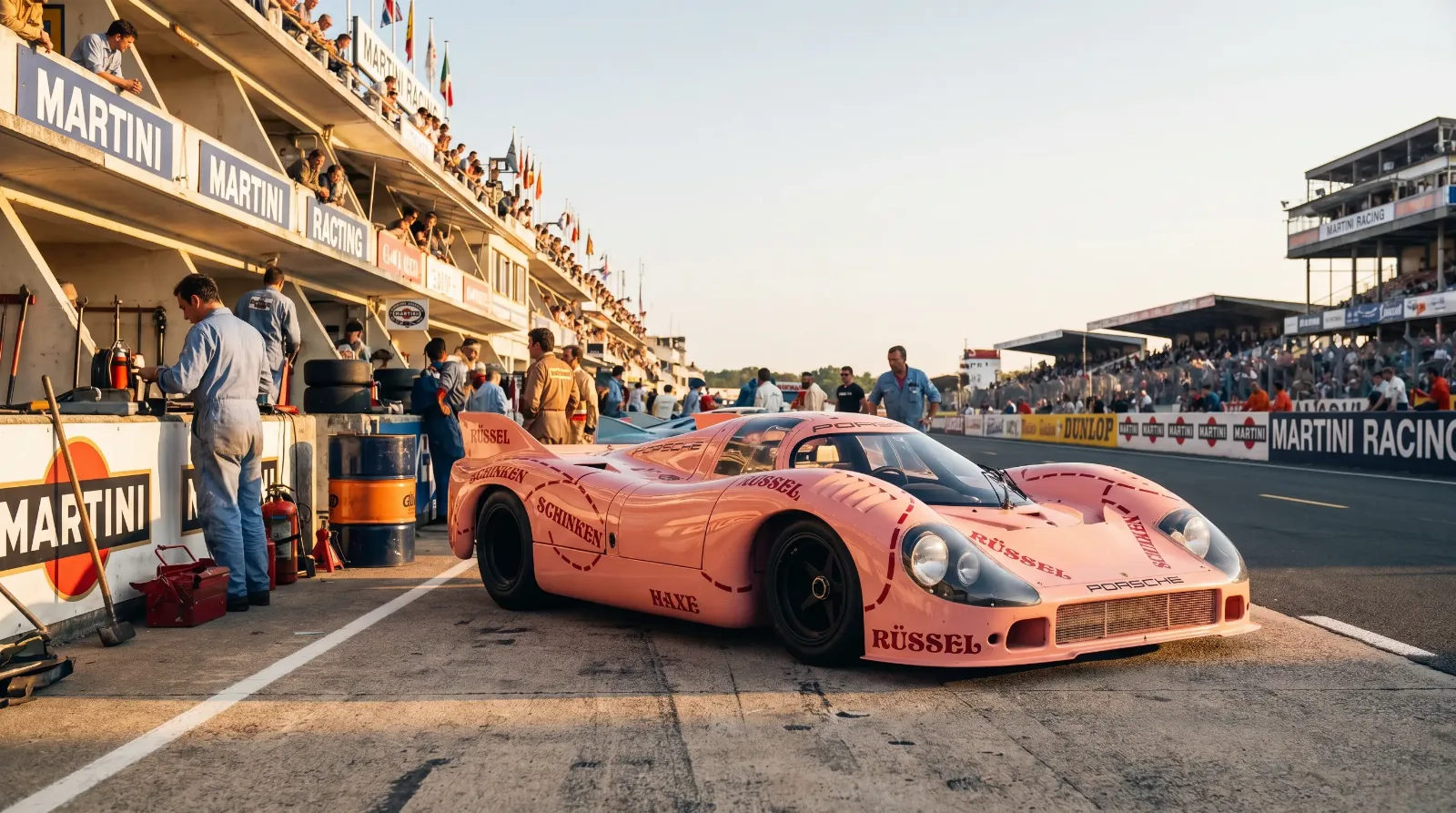
Somebody at Porsche looked at a fat, wide-bodied prototype sitting in the pit lane at Le Mans in 1971 and decided the only honest thing to do was paint it like a pig and label the cuts of meat on its flanks. That is not a joke or an exaggeration. The porsche pink pig livery is real, it raced at the world's most serious endurance event, and it remains one of the strangest things a factory racing team has ever rolled onto a starting grid. The car underneath the paint was a 917/20, a one-off built to test a wider, heavier aerodynamic shape that Porsche's engineers thought might solve some of the stability problems the standard 917 still had at very high speed.
An aerodynamic test that needed a body to match
By 1971, Porsche had already won Le Mans once and was chasing better top-end stability rather than raw power. French aerodynamicist input and Porsche's own wind tunnel work led to a wider track and a bulbous, rounded body shape for a single experimental chassis, quite different from the slim, low-drag longtail cars running elsewhere in the same race. The result looked heavy and awkward parked next to a standard 917K, which is exactly what earned it the nickname before it even got its paint job. Drivers and mechanics reportedly started calling it "Sau," the German word for pig or sow, on sight, well before anyone had picked up a paintbrush.
Someone at the factory, Porsche design chief Anatole Lapine, decided to lean into the joke rather than fight it. The car was painted pink and marked out like a butcher's diagram, with the names of prime cuts of meat labeled in German across the bodywork exactly where those cuts would sit on an actual pig. It was equal parts engineering test mule and factory prank, run at Le Mans with a completely straight face.
How it actually performed
The wider body did what it was supposed to do in a straight line, giving the car noticeably better stability than the standard-bodied 917s at the very top of its speed range. It ran with drivers Reinhold Joest and Willi Kauhsen, qualified seventh fastest, and ran as high as third place before a brake failure caused an accident that ended its run. As a one-off aerodynamic test rather than a serious win attempt, that outcome was not really a failure. Porsche got the data it needed, and the wider-body concept it proved out fed directly into the following seasons of Can-Am racing, where similar thinking eventually produced the far more serious 917/10 and 917/30 machines.
Why the joke stuck around for decades
Most one-off test cars from this era disappear into obscurity once their job is done. The Pink Pig did the opposite. Its combination of genuine engineering purpose and deliberately absurd presentation made it a favorite among Porsche enthusiasts almost immediately, and it has stayed that way. Porsche itself leaned back into the joke decades later, running a modern 911 RSR race car in a near-identical pink butcher livery at Le Mans in 2018, explicitly as a tribute to the 1971 original. That kind of self-aware callback is rare for a manufacturer as historically serious about its racing program as Porsche, which is part of why it landed so well with longtime fans.
"Most factories protect their image. Porsche painted a race car like a diagram from a butcher shop and let it become one of the most photographed cars they ever built."
— Patrick Walsh
| Detail | 1971 Pink Pig |
|---|---|
| Model | Porsche 917/20 |
| Purpose | Wide-body aerodynamic test |
| Livery | Pink, labeled like a butcher's diagram |
| Nickname origin | Coined by team members before the paint job |
| Legacy | Tribute livery run on a 911 RSR at Le Mans in 2018 |
Where it fits in the wider 917 story
The Pink Pig only makes sense against the backdrop of everything else Porsche was doing with the 917 platform at the time, from the earlier factory and customer teams covered in Porsche's motorsport heritage to the wide-body Can-Am cars that came directly out of this experiment's data. Readers who want to see where that aerodynamic thinking eventually landed should look at a related deep-dive covering the 917/30, the car that took the wide-body concept the Pink Pig pioneered and turned it into the most powerful racing car of its era.
It is worth remembering, too, that the Pink Pig was never meant to be remembered at all. It was a test mule, built to answer an engineering question and then presumably forgotten once the data had been collected. Instead it became one of the most recognizable Porsche race cars in existence, proof that sometimes the ugliest, strangest looking car in the garage ends up being the one everybody wants a poster of.
What survives and what it means to own a piece of it
The original 1971 car survives today and has been shown at Porsche-related events and museum displays over the years, drawing crowds that a more conventional-looking prototype from the same season rarely matches. Its rarity as a genuine one-off, rather than one of dozens of similar chassis built for a production racing series, makes it effectively priceless in the way only a true single-build factory experiment can be. There is no market comparable to it, because there is nothing else quite like it.
That uniqueness has not stopped an entire cottage industry from growing up around the livery itself. Scale model kits reproduce the butcher's diagram in painstaking detail, and enthusiasts building tribute cars on other 917 chassis, or even on unrelated platforms, still argue over getting the exact pink shade and label placement right. It says something about the car's staying power that a paint scheme designed half as a joke has become as carefully studied by restorers as any of Porsche's more conventional factory liveries. Few one-off test mules from any era get treated with that kind of reverence, and fewer still earn it by being deliberately ridiculous rather than serious.