
Rain fell on the Sarthe circuit for most of June 14, 1970, and somewhere in that gray weather the Porsche 917 finally did the one thing it had been built to do. It won Le Mans. Porsche had been trying and failing at outright victory for almost two decades, and the porsche 917 le mans history that opened that weekend changed the company's identity for good. Before 1970, Porsche was the plucky class winner, the small German firm that beat bigger cars on efficiency and reliability. After 1970, it was a Le Mans winner, full stop.
Car Features
6 min read
The 917: The Car That Finally Won Le Mans
The rain-soaked 1970 running of Le Mans gave Porsche its first overall win, courtesy of a Salzburg-entered 917 and two drivers who simply outlasted everyone else.
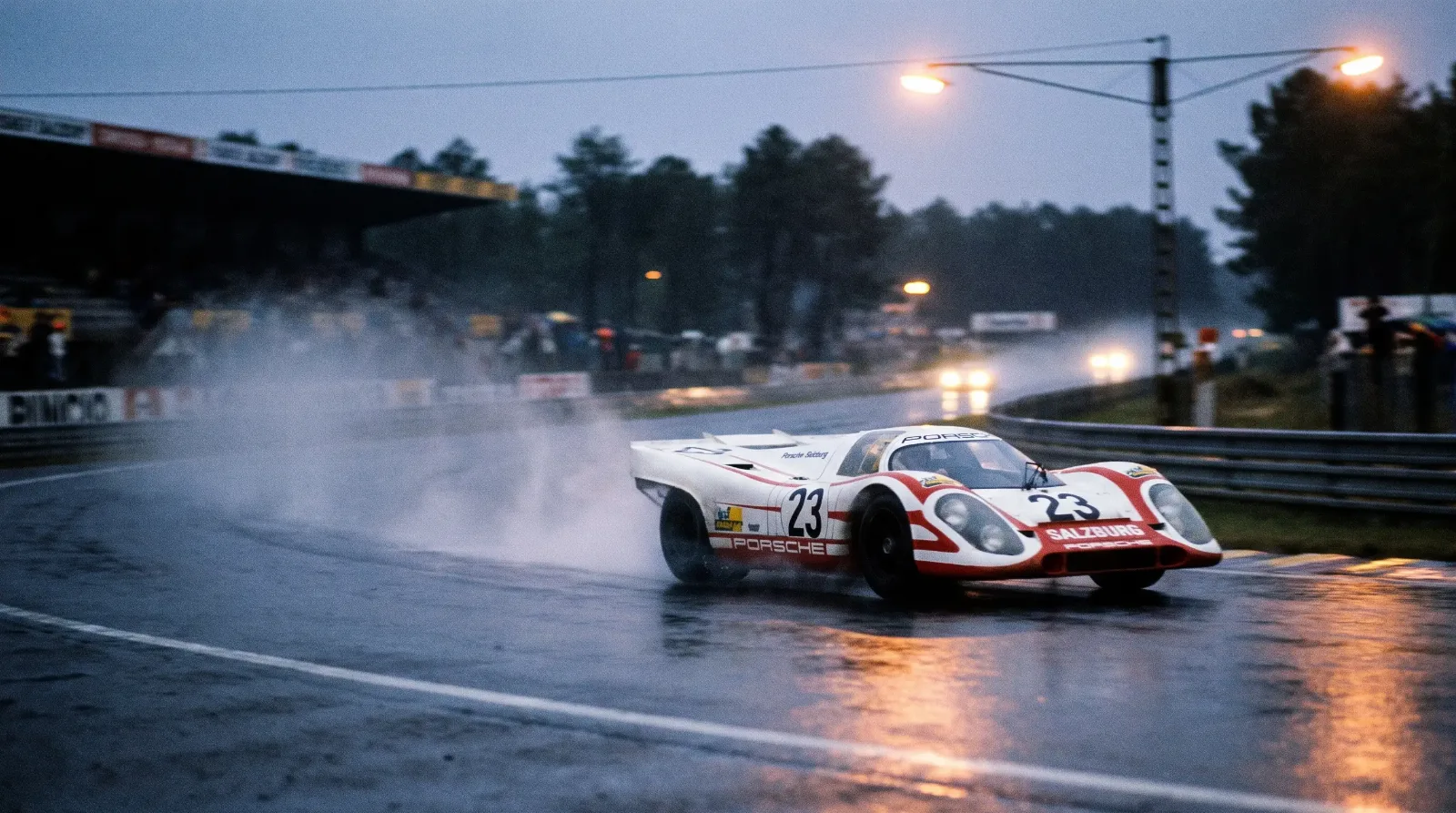
The car that crossed the line first was chassis 917-023, painted white with a broad red stripe down the nose and flanks, entered by the Porsche Salzburg team rather than the factory itself. That distinction mattered at the time and still matters to people who care about how this era actually worked. If you want the fuller account of how the 917 got to that grid in the first place, Porsche's racing legend lays out the homologation fight and the early, terrifying development seasons that came before this win.
A car nobody wanted to drive at first
The 917 arrived in 1969 as a machine built purely to satisfy a rule. The FIA's Group 4 sports car regulations required 25 examples for homologation, and Porsche built exactly that many, then a few more, in a scramble that became its own legend inside the factory. What it produced was a car with a 4.5-liter flat-12 engine, around 580 hp (588 PS) in its original 1969 tune, and an aerodynamic package so unstable at speed that several factory drivers refused to race it in its earliest form. John Woolfe, a British privateer, died in a 917 on the opening lap of the 1969 Le Mans race, and that tragedy hung over the car's reputation into the following season.
Porsche's engineers spent the winter of 1969 into 1970 reworking the tail sections, adding fixed fins and shortening the bodywork on some cars to tame the high-speed instability. The result was a car that was still brutally fast but no longer trying to kill the people driving it. That single change, more than any horsepower figure, is what made the 1970 win possible.
Hans Herrmann's last race
Hans Herrmann was 42 years old by June 1970, already a veteran of Mercedes' Formula 1 program in the 1950s and a survivor of some of the era's worst crashes. He had told friends and reporters before the race that this would be his final season regardless of the result. He shared the winning car with Richard Attwood, an Englishman who had come agonizingly close the year before, sharing a 917 with Vic Elford that led for hours in 1969 before a gearbox failure ended their race with just two hours left on the clock.
The weather did more to decide the race than any single mechanical advantage. Heavy rain through the night thinned the field dramatically, and by Sunday morning several faster prototypes, including Ferrari's 512s and the rival Gulf-liveried 917s from John Wyer's team, were out of contention through crashes and mechanical failures. Attwood and Herrmann simply kept circulating, methodically, while cars around them fell away. The finishing count was startlingly low, just seven cars classified at the end, a reminder of how punishing that particular Le Mans had become.
"Nobody remembers the fastest lap from a race like that. They remember who was still moving when the rain stopped."
Patrick Walsh
Why the Salzburg car, not a factory entry
Porsche Salzburg was the family's own dealership and importer business in Austria, run under the wing of Louise Piëch, Ferdinand Porsche's daughter. Entering the winning car under that banner rather than a factory works entry was partly a matter of racing politics and partly a matter of family. Ferdinand Piëch, Louise's son, was running Porsche's racing department at the time and had every incentive to see a Piëch-adjacent entry take the biggest win in the company's history. It is a detail easy to miss looking at photographs of the winning car today, but it explains why the livery on that particular 917 looks nothing like the factory's usual racing colors, and everything like a family crest.
| Detail | 1970 winning car |
|---|---|
| Chassis | 917-023 |
| Team | Porsche Salzburg |
| Drivers | Hans Herrmann, Richard Attwood |
| Engine | 4.5-liter flat-12 |
| Result | 1st overall, Porsche's first Le Mans win |
A win that reset the record book
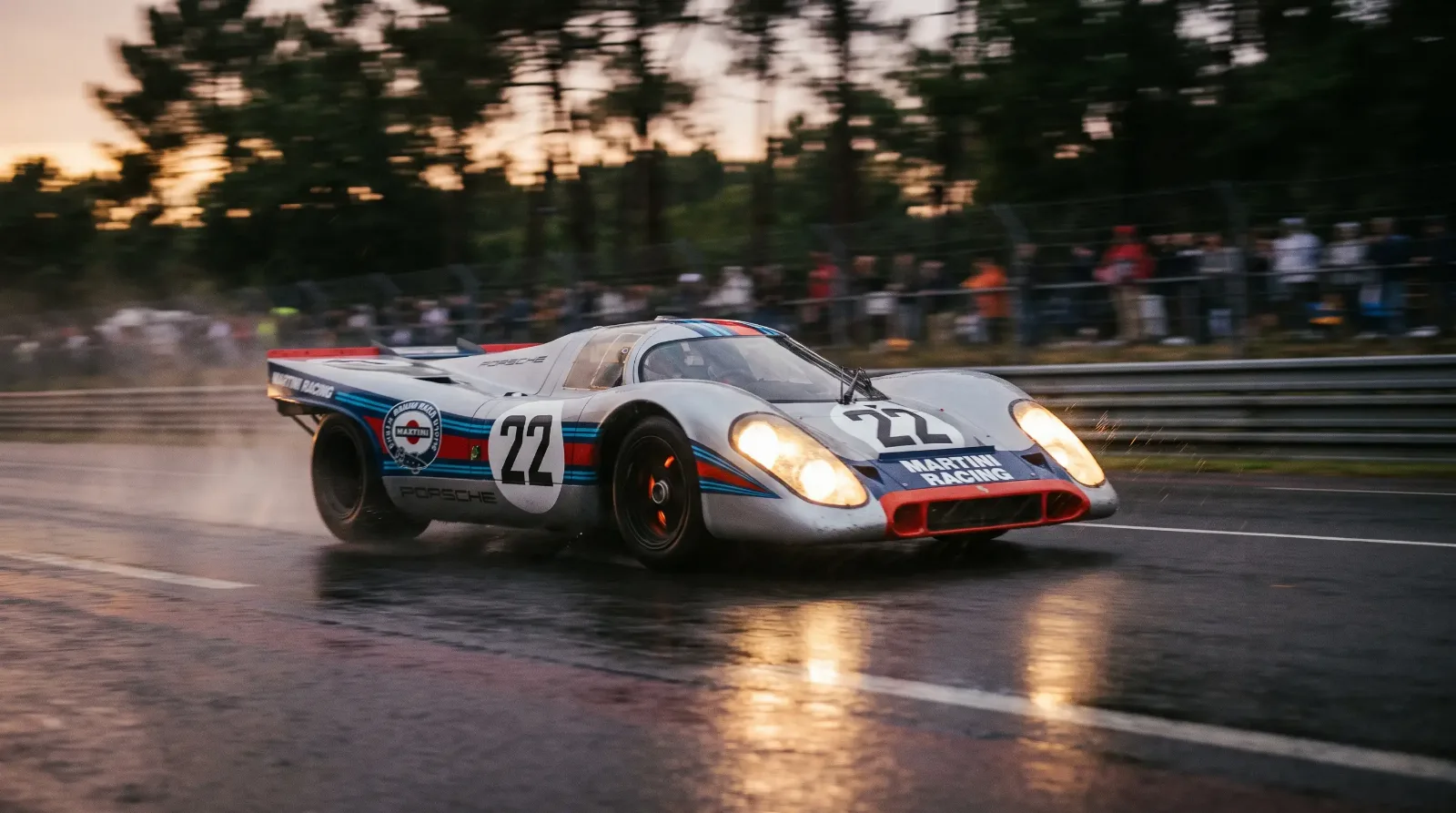
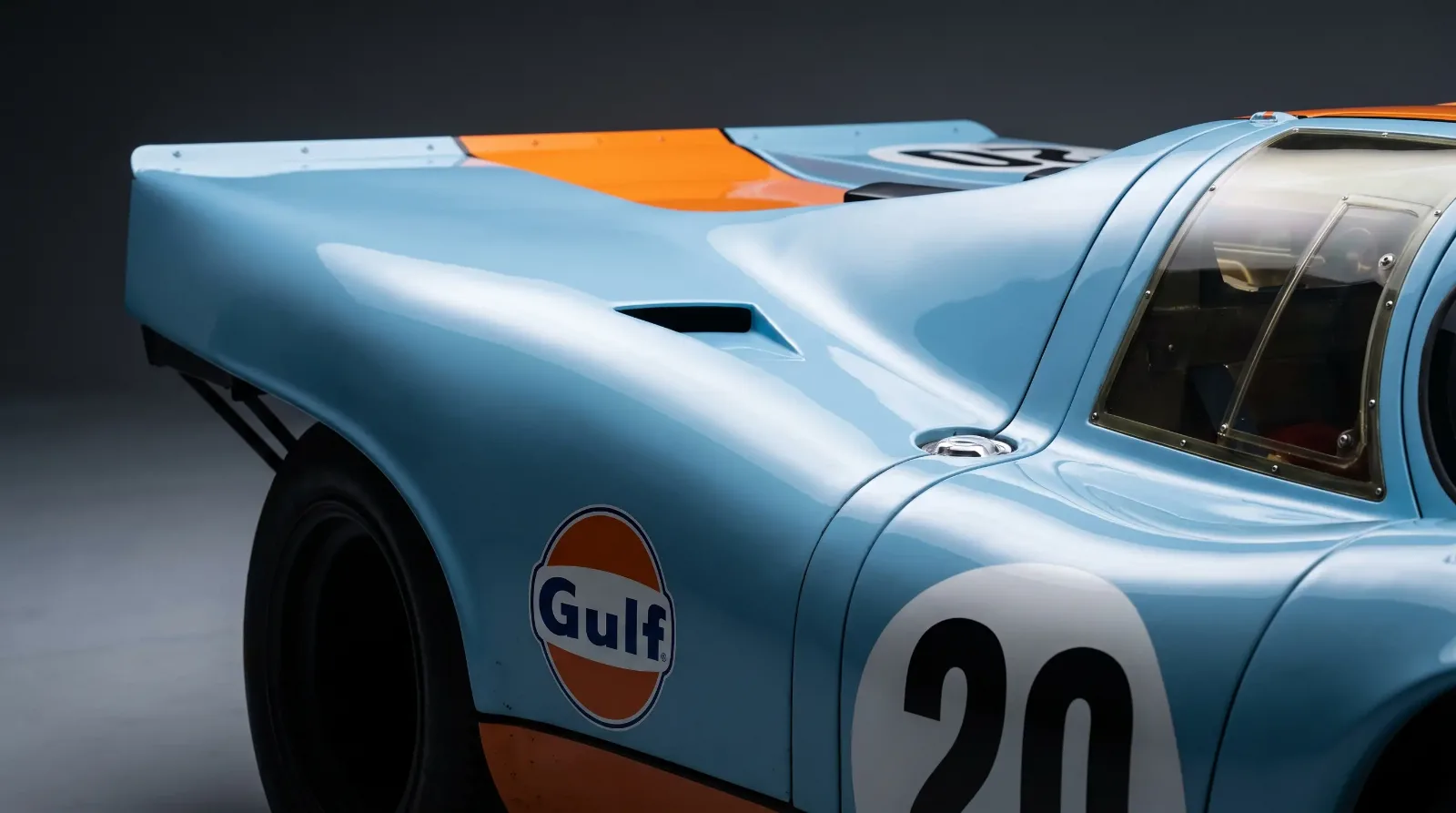
By the following year, 1971, Porsche and Martini Racing's 917 won again, this time in a short-tail car built around a lighter magnesium-alloy chassis, and the distance it covered, over 5,300 kilometers, stood as a Le Mans record for close to four decades. But 1970 is the one people point to, because it is the first, and because of how close Porsche had come and failed in the years before it. The car's story does not end at the finish line either. Gulf Oil's sponsorship of the rival 917 team produced its own chapter in the model's history, one covered in the next story in this set, and anyone assembling the full picture of the model should read both pieces together.
For a broader view of how this single race fits into the company's decades of competition, the classic Porsche story covers the wider arc from the 356 through the air-cooled 911 era. And if the 917's history has you thinking about what it is like to own something from this period, there are always classic Porsches for sale to browse, even if none of them come with a 4.5-liter flat-12 in the back.
What the win actually changed
The immediate effect was commercial as much as sporting. Porsche's reputation shifted overnight from a maker of well-engineered small cars into a manufacturer capable of beating anyone, anywhere, on the biggest stage endurance racing offered. Dealers reported a jump in interest in road cars that had nothing mechanically in common with the 917, simply because the name on the hood had just won the world's hardest race. That halo effect, more than the trophy itself, is the real legacy of June 1970. The rain stopped, the Salzburg car crossed the line, and Porsche stopped being an underdog for good.
Sources and notes
Related Reading
Have a
Porsche
for Sale?
Reach thousands of serious classic car collectors across the US.
Sell It Here →
Are You a Classic Car Dealer?
List your full inventory and connect with targeted classic car buyers.
Join as a Dealer →

About the author
Patrick Walsh
Automotive journalist covering classic car shows, events, and the enthusiast community across North America.
Related Listings - Porsche
Comments
Be the first to comment on this article.