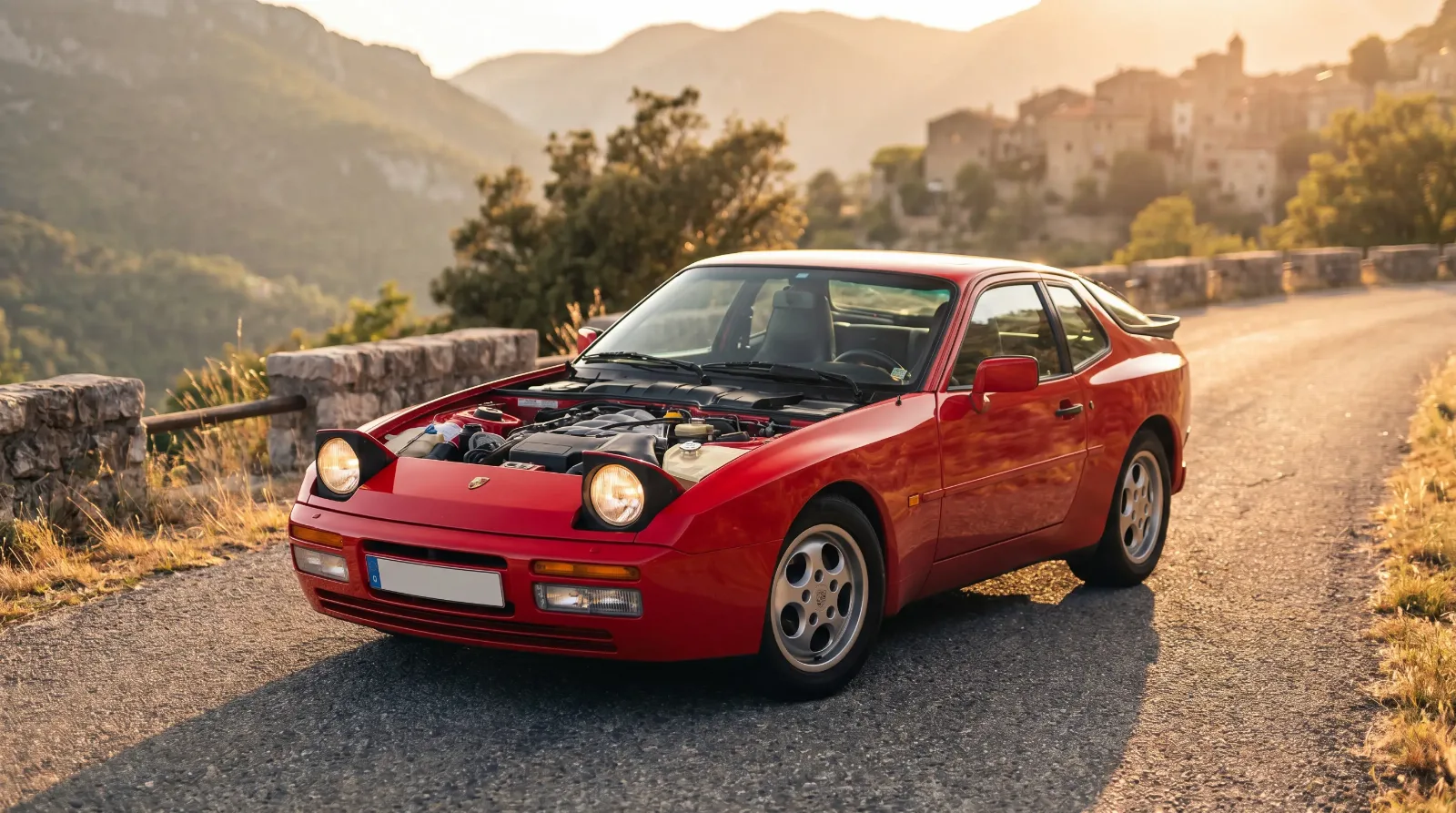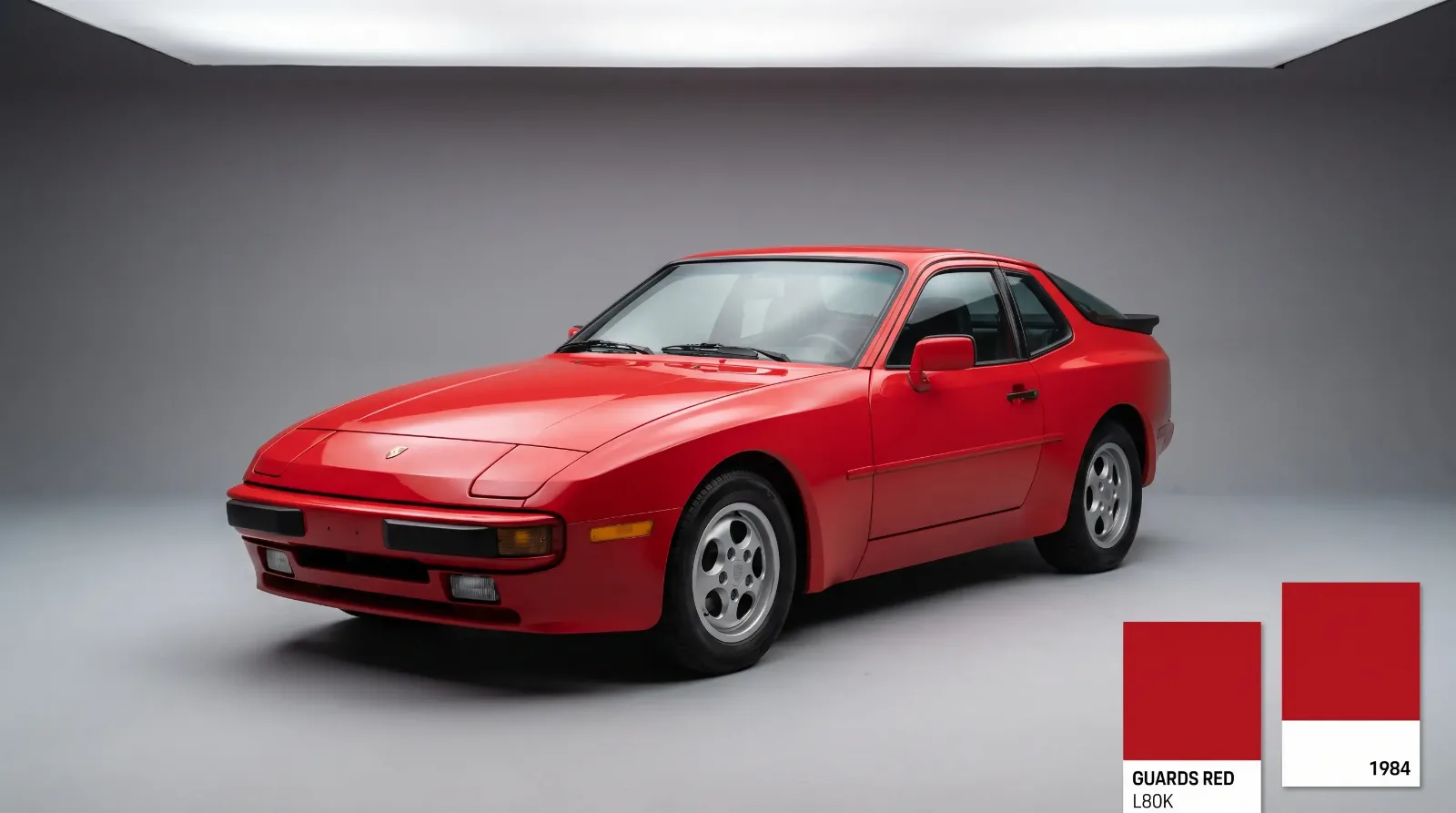
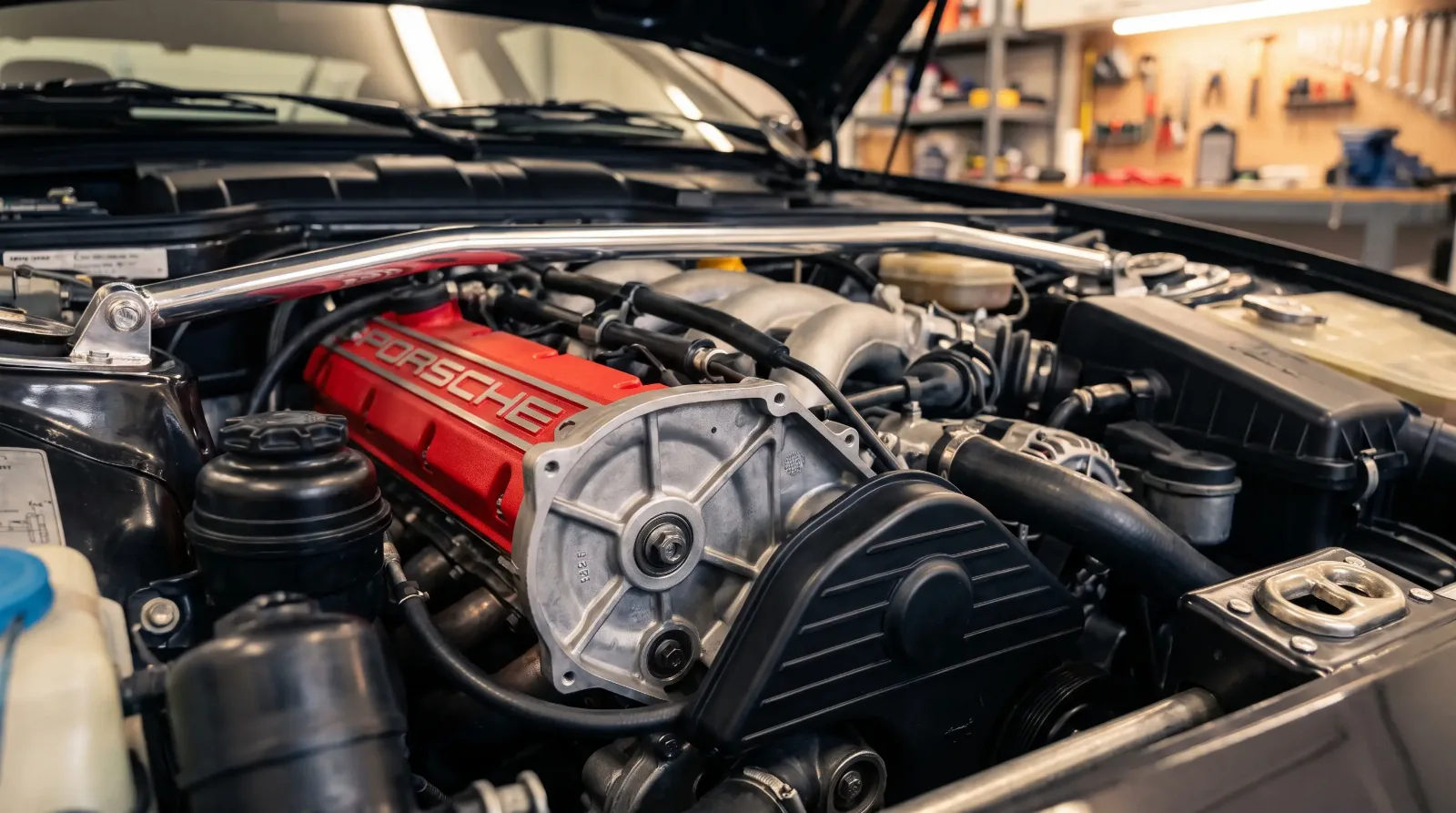
The Porsche 944 engine is a big four-cylinder that shouldn't feel as smooth as it does, and the reason comes down to two balance shafts spinning at twice crankshaft speed. Big fours vibrate. That's just physics, the larger the cylinders, the more the engine wants to shake itself apart at speed. Porsche's answer was to license a Mitsubishi patent, bolt two counter-rotating shafts into the block, and cancel out the vibration before it ever reached the driver's hands. It worked, and it's the single biggest reason the 944 doesn't feel like a compromise sitting next to a six-cylinder Porsche.
Where the engine actually came from
The 944's 2.5-liter four wasn't designed from a blank sheet. Porsche took the 928's 4.5-liter V8, cut it roughly in half, and built a standalone four-cylinder architecture around that bore and stroke. That lineage explains why the 944 engine feels more substantial than a typical economy-car four of the era, because underneath it's sharing DNA with a genuine V8 GT engine, not a parts-bin compact car motor. The result made 143 hp in US-spec base form at launch in 1982 (European versions were rated higher, around 161 hp, under a different test standard), a real number for a naturally aspirated 2.5-liter four in that period, not an inflated brochure figure.
The 924 that preceded the 944 used a smaller, lighter four sourced from the VW/Audi parts bin, and it worked fine for what it was, but it never felt like a Porsche engine to people who knew what to compare it against. The 944's engine solved that problem by being genuinely Porsche's own casting, machined and assembled with the same standards as the flat-six units going into 911s at the same factory. That's not marketing language, it's the actual production history, and it's why the 944 never got dismissed as a badge-engineered economy car the way some competitors from other manufacturers did during the same period.
The balance shaft math nobody talks about
Here's the number that matters. A four-cylinder engine produces second-order vibration at twice engine speed, and above roughly 2,500-3,000 rpm that vibration becomes noticeable enough to fatigue a driver on a long trip. Porsche's balance shafts spin at exactly double crankshaft speed in opposite directions, and the counter-rotating forces cancel the shake almost entirely. The Mitsubishi patent Porsche licensed had already proven the concept in four-cylinder applications, and Porsche's execution of it in the 944 remains one of the cleaner implementations from that era. It's a two-shaft system, not the more common single-shaft designs that only partially cancel the vibration.
What changed across the 944's life, in real numbers
The base 2.5-liter engine grew over the model's run, not just in trim badges but in actual displacement and output. The 944S added a 16-valve head and pushed output to 187 hp without a turbo. The 944 Turbo kept the 8-valve architecture but added forced induction, landing at 217 hp at introduction and a genuinely different torque curve, the kind that makes a car feel quick from a stoplight instead of just quick on paper. The final 944 S2 bumped displacement to 3.0 liters and 16 valves, landing at 208 hp naturally aspirated, which is a real number for a four-cylinder street car in 1989, not catalog fantasy.
What's easy to miss in that progression is how Porsche solved the same power problem two different ways. The Turbo chased power through boost while keeping the simpler 8-valve head, which meant more heat and more stress on the internals under sustained hard driving. The S2 chased the same power range through breathing, a 16-valve head and more displacement, which meant a less peaky delivery and, in practice, an engine that tolerates a harder life without a turbo's added complexity. Neither approach is wrong. They're just different bets on where the risk sits, and that risk profile still shows up in used-market reliability patterns today.
| Variant | Displacement | Valve config | Approx. power |
|---|---|---|---|
| 944 base (US) | 2.5L | 8-valve | 143 hp |
| 944 Turbo | 2.5L turbo | 8-valve | 217 hp |
| 944 S | 2.5L | 16-valve | 187 hp |
| 944 S2 | 3.0L | 16-valve | 208 hp |
Why this design still matters to buyers
The balance shaft system is also the part of the car that separates a well-maintained example from an expensive mistake. That second belt runs the balance shafts and it fails on its own schedule, independent of the main timing belt. A snapped balance shaft belt at the wrong rpm bends valves and can crack a piston, and the repair bill dwarfs what most people expect walking into a "cheap Porsche." The number that actually matters when shopping isn't horsepower, it's service records. A documented belt interval history is worth more than a few extra claimed horsepower on an unverified example.
"Everybody wants to talk about the Turbo's power number. The number I actually care about is the date on the last balance shaft belt service. That number tells you whether the engine you're buying is going to last or grenade itself in six months."
— Dan Reeves
The engine's place in the bigger picture
This balance-shaft design is the mechanical heart of the transaxle Porsches, carried forward with refinements all the way into the 968's final 3.0-liter unit. It's a rare case of Porsche licensing outside technology, adapting it cleanly, and getting a decade and a half of use out of the decision without a major redesign. That's a good return on one engineering choice made in the late 1970s.
For the next story in this set, covering a specific color and production detail from the same era, see the next story in this set.