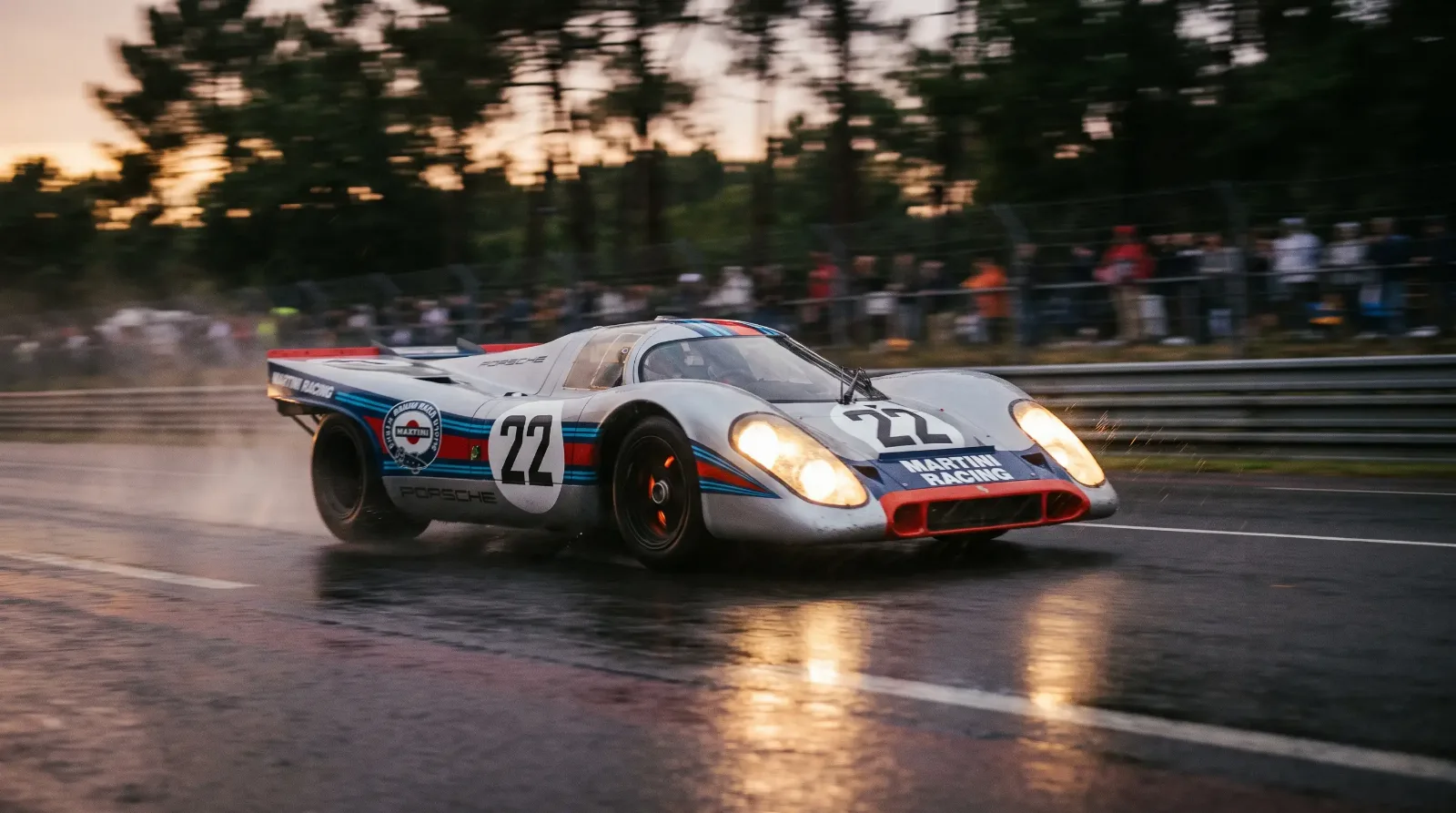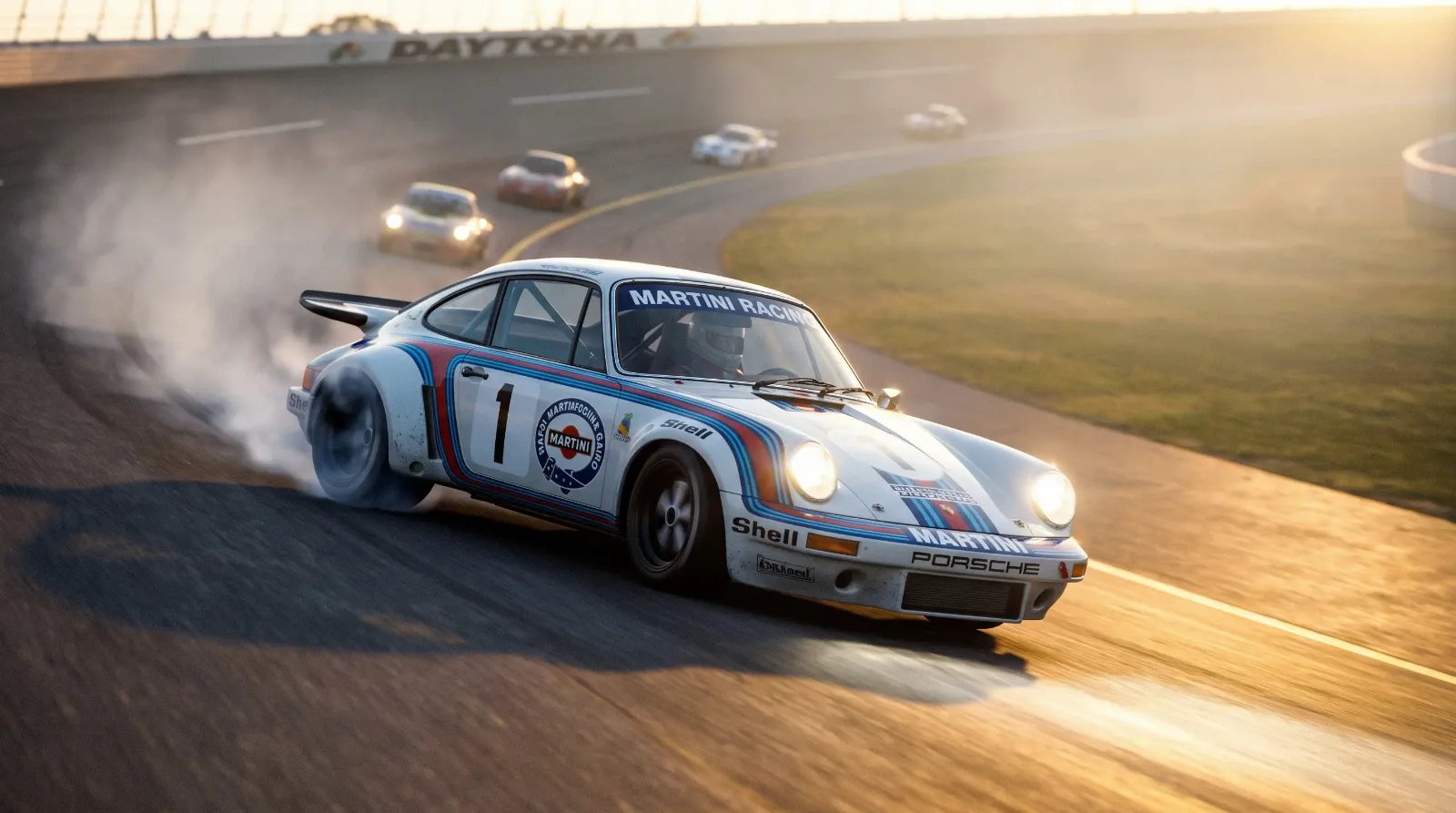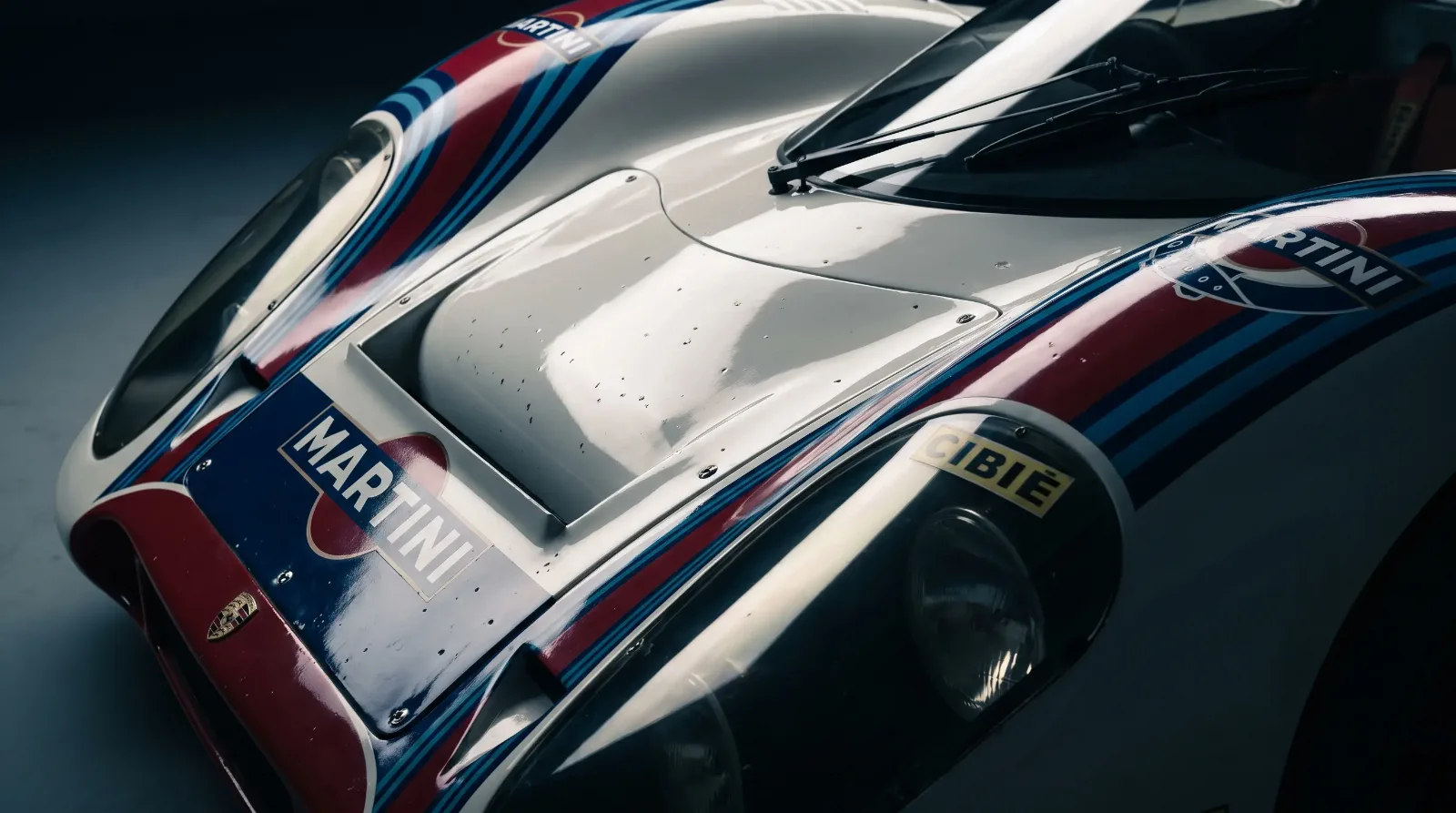
Ask ten people to picture a Porsche race car and at least six of them will describe the same thing without ever having planned to: a white body slashed with bands of red and dark blue, sponsor script running low along the rocker panels. That's Martini Racing Porsche, and it has become such a fixed part of how people visualize Porsche's competition history that it's easy to forget the livery started on a 917 in the early 1970s and kept reappearing, on 936s, 935s, and 956s, for the better part of two decades. Few sponsor liveries in any sport have aged this well or been imitated this often.
Where the stripes came from
Martini & Rossi, the Italian vermouth maker, had been involved in motorsport sponsorship since the 1960s, backing Lancia and other European efforts before its partnership with Porsche took shape in the early 1970s. The deal made sense on paper for reasons beyond marketing: Martini wanted association with a manufacturer that was winning consistently, and Porsche's factory racing program, flush with success from the 917, needed sponsorship money to keep funding an increasingly expensive arms race against Ferrari and the rest of the endurance racing field.
The livery itself, that particular arrangement of red and blue bands over white, wasn't unique to racing; it echoed Martini's existing branding. But applied to the low, wide bodywork of a 917 or later a 936, it did something the brand's print advertising never managed. It made the sponsorship look inseparable from the machine, as though the car had always been meant to wear those colors.
The cars that carried it best
The Martini livery's earliest celebrated years ran through the long-tail and short-tail 917 endurance racers at Le Mans in 1970 and 1971, before finding its most famous home on the 936, the car that returned Porsche to Le Mans victory in 1976 and 1977 after the factory had stepped back from outright prototype racing for a few seasons. Jacky Ickx, driving Martini-liveried cars across multiple seasons, became as associated with the paint scheme as any driver in Porsche's history, and the pairing of a fast, patient driver with an instantly recognizable livery did a great deal to cement both in the public imagination.
The scheme reappeared later on 935s and 956s through the late 1970s and into the 1980s, proof that Porsche's marketing department understood something a lot of manufacturers still get wrong: a good livery doesn't need reinventing every season, it needs protecting. The core proportions and color placement stayed remarkably consistent across a decade of different chassis, which is exactly why it reads as one continuous story rather than a series of unrelated sponsorship deals.
| Chassis | Era | Notable result under Martini colors |
|---|---|---|
| 917 LH, 917 K | 1970-1971 | Le Mans overall win (1971) |
| 936 | 1976-1977, 1981 | Le Mans overall wins |
| 935, 956 | Late 1970s-1980s | WEC and Group C rounds |
Getting the stripes right wasn't simple
Applying a sponsor livery to a race car sounds like a paint department's problem, but on cars shaped by ground effect and constantly revised bodywork, it was closer to an engineering exercise. The 917's swooping bodywork and the 936's low nose meant the stripes had to be redrawn, not just resized, for each new chassis so the proportions still read correctly at speed and from a grandstand. Porsche's competition department worked closely with Martini's own design team on every application, which is part of why the livery never looks slapped on the way some sponsor decals from the same era clearly do.
Weather and circuit conditions complicated things further. Endurance races run through rain, darkness, and hours of tire dust, and a livery that looked sharp on pole day needed to still be legible to timekeepers and photographers after twenty hours of racing. Porsche's painters used specific masking techniques to keep the stripe edges crisp even as the rest of the body picked up scuffs, grime, and rubber marbles, a detail that mattered more to the sponsorship deal than most fans ever noticed.
Why it still sells cars and posters
Decades on, the Martini livery has outgrown its original sponsorship deal entirely. It shows up on tribute liveries for road-going 911s, on scale models, on apparel that has nothing to do with either Porsche or vermouth, and its resale value as a design in its own right says something about how rare it is for a corporate paint scheme to become genuinely beloved rather than merely tolerated. Part of that longevity traces to timing: the livery arrived during Porsche's racing legend years, when the 917 was already reshaping what people expected from endurance racing, and it rode that momentum through every subsequent chassis it touched.
"You could cover a 936's badges and most enthusiasts would still name the car in half a second, because the stripes did as much identity work as the silhouette ever did."
— Patrick Walsh
The engineering story behind the paint
It's worth remembering that the Martini cars weren't winning on looks. The same period that produced the livery's most famous appearances also produced some of Porsche's most important aerodynamic and engine development work, much of it driven by the same competition department responsible for the 917, 936, and 956 programs. For readers who want to understand the technical decisions behind those wins rather than just the paint scheme, a related deep-dive covers the engineer most responsible for turning Porsche's race cars into aerodynamic problem-solvers rather than simply fast, brave machines.
The livery endures because the cars underneath it kept winning long enough for the two to become inseparable in memory. Take away the results and it's just an attractive paint job. With them, it's shorthand for one of the most successful stretches any manufacturer has had in endurance racing.
Talk to anyone who restores period Porsches for a living and they'll tell you the Martini scheme is also one of the hardest to get right on a modern restoration. The stripe widths, the exact placement of the sponsor script, the specific shade of blue against the white, all of it has to match period photographs rather than a generic template, because enthusiasts who know the cars will spot an inaccurate stripe from across a concours field. That level of scrutiny is its own tribute to how carefully the original livery was designed in the first place.