The engineering problem facing European sports car makers right after the war was brutal and specific: rebuild an industry with bombed-out factories, rationed steel, and almost no domestic market able to afford a sports car, then somehow produce something worth exporting. What actually made it to American shores in the late 1940s reflects some genuinely clever solutions to that problem, and a few honest compromises where the engineering had to bend to what materials and capacity actually allowed.
I look at this era from a systems angle: what were the actual constraints, what tradeoffs did engineers make under those constraints, and what failed as a result. For the wider decade context, the late 1940s import sports cars guide is worth reading alongside this piece.
The manufacturing constraints were real
Steel was rationed across postwar Europe, and what was available often went to reconstruction and export industries the government prioritized over domestic car production. That single fact shaped nearly every engineering decision European makers made in this period. Lighter, smaller-displacement engines were not always a stylistic choice, they were frequently the only option available given material constraints and the punishing tax structures several European governments imposed on larger-displacement cars.
Labor was skilled but scarce, and factories themselves had often been damaged or repurposed during the war. That combination pushed several manufacturers toward smaller-scale, higher-craftsmanship production runs rather than the mass-manufacturing approach American companies were scaling back up to during these same years. It is a genuinely different production philosophy, born less from choice than from necessity, and it produced cars with a different character as a direct result.
Jaguar's XK120 and what its engineering actually solved
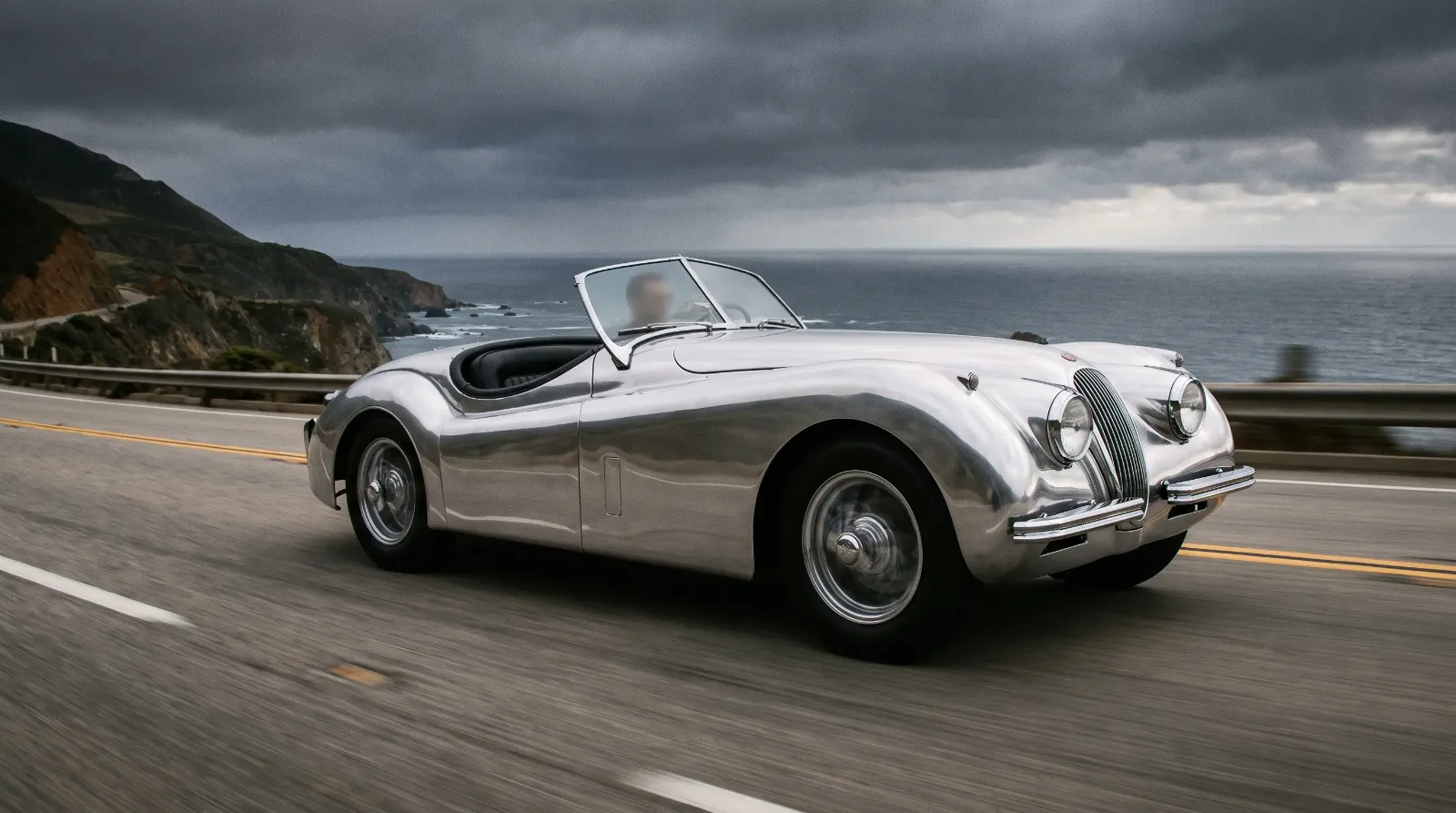
The Jaguar XK120, introduced in 1948, is worth examining closely as an engineering response to these constraints rather than just an admired design. Its twin-cam straight-six engine delivered genuinely strong performance for the era, and the car's claimed top speed made it, at launch, one of the faster production cars available anywhere, a genuine engineering achievement given the resource constraints Jaguar was working under.
What made the XK120 work as a business proposition was that it paired real performance with a price the American market could absorb, which was not a given for European sports cars trying to export in this period. Jaguar priced it aggressively relative to what it delivered, and American buyers responded, giving the company an export success story that other manufacturers studied closely.
MG and the case for simplicity as engineering discipline
MG's postwar TC model took a different, more austere approach, and the engineering logic behind that austerity is worth understanding on its own terms. Rather than chase outright performance, MG built a lighter, mechanically simpler car that was easier to produce under constrained conditions and easier for owners to maintain without specialized support. That is a legitimate engineering strategy, not a lesser one, and it succeeded on its own terms: American servicemen who had encountered the TC while stationed in Britain brought that enthusiasm home with them, and MG built a genuine following in the United States as a direct result.
| Manufacturer | Approach | Engineering tradeoff |
|---|---|---|
| Jaguar (XK120) | Performance-focused, aggressive pricing | Advanced twin-cam engine balanced against production cost |
| MG (TC) | Simplicity and reliability | Modest performance in exchange for ease of maintenance and lower cost |
| Porsche (356, late 1940s) | Lightweight, rear-engine efficiency | Small displacement engine compensated by minimal weight |
Porsche's early approach, a different constraint set
Porsche's earliest postwar cars, developed under an even more resource-constrained environment than the British manufacturers faced, offer a useful contrast in engineering philosophy. Rather than chase power, the small team working on the 356 leaned entirely into weight reduction and aerodynamic efficiency, extracting genuine performance from a small-displacement engine by minimizing everything the engine had to move. That is a coherent engineering strategy in its own right, and one that would define Porsche's approach for decades afterward, not an accident of postwar poverty that the company simply grew out of once resources improved.
The early 356 did not reach the American market in significant numbers until slightly later than Jaguar and MG established their footholds, but the underlying engineering logic, do more with less rather than simply do less, is directly traceable to these same postwar constraints. Understanding that origin helps explain why Porsche's design philosophy remained consistent even after the company had the resources to build something heavier and more powerful, had it chosen to.
Why American buyers responded at all
The American market these cars entered had almost no domestic equivalent. Big Three sports cars barely existed yet, and what passed for a sporting American car in the late 1940s was usually a full-size sedan with a slightly firmer suspension rather than anything genuinely nimble. Returning servicemen who had encountered small, responsive European cars overseas found nothing like them at home, and that gap in the market is what these imports filled, quite deliberately in some cases and somewhat by accident in others.
The honest engineering assessment is that these cars were not uniformly excellent. Reliability varied significantly between makes, parts support in America was thin at first, and the failure modes, electrical systems especially, were a real source of owner frustration that period road tests documented candidly. The successes, Jaguar and MG chief among them, succeeded because they solved a specific problem well enough to outweigh those real shortcomings, not because the shortcomings did not exist.
"I like this era because the engineering tradeoffs are so visible if you look for them. Every one of these cars is a set of decisions made under real constraints, and you can trace almost every design choice back to a specific material shortage or a specific market gap the engineers were trying to close."
— Emily Chen
If you want to see how those European engineering traditions carried forward into today's collector market, classic European cars is worth a look. And the broader question of how postwar cars diverged from what came before deserves its own examination, which read on covers in detail.