Step back far enough from the muscle car era and the pro street 55 chevy tells a different story than the Camaros and Chevelles that came a decade later. This is a hot rod platform first, a car that was already a customizing icon before Pro Street existed, and builders who tubbed a 1955 Chevy in the 1980s were folding two generations of car culture into one build.
A body that predates the muscle car era entirely
The 1955 Chevrolet, along with its 1956 and 1957 siblings, arrived a full decade before the muscle car boom that produced the Camaro and Chevelle. By the time Pro Street builders started looking at the Tri-Five as a canvas, the car already carried decades of hot rod history behind it, having been a favorite among customizers and drag racers since almost the moment it left the factory. Tubbing a 55 Chevy for Pro Street meant working within an established, almost reverent hot rod tradition rather than inventing a new use for a recently retired muscle car.
That history shaped how builders approached the platform. A Tri-Five Pro Street build had to answer to two audiences at once, muscle car fans drawn to the tubbed rear end and big engine, and traditional hot rodders who had strong opinions about how a 55 Chevy should look and what modifications respected the car's existing customizing legacy.
Small-block Chevy power, appropriately
The 1955 model year is historically significant for one specific reason relevant to Pro Street builders: it introduced the small-block Chevy V8 to the world. That connection was not lost on Pro Street builders decades later, and a tubbed 55 Chevy running a built small-block carried a certain poetic logic that a big-block swap, however powerful, never quite matched. Plenty of builders ran 350s and 383 strokers specifically because pairing the platform that introduced the small-block with a modern version of that same engine family felt like the correct choice, not just the cheap one.
That said, plenty of builders went big-block anyway, chasing the same tunnel-ram-and-dual-carb spectacle that defined so much of the Pro Street look regardless of platform. The Tri-Five's roomy engine bay accommodated either choice without much drama.
"Putting a built small-block in a tubbed 55 wasn't just practical. It closed a loop that started with that same car in 1955."
- Patrick Walsh
A different visual language than the muscle cars
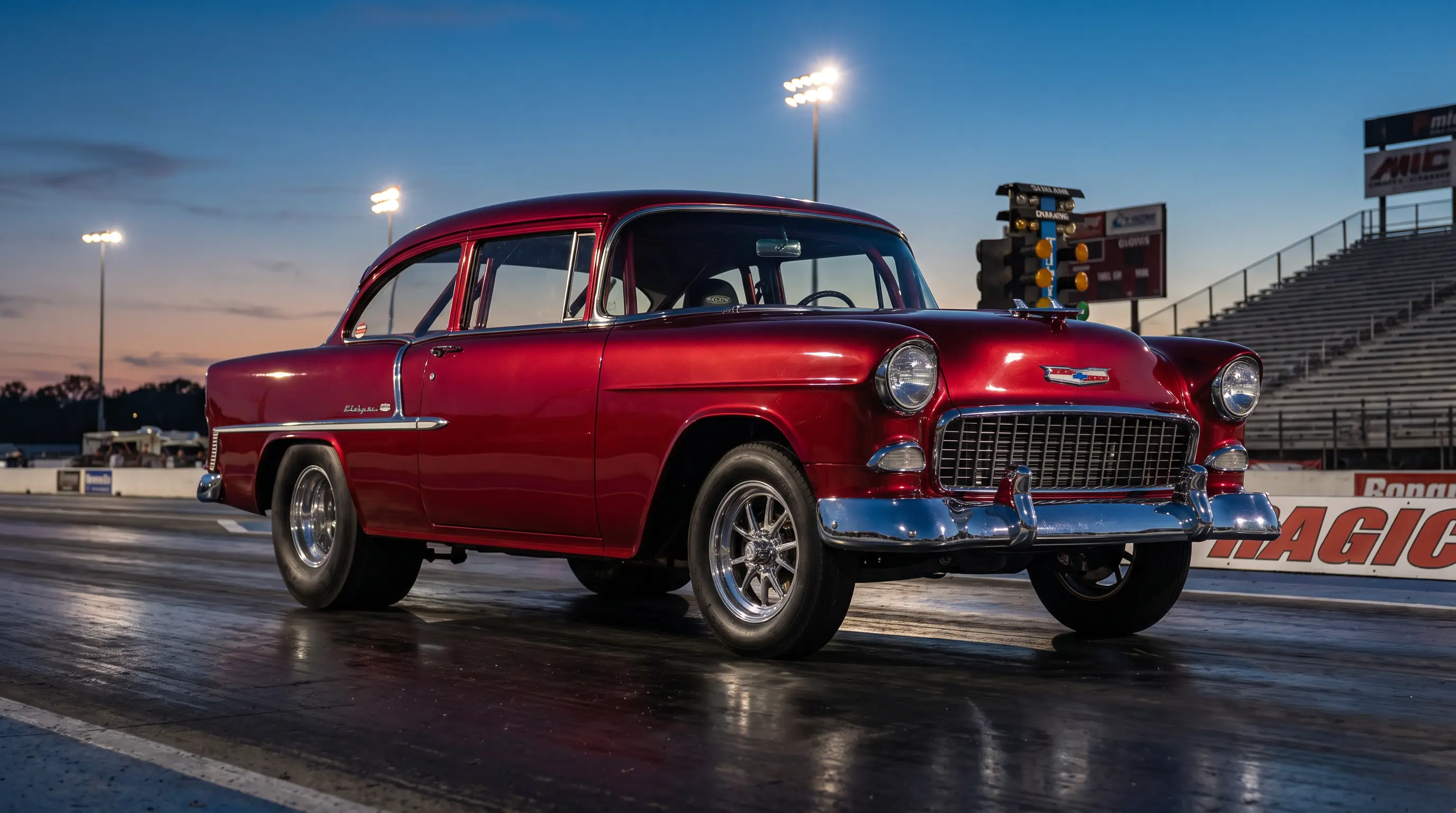
A Pro Street 55 Chevy tends to read differently at a show than a tubbed Camaro or Chevelle, even with a similar rear tire and stance. The Tri-Five's rounder, more upright 1950s body lines create a distinct silhouette once the rear quarters are flared and the ride height dropped up front, something closer to a traditional hot rod wearing Pro Street modifications than a muscle car pushed to an extreme. That visual contrast is part of why 55 Chevy builds stood out at mixed shows where Camaros and Chevelles otherwise dominated the field.
Paint and finish work on Tri-Five builds also tended to lean more toward traditional hot rod color choices, deep candies and classic two-tones, rather than the bolder single-stage colors common on 1970s muscle car platforms, reflecting the different customizing tradition the body style came from.
How the 55 Chevy fits the wider Pro Street story
Seeing the Tri-Five's place in Pro Street history means understanding how the movement grew to embrace a pre-muscle-car platform in the first place, expanding beyond the Camaros and Chevelles that defined its most visible years. For our pro street muscle cars retrospective, the 55 Chevy represents an instructive outlier, proof the movement's core idea, a tubbed rear end and a big engine, translated to a body style from an entirely different era of American car design.
Chevy's compact lineup offered its own outlier too, and the two stories connect through shared small-block heritage and a similar willingness among builders to work outside the standard muscle car platform list. Here, a related story covers that other Chevy compact's own Pro Street path, which followed a somewhat different trajectory than the Tri-Five's hot rod pedigree.
Collecting a Tri-Five Pro Street build today
Genuine period Pro Street 55 Chevys carry real weight with collectors specifically because the platform sits at the intersection of two respected collector categories, traditional hot rods and Pro Street builds. A well-documented example with period-correct tub work and a verifiable history draws interest from buyers on both sides of that line, which can push prices higher than a comparable Camaro build with a similar spec sheet.
Because Tri-Fives were already valuable and sought-after before any Pro Street builder got near one, surviving tubbed examples from the golden era are genuinely scarce. Anyone hunting for one should watch listings closely and move quickly when a documented example appears, since these do not sit on the market long. Pro Street cars for sale now is a good place to start tracking what is currently available.
Where two traditions meet
The Pro Street 55 Chevy never fit neatly into either the muscle car world or the traditional hot rod world, and that is exactly what made it interesting. Builders who tubbed a Tri-Five were making a deliberate statement about where Pro Street's roots actually reached, further back than most casual observers assumed, and that statement still resonates with collectors who understand the platform's full history today.
Tri-Five model years and what changed
The three Tri-Five model years, 1955 through 1957, each carried slightly different styling cues that mattered to builders choosing a starting point for a Pro Street project.
| Model year | Builder notes |
|---|---|
| 1955 | Introduced the small-block V8, cleanest early Tri-Five grille and trim |
| 1956 | Revised grille and trim, similar structure to 1955 |
| 1957 | Most recognizable year with tailfins, most commonly chosen for builds |
The 1957 model, with its distinctive tailfins and chrome trim, became the most popular Pro Street starting point specifically because it was already the most collected and recognized Tri-Five year, meaning a finished build carried instant visual recognition even before a spectator noticed the tubbed rear end. The plainer 1955 held its own appeal for builders who wanted to lean into that small-block heritage connection more directly, favoring understatement over the 57's chrome-heavy presence.
Structural differences between the three years were modest enough that back-half kits developed for one Tri-Five year generally adapted to the others without major rework, which kept the platform accessible to builders regardless of which specific year they managed to find as a donor car.
Donor car availability shifted the calculation somewhat by the 1980s, since decades of hot rod interest had already pulled a lot of clean Tri-Fives into private collections long before Pro Street builders started looking for tubbing candidates. Finding a rough, project-grade 55, 56, or 57 at a reasonable price took more legwork than sourcing a comparable Camaro or Chevelle, which is part of why fewer Tri-Five Pro Street builds exist relative to the muscle car platforms that came a decade later.