
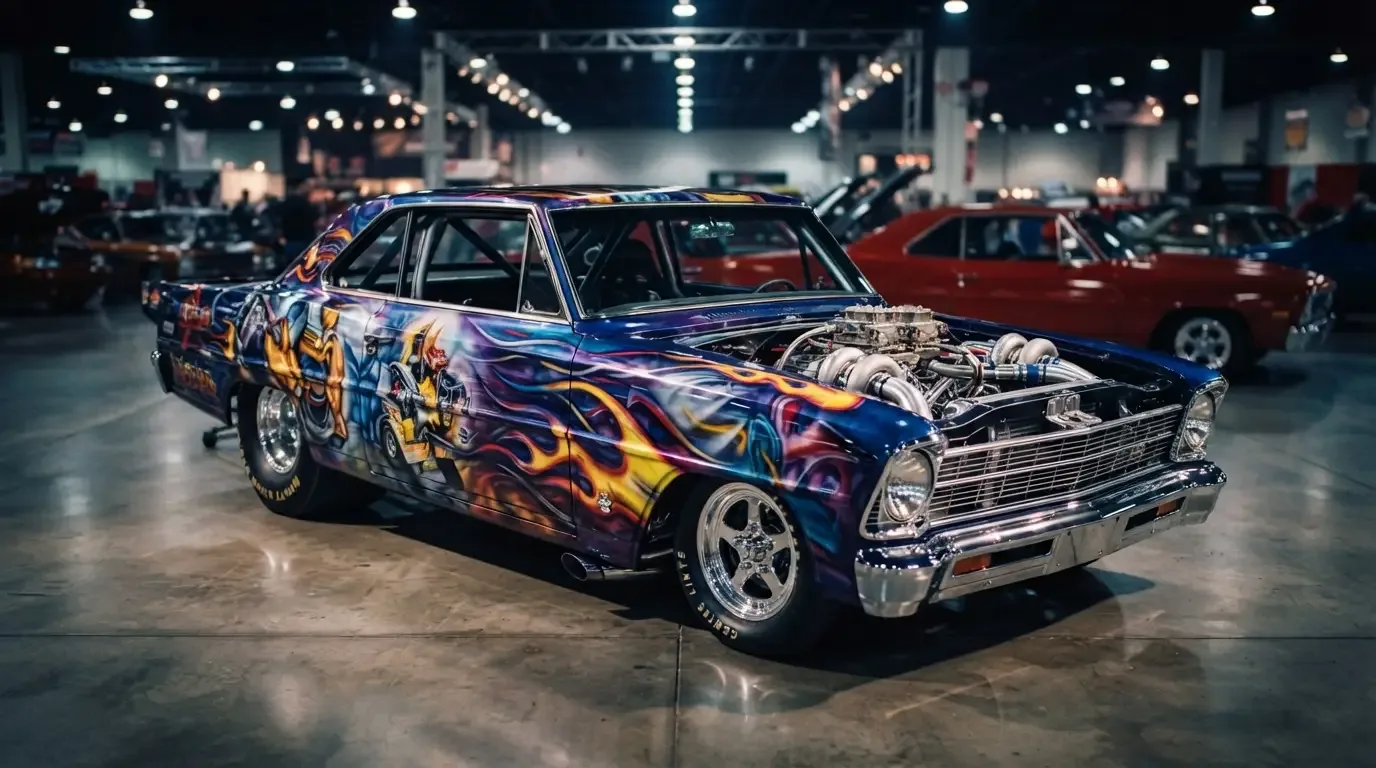
There is a photo that used to circulate at every club swap meet worth its salt, a shot of Rick Dobbertin's 1965 Chevy II sitting under harsh show lights with its hood raised, twin turbochargers catching the glare like chrome jewelry. Somebody always had a story about the first time they saw that car in person, usually followed by a low whistle and a shake of the head. Before the Pontiac J-2000 made Dobbertin a household name in wider pro street circles, this Chevy II was already doing the work of turning him into a legend.
Car Features
6 min read
Rick Dobbertin's Twin-Turbo Chevy II
Before the J-2000 made him famous, Rick Dobbertin's twin-turbo, supercharged, nitrous-fed 1965 Chevy II set the standard for what a serious pro street build could be.
A speed shop background that shaped the build
Dobbertin ran a Virginia-based speed shop in the late 1970s that specialized in turbocharging, supercharging, and nitrous oxide injection, and by his own account, the idea for the Chevy II grew out of a simple thought while printing shop T-shirts advertising all three specialties. Why not put all of it into one car. That is essentially what he did, and the result was a build that treated forced induction as a layered system rather than a single choice between one method or another.
The finished car ran on a 454 cubic inch LS7 big block Chevrolet V8, fed by Holley 750 cfm carburetors and boosted by twin Roto-Master turbochargers working alongside a BDS 6-71 supercharger, with an 8-port nitrous oxide system stacked on top for good measure. Power went through a B and M Comp Turbo 400 transmission to a Dana 60 rear end, with JFZ brakes handling the stopping duties. Twin radiators kept the whole combination from cooking itself under sustained use, a real concern given how much heat that stack of forced induction methods was capable of generating. Cooling a 454 big block running twin turbos, a positive-displacement supercharger, and nitrous all at once is not a job for a single radiator, and running dual cores was as much a functional necessity as it was an engineering flex for the cameras.
Layering three induction systems without destroying the engine
Combining twin turbochargers, a positive-displacement supercharger, and a nitrous system on the same engine is not simply a matter of bolting all three pieces onto an intake and hoping for the best. Each system changes the pressure and temperature the others have to work around, and getting them to cooperate instead of fighting each other under load takes careful tuning of boost control, fuel delivery, and ignition timing across the whole power band. A turbo system that spools too aggressively on top of an already-boosted intake charge from a supercharger can push cylinder pressures past what even a stout 454 big block can survive, and adding nitrous into that mix without accounting for the extra oxygen and fuel volume already present from the forced induction stack is a fast way to turn a showpiece into a pile of broken parts. Dobbertin's speed shop background in exactly these three disciplines is likely what kept the Chevy II's engine intact through years of demonstration runs rather than becoming another cautionary tale about overreaching on paper specifications.
Three thousand hours and a full roll cage
Dobbertin put more than three thousand hours into the build across roughly three years, and that time investment shows in details that went well beyond the driveline. A full roll cage and a Deist Flame Out fire suppression system reflected a builder who understood exactly how much could go wrong with an engine bay running this much boost and this much nitrous at once, and who built accordingly rather than cutting corners on safety to chase a faster build schedule.
Awards that backed up the engineering
The Chevy II earned Hot Rod magazine's Street Machine of the Year honor in 1982, and it followed that with top awards at the Car Craft Street Machine Nationals in both 1982 and 1983, a two-year run of recognition at one of the sport's most respected events. That consistency across multiple years and multiple judging bodies set the car apart from builds that peaked for a single season before fading from view. You can trace how this fits into the wider arc of Dobbertin's career, and how it set up everything that followed with the J-2000, in our complete history of the movement's most significant machines.
"A car that wins the same category two years running is not coasting on reputation. Judges expect more the second time around, and this one delivered more."
- Wayne Coburn
Notoriety earned the hard way
What made the Chevy II stand out from other heavily boosted pro street cars of its era was not just the sheer number of induction methods layered onto one engine, but the fact that it actually ran and drove reliably enough to be shown, driven to events, and demonstrated in front of crowds rather than sitting as a static display piece. Building a car that could survive twin turbos, a supercharger, and nitrous all working in concert without grenading the engine on its first serious pull took real engineering discipline, not just ambition. That combination of ludicrous specification and genuine functionality is what earned it lasting respect among people who actually understood what they were looking at under the hood.
How the Chevy II set up everything that came after
Success with the Chevy II gave Dobbertin both the reputation and the confidence to attempt something even more ambitious with the Pontiac J-2000 a few years later, a build that traded the big block muscle car formula for an unlikely four-cylinder platform wrapped around an equally extreme engineering approach. Without the Chevy II proving that Dobbertin could execute a multi-system forced induction build reliably enough to show, drive, and demonstrate in public, it is hard to imagine builders or magazine editors taking the far stranger J-2000 project as seriously as they eventually did. The two cars are best understood as a pair rather than as separate, unrelated projects, since the second build only makes sense in light of what the first one already proved was possible.
A legacy that still gets referenced
Decades later, the Chevy II remains a touchstone example whenever pro street enthusiasts discuss what a truly committed build from the early 1980s looked like. It set a standard for combining multiple forms of forced induction that few builders since have attempted to match, let alone exceed, and it established Dobbertin's reputation well before his later, more visually flamboyant projects carried his name to an even wider audience. Anyone hoping to understand where the movement's most ambitious engineering came from should start here. And for those drawn to the era this car represents, it is worth taking time to find a classic Pro Street car that carries some of that same period-correct engineering spirit.
Sources and notes
Related Reading

About the author
Wayne Coburn
Longtime Corvette owner, judge and club figure who knows the cars, the records and the people behind them.
Comments
Be the first to comment on this article.