
The Pontiac J-2000 that Rick Dobbertin built started life as a car nobody expected to survive at all. It was a Pontiac test vehicle, one of many J-body compacts the factory ran through evaluation before scheduling the whole batch for the crusher. Dobbertin got hold of it before that happened, and what he built from that unlikely starting point became one of the most documented pro street cars of the entire era, a machine that still gets discussed by name decades after it stopped touring the show circuit.
Car Features
7 min read
Rick Dobbertin's Pontiac J2000: Rolling Automotive Art
A Pontiac test car headed for the crusher became one of pro street's most famous machines, with a flip-up stainless chassis and triple-mode forced induction.
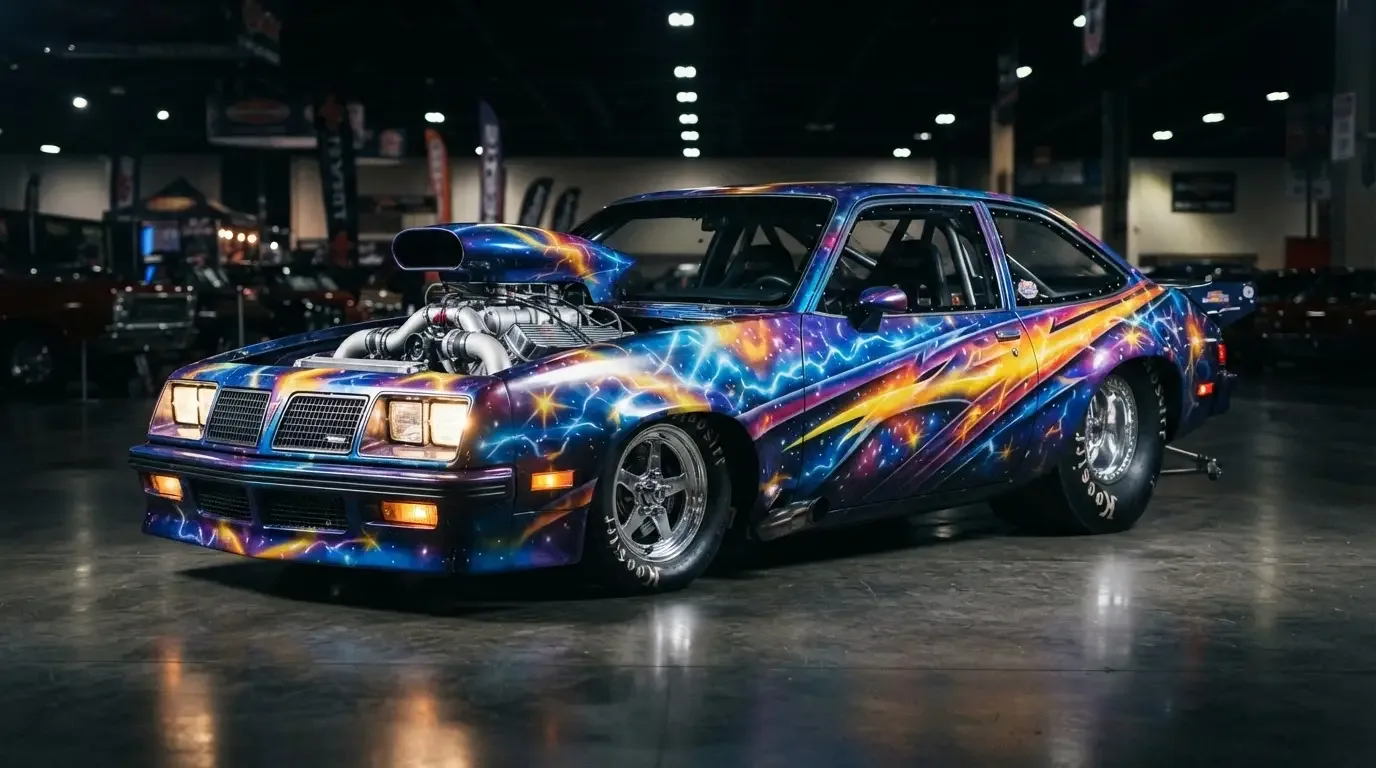
An unlikely platform for the pro street treatment
At the height of pro street's popularity in the mid-1980s, the style was almost exclusively associated with big American muscle cars and full-size bodies. A four-cylinder compact hatchback like the J-2000 was not the obvious choice for the treatment, and that is exactly what made Dobbertin's build stand out from the moment it debuted. Turning a small, unglamorous platform into a showpiece required more engineering creativity than simply repeating the formula on another Nova or Camaro, and the finished car proved that the pro street approach could work on almost any body if the execution was serious enough.
Engineering that went well beyond the usual back half tub
The J-2000 was built around a tube-frame chassis fabricated from polished 304 stainless steel, a material choice that alone set it apart from most builds of the period, which typically used mild steel tubing finished in paint or chrome plating rather than raw polished stainless. Under the pneumatically operated flip-up body and flip front section sat an all-alloy 350 cubic inch Chevrolet V8 running dual Magnuson superchargers, dual Rotomaster turbochargers, and a 20-port nitrous oxide system stacked on top of that boost. That is an unusual amount of forced induction layered onto one engine, and it reflected Dobbertin's background running a Virginia-based speed shop in the late 1970s that specialized specifically in turbocharging, supercharging, and nitrous work.
The graphics work covered the body in dozens of colors, a visual signature that made the car instantly recognizable in magazine photography even from a distance. Combined with the flip-up bodywork, which let judges and photographers see the entire chassis and driveline without removing a single panel, the J-2000 was built to be examined as much as it was built to be driven.
The flip-up body solved a real judging problem
Show judges and photographers had always faced the same frustration with heavily built engine bays and chassis work, since a fixed hood and body only let them see what was visible through the gaps. Dobbertin's pneumatically operated flip-up body and flip front section solved that problem directly by letting the entire car open up like a clamshell, exposing the polished stainless chassis and the stacked forced induction system without anyone needing to lie on a creeper or crane their neck under a fender. That mechanism alone required a level of engineering most builders never attempted, since making a full body panel lift cleanly and repeatedly without binding or leaking hydraulic fluid onto show carpet is its own separate project layered on top of the driveline work.
Hot Rod of the Year and hundreds of trophies
The car won Hot Rod magazine's Hot Rod of the Year honor in 1986, and it went on to collect hundreds of additional trophies at shows across the country in the years that followed. That kind of sustained trophy run was rare even among the best-known cars of the era, since most pro street builds had a peak season or two before a newer car took the spotlight. The J-2000 kept winning well past its debut, a sign of how far ahead of the field its combination of engineering and presentation really was.
Its reputation reached beyond the United States as well. Chic Henry, the man behind Australia's Summernats event, approached Dobbertin at the 1987 Street Machine Nationals in DuQuoin, Illinois, a conversation that led to the car crossing the Pacific for the inaugural Summernats in 1988, introducing an entire overseas audience to what American pro street building could look like at its most extreme.
"Dobbertin took a car nobody respected and made it the car everybody talked about. That is the whole story of the J-2000 in one sentence, and it is why the build still gets referenced when people list the famous famous pro street cars history from that decade."
- Tom Ramirez
A long search that ended with a familiar name
After the J-2000's touring days wound down, the car passed out of the public eye for years while collectors and enthusiasts periodically asked what had become of it. It took years of trying before the car was located and secured, and it ended with Matt and Debbie Hay taking ownership, a couple whose own pro street reputation had been built years earlier with their own award-winning pink Thunderbird. Their pursuit of the J-2000 says as much about the car's standing in pro street history as any trophy count does. Serious collectors do not chase a car for years on end unless it represents something genuinely significant to the movement.
Dobbertin himself did not stop at the J-2000. His other builds, including the twin-turbocharged 1965 Chevy II that followed a similar formula of extreme engineering wrapped in showpiece presentation, are covered in a related story that traces how his approach carried forward from one car to the next.
A model kit that introduced the car to a new generation
Revell's decision to produce a 1/25 scale kit of the J-2000 in 1987 mattered more than a novelty item might suggest. Model kits of real show cars were reserved for machines that had already proven themselves as genuine cultural touchstones, since a manufacturer was not going to invest in tooling for a car that might be forgotten within a year. That the J-2000 earned that treatment while it was still actively touring put it in rare company among pro street builds of the era, and it introduced the car to hobbyists who might never have seen it in person at a live show, extending its reach well beyond the regional and national events where it actually appeared.
Why the J-2000 still matters to collectors
The J-2000 represents a specific moment in pro street history when the movement proved it was not limited to the expected muscle car platforms, and when engineering ambition, in this case a tube chassis in polished stainless with triple-mode forced induction, could carry a build as far as any big-block Chevelle or Nova. For anyone tracking the movement's most significant machines, or simply looking to understand what separates a merely good pro street build from a legendary one, the J-2000 remains a reference point. Enthusiasts hoping to own a piece of that history, or simply a well-documented example from the same period, can start by browsing Pro Street cars for sale now to see what period-correct machines are currently available.
Sources and notes
- 1985 Pontiac J-2000 "RADical," Dobbertin Performance
- Interview: Rick Dobbertin on his Pontiac J2000 pro streeter, Street Machine Australia
- The most famous car of the 1980s pro street era has a new owner, Street Machine Australia
- A history of Summernats: the first 10 years, Summernats
- Revell J-2000 Pontiac Pro/Street model kit, Scalemates
Related Reading

About the author
Tom Ramirez
Corvette researcher and historian based in Bowling Green, Kentucky. Two decades documenting Corvette production history from original factory records.
Comments
Be the first to comment on this article.