
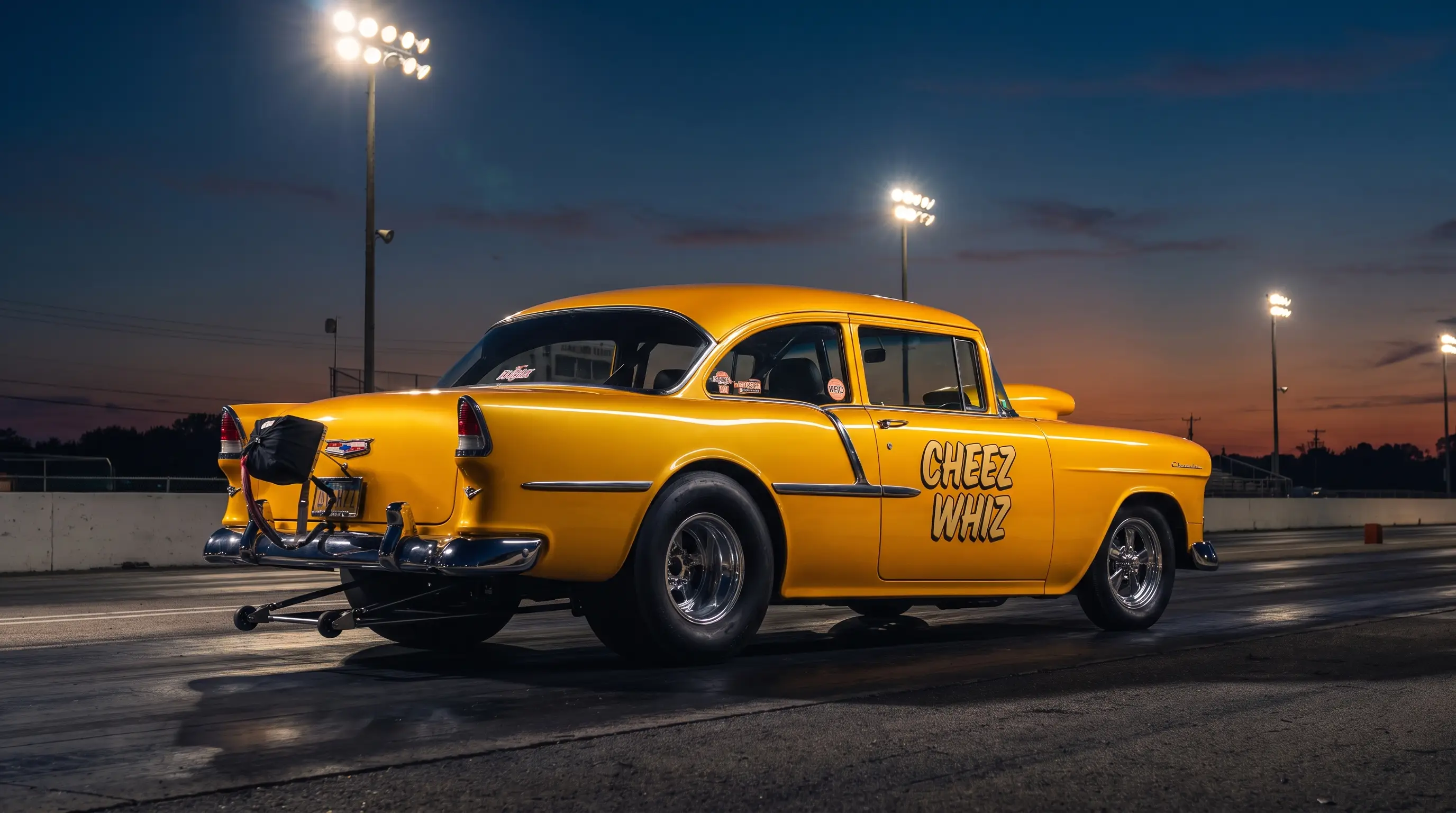
Some cars get famous for a single moment rather than a whole career of trophies, and Scott Sullivan's Cheez Whiz 55 Chevy earned its reputation the day it drove itself from Ohio all the way to Los Angeles and then ripped off a ten second pass at the strip like that was nothing unusual for a car with a full interior and a paint job worth staring at. That single drive did more for the car's legend than any show trophy could have, because it proved the whole point of what a real pro street build is supposed to be able to do.
Car Features
7 min read
Scott Sullivan's Cheez Whiz 55 Chevy
Scott Sullivan drove his Cheez Whiz 55 Chevy from Ohio to Los Angeles and ran a ten second pass, proving a real pro street build could do both show and strip.
A builder who was already a pioneer before this car existed
By the time Cheez Whiz rolled out of the shop in the mid 1980s, Scott Sullivan had already spent years quietly establishing himself as one of the earliest builders to popularize the pro street look, with his 1967 Nova serving as an early proof of concept for the style before it had fully caught on nationally. That head start mattered. Sullivan was not chasing a trend with Cheez Whiz. He was refining an approach he had already been developing for years, which is part of why the car came out as polished and coherent as it did rather than looking like a builder's first attempt at the formula. Builders who arrive at a style early, before it has a name and a formula everyone else is copying, tend to develop a more personal, considered version of it than the builders who follow after them.
Built to be driven, not just displayed
What separates Cheez Whiz from a lot of the show-only builds that filled magazine pages during the same era is that Sullivan actually used the car the way a car is supposed to be used. Driving it cross country from Ohio to California was not a stunt dreamed up for a magazine feature. It was Sullivan demonstrating, without much fanfare, that a properly built pro street car could cover real highway miles and still deliver a legitimate ten second run at the end of the trip. That combination of long-distance drivability and genuine strip performance is rare enough among show cars of any era, and it is rarer still among cars built primarily to turn heads at a parking lot show. Most builders who invested that much money and time into a show finish treated their car with a certain protective caution, trailering it everywhere and limiting its exposure to real road wear. Sullivan drove his the way an owner drives a car he actually trusts.
Why the cross country drive mattered more than any trophy
Consider what a drive from Ohio to Los Angeles actually demands of a car built with a tubbed back half, a mountain motor, and a full show finish. Highway speeds for hours at a stretch, fuel stops in unfamiliar towns, heat cycles the engine has to survive without the benefit of a trailer and a climate-controlled staging area, and then, at the end of all that, a strip pass that has to hold up under full throttle after thousands of miles of wear. Most show cars built during the same period would never have attempted that trip, let alone finished it and gone straight to a ten second run. Sullivan treated the drive almost casually, which says something about how much confidence he had in his own build quality rather than just his paint work.
The name and the finish that made it memorable
Part of what makes Cheez Whiz stick in people's memory is simply the name itself, playful and unpretentious in a way that stood out against some of the more self-serious car names of the period. The paint and bodywork underneath that name lived up to the attention it drew, with the kind of smooth, seamless finish that Sullivan would become known for across his whole career, a signature that carried forward into his later builds as the broader pro street movement began shifting toward cleaner, more restrained presentation through the early 1990s. You can read the background on how this car fits alongside the other machines that defined that transition.
"A ten second pass after a cross-country drive tells you everything about a build that a trophy case never will. That car did the work most show cars only pretend to be capable of."
- Mike Sullivan
Fifty years of building behind one famous name
Sullivan spent roughly fifty years building hot rods out of a modest home garage, and Cheez Whiz sits as one highlight among a career full of them rather than a one-off fluke. Very few builders manage that kind of sustained output, since most hobbyists burn out after a handful of major projects or drift toward other interests once life gets in the way. That longevity gives the car extra weight in conversations about pro street history, since it was not built by someone chasing a single moment of attention before disappearing from the scene. It was built by a craftsman in the middle of a decades-long body of work, which is part of why the car still holds up as a reference point for what a serious build from that garage looked like.
A benchmark for judging other builds against
Once a car like Cheez Whiz establishes what a genuine dual-purpose pro street build looks like, it becomes a natural yardstick for evaluating everything that comes after it. Collectors and judges who know the car's history tend to ask harder questions of other builds claiming similar capability, since Sullivan set a real, documented example of what driving a car cross country and then running a ten second pass actually looks like rather than what it sounds like on a spec sheet. That benchmark effect is part of the quiet influence a car like this has on the hobby, even among people who never saw it in person and only know the story secondhand through club conversation and magazine archives.
Why collectors still talk about it today
Cheez Whiz occupies a specific place in pro street history as proof that show quality and strip performance were never mutually exclusive, no matter how much the broader movement sometimes drifted toward pure spectacle. If you are interested in Sullivan's other notable machines from the same period, his Nova build from the same garage is worth a look too, since it shares the same builder's eye for finish and function working together rather than competing with each other. For collectors hoping to find a car with that same level of drivability behind the paint, it is worth taking the time to shop classic Pro Street car listings and asking hard questions about what a given car has actually done beyond sitting still for photographs.
Sources and notes
Related Reading

About the author
Mike Sullivan
Detroit-area muscle car enthusiast and restoration specialist with three decades of hands-on experience working on American iron.
More in Car Features
Comments
Be the first to comment on this article.