
Picture a Saturday night at a regional strip somewhere in Ohio in 1978. Bill "Grumpy" Jenkins rolls his 1972 Chevrolet Vega up to the line, a car with a tube chassis and slicks so wide they look wrong under those tiny quarter panels. The crowd is not there for a street car show. They are there for elapsed times. But somewhere in that crowd is a guy who owns a Nova at home, and he is looking at that Vega and thinking about what it would take to make his own car look and feel like that on a Friday night cruise. That moment, repeated in a thousand variations across the country, is where drag racing pro street really starts.
Car Features
7 min read
How Drag Racing Shaped Pro Street
From Grumpy Jenkins' tube-chassis Vega to a genre built on strip credibility, drag racing pro street never fully left the quarter mile behind.
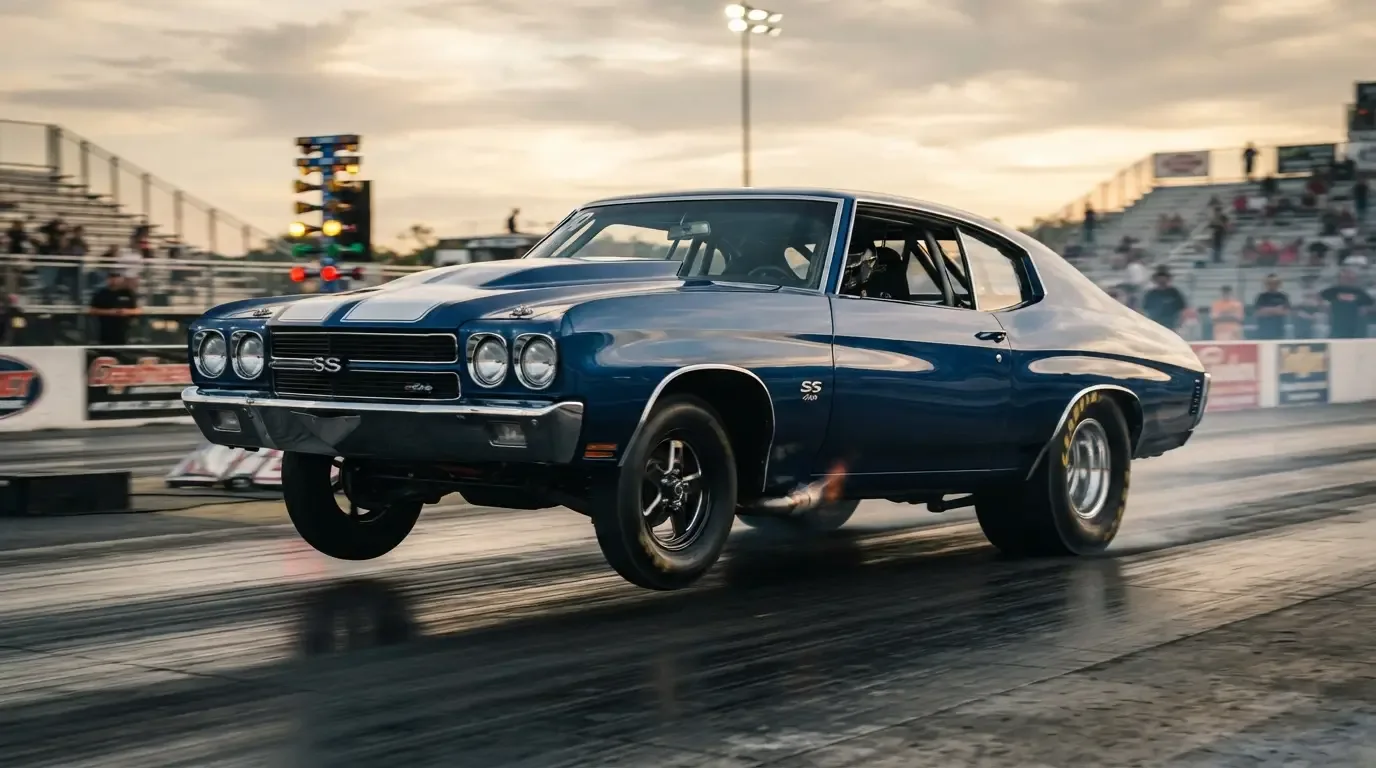
Pro Stock gave the class its shape before it had a name
Pro Stock racing in the early 1970s established the visual language that pro street would later borrow wholesale: a tube chassis hidden under production sheet metal, huge rear slicks tucked under narrowed quarter panels, and a front end running the smallest tire that could still steer the car. Jenkins' Vega was not built to be driven to the grocery store. It was built to leave the line hard and get to the far end fast. But the look stuck in people's heads, and by the late 1970s builders were asking a different question. What if you kept that exact silhouette, but made the car street legal, with a full interior, working lights, and a title in your name.
Rod Saboury is a name that gets mentioned often when people talk about the earliest days of that transition, since he had been working in and around this style since the 1970s, well before magazines gave it a name. The strip provided the blueprint. The street is where the blueprint got a body and a paint job.
The strip stayed the honest measure of a build
Even once pro street became a magazine phenomenon with more attention paid to paint than to elapsed time, the drag strip never fully left the picture. A car could win every trophy at a regional show, but if it could not back up its looks with a real pass down the quarter mile, serious builders and serious buyers noticed. That tension, between show-car polish and strip-car function, is what gives the best pro street builds their staying power. The cars that only looked fast got forgotten. The cars that actually ran numbers close to what their engine bay promised are the ones still talked about decades later.
"Every pro street car is answering the same question a Pro Stock car answered first. Can you put that much power to the ground without the front end lifting off the pavement. Everything else, the paint, the interior, the graphics, that came after."
- Patrick Walsh
What separated a real chassis from a costume tub
Not every tubbed back half was built the same way, and the strip is where that difference got exposed fast. A car built with a properly engineered four link or ladder bar setup, real anti-squat geometry, and a rear end sized for the power on tap could put its tires down and actually go. A car built purely for looks, with a tub welded in but no real thought given to how the suspension would behave under load, tended to either spin the tires uselessly or lift the front end in a way that scared the driver more than it impressed anyone watching. Builders who came up around real drag cars understood this instinctively, since they had already seen what happened when a chassis was engineered wrong at an actual event. That knowledge transfer from the strip to the street garage is a big part of why the best pro street cars from drag-heavy regions tended to actually perform, not just pose.
The eight ten and eleven second club
By the mid-1980s, a serious pro street car running mid to low elevens or better on a good night was carrying real bragging rights, especially since these were cars with full interiors, glass, and heat, not stripped-out race cars. That was the point. The whole appeal of drag racing pro street was proving you could have a car that behaved like a race car under full throttle and still had a back seat and a stereo. It is worth reading history of pro street cars history if you want the fuller timeline of how that balance between show and strip performance shifted decade by decade.
Drag racing kept the movement honest
As pro street drifted more toward pure show culture through the late 1980s and into the 1990s, drag racing remained the thing that separated a genuine build from a car that only wore the costume. A tubbed back half and a set of pizza cutter front tires can be bolted onto almost anything for the look. Making the car actually run the number that back half promises takes real engine work, real chassis setup, and real seat time at the strip. That distinction still matters to collectors today, and it is a big part of why cars with documented strip history tend to command more respect, and more money, than cars that only ever did burnouts for a magazine photographer.
If you want to see how that history connects to what came next for the style, there is a related story covering how pro street evolved once the strip influence started to share space with pure street machine culture.
Magazines turned strip credibility into a selling point
By the mid-1980s, magazine editors had figured out that a car with a real time slip attached to its feature story sold better than a car with paint alone, and that shifted how builders talked about their own cars. A build sheet started listing quarter mile numbers alongside horsepower claims and paint details, because readers wanted proof, not just a promise. That editorial habit reinforced the whole culture's respect for the strip, since it meant even builders who personally cared more about show trophies than elapsed times still had an incentive to prove their car could run, if only to get the better magazine spread.
Why the strip roots still matter to buyers
Anyone shopping for a real period pro street car today should care about this history, because it changes what questions are worth asking. A car with a genuine chassis pedigree tied back to a known Pro Stock or drag radial builder is a different animal than a car that just looks the part. That drag racing DNA is part of what makes these cars collectible rather than just visually interesting, and it is worth keeping in mind while you Pro Street cars for sale now and start comparing build sheets against what a car actually claims to run.
The movement never fully left the strip behind, even at its most show-focused. That connection back to Jenkins' Vega and every tube-chassis Pro Stock car that came before it is the reason pro street still reads as a race car wearing street clothes, not the other way around.
Sources and notes
Related Reading

About the author
Patrick Walsh
Automotive journalist covering classic car shows, events, and the enthusiast community across North America.


Comments
Be the first to comment on this article.