
Ask an old-timer about the fairground cruiser era and watch their eyes change. They will tell you about a summer evening, a gravel lot behind a county fairground, a line of tubbed muscle cars idling with their blowers ticking over in the heat, and a crowd that had come as much to be seen as to look. That scene, repeated across small towns and big cities alike through the Pro Street years, is the heart of what the fairground cruiser era actually meant to the people who lived it.
Car Features
7 min read
The Fairground Cruiser Era
Before the magazines ever showed up, the fairground cruiser era was where Pro Street's grassroots culture lived, in gravel lots full of idling big blocks.
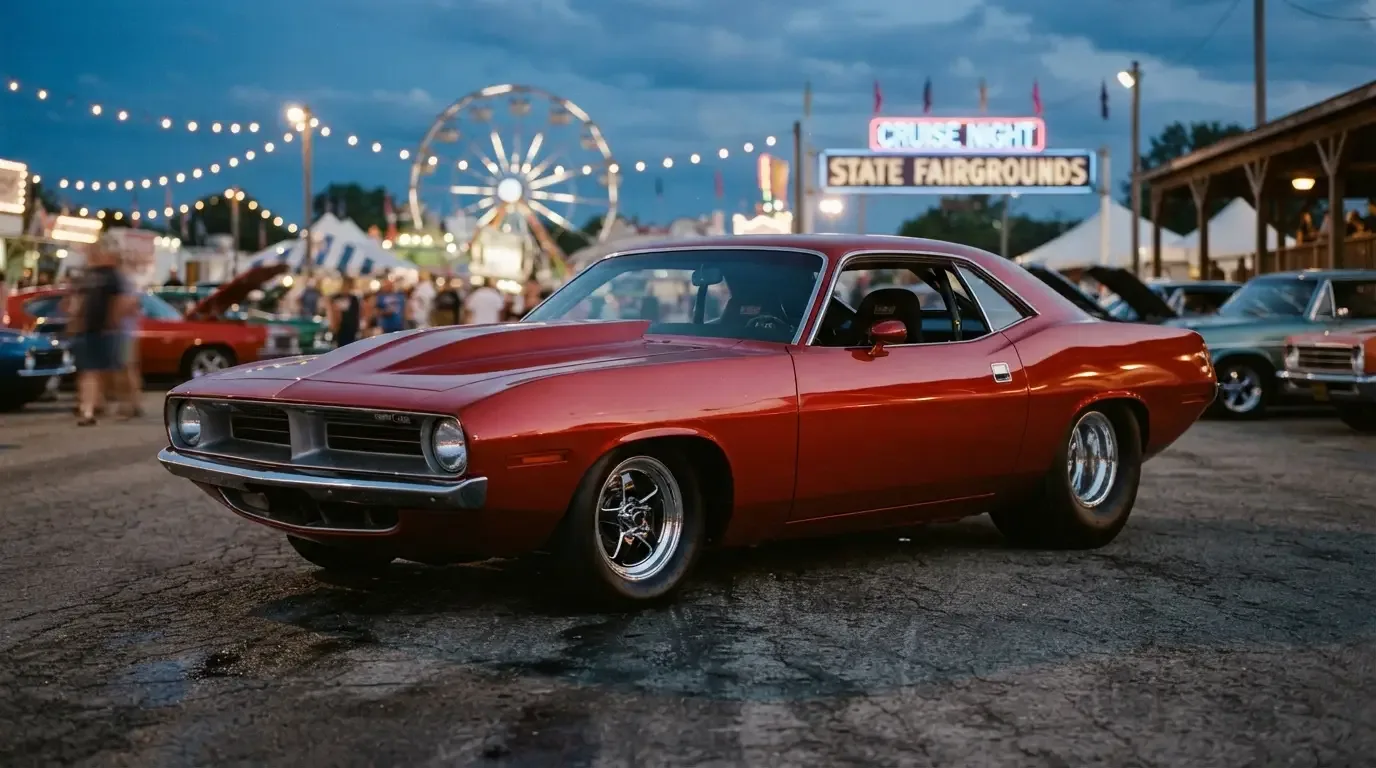
Where these gatherings happened
County fairgrounds made natural gathering spots for a simple reason. They had space, they had gravel or asphalt lots built for crowds, and they usually sat close enough to town that a car could cruise in on a Friday night without a long haul on the highway. Local promoters and car clubs learned quickly that fairground property, often underused outside of the actual fair season, was perfect for informal drag racing, static shows, and the kind of loose, unstructured hangout that defined a lot of Pro Street's grassroots culture.
Unlike the big national events that drew builders from across the country, fairground gatherings were mostly local affairs, built around the same faces week after week. A regular crowd meant a car's reputation traveled fast. Everybody knew whose big block ran hardest, whose paint job was fresh, and whose tub job had been done right the first time versus who had to redo theirs after it cracked under real launch stress.
The rhythm of a typical night
These evenings followed an unwritten but well understood pattern. Cars rolled in slowly as the sun went down, engines still cooling from the drive over, owners leaning against fenders and trading updates on whatever project was currently torn apart back home. As the crowd grew, informal matchups formed, sometimes a genuine grudge race settled over weeks of trash talk, sometimes just two strangers who happened to pull up next to each other and decided to find out whose car was quicker.
There was no entry fee, no formal judging, no trophy at the end of the night. The reward was simpler than that. A car that turned heads, that sounded right, that ran hard when it mattered, earned respect that carried forward to the next gathering. That informal social currency mattered as much to a lot of builders as anything a magazine or sanctioned event could offer, because it came directly from people who understood exactly what they were looking at.
Why the fairground scene mattered to Pro Street's spread
These local gatherings were the connective tissue that let the Pro Street style travel between towns that never made a magazine page. A builder who saw something clever done to a rival's car at the fairground would go home and figure out how to do something similar, sometimes better, on his own project. Ideas about tub width, engine dress, and paint trends spread this way just as much as they did through national publications, moving person to person at a pace that felt slower but often ran deeper than anything print media could manage.
For a fuller picture of how this grassroots energy connected to the movement's broader story, the full story traces the path from these local gatherings through the national attention the style eventually earned. The fairground scene was where a lot of builders first encountered the culture before ever picking up a magazine that covered it formally.
"I remember the sound before I remember anything else. A dozen big blocks idling together in a gravel lot at dusk, and somewhere in that noise you could already tell which car was going to be the one everybody talked about on the drive home."
- Nora Beckett
The people who kept the lot running
Every fairground scene had a handful of people who made it function without anyone officially appointing them to the job. Somebody's uncle who knew the fairground caretaker and could get the gate unlocked after hours. A local parts store owner who let regulars run a tab through lean months and got paid back in loyalty as much as cash. A guy with a flatbed trailer who would go pull somebody's broken-down project out of a ditch on a Tuesday night without being asked twice. None of that shows up in any magazine feature, but it is exactly the kind of infrastructure that let a fairground scene survive year after year.
Wives and girlfriends often ran their own informal network too, coordinating who was bringing food, keeping half an eye on younger kids running around the gravel lot, and generally making sure a night that could have devolved into pure chaos stayed something closer to a community gathering. That domestic scaffolding rarely gets credit in the retelling, but anyone who was actually there will tell you the scene could not have lasted as long as it did without it.
What is left of that world today
Many of the actual fairgrounds that hosted these gatherings have changed considerably, some paved over for other uses, some still standing but rarely used for anything resembling their old informal car culture role. The specific community that gathered there, the regulars who knew each other's cars by sound alone, has mostly scattered or aged out of active participation. What survives is mostly memory, a handful of photographs, and the occasional car that still carries its original fairground-era build.
Those surviving cars carry a particular kind of value for people who understand this history, distinct from documented magazine cover cars but meaningful in its own right. A car with a genuine local reputation, verified by people who were actually there, tells a story that a national publication never captured. If that kind of grassroots history speaks to you, take a look at what is currently listed as a classic Pro Street car for sale and ask sellers directly about local history and community reputation, not just build specifications, because that is often where the most interesting stories are hiding.
What stays with me most, looking back on all of this, is how ordinary the whole thing felt at the time. Nobody standing in that gravel lot thought they were witnessing something that people would still be writing about decades later. It was just Friday night, just the cars they had poured their weekends and paychecks into, just a chance to stand around with people who understood exactly why any of it mattered. That is usually how the best parts of car culture work. Nobody realizes they are living inside a piece of history until long after the lot has gone quiet.
Sources and notes
Related Reading
#hot rod history
#Pro Street
#muscle car community
#cruise nights
#fairground cruiser
#grassroots car culture

About the author
Nora Beckett
Automotive features writer and photographer who tells the human stories behind the cars, from show fields to cross-country road trips.
Comments
Be the first to comment on this article.