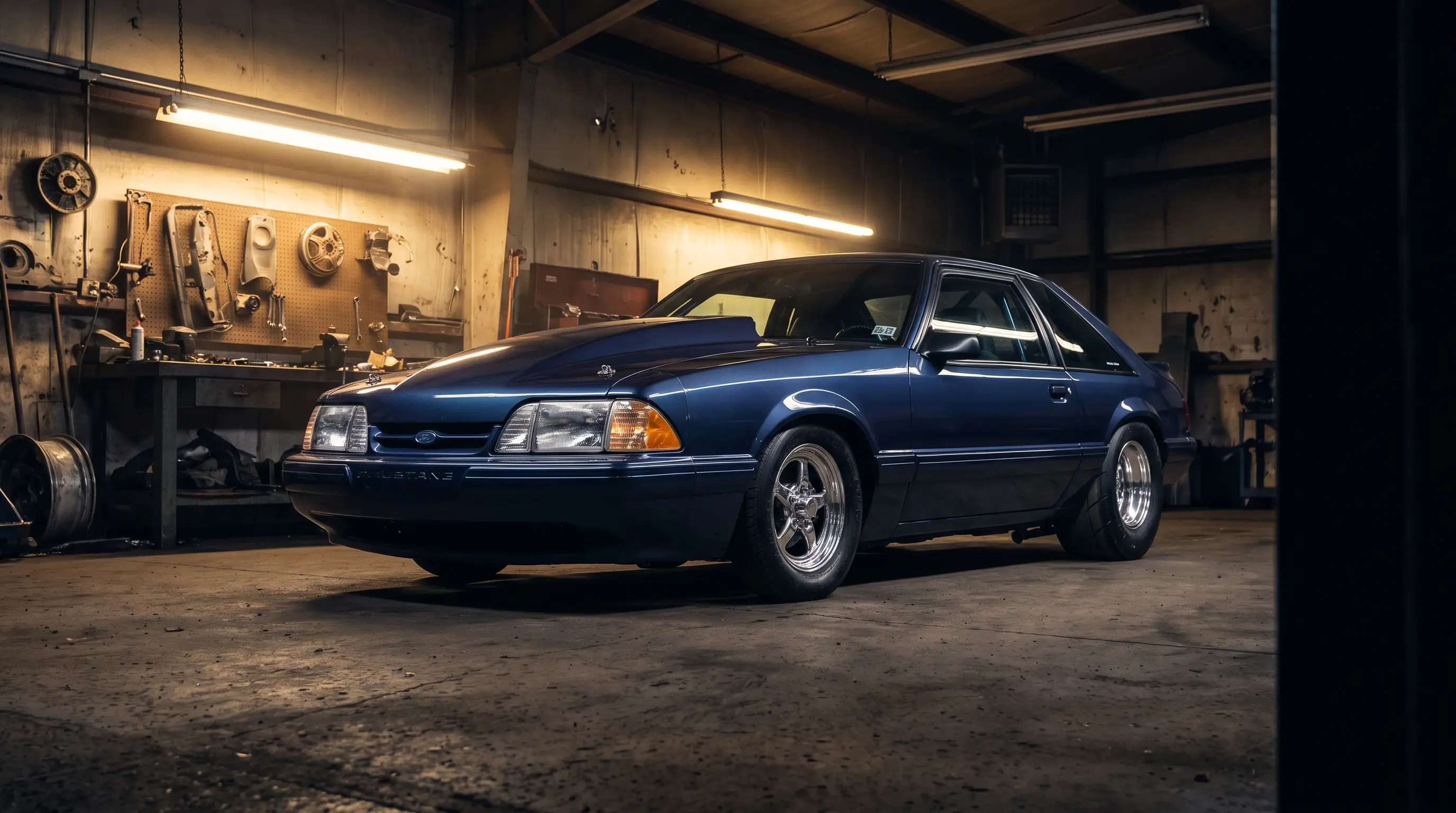
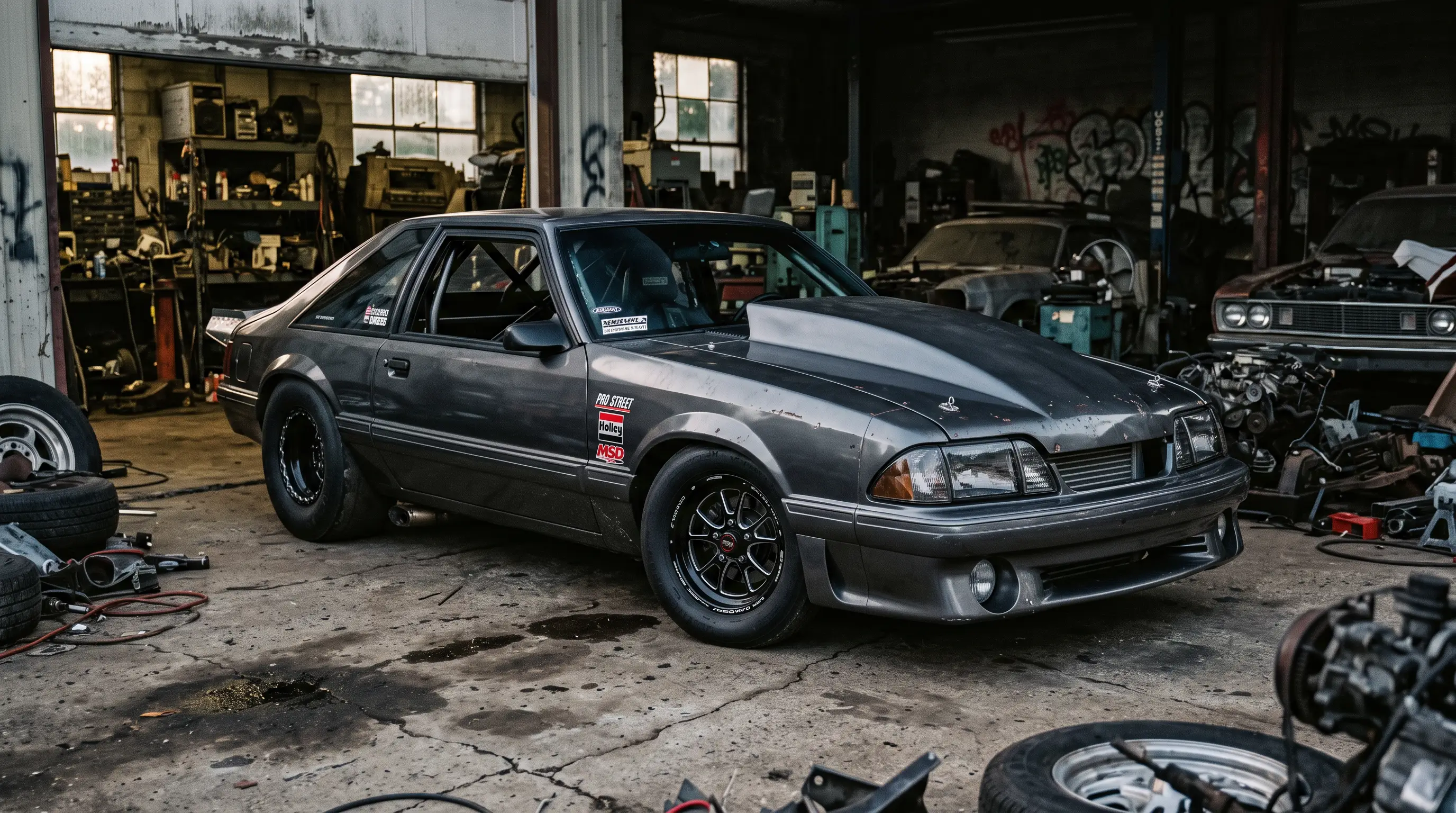
Fox body pro street builds took over the Ford side of the movement almost by accident. Ford never designed the Fox platform with drag radials and tubbed rear quarters in mind, but the light unibody structure and cheap, plentiful donor cars turned out to be exactly what Pro Street builders needed once the platform aged into junkyard territory by the mid-1980s.
The weight advantage nobody planned for
Ford introduced the Fox platform in 1978 for the Fairmont and brought it to the Mustang for 1979, aiming for fuel economy and manufacturing simplicity rather than performance. Ironically, those same priorities, a lighter unibody and less structural mass than the Mustangs it replaced, made the car unusually well suited to Pro Street tubbing a few years later. A builder cutting into a Fox-body's rear structure was working with less material to begin with, which meant a back-half kit could deliver a bigger relative improvement in weight distribution than the same kit installed in a heavier car.
That lighter starting weight also meant a Fox-body Pro Street build could get serious performance out of a comparatively modest small-block, which mattered to builders working with tighter budgets than the shops turning out flagship Camaro and Chevelle projects for paying customers.
Cheap donors, fast turnaround
By the time Pro Street was in full swing through the mid-to-late 1980s, Fox-body Mustangs were already aging out of daily-driver duty in large numbers, exactly the pipeline of cheap, plentiful donor cars that had earlier made the Nova so popular on the GM side. A builder could find a rough but structurally sound Fox-body for a fraction of what a clean early Mustang or a comparable Camaro cost, which meant more of the build budget could go toward the engine, chassis, and paint rather than the base car itself.
That affordability brought a wave of home-built Fox-body Pro Street projects that never got shop-level attention but still captured the platform's essential formula, tubbed rear quarters, a narrowed rear end, and a built 302 or 351 under a scooped hood.
"A Fox-body cost you almost nothing to start with, so you could put real money into the parts that actually mattered instead of just paying for a clean shell."
- Wayne Coburn
Why the Fox-body outlasted earlier Mustangs in Pro Street circles
Earlier Mustang generations required more extensive structural work to accept a proper tub job, since their unibody construction predated the kind of aftermarket support that eventually grew up around the Fox platform specifically. As more builders committed to Fox-bodies, the aftermarket responded with dedicated back-half kits, subframe connectors, and reinforcement plates designed for the platform's particular structure, which made each subsequent Fox-body build a little easier than the one before it.
That snowball effect mirrored what had already happened with the Camaro on the GM side. Once enough builders committed to one platform within a make, the parts support followed, and that support in turn attracted more builders, until the Fox-body became the default answer whenever someone said they wanted to build a Pro Street Ford.
Where the Fox-body sits in Pro Street's Ford story
The Fox-body's rise did not happen in isolation from the rest of the movement. Understanding how Ford builders arrived at the tubbed street car format at all means looking back at the movement's earliest years and how it grew out of drag strip pit lanes into a street-legal show phenomenon. For where this started, the Fox-body chapter fits into a longer story about how builders across every make converged on similar solutions from different starting points.
Within the Ford camp specifically, the Fox-body eventually overshadowed even the classic first-generation Mustang as a Pro Street donor, a shift that says less about which car looked better and more about which one was easier and cheaper to build correctly.
Buying a Fox-body Pro Street build today
Because so many Fox-bodies were cheap and plentiful during the build years, plenty of rough, poorly executed tub jobs exist alongside the genuinely well-built examples, and telling the two apart takes a careful inspection rather than a glance across a parking lot. Check where the back-half structure ties into the original unibody rails, since that connection is where a rushed or budget build shows its weaknesses first.
A properly documented Fox-body build with clean welds and a verifiable history is worth seeking out patiently rather than settling for the first car that comes up for sale. You can browse current listings and see a classic Pro Street car for sale to compare asking prices and build quality across what is actually available before committing to one.
An accidental platform that earned its dominance
Ford never set out to build the ideal Pro Street donor car, but the Fox-body's light structure and eventual junkyard abundance made it exactly that. The platform's dominance among Ford Pro Street builds through the late 1980s and into the 1990s owes more to those practical accidents of weight and availability than to any deliberate performance pedigree, and that honest, workmanlike origin story is part of why builders still respect it.
Fox-body years builders favored
Not every Fox-body year offered the same starting point, and builders developed clear preferences as the platform matured through its production run.
| Fox-body years | Builder relevance |
|---|---|
| 1979 to 1982 | Earliest Fox Mustangs, weaker factory engines, less common Pro Street donor |
| 1983 to 1986 | Improved factory 5.0 output, growing popularity as a tub candidate |
| 1987 to 1993 | Restyled body, strongest factory 5.0 support, favored donor years for late-era builds |
The 1987 restyle in particular brought a cleaner nose and updated interior that a lot of builders preferred visually, even though the mechanical changes underneath mattered more to the actual build than the cosmetic ones. A builder chasing the cleanest possible late-era Fox-body Pro Street project usually started hunting in that final body style window specifically because donor cars from those years combined the best factory power with the most modern-feeling proportions available on the platform.
Hood and cowl options also expanded as the aftermarket matured around the Fox-body specifically, giving later builds access to fiberglass pieces that simply were not available when the platform was newer and less established as a Pro Street favorite.
Interior differences across those years mattered less to builders than the engine and body changes, since most Fox-body Pro Street cabins ended up gutted or heavily simplified regardless of what came from the factory. A builder was rarely choosing a donor year based on seat comfort or dashboard styling when the whole interior was likely getting replaced with basic buckets and a stripped-down panel anyway. What mattered on paper was the title, the VIN, and whether the frame rails underneath were straight enough to carry a tub kit without extra corrective work before the real fabrication even began.