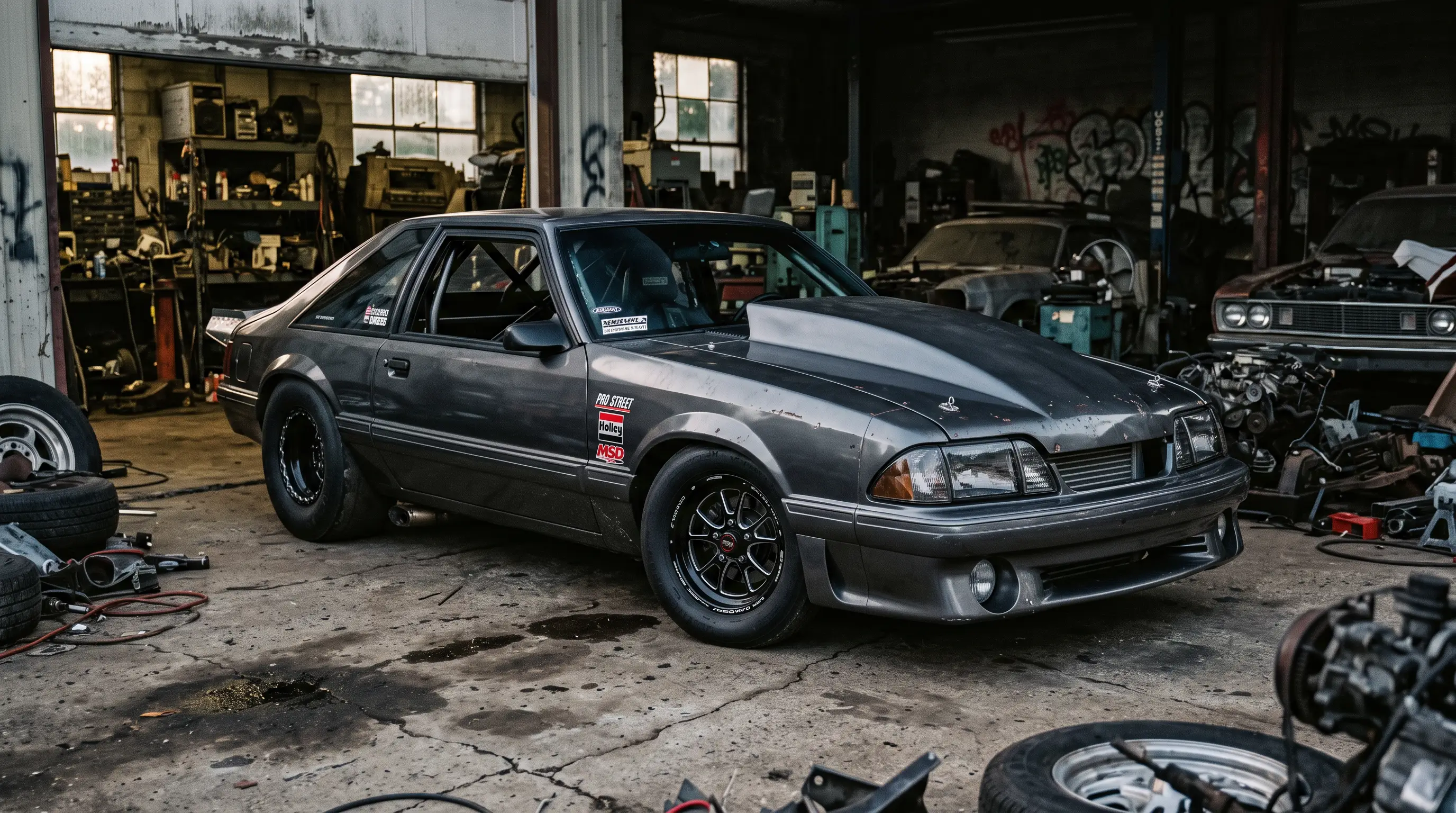
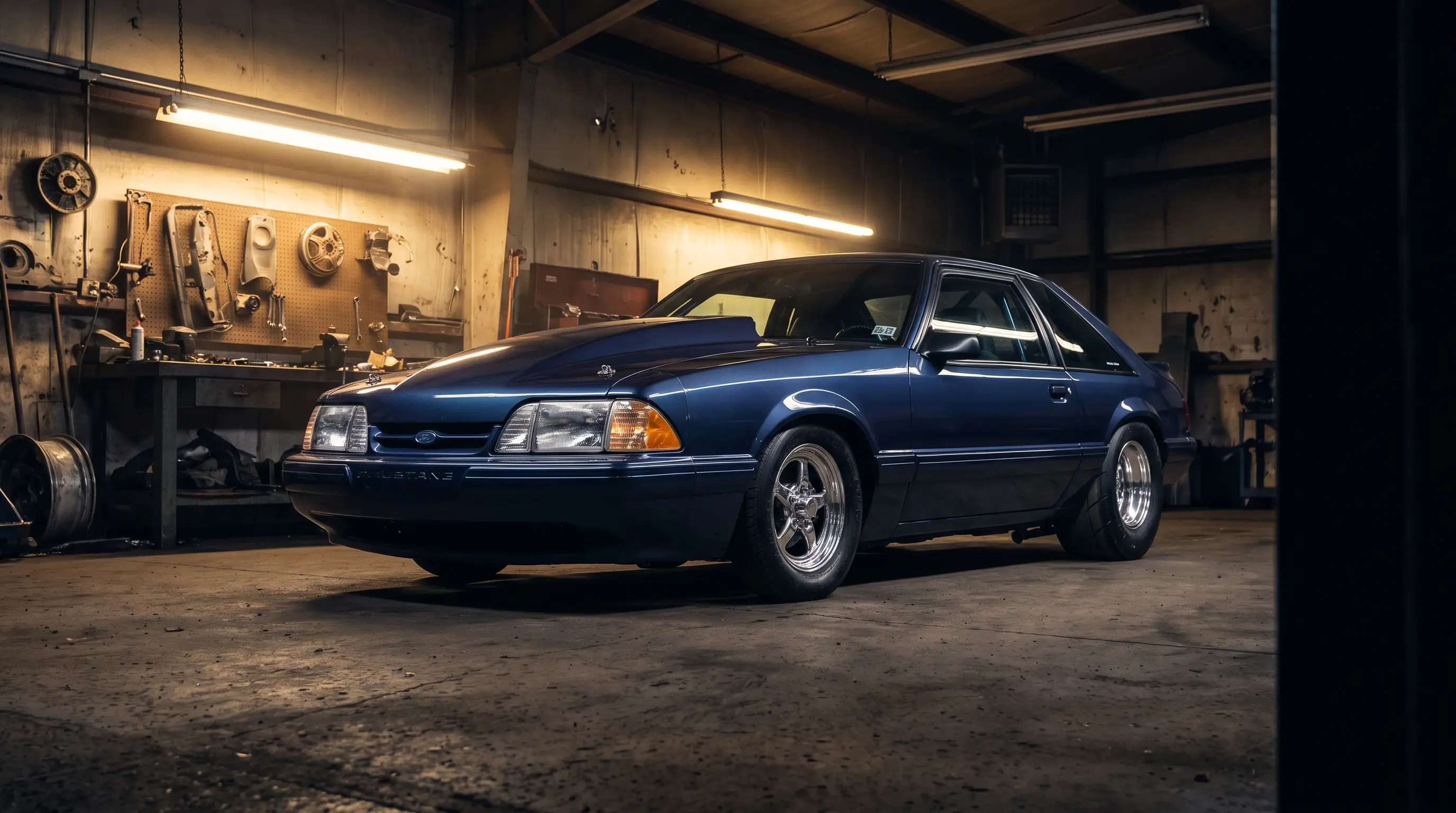
Every Pro Street show had its Camaros and its Chevelles, and then off in its own corner, usually a little louder and running a little leaner, sat the pro street mustang. Ford loyalists never had the same overwhelming donor car numbers Chevy builders enjoyed, so when a Mustang showed up wearing a full tub job and a set of monster rear tires, it tended to draw a crowd specifically because it was the exception rather than the rule.
A lighter starting point than the GM crowd
The Fox-body Mustang, built from 1979 through 1993, became the platform of choice for most serious Pro Street Ford builds, and the reason came down to simple physics. A Fox-body weighed considerably less than a comparable Camaro or Chevelle, which meant a builder chasing quarter-mile performance could get there with less engine and less expense. That lighter unibody structure also meant back-half work followed a similar logic to a Nova build, cutting and replacing rear structure rather than modifying a heavy separate frame.
Earlier Mustangs, the 1965 through 1973 first and second generations, saw Pro Street attention too, particularly from builders who wanted the classic long-hood, short-deck proportions rather than the boxier Fox-body lines. These older cars required more extensive structural work since their unibody construction was less forgiving of a tub job than the later Fox platform, which is part of why fewer of them got the full treatment compared to Fox-bodies.
Fighting for parts in a Chevy-dominated hobby
Anyone who built a Pro Street Mustang in the 1980s will tell you the aftermarket favored Chevy builders first and Ford builders second. Back-half kits, tub sheet metal, and narrowed rear ends all came to market for Camaro and Nova applications before a Mustang-specific version usually followed. That gap forced Ford builders to either adapt Chevy-oriented parts to fit a Mustang chassis or wait for a smaller handful of Ford specialist shops to catch up.
That extra difficulty became part of the platform's identity. A well-built Pro Street Mustang represented more problem-solving per car than a comparable Camaro, since the builder usually could not just order a catalog kit and bolt it in without modification.
"Building a Mustang back then meant you were going to be on the phone with three different suppliers just to make one back half fit right. Nobody did it because it was easy."
- Patrick Walsh
Where the Mustang fits in the platform hierarchy
Seeing the Mustang's place in the wider Pro Street world means looking past just one make. GM, Ford, and Mopar builders were all solving the same core problem, how to get a big rear tire under a street car's quarter panels, and each camp arrived at slightly different answers depending on what their chosen platform offered. For more on the pro street muscle cars across every major platform of the era, the Mustang's story reads as one determined underdog chapter in a much bigger competition.
The movement itself did not begin with any single make. Understanding where this started puts the Mustang's late arrival to full-tub builds in better context, since the earliest Pro Street cars leaned heavily on whatever platform a given drag racing shop already had experience with, and that was rarely Ford in the movement's opening years.
The Fox-body's second act
By the mid-1980s the Fox-body Mustang had become genuinely competitive as a Pro Street donor, helped along by Ford's own factory performance push with the 5.0 that put a stronger small-block into showrooms and, eventually, into a lot more junkyards for builders to pull from. That factory momentum gave Fox-body Pro Street builds a credibility boost that older Mustangs never quite got in the same era, since a tubbed 5.0 Mustang connected directly to what Ford was actually selling and racing at the time.
The result was a second wave of Mustang builds through the late 1980s and into the early 1990s that leaned specifically on Fox-body donor cars, running built 302s and 351s with the same tunnel-ram-and-dual-carb theatrics that GM builders favored, just wrapped in a leaner, more angular body.
Buying a Pro Street Mustang today
Surviving period Mustang builds are notably rarer than Camaro equivalents, a direct result of how much smaller the original Ford-focused builder community was. That rarity now works in a genuine Mustang build's favor with collectors specifically hunting for something less common than the GM cars that dominate most Pro Street show fields.
If you want one, expect the hunt to take real patience, since good examples surface unpredictably rather than on any set schedule. Checking classic Pro Street cars on the market regularly is the most practical way to stay ahead of a rare Mustang build before it moves to another buyer.
The underdog that earned its respect
The Pro Street Mustang never had the numbers or the parts support the Camaro enjoyed, and it never needed to. What it offered was a leaner, harder-fought version of the same idea, built by people willing to do extra work for a car that stood out precisely because it was not just another tubbed Chevy.
Generation by generation notes for builders
Not every Mustang generation lent itself equally well to a Pro Street build, and the differences matter to anyone researching a specific car's history or planning a project of their own.
| Mustang generation | Pro Street relevance |
|---|---|
| 1965 to 1973 | Classic long-hood proportions, more extensive structural work required for tubbing |
| 1974 to 1978 | Rarely tubbed, smaller Mustang II body saw little Pro Street attention |
| 1979 to 1993 | Fox-body, the dominant Pro Street Mustang platform, lightest unibody of the bunch |
The Mustang II years stand out as the platform's quiet gap. Builders largely skipped that generation entirely, favoring either the earlier classic body or waiting for the Fox-body to arrive, and surviving Pro Street examples from those years are rare enough that most builders today have never actually seen one in person.
Engine swaps within the Ford family followed their own quirks too. A 351 Windsor demanded more engine bay clearance work in a Fox-body than a 302 did, and builders chasing serious cubic inches sometimes reached outside the Windsor family entirely for a big-block 429 or 460, though those swaps were rarer and considerably more involved than anything a small-block Ford build required.
Suspension geometry differed enough between generations that a builder moving from Fox-body experience to an early classic Mustang project could not simply carry over the same back-half approach without rethinking the front end too. That extra learning curve is one more reason Ford specialist shops built a reputation distinct from the general Pro Street builder crowd, since real cross-generation Mustang expertise took years to accumulate properly. A shop that had mastered Fox-body geometry still had to relearn a fair amount before tackling a first-generation car correctly.