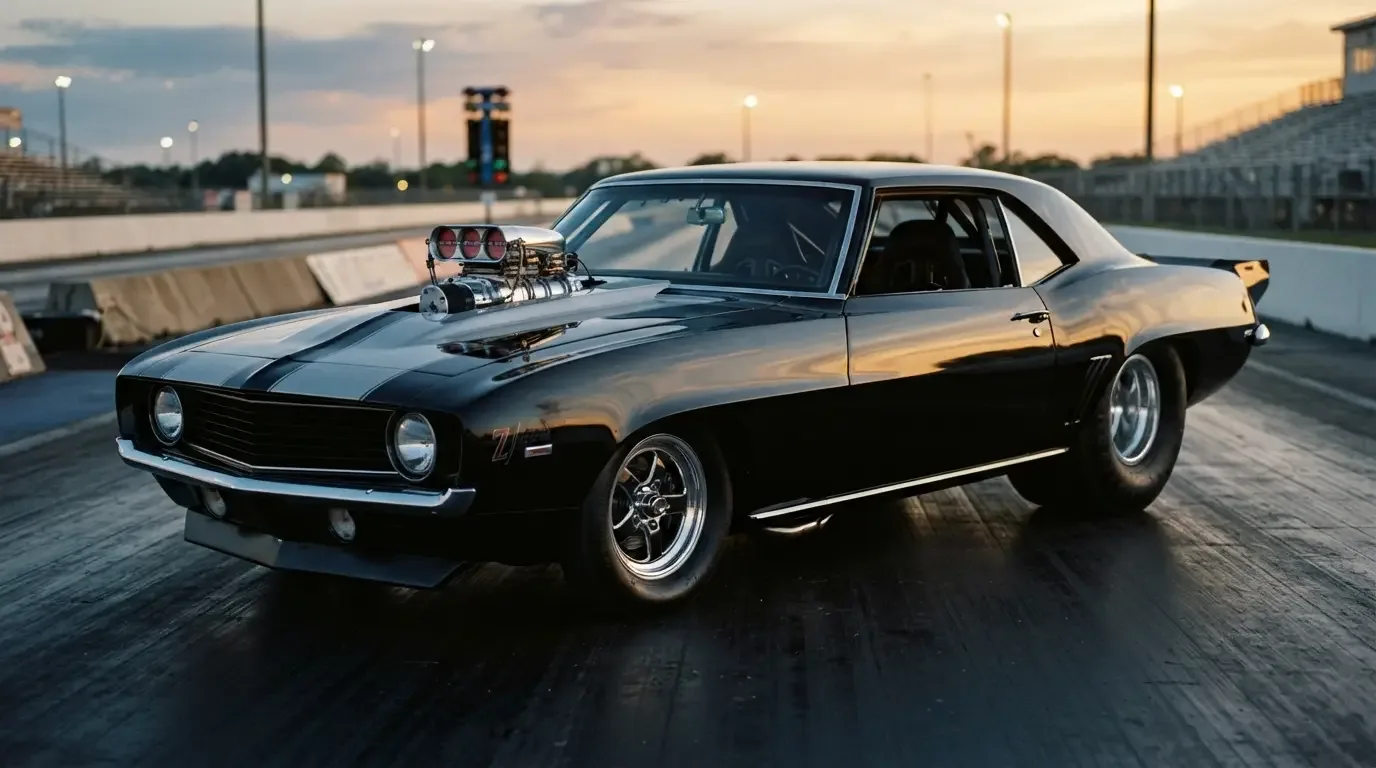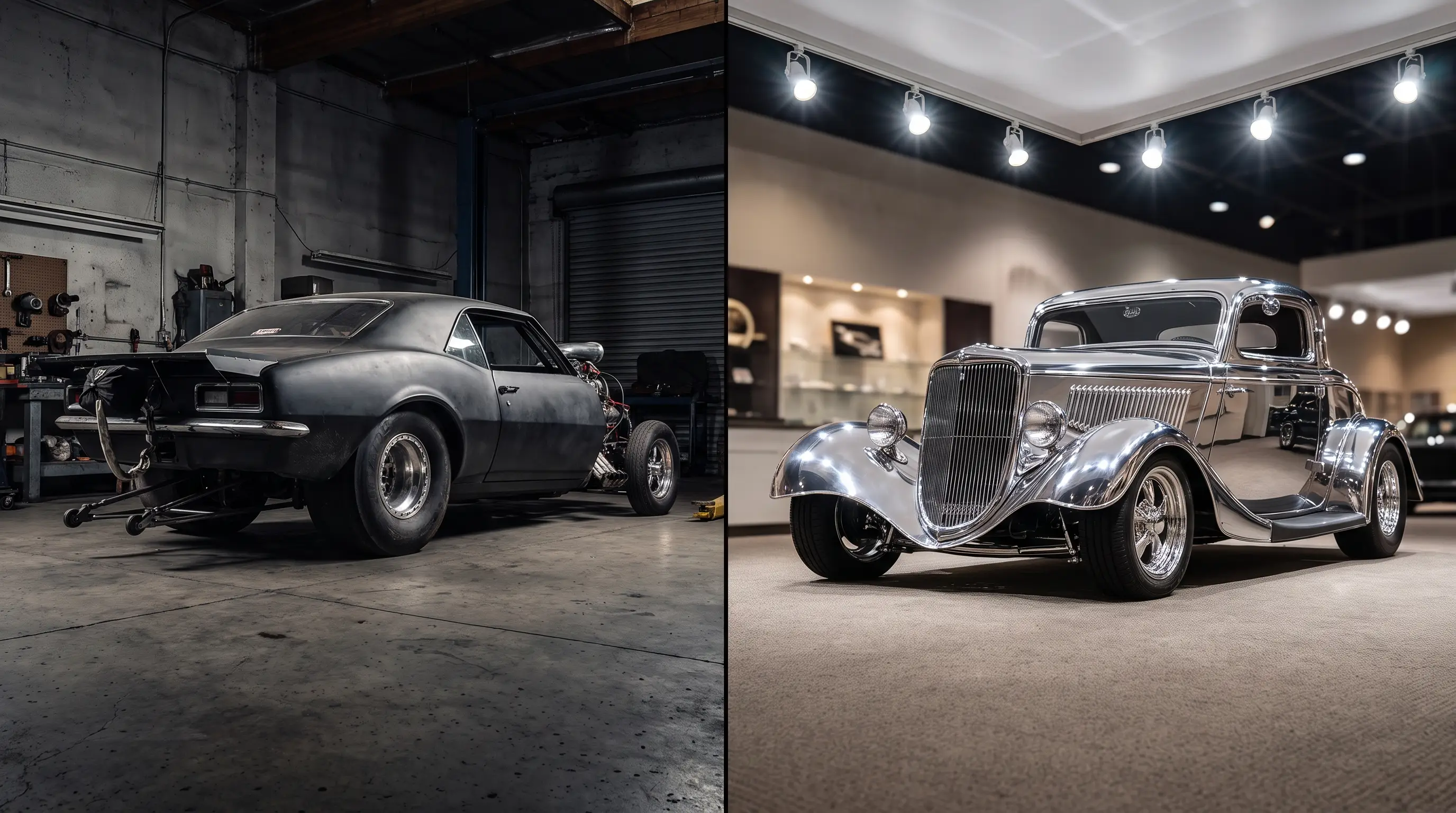
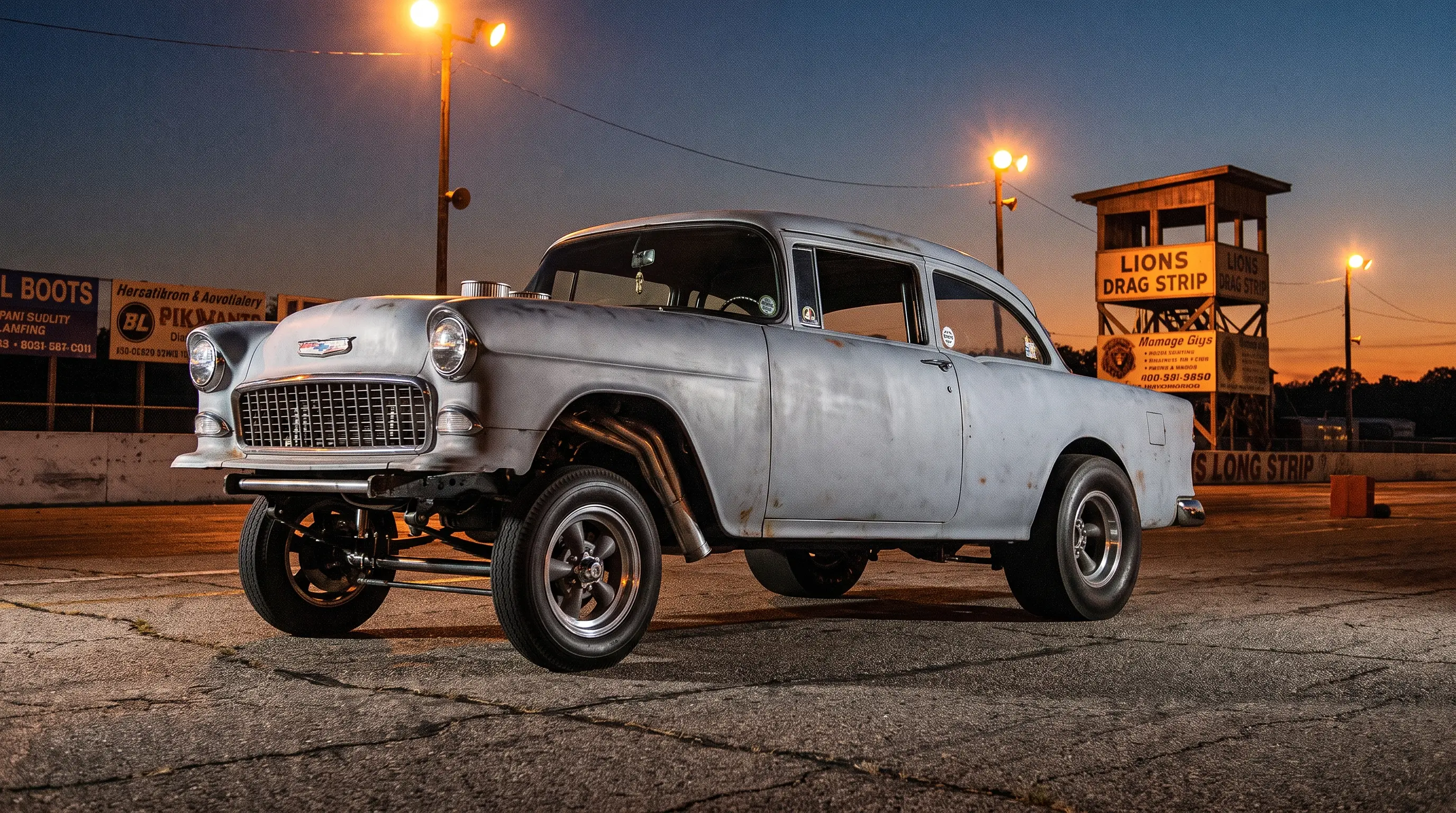
Ask ten Pro Street guys where the style came from and at least six of them will start talking about gassers before they even mention the eighties. That is not nostalgia talking. The gasser style explained honestly means going back to the straight-axle, nose-high altered-wheelbase cars that ran match races and NHRA Gas classes through the 1960s, because Pro Street borrowed its entire visual language from them. The front-end rake, the skinny front rubber, the fat rear meats tucked under a tubbed quarter panel, all of it traces to cars that were built to launch hard on a drag strip, not to look aggressive parked at a cruise night. The look came first from function. Pro Street kept the function's silhouette and put it on the street.
What a gasser actually was
A true gasser was a National Hot Rod Association Gas class car, usually a Willys, an Anglia, a Chevy sedan or a Studebaker, running a straight front axle in place of the factory independent suspension. Lifting the front end raised the car's center of gravity forward under hard acceleration, which planted the rear tires and helped the car hook off the line. Owners chased weight transfer any way they could get it. Some ran the axle high enough that the car looked like it was rearing back on its hind legs at the starting line. That stance, more than any single mechanical spec, is what later builders wanted to recreate on cars that never saw a straight axle in period.
How the look crossed over to the street
By the time Pro Street builders were tubbing quarter panels in home garages in the late 1970s and through the 1980s, straight axles on a street-driven muscle car were mostly gone, phased out for handling and safety reasons on anything meant to see a public road regularly. What survived was the attitude. Builders kept the front stance high and light looking, ran narrow front tires for the same visual effect, and pushed enormous rear tires under the back of the car the way a gasser pushed slicks. A Nova or a Camaro built in this style did not need a solid axle to read as a gasser descendant. The proportions did the talking. That inherited stance is a big part of why people still reach for the word gasser when they are trying to describe a Pro Street car's front end, even on builds with a fully independent front suspension.
Wayne remembers this argument coming up at nearly every cruise night he has ever worked a folding chair at. Somebody young points at a nose-high Nova and calls it a gasser, and somebody older corrects them, and somebody in the middle just shrugs and says they are cousins anyway. the full story on how Pro Street separated itself from the styles it borrowed from is worth reading if you want the whole family tree, because gasser is only one branch of it.
Why the rake mattered more than the paint
Plenty of newcomers assume the gasser look is about flame jobs and pinstriping, and sure, a lot of gassers wore loud paint because match racing was showbiz as much as it was competition. But the rake is the part that carried forward into Pro Street. A car sitting nose up and rear down looks like it is already moving before the key turns. Builders who wanted that reaction on a street car did not need a straight axle to fake the geometry. Some ran taller front springs, some ran smaller front tires and wheels, some just left the front end alone and let the huge rear tire tub do the visual work by comparison. Whatever the method, the goal was identical to what gasser racers wanted decades earlier: a car that looked ready to launch even sitting still at a stoplight.
"You can put a straight axle under a car today and it still won't read as authentic if the rest of the proportions are wrong. The rake has to be earned by the whole build, not bolted on as a shortcut."
- Wayne Coburn
Where the styles diverge today
Modern builders who chase a true gasser restoration keep the straight axle and the period-correct drag geometry, and they show at events built specifically around that history. Pro Street builders, by contrast, kept the visual cues but modernized the running gear underneath, favoring independent front suspension, disc brakes, and a driveline meant to see real street miles rather than a quarter mile at a time. Both camps respect each other's builds, but a purist gasser guy will tell you fast that his car is not a Pro Street car, and a Pro Street builder will tell you just as fast that his car was never trying to be a period-correct gasser. They share a grandparent. They are not the same thing.
| Trait | Period gasser | Pro Street descendant |
|---|---|---|
| Front suspension | Straight axle | Usually independent, kept stock-style or modified |
| Primary use | NHRA Gas class competition | Street driving, shows, occasional strip runs |
| Rear tire width | Drag slicks, moderate by later standards | Often dramatically wider, tubbed quarters |
| Era of peak popularity | Mid 1960s | Late 1970s through the 1990s, with a modern revival |
If the gasser-inspired stance has you wanting the real thing under your own roof, plenty of builders and collectors keep an eye on classic Pro Street car for sale listings for exactly this reason. There is a steady, if small, market of buyers who want the nose-up look without committing to a full straight-axle restoration.
The lasting influence
What makes the gasser story worth telling today is how durable the visual formula turned out to be. Decades after the last serious NHRA Gas class race, builders still reach for that stance because it communicates aggression instantly, without a single word of explanation needed. A tubbed rear end and a lightened front end tell a viewer everything about a car's intent in about two seconds. Pro Street took that shorthand and ran with it for two decades, and the revival builders working today are still borrowing from the same well. The gasser style explained is really a story about proportion doing the work that horsepower figures alone never could.
Names that kept the connection alive
A handful of builders spent careers straddling both worlds, restoring period-correct gassers on one side of the shop while turning out Pro Street conversions on the other, and their presence at the same swap meets and cruise nights kept the family resemblance visible to a new generation. Magazine feature cars from the 1980s often ran captions that used gasser and Pro Street almost interchangeably, which frustrated purists even then but reflected how blurry the line looked to a casual observer at the time. Wayne has heard old-timers argue that the confusion actually helped the Pro Street scene grow faster than it might have otherwise, since curious onlookers who already respected gasser history had an easy entry point into a newer, more street-friendly version of the same visual idea.
What a beginner should look for
Anyone trying to sort a genuine gasser-inspired build from a generic tubbed muscle car should start with the front end. A car chasing the gasser look on purpose usually shows some deliberate nod to that raised, light-front stance, whether through ride height, tire choice, or wheel style, rather than simply leaving the front end stock while the rear gets all the attention. The rear tire size alone does not make a car a gasser descendant. It is the conversation between a purposeful front stance and a dramatic rear footprint that signals a builder was thinking about that specific lineage rather than just chasing width for its own sake. Once you know to look for that relationship, it becomes obvious which builds are paying real homage and which ones just happened to end up with a wide back tire.
Sources and notes
- Pro Street - Wikipedia
- Turning up their noses: Gassers still rule the strip and the street - Hagerty Media
- What Is a Gasser? History, Drag Racing Influence and Build Parts - Speedway Motors
- Body Styles: What Is A Gasser And Where Did It Come From? - Street Muscle
- Pro Street: A Look Back At The Bow-Tie Style That Never Gets Old - Chevy Hardcore