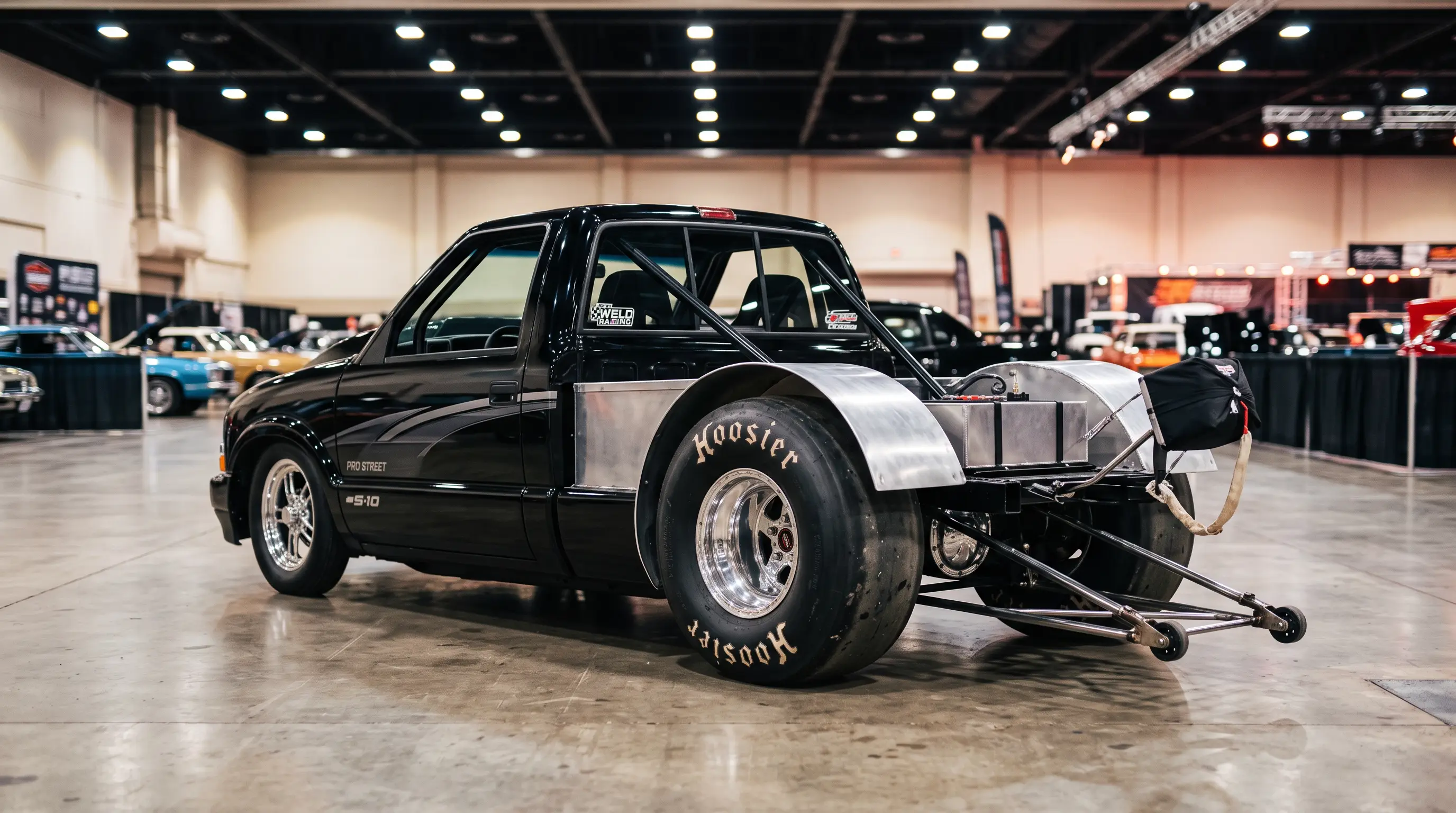
There is a particular kind of argument that breaks out at truck shows whenever the Pro Street S10 comes up, and it usually starts with somebody insisting that a compact pickup has no business wearing a tub job that size. Then somebody else points at the specific proportions of a Chevy S-10 and explains why it works better than half the full-size trucks in the lot. Chevrolet introduced the S-10 for the 1982 model year as its compact pickup answer, and within a few years builders had discovered that its short wheelbase and narrow factory stance made it an almost ideal donor for the Pro Street treatment.
Why the S-10's small size became an advantage
A full-size truck has room to spare for a tub job, but that same room can dilute the visual impact of a wide rear tire, since the truck's overall bulk makes even a fourteen-inch tire look proportionally smaller. The S-10 flipped that math. Its compact factory dimensions meant that any serious rear tire width read as dramatically oversized the moment it went in, because the whole truck around it was smaller to begin with. Builders who wanted maximum visual contrast between a narrow front and a fat rear tire found the S-10's proportions did a lot of that work automatically, before a single weld went into the tub itself.
The engine swap culture that grew around it
Factory S-10s came with modest four and six cylinder engines that were never going to satisfy anyone chasing serious quarter-mile numbers, so the platform developed a strong swap culture almost immediately among performance-minded owners. Small-block V8s from Chevy's own catalog became the most common transplant, dropped into an engine bay that was never designed to hold one, which required its own set of fabrication skills separate from the tub work out back. A well-executed S-10 build married both projects, a V8 swap up front and a tubbed rear end out back, into a truck that shared almost nothing mechanically with what left the factory.
What set S-10 builds apart from bigger truck projects
Beyond the size advantage, S-10 builds tended to attract a slightly different kind of builder than the full-size squarebody crowd, often younger, often working with a smaller budget, and often treating the compact truck as an accessible entry point into serious fabrication work. A full-size donor truck cost more to acquire and more to feed with parts. An S-10 was cheap, common through the 1980s and into the 1990s, and forgiving enough for a first-time builder to learn tub work on without risking a more expensive platform. That accessibility helped keep the compact truck side of Pro Street alive even as full-size truck prices crept upward over the following decades.
"Guys learned to tub a rear end on an S-10 because it was cheap enough to mess up. Nobody wants their first tub job to be on a truck they can't afford to replace."
- Wayne Coburn
The stance that made these trucks recognizable
A well-built Pro Street S-10 carries a distinct silhouette even among other tubbed trucks, thanks to how aggressively the compact wheelbase amplifies the front-to-rear contrast. Lowered front suspension combined with a tubbed rear end sitting under massive rubber gives these trucks a stance that looks almost cartoonish in the best possible way, closer to a caricature of the Pro Street formula than a subtle execution of it. That is not a criticism. Owners who chose the S-10 platform generally wanted exactly that kind of maximum visual statement, and the truck's small factory dimensions delivered it more efficiently than almost any other platform in the movement.
Where the S-10 fits in the bigger truck story
The compact pickup era that produced the S-10 also produced competitors from Ford and Dodge, and plenty of those platforms saw their own Pro Street conversions, though the S-10 remains one of the most commonly referenced examples of the genre today. our complete history of Pro Street trucks covers how the compact platforms fit alongside their full-size counterparts, including some of the less common trucks builders experimented with over the years. The compact truck branch of the movement never rivaled the car side in sheer numbers, but it produced some of the most photographed and talked about builds the scene has ever seen.
Buying one today
A genuine, well-documented Pro Street S-10 build is not something you stumble across every week, and the ones that survive tend to carry real history with them, often multiple owners and multiple rounds of refinement to the drivetrain over the decades. Anyone shopping this corner of the market should expect to do homework on the swap quality and the tub fabrication before committing, since build quality varies enormously between a professionally executed truck and a garage project that never quite got finished right. If you want to see what is currently available, you can find a classic Pro Street car and filter through whatever compact truck builds happen to be listed alongside the cars.
Why the platform still draws new builders
Even now, decades after the S-10 left production, the compact truck keeps drawing fresh interest from builders looking for an affordable entry into fabrication work. Donor trucks remain more findable and more affordable than a lot of the classic muscle cars that anchor the rest of the Pro Street world, and the compact size that made the original builds so visually striking also makes the truck easier to store and maneuver in a home garage with limited space. That practical appeal matters just as much as nostalgia in explaining why the S-10 keeps showing up on build forums and at regional truck shows, well after the platform's original heyday has passed into history.
A truck that earned its reputation the hard way
Nobody handed the S-10 its place in Pro Street history. Builders had to prove the compact platform could handle the stress of a serious tub job and a V8 swap through years of trial and error, often learning frame reinforcement lessons the hard way on early attempts before later builders refined the process into something more reliable. That earned reputation is part of why the truck still gets respect from people who know the scene's history, rather than being dismissed as a smaller, lesser version of the full-size trucks that came before it. A well-built S-10 stands on its own next to any other Pro Street project, compact size and all.
What separates a good build from a great one
The difference between an average S-10 conversion and a genuinely great one usually comes down to how well the different modifications talk to each other. A great build matches its front suspension changes to its rear tire width, matches its engine choice to the driveline components actually installed underneath, and matches its stance to proportions that suit the truck's specific body lines rather than copying another builder's formula wholesale. Wayne has seen plenty of S-10s with impressive individual pieces, a strong swap here, a wide tire there, that never quite came together as a cohesive whole because nobody stepped back and considered how the parts related to each other. The best examples in the scene got that way because somebody thought about the whole truck, not just the individual modifications going into it.