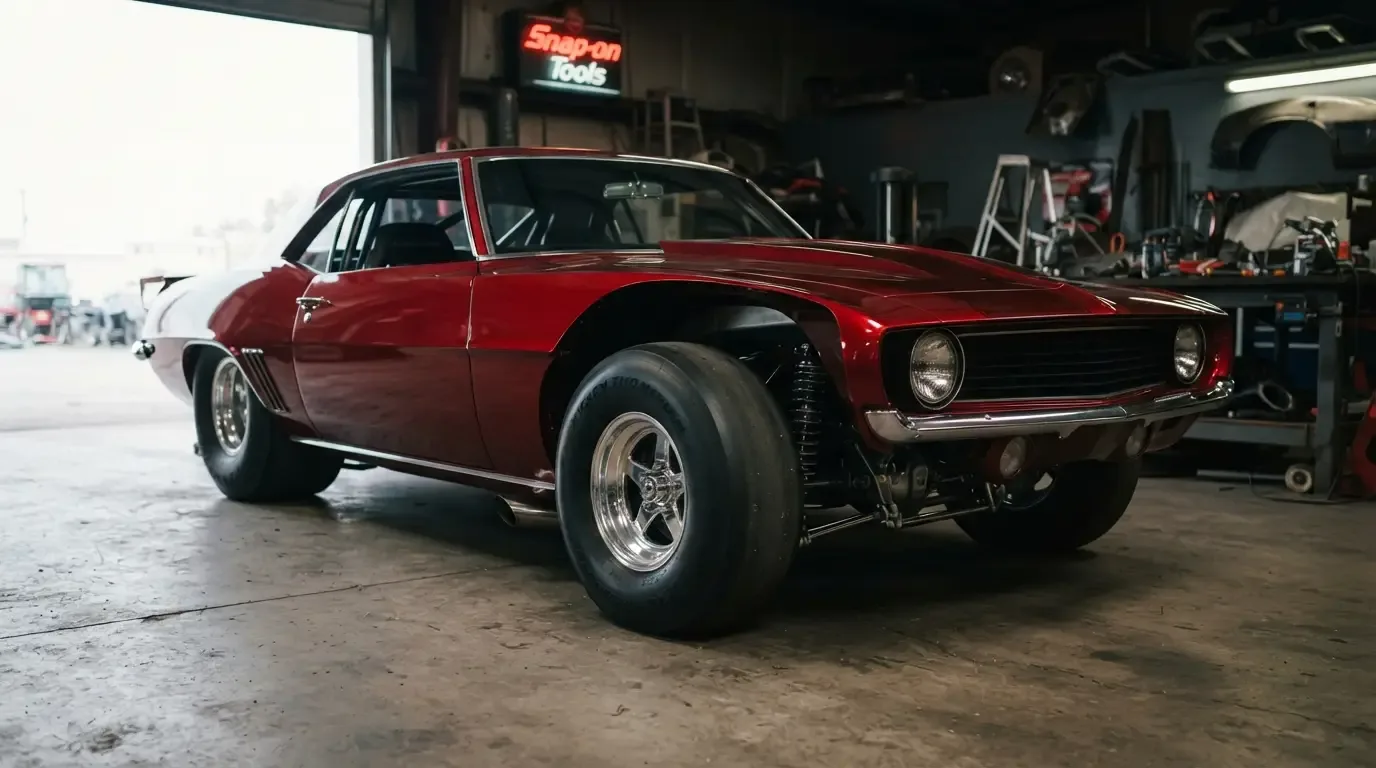

Every car club has that one guy who tells the same story at every meeting, and in ours it is Ray, who insists he was the first person on our street to cut a wheel well with a cutoff wheel and a lot of nerve. Whether that is true is beside the point. What matters is that the story is always about the same thing: getting a tire that big to actually fit under a factory quarter panel, and the tubbed rear end that made it possible. Tubbed Pro Street cars did not happen by accident, and understanding how the tub became the defining feature of the whole movement means understanding what builders were actually fighting against under those fenders.
The problem factory sheet metal could not solve
A stock rear wheel well on a muscle car or hot rod was designed around a tire maybe eight or nine inches wide. Drag racers chasing traction wanted something closer to fourteen, sixteen, sometimes wider still. There was no bolt-on solution for that gap. The only answer was to cut the inner wheel house out entirely and fabricate a new one, pushed inward toward the driveshaft tunnel, so the tire had somewhere to live without punching through the trunk floor or the quarter panel every time the suspension moved. That fabrication work is the tub, and it is why tubbed Pro Street cars look so different from a car that simply has wider tires bolted on the outside.
Doing it right versus doing it fast
Ray will tell you his first attempt looked terrible, and he is not wrong. Early tub jobs in home garages were often crude, with visible weld lines and mismatched sheet metal that told you exactly where the cutting had happened. As the style matured through the 1980s, builders got better at making the transition look intentional, blending the new tub into the original body lines so a car could still pass for stock at a glance from the front three-quarter view. That distinction, rough tub versus a seamless one, became a real point of pride and a real point of judging at shows, separating a weekend hack job from a build somebody had genuinely put craft into.
Readers who want the full backstory of how the whole movement got started should look at our complete history, which lays out the drag strip roots this all grew from.
What a proper tub job actually involves
Cutting the metal is the easy part to describe and the hard part to do well. Builders have to account for the width of the new tire and wheel combination, the travel of the suspension under hard acceleration, and the clearance needed for the driveshaft and any back-half chassis work happening at the same time. Get the width wrong and the tire rubs under load. Get the height wrong and the trunk floor loses too much depth to be useful. It is a measure-twice job, and the clubs I have run with over the years have more than one story about a builder who measured once and paid for it with a tire that ate through sheet metal on the first hard pass down the strip.
| Tub Consideration | Why It Matters |
|---|---|
| Tire and wheel width | Sets the minimum tub opening needed for clearance |
| Suspension travel | Tub must clear the tire through full compression |
| Driveshaft and chassis | Coordinated with any back-half work happening at the same time |
| Trunk floor depth | Reduced by the new tub, affects usable storage |
Why the community still argues about it
Sit in on enough club conversations and you will hear the debate that never really settles: how big is too big. Some members hold that a mild tub keeping close to a stock look is the more honest approach, respecting the original lines of the car. Others want the drama of a truly massive tire and do not mind if the tub reshapes half the rear quarter panel to get there. Neither side is wrong exactly, they are just chasing different versions of what a Pro Street car should be. Ray, for what it is worth, has softened his stance over the years and now says the best tub job is the one you cannot spot unless somebody points it out to you, which is a fair way to put it after three decades of arguing about sheet metal in a parking lot.
"You can always tell who did their own tub work and who paid a shop, because the shop guys stop talking about it after the first year and the home builders never do."
- Wayne Coburn
Regional habits that shaped the look
Spend time with clubs from different parts of the country and you start to notice the tub work has its own regional accents. Cars that came out of strip-heavy areas in the Midwest tended toward function first, tubs cut wide and blunt with less concern for how the transition looked from outside the car. Builders working in areas with a stronger show circuit, especially through the late 1980s and into the 1990s, put more effort into blending the tub seamlessly, sometimes spending as much time on the cosmetic transition as on the structural fabrication itself. Neither approach is more correct, but talking to enough old-timers makes the regional split obvious once you know to look for it.
Ray's own car came out of that Midwest tradition, and he still argues that a tub job somebody can spot from ten feet away is nothing to be embarrassed about, since the whole point was traction, not a magazine cover. Other members in our club, particularly the ones who came up around the coastal show scene, disagree just as firmly. It is one of those debates that never gets settled and honestly does not need to be, since both approaches produced legitimate, respected cars that still show up at swap meets and reunions decades later.
Documentation matters more than people expect
Here is the part nobody thinks about when they are cutting sheet metal in a driveway: photographs of the process become the proof later on. A car with paperwork and build photos showing the tub work is worth more to a buyer and more to a club than one with no history behind it, especially decades later when nobody left to ask can confirm who did the fabrication or when. The clubs that keep good build records tend to be the ones whose cars hold their reputation the longest, tubbed rear end and all.
For anyone chasing one of these builds themselves, it is worth taking the time to find a classic Pro Street car with documentation intact rather than relying on a seller's word alone.
Sources and notes
- Pro Street - Wikipedia
- Pro Street's Greatest Builds Honored at 2024 Grand National Roadster Show - Hagerty Media
- Defining muscle car terms: pro touring, pro street, and street freak - In The Garage Media
- Difference in back-halved vs tubbed out - Team Camaro Tech
- Car Craft's Street Freaks - Magazine Covers 1976 to 1985
- Street Machine Nationals - Du Quoin, IL