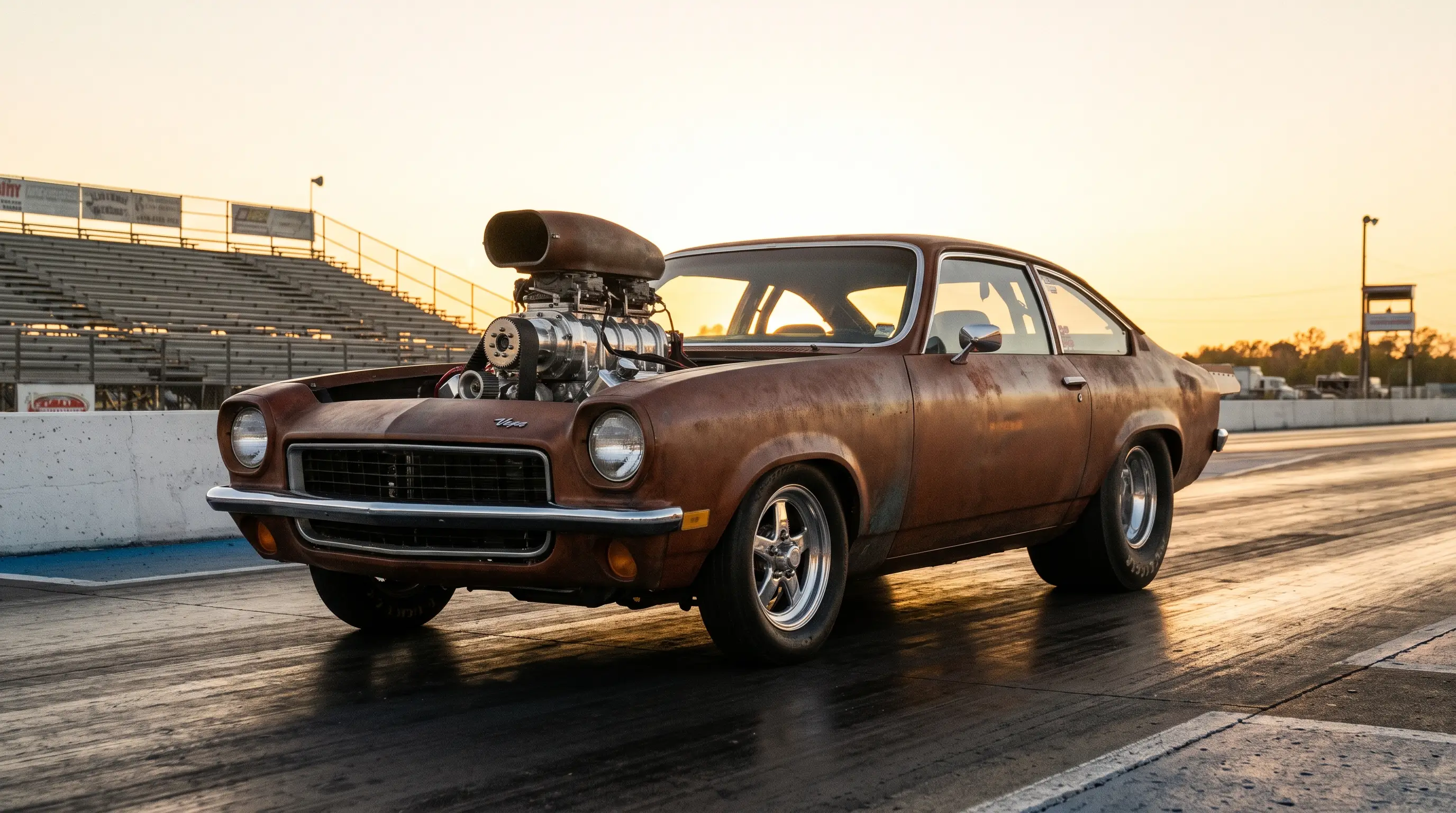
Nobody at our club believed Ed's Vega would run in the nines the first time he said it out loud. It was a Chevy Vega, after all, the subcompact everyone remembered for rusting out in driveways and burning oil by the time it hit thirty thousand miles on the odometer. Then he took it to the strip on a cold Saturday morning and proved every doubter wrong. The pro street chevy vega story is full of moments like that, a car built almost as a joke that ended up humbling machines twice its size and price.
An unlikely donor car with one huge advantage
Chevrolet built the Vega from 1971 through 1977 as an economy subcompact meant to compete with imports, and it earned a reputation for rust problems and an aluminum-block engine that wore out faster than owners expected. By the time the car left production, it had become something of a punchline in automotive circles. But that same unloved reputation meant Vegas were dirt cheap and plentiful through the late 1970s and 1980s, exactly the kind of expendable starting point drag racers wanted for a serious weight-reduction project.
The Vega's one undeniable advantage was mass, or the lack of it. This was one of the lightest American-built cars of its era, and in a sport where power-to-weight ratio decides who wins, a light shell with a big engine crammed inside is a formula that works regardless of what badge is on the trunk lid.
Stuffing a big engine into a small body
Fitting a big block Chevrolet engine into a car designed around a small four-cylinder required real surgery. Builders cut and reshaped firewalls, relocated front suspension components, and in many cases moved the entire engine setback further into the chassis just to get the weight distribution and clearance right. This was not a bolt-in swap by any stretch, and the builders who pulled it off successfully earned a specific kind of respect in the hobby for tackling a harder fabrication job than a Nova or Camaro swap ever demanded.
Once the engine was in, the rest of the Pro Street formula followed the usual script. Tubbed rear quarters, wide slicks out back, a narrowed front end, and a stripped interior turned an already light car into something absurdly quick. A Vega that weighed roughly half of what a full-size muscle car weighed, carrying nearly the same horsepower under its hood, produced power-to-weight numbers that bigger, more prestigious platforms simply could not match without spending far more money chasing the same result.
Why giant-slaying became the platform's identity
Every hobby needs an underdog story, and the Vega became Pro Street's favorite one. Watching a subcompact that most people associated with breakdowns and rust holes out-accelerate a full-size Chevelle or Camaro at a stoplight created a specific kind of satisfaction for builders who felt looked down on for choosing a cheap, unglamorous starting point. The whole picture of how different platforms competed for attention in this era helps explain why a car nobody respected on paper became one of the more talked-about builds at any show it attended.
That giant-slayer reputation was not just talk. The Vega's light weight gave it a genuine mechanical advantage that no amount of engine work could fully replicate on a heavier platform, which is exactly why builders kept returning to it decade after decade despite its rust-prone reputation and thin aftermarket support compared to more popular Chevy models.
"Ed used to say his Vega had nothing left to prove after that first run at the strip. Every skeptic who laughed at the car in the pits went quiet once they saw the time slip."
- Wayne Coburn
The rust problem builders had to solve first
Before any tub work or engine swap happened, a lot of Vega Pro Street projects had to solve the platform's notorious rust issues just to have a usable shell to build on. The Vega's steel was thinner and less corrosion resistant than most of its contemporaries, and cars stored outside for even a few winters in northern climates often had rot in the floor pans, rocker panels, and rear frame rails before a builder ever got to the fun part of the project. That meant serious Vega builds frequently started with more patch panel work and rust repair than a comparable Nova or Camaro project, adding real time and cost to a build that was already supposed to be the budget option.
Builders who stuck with the platform anyway generally did so because the payoff in the power-to-weight column justified the extra headache. A rust-free or properly repaired Vega shell weighed so little to begin with that even after adding a big engine, a stronger frame, and tub work, the finished car still came in lighter than most alternatives, which is the entire reason anyone put up with the extra fabrication trouble in the first place.
Interior and glass, the last places to save weight
Serious Vega builders did not stop at the engine swap and tub work. Because the car started so light, every remaining pound mattered more on a percentage basis than it did on a heavier platform. Builders commonly swapped factory glass for lightweight plexiglass in the rear window and quarter windows, stripped sound deadening and unnecessary interior trim down to bare essentials, and sometimes replaced steel hoods and deck lids with fiberglass equivalents. None of this was unique to the Vega, but the returns were more dramatic on a car this small, since shaving fifty pounds off an already featherweight shell moved the power-to-weight needle further than the same fifty pounds would on a full-size Impala.
Finding a surviving example
Well-built Pro Street Vegas from the genre's peak years are genuinely uncommon today, since the platform's rust issues claimed a large share of the surviving shells before anyone thought to preserve them as historically significant. The ones that do survive with documented build history and quality fabrication carry a specific kind of respect among collectors who understand exactly how much harder this platform was to build correctly compared to its more common, more forgiving competitors. If you want to see what is currently available, you can find a classic Pro Street car and compare how a well-preserved Vega build stacks up against the bigger, more famous platforms it used to embarrass on the strip.
Ed still brings that same Vega to our club meetings, and there is still always somebody new who does not believe the stories until they see the time slips for themselves, and every time it happens, Ed just smiles and says he told them so.