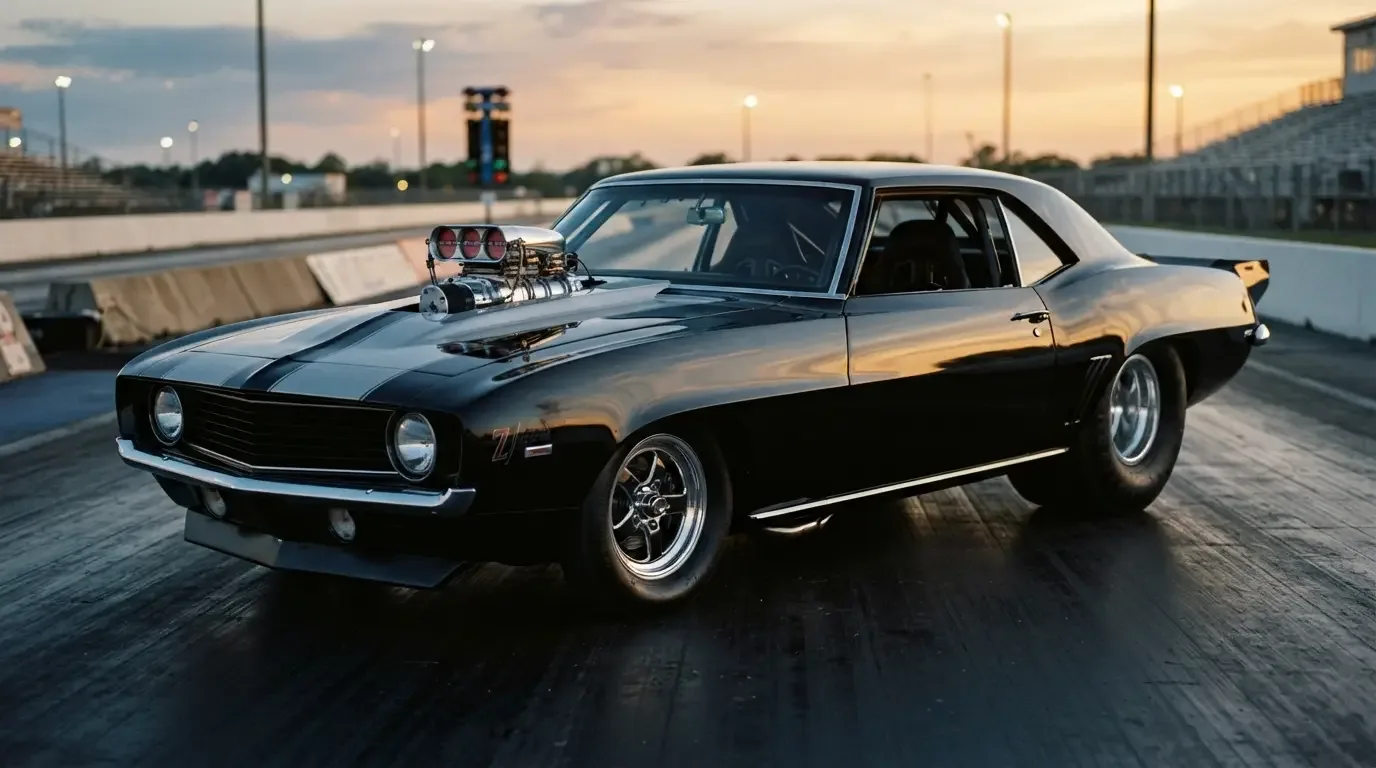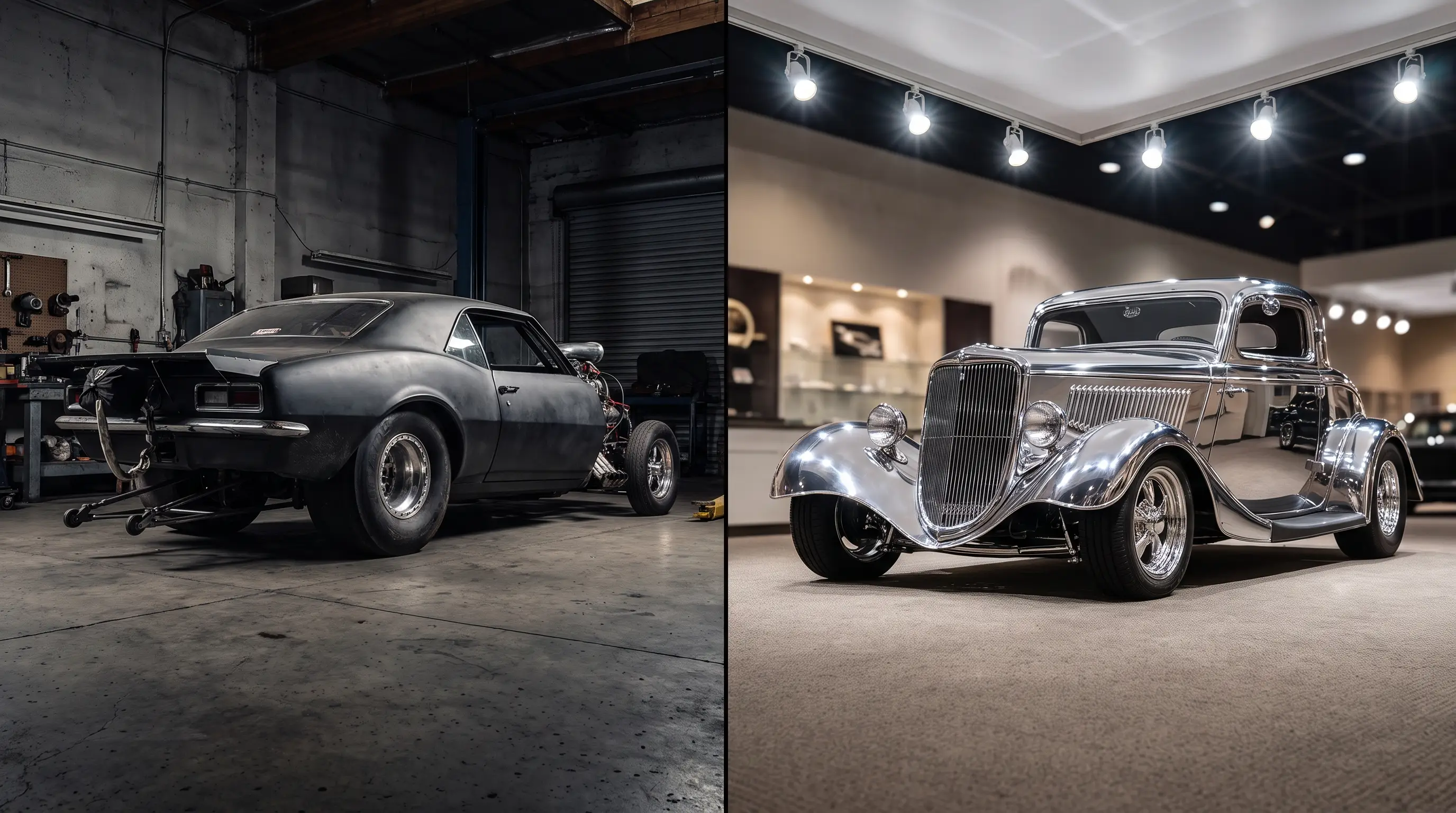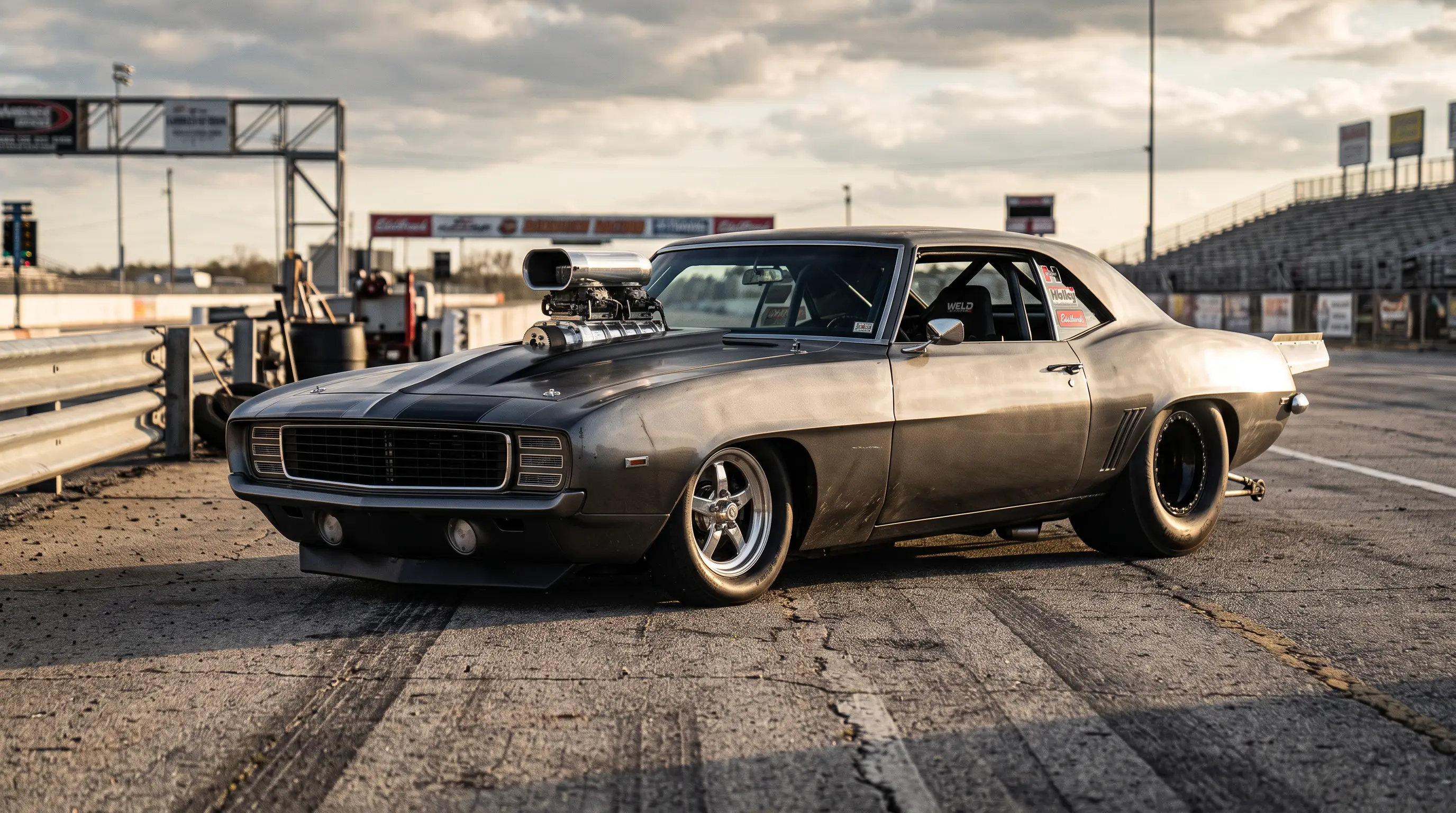
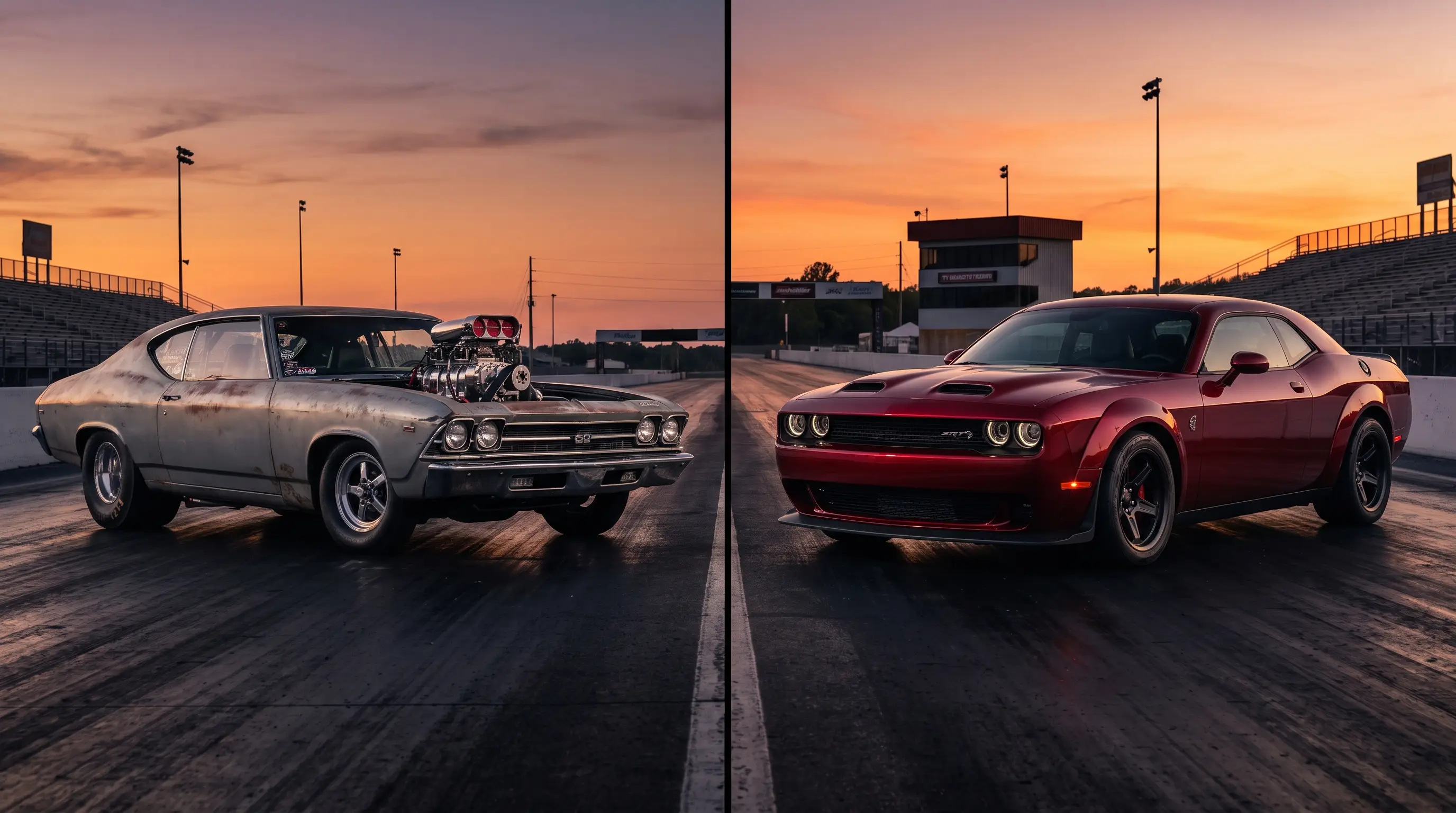
Park a tubbed 1970 Chevelle next to a new Hellcat and the conversation at that show is going to run one direction fast. Pro street vs modern muscle is not really a fair fight in the way people usually frame it, because the two are answering different questions with different tools built forty years apart. One is a hand-built expression of a specific era's drag racing obsession. The other is a factory engineering exercise chasing quarter-mile numbers with a supercharger and a computer doing most of the thinking. Both are fast. Only one of them was ever meant to look the way it does.
Where the numbers actually land
A well-built Pro Street car running a healthy small block or big block with a single four-barrel or a mild blower can run mid-to-high 12s in the quarter mile without much trouble, and a serious build with real power under the hood can dip into the 10s. Factory modern muscle, meanwhile, walks off a dealer lot doing 11s in stock trim on the right tire, since the supercharged Dodge Challenger SRT Hellcat carries an NHRA-certified 11.2-second stock quarter mile on its factory Pirelli tires, and the limited-run Challenger SRT Demon pushed that further with a factory-claimed 9.65-second run on drag radials, a time stock-power Demons have since beaten on their own at a dragstrip. On paper, a brand new muscle car can outrun a lot of Pro Street builds without anyone touching the engine. That comparison misses why Pro Street exists in the first place, though, because straight-line speed was never the entire pitch.
Stance versus stock proportions
Modern muscle cars are wide and low from the factory, built around aerodynamics and structural rigidity that a 1970s unibody or full-frame car never had to consider. Pro Street cars get their proportions from tubbed rear quarters and narrowed front ends, a look that has to be built by hand because no factory ever offered it. That difference in origin is the whole story. A modern Camaro or Challenger looks aggressive because an entire engineering and design team spent years tuning its proportions in a wind tunnel and a studio. A Pro Street car looks aggressive because a builder cut, welded, and fabricated a body until the tires and stance said what a factory line never could. You can read pro street vs pro touring history for the fuller account of how Pro Street's look diverged from other performance builds of its own era, before modern muscle even entered the conversation.
What each one actually costs to own
A factory modern muscle car comes with a warranty, dealer support, and parts availability that a hand-built Pro Street car simply cannot match. Insurance, financing, and service are all straightforward because the car is, underneath the performance trim, still a regular production vehicle. A Pro Street car is a one-off or small-batch build, which means every mechanical issue is a custom problem with a custom solution, usually solved by a fabricator rather than a parts counter. That trade-off is part of what buyers are actually purchasing when they choose one over the other. Modern muscle buys convenience and modern safety systems. Pro Street buys a piece of a specific era that nothing currently in production actually replicates.
"Nobody cross-shops these two the way people online pretend they do. A guy buying a Pro Street Nova already knows a new Charger is quicker. That was never the question he was asking himself."
- Patrick Walsh
The driving experience nobody talks about enough
Sitting in a tubbed Pro Street car with a manual transmission and no power steering assist is a physical experience in a way a modern muscle car, with its computer-managed everything, mostly is not. The clutch is heavy. The steering is heavy at low speed. The huge rear tire changes how the car reacts to throttle input in a way that rewards a driver who understands what is happening underneath the car rather than trusting traction control to sort it out. That is not automatically better. Plenty of drivers prefer the modern car's predictability and the safety net that comes with it. But it is a genuinely different experience behind the wheel, and it is one reason Pro Street ownership has stayed a passionate, if smaller, community rather than fading out once factory cars got fast enough to outrun the old builds on paper.
Why the rivalry keeps resurfacing anyway
Every few years a new factory muscle car generation launches with bigger horsepower numbers, and every few years someone online resurrects the comparison to see how a decades-old Pro Street build stacks up. It makes for an easy headline, but the builders and owners inside the scene rarely take the bait seriously, because they were never building for that comparison. If you want to see what real Pro Street builds cost and look like today, Pro Street cars for sale now gives a much better sense of the current market than any quarter-mile chart. There is also a related story on why the style ended up looking as aggressive as it does, which explains a lot about why owners are drawn to it despite the horsepower gap with modern factory cars.
Two eras, not two competitors
The most honest way to frame pro street vs modern muscle is as a comparison between two different eras of thinking about performance rather than a genuine head-to-head. One era prized fabrication skill and a distinctive, hand-built look achieved with whatever a home garage could manage. The other prizes computer-tuned efficiency and factory consistency at a price point regular buyers can actually afford. Both produce genuinely quick cars. Only one of them produces a silhouette you can spot from three blocks away without reading a single badge.
How ownership culture differs between the two
Modern muscle car owners generally join a factory-supported community built around dealer events, manufacturer-sponsored track days, and an active online forum culture tied directly to a specific model. Pro Street ownership tends to run through regional car clubs and cruise nights instead, communities that formed organically around shared fabrication knowledge rather than any single manufacturer's marketing calendar. Both communities are passionate, but they trade in different currencies. Modern muscle enthusiasts often trade dyno numbers and tuning software comparisons. Pro Street owners trade stories about who built what tub job, which shop did the best driveline work in a given region, and how a particular car has evolved across multiple owners over several decades.
What each says about the era that built it
A Pro Street car is, in a real sense, a physical record of what a home builder with limited resources could accomplish with fabrication skill, patience, and a welder in the late 1970s and through the 1980s and 1990s. A modern muscle car is a record of what a major manufacturer's engineering budget could accomplish once computer modeling, forced induction, and traction control matured enough to make huge horsepower streetable for an average buyer. Both are legitimate achievements. They simply belong to completely different chapters of automotive history, built by different people solving different problems with the tools available to them at the time, which is really the whole reason the comparison keeps drawing interest even though it was never a fair fight to begin with.