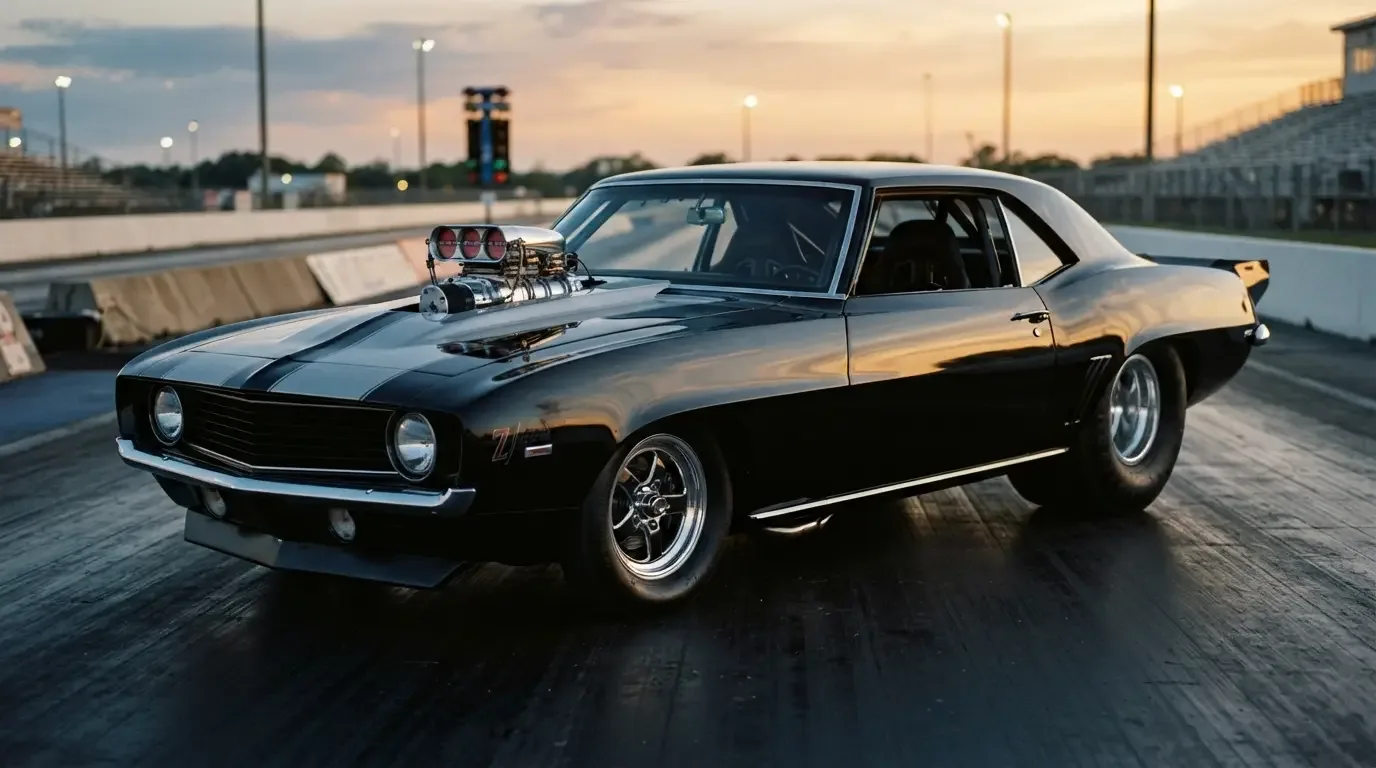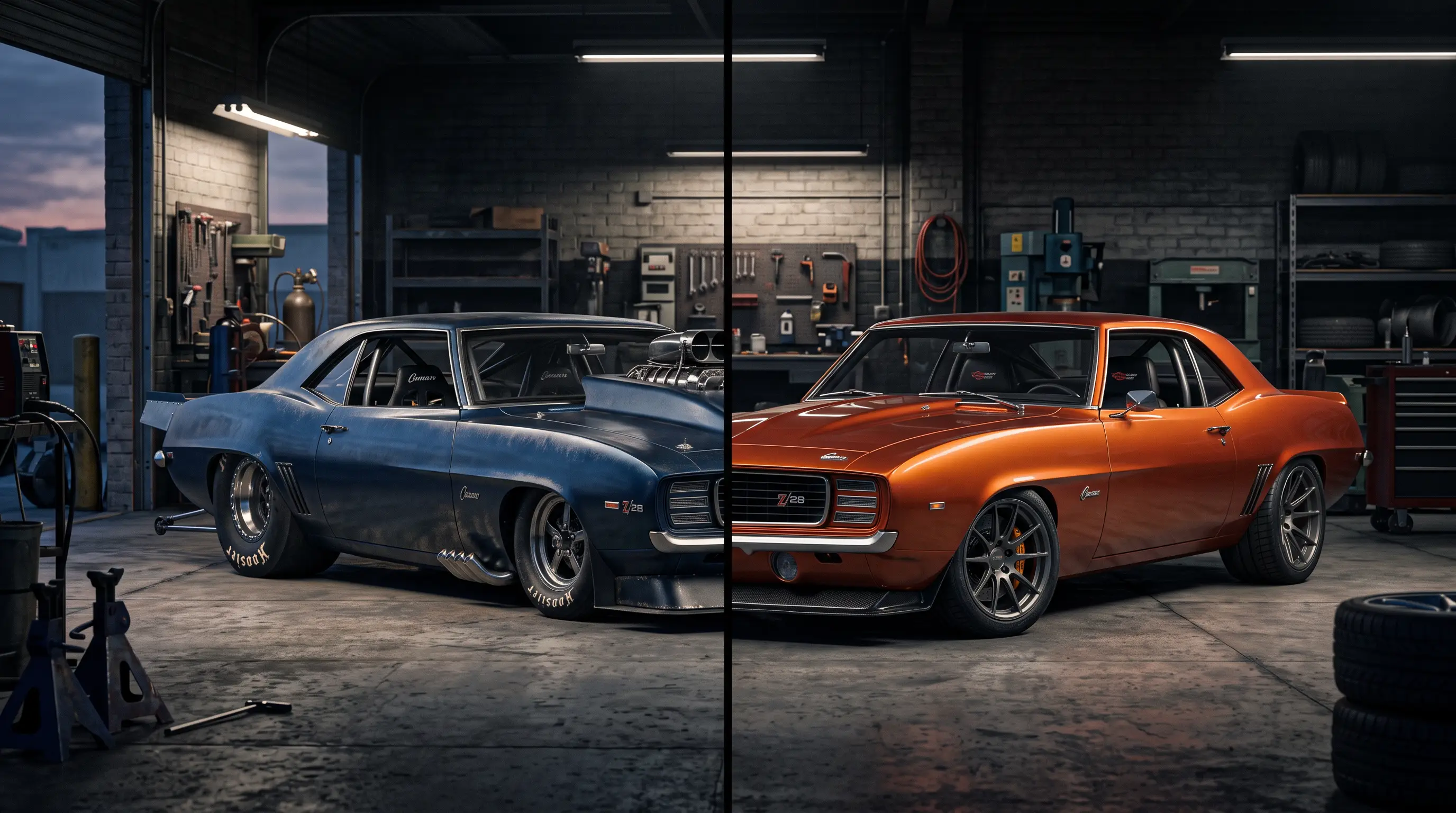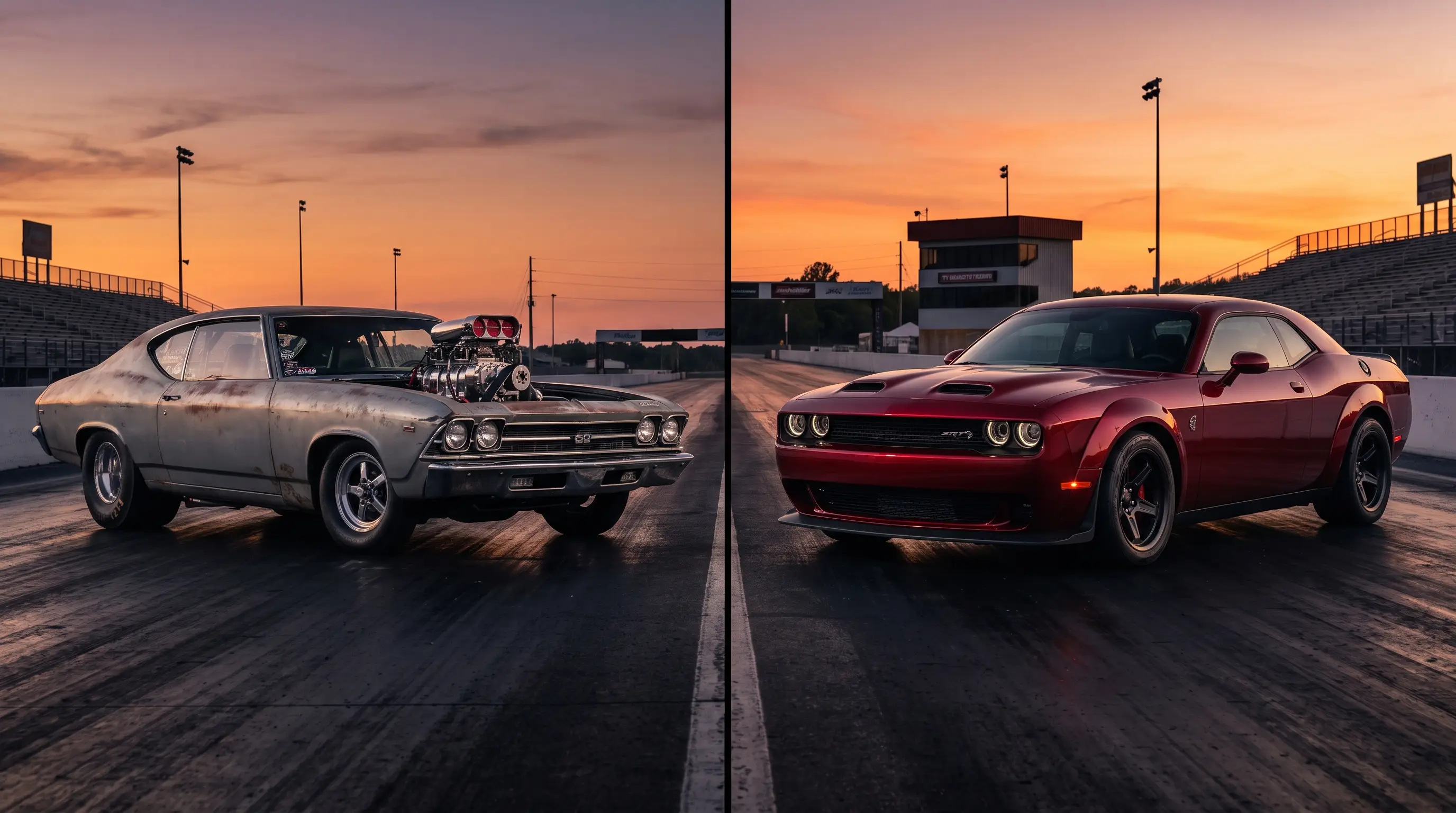
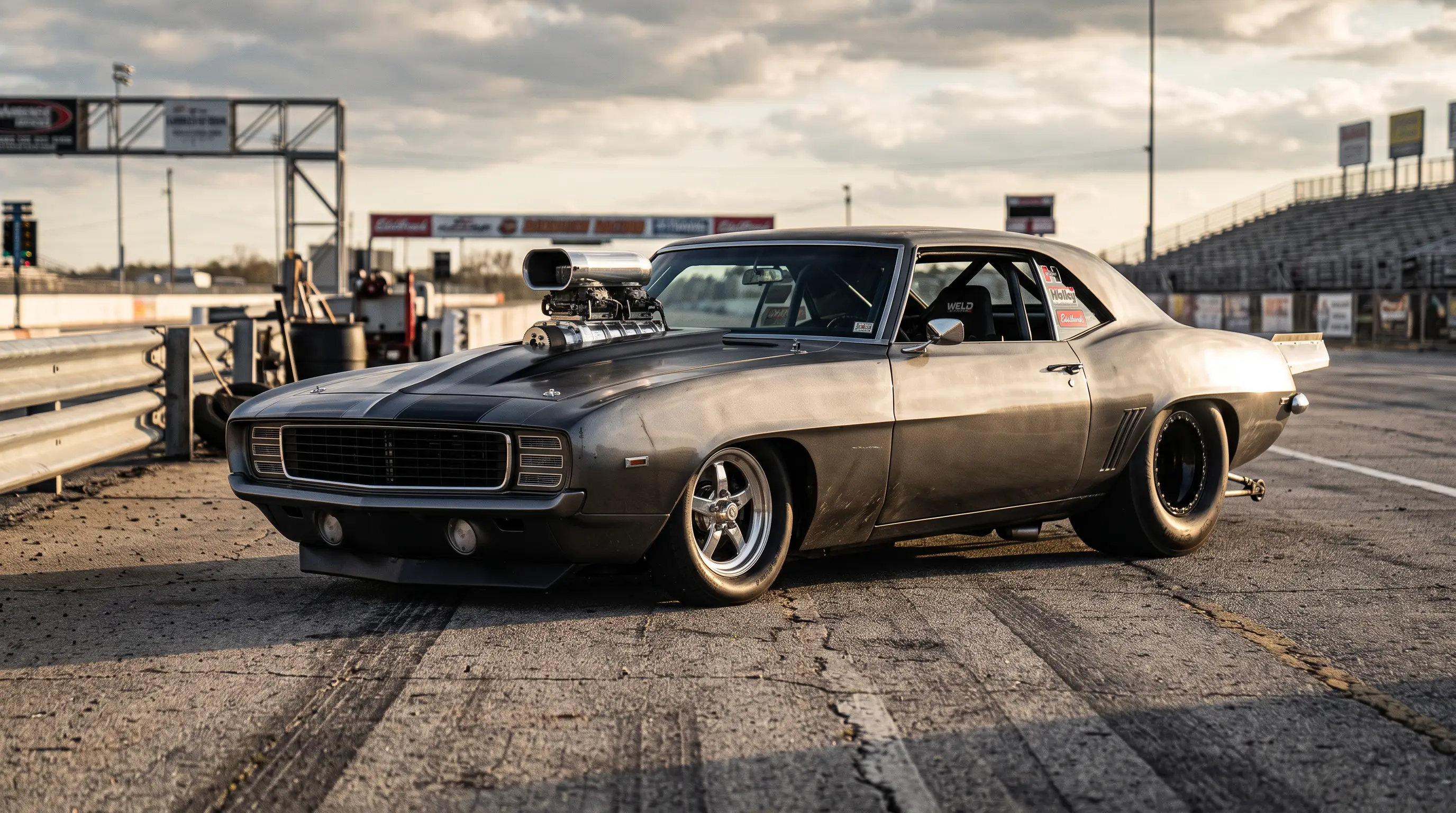
A buddy of mine brought his teenage nephew to a cruise night a few summers back, and the kid stood in front of a tubbed Camaro for a solid two minutes before saying anything. Then he just said "why does it look mad." That is about as good a question as I have ever heard about the style, honestly, because pro street aggressive is not an accident of engineering. Every proportion on one of these cars was chosen, sometimes fought over in a garage for weeks, to make the car read as ready to fight before the engine even turns over.
The rear tire is doing most of the talking
Start with the obvious part. A Pro Street rear tire is enormous compared to anything a factory ever bolted under a muscle car, sometimes stretching to twelve, fourteen, even more inches of tread width tucked inside a tubbed quarter panel. That kind of width was never subtle, and it was never meant to be. A wide rear tire signals grip and power in a way that reads instantly to anyone standing near the car, drag racing background or not. It is the single loudest visual cue on the entire build, and builders have known that since the earliest days of the style, which is why the tub job usually gets planned before almost anything else on the car.
The front end shrinks so the back can grow
Here is the part a lot of newcomers miss. The aggression is not just about the big rear tire. It is about the contrast between a lightened, narrowed front end and that massive rear footprint. Builders ran skinny front tires, sometimes pulled front sway bars, sometimes raised the front ride height slightly, all to exaggerate the difference between front and back. A car that looks small up front and enormous out back reads as predatory in a way a perfectly balanced, evenly proportioned car never will. That contrast is borrowed directly from drag racing geometry, where a light front end and a planted rear end were originally about weight transfer off the line, not looks. Builders kept the geometry even after the reason for it stopped being purely functional.
Height and stance do more work than most people notice
A Pro Street car sitting level would lose most of its punch. The nose-down or nose-level, rear-up stance that a lot of these builds carry pushes the eye toward the back tires immediately, reinforcing the same message the tub job is already sending. Lowered front suspension combined with a tubbed, sometimes slightly raised rear end creates a forward lean that mimics a sprinter crouched at a starting block. It is not subtle, and it was never trying to be. The whole point of the stance is to make a parked car look like it is already accelerating.
"You want people to see the car before they hear it. If the stance doesn't grab someone from across a parking lot, no amount of engine noise is going to fix that first impression."
- Wayne Coburn
Function that became a fashion statement
It is worth remembering that none of this started as pure style. Tubbed rear quarters existed because builders needed physical room for a wider tire, not because a wide tire alone looked good sitting on a narrow quarter panel. Once builders realized how much visual impact the modification carried on its own, the aesthetic took on a life independent of whatever horsepower sat under the hood. A Pro Street car with a modest engine but a beautifully executed tub job and stance could still turn heads the same way a much faster, more understated build never would. The look became its own reward, separate from straight-line performance, which is part of why the style survived long after purely functional drag geometry stopped being the point.
Where the aggression comes from today
Modern builders working in the Pro Street revival have leaned even further into this proportion game, sometimes running rear tire widths that would have seemed extreme even by 1980s standards. Wider wheel wells, more dramatic tub jobs, and paint schemes chosen specifically to accentuate the front-to-rear contrast all keep pushing the same visual formula that started decades ago. the whole picture of how this style separated from its drag racing cousins covers a lot more of that history if you want the full lineage. What has not changed is the underlying goal. Builders are still chasing a car that looks like it wants a fight before the driver ever touches the key.
Seeing it in person changes the argument
Photos genuinely undersell how aggressive these proportions look in real life, because a picture flattens the depth between the narrow front and the wide rear in a way your eye never does standing next to the actual car. If you want to understand why the style has held onto its fan base for decades despite being objectively impractical for daily driving, you have to stand next to one. For anyone who wants to go past photos and specs entirely, you can find a classic Pro Street car and see the proportions up close for yourself. There is no substitute for standing next to a genuine tub job and letting the stance do what it was built to do.
The sound reinforces the visual
Aggression is not purely a visual argument, and any honest accounting of the style has to mention sound alongside stance. A big carbureted engine idling roughly, sitting behind that narrowed front end and under that wide rear stance, adds an audible layer to the whole impression before the car ever moves. Builders who paired a lumpy cam with an aggressive stance were not being subtle about it, and that combination of sound and silhouette together is a big part of why these cars leave such a strong impression at a show, even parked and silent in the lineup with the engine off. The reputation for aggressive noise usually arrives at a venue before the car itself does, once people start talking about which builds are running.
A formula that still gets copied
Younger builders working on entirely different platforms, from later-model performance cars to import-based projects, still borrow pieces of this same visual logic even when they have never heard the term Pro Street applied to their own work. A narrow front paired with a wide rear remains one of the most reliable ways to make any vehicle read as purposeful rather than passive, regardless of the era or the badge on the hood. It shows how well the original builders solved the proportion problem decades ago, and it is why the aggressive Pro Street silhouette keeps showing up in new forms even as the specific cars that started the trend age into full-blown collector status.