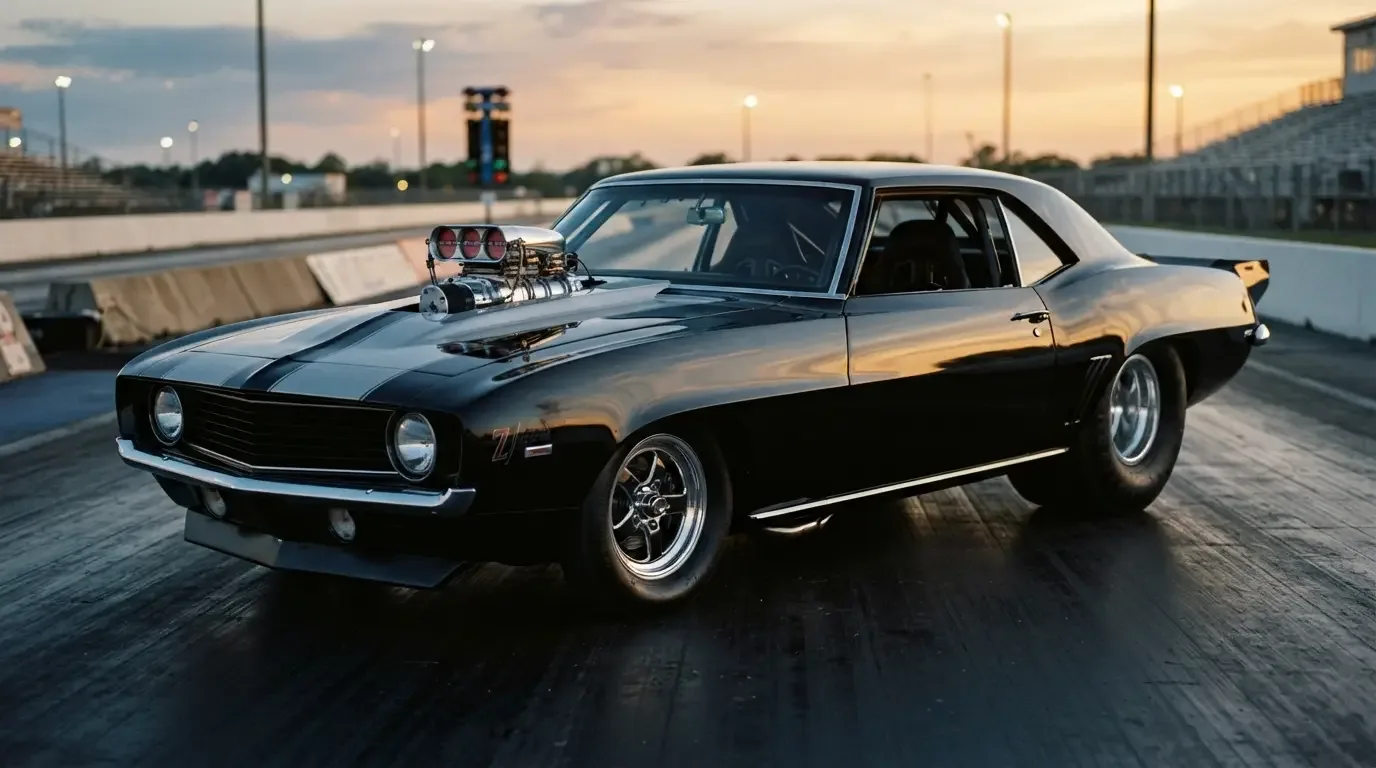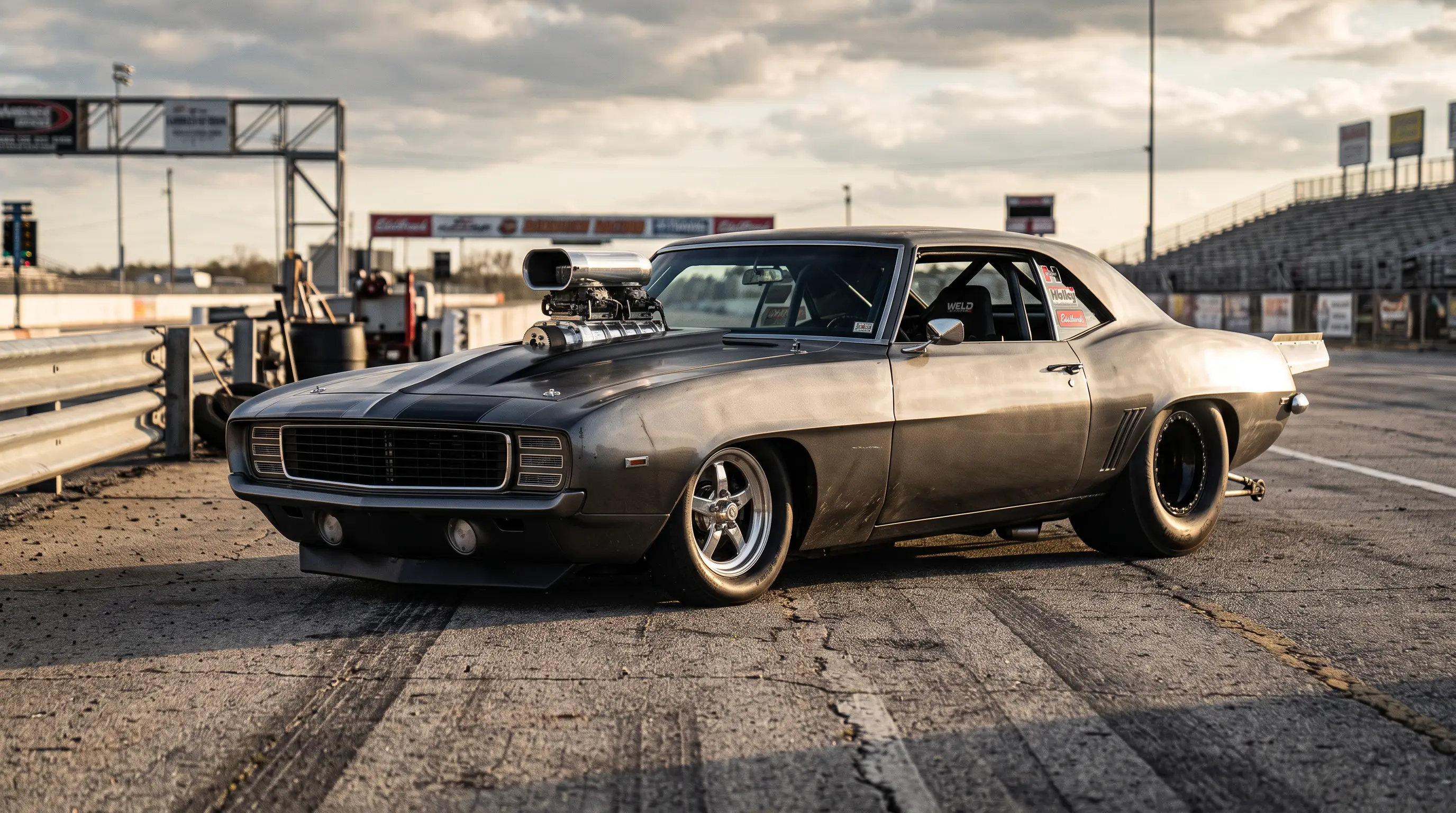
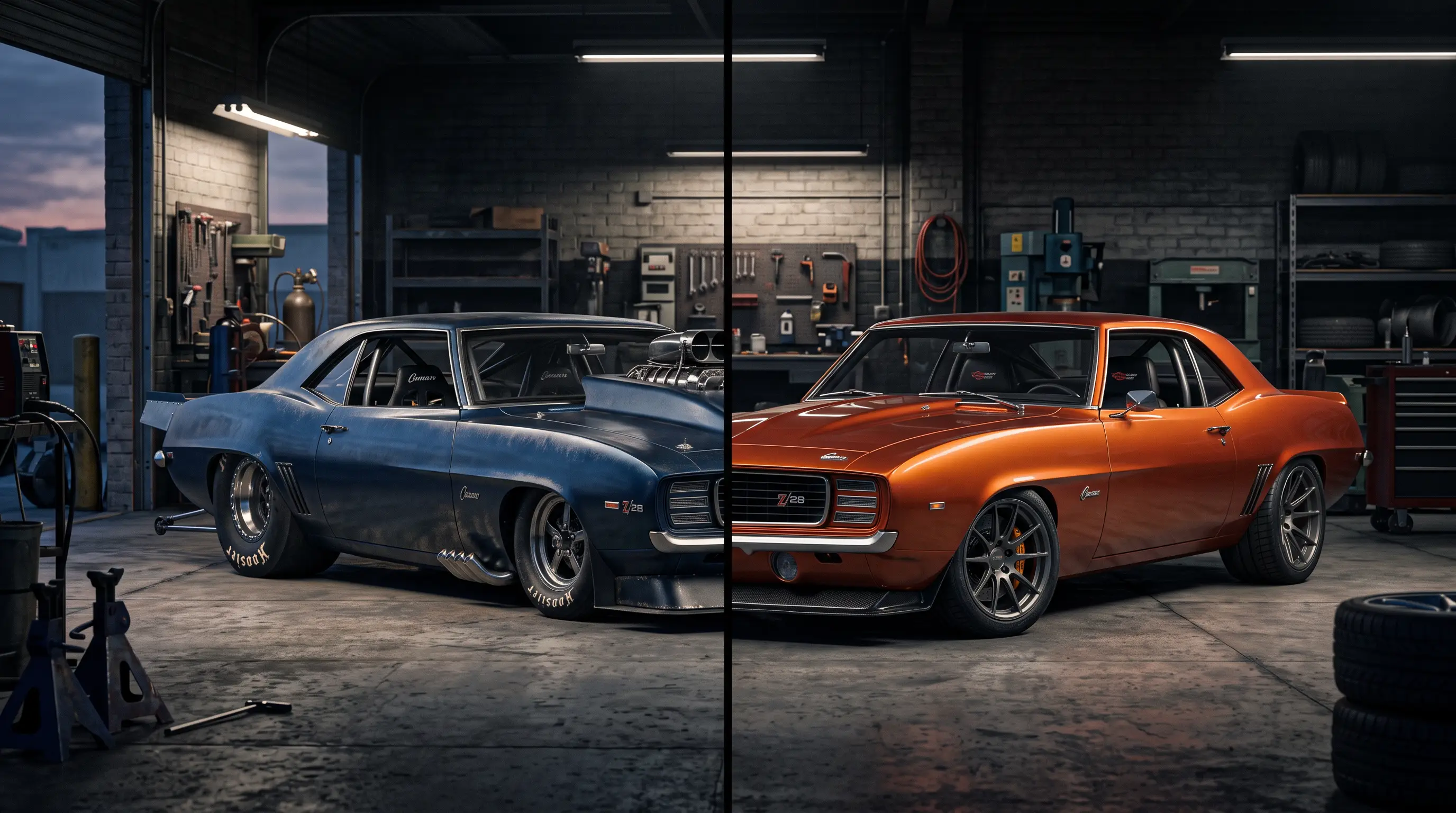
Two builders can start with the identical donor car, a 1969 Camaro, say, and finish with machines that share almost nothing in philosophy. One ends up tubbed, narrowed and blown, built to look ferocious sitting still and to launch hard in a straight line. The other ends up on modern suspension and big brakes, built to carve a canyon road at speed. That is the pro street vs pro touring divide in a sentence, and it defines two of the most influential movements to come out of classic muscle car culture.
Pro Street's straight-line obsession
Pro Street emerged in the late 1970s and grew through the 1980s and 1990s around a simple idea borrowed directly from drag racing: huge rear tires under a tubbed body, a narrow front end, and an engine built to make serious power in a straight line. The look mattered as much as the function. A Pro Street car announced its purpose the moment you saw it, with rear tires that dwarfed the fronts and a stance that made clear this was not a car built for tight corners. Handling was rarely a priority, and plenty of Pro Street cars rode on suspension geometry that would have made a road course driver nervous.
The engines followed the same straight-line logic. Blowers, tunnel rams and nitrous all showed up on Pro Street cars because they served one goal, making the most power possible off the line and through a quarter mile, even if the car never actually saw a real drag strip. Style and street presence carried as much weight as any timing slip.
Pro Touring's answer to a different question
Pro Touring arrived later, largely as a reaction against the Pro Street formula, and it asked a different question entirely: what if a classic muscle car could actually handle like a modern sports car while keeping its original body and character? Builders swapped in modern independent front suspension, upgraded brakes at all four corners, wider but proportionally matched tires front and rear, and chassis stiffening that a Pro Street car never needed because it was never going to see a corner at speed. The goal was balance rather than spectacle, a car that could run a road course one weekend and cruise comfortably the next.
| Element | Pro Street | Pro Touring |
|---|---|---|
| Rear tires | Massive, often tubbed body to fit | Wide but proportional to front |
| Front tires | Narrow, minimal grip by design | Matched width to rear for balance |
| Suspension focus | Straight-line launch | Cornering grip and stability |
| Brakes | Often stock or lightly upgraded | Major upgrade, all four corners |
| Primary goal | Visual drama, quarter mile posture | Real-world handling performance |
Two movements, two different owners
The kind of enthusiast drawn to each movement tended to differ too. Pro Street attracted builders who grew up around drag racing culture and wanted their street car to echo that world, even symbolically. Pro Touring drew builders who wanted a genuinely capable driver, something that could keep up with a modern car through a set of corners rather than just look intimidating parked at a show. Neither approach was more legitimate than the other. They simply answered different questions about what a classic muscle car should be able to do. Anyone who wants the fuller comparison between the two schools of thought can find pro street vs pro touring history laid out with more detail on how each style evolved from its own set of priorities.
Cost profiles differed as well. A Pro Street build could get expensive through the drivetrain, particularly with a blower and narrowed rear end, but the suspension and brake work stayed relatively modest since handling was not the priority. A Pro Touring build often spent the bigger money on chassis and suspension components, since a modern independent front end and four-wheel disc setup with real stopping power cost more than most owners expected going in.
"Pro Street asked how fast can you get from a dead stop. Pro Touring asked how well can you actually drive the thing. Both are fair questions. They just lead to completely different cars."
- Patrick Walsh
What the driving experience actually feels like
Spend time behind the wheel of each type of car and the philosophical divide becomes obvious within the first few minutes. A Pro Street car under power pulls hard and straight, but the narrow front tires and drag-oriented suspension geometry make it feel nervous and vague the moment a corner shows up, exactly as designed, since cornering grip was never part of the specification. A Pro Touring car under power feels composed through the same corner, with the modern suspension and matched tire widths front and rear delivering predictable, confidence-inspiring handling that a driver coming from a modern car would recognize immediately.
Neither experience is better in an absolute sense, and enthusiasts who have driven both tend to describe them as answering completely different questions about what a classic car should feel like. A Pro Street car rewards a driver who wants raw, unfiltered acceleration and does not mind sacrificing everything else to get it. A Pro Touring car rewards a driver who wants the classic body and soundtrack of a muscle car combined with handling that would not embarrass it on a modern road course. Understanding which experience a buyer actually wants, rather than which one looks better in photos, is often the deciding factor in choosing between the two styles.
Where the two movements overlap today
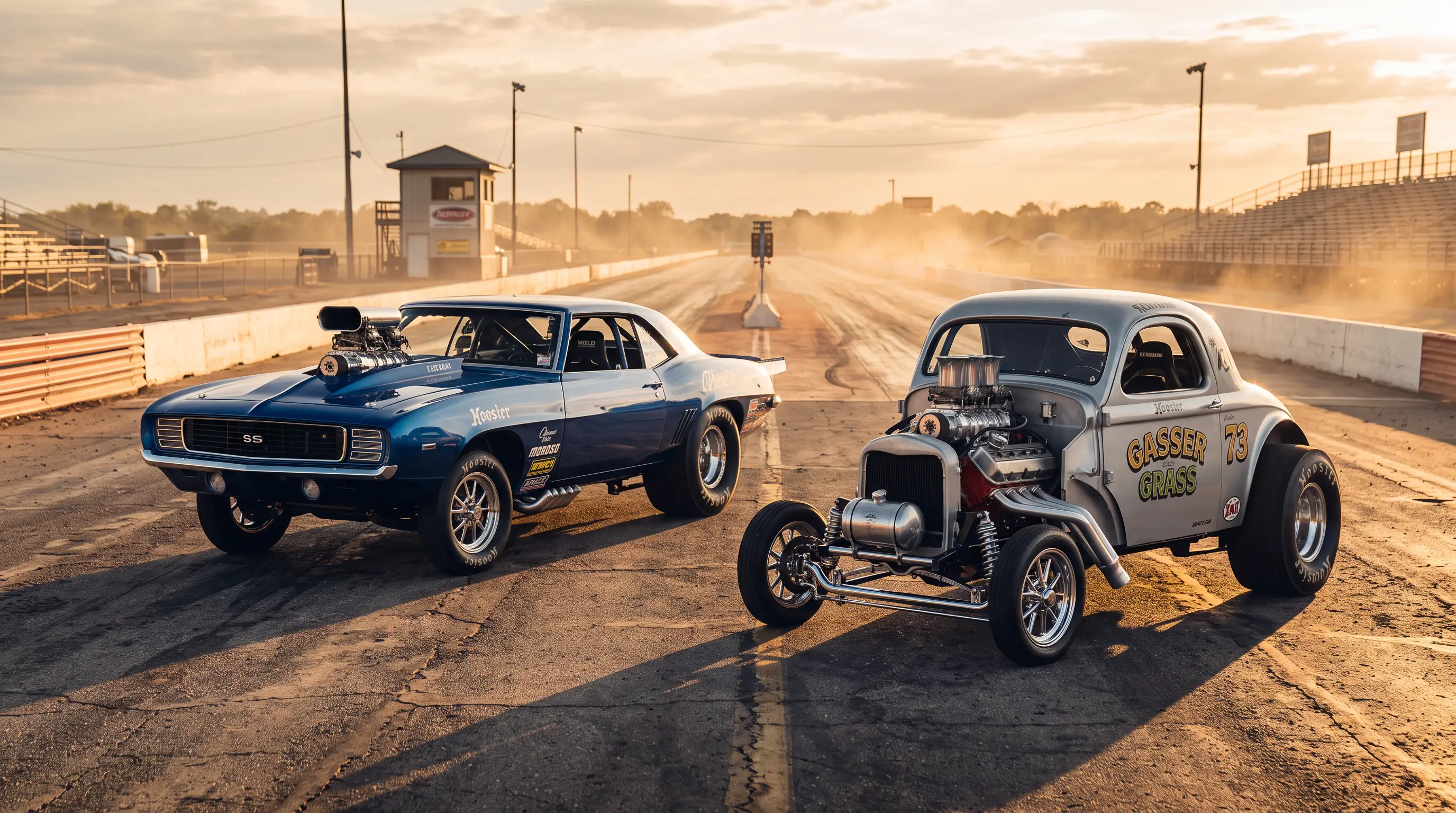
Some modern builders blend elements of both, keeping a wide rear stance for visual presence while adding modern suspension geometry underneath for real handling capability. That hybrid approach has softened the old rivalry between the two camps, though purists on each side still argue that a true Pro Street car should stay committed to straight-line drama and a true Pro Touring car should stay committed to balanced handling above all else. Readers interested in how Pro Street compares against yet another rival build style should check a related story on how the gasser look factors into the same family tree.
Buyers deciding between the two should be honest about how they intend to drive the car. Anyone leaning toward the straight-line, drag-inspired look should look at listings for Pro Street cars for sale now and go in expecting a car built for spectacle and launch rather than cornering confidence, since that tradeoff is baked into the format from the ground up.