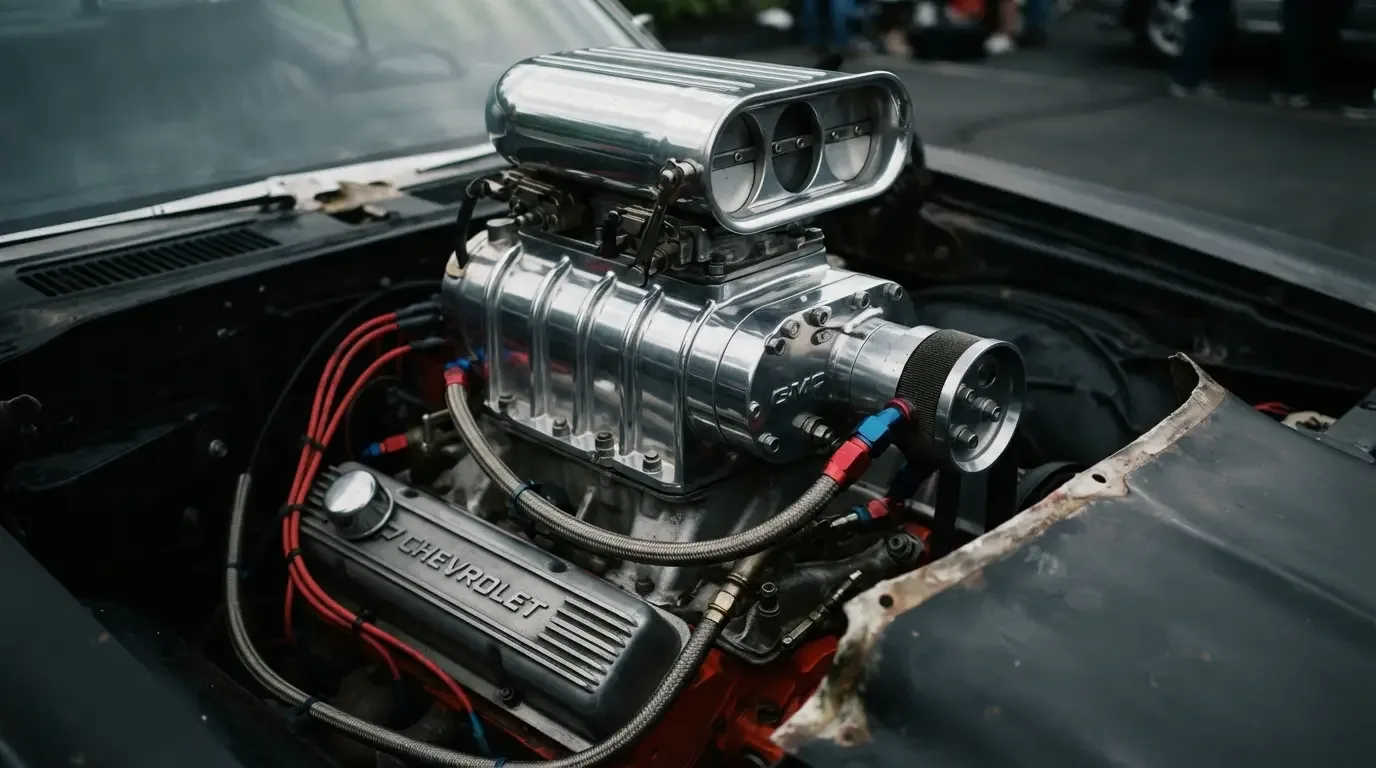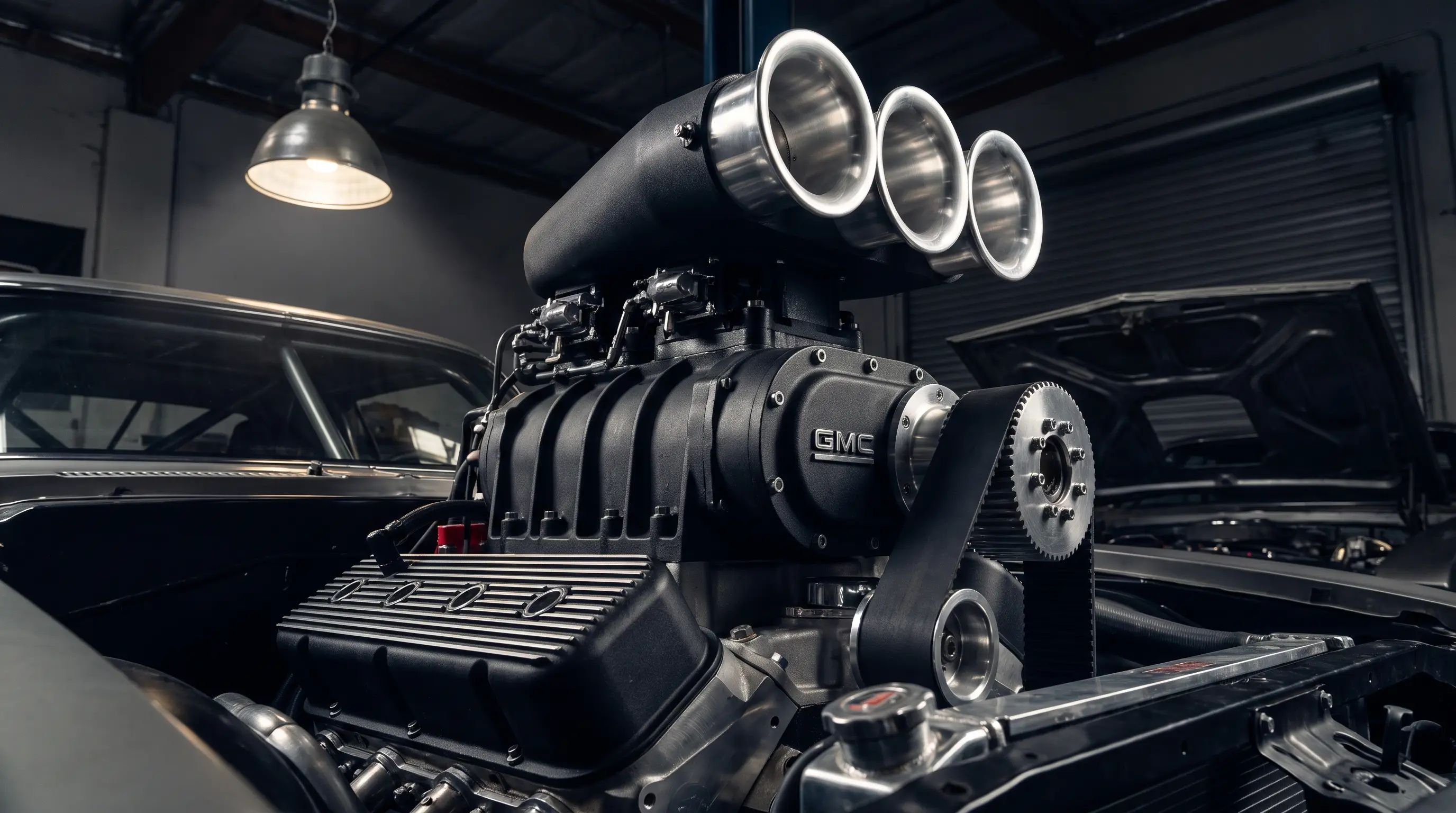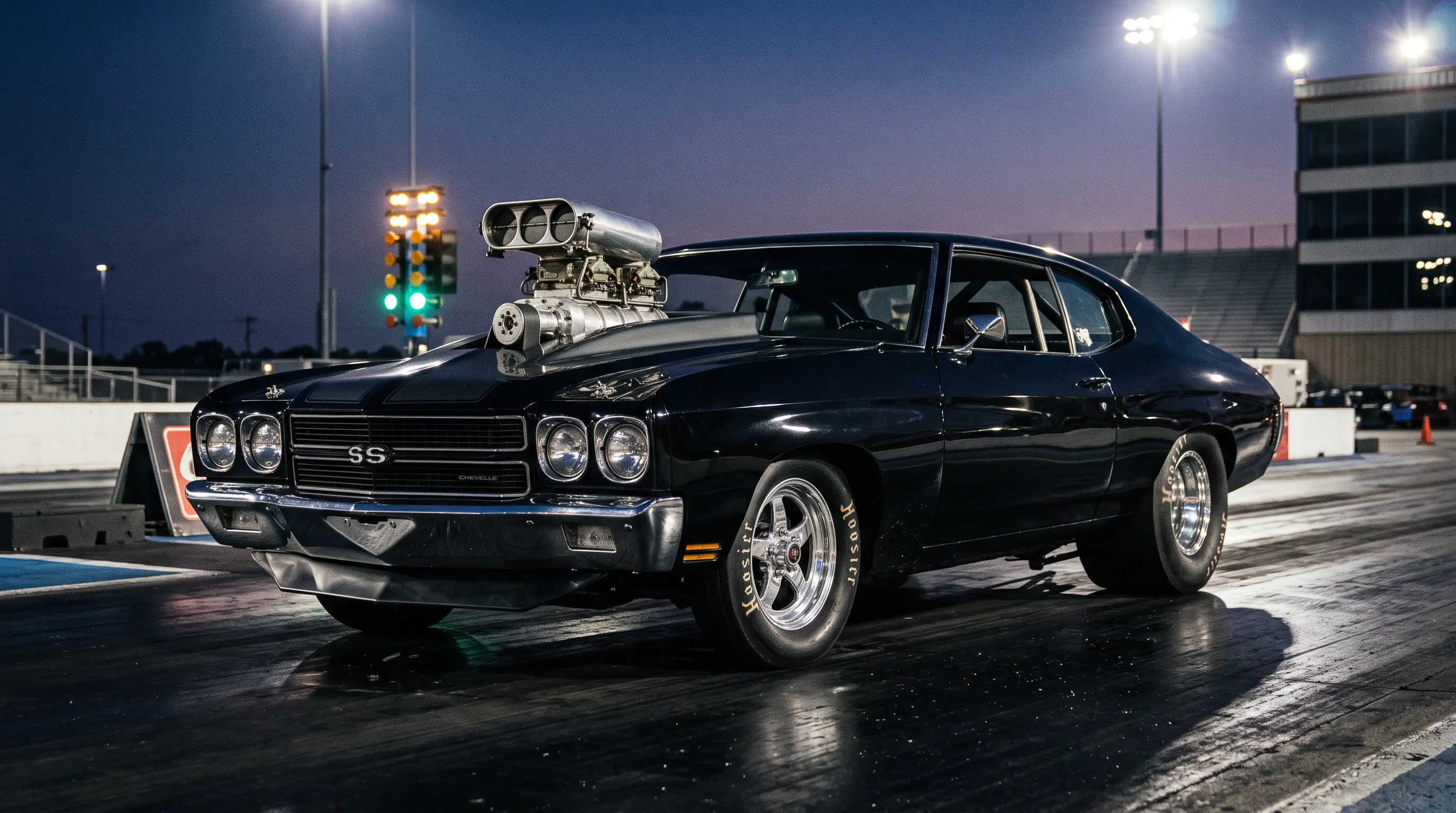
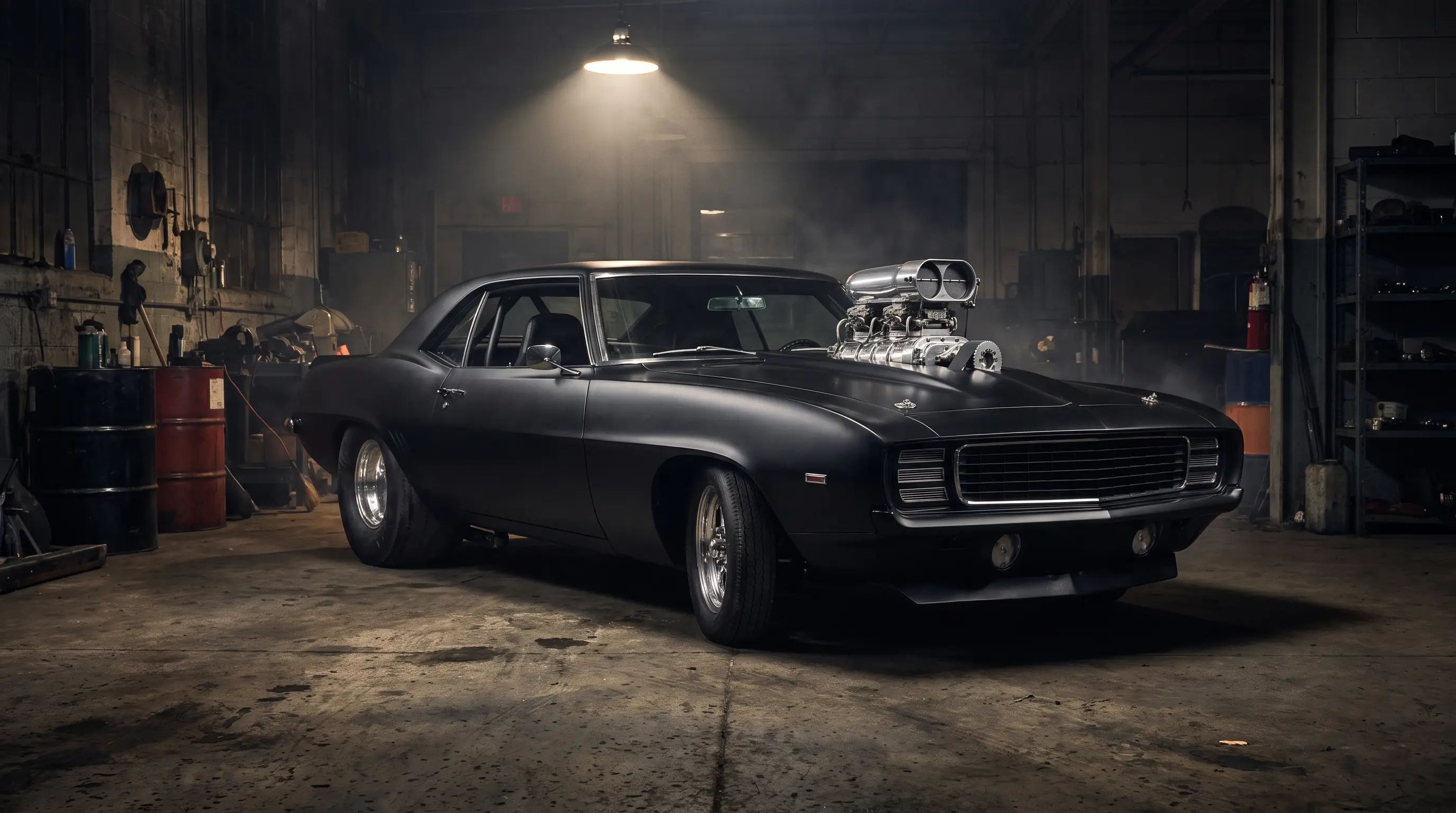
A blower makes a Pro Street car breathe harder than it ever could on its own. Bolt a Roots-type supercharger on top of a big-block, and you are not adding a cosmetic piece, you are force-feeding air and fuel into the cylinders faster than the engine could pull it in by itself. That is the whole point, and it is why the blower became the signature piece of the Pro Street movement.
What a blower actually does
A Roots supercharger uses two meshing rotors to push air into the intake manifold under pressure. Normal aspiration relies on atmospheric pressure and engine vacuum to fill the cylinders. A blower forces more air in than atmospheric pressure alone would allow, and more air means more fuel can be burned per cycle, which means more power. The boost is driven directly off the crankshaft through a belt, so the blower spins in proportion to engine speed. Mash the throttle and the blower works harder immediately, no turbo lag, no waiting.
On a Pro Street car this was not a subtle upgrade. A 6-71 or 8-71 blower on a big-block Chevy or Mopar wedge could add several hundred horsepower over the naturally aspirated version of the same engine. That kind of gain is the reason blown big-blocks became the default engine choice for anyone serious about running quick times at the strip while still driving the car on the street.
Why builders picked GMC diesel blowers specifically
The 6-71 and 8-71 designations come from GMC diesel truck engines, where these blowers originally did unglamorous work moving air through two-stroke diesels. Drag racers discovered in the 1960s that the same units, adapted with a proper intake manifold and drive system, worked extremely well on gasoline V8s. By the time Pro Street took off in the late 1970s and early 1980s, the GMC blower was already a proven quantity in the racing world, and it was available, affordable, and rebuildable, which mattered to builders working out of home garages rather than professional shops. For the full mechanical story of how that swap happened, pro street blower history covers the transition from truck part to street icon in more detail.
The numbers that matter
Blower size is measured in cubic inches of displacement per revolution, which is where the 6-71 and 8-71 names come from. An 8-71 physically moves more air per rotation than a 6-71, which generally means more boost potential on the same engine, provided the fuel system and bottom end can handle it. Builders picked blower size based on the engine displacement underneath it and how much boost they wanted to run. A big-block over 500 cubic inches could support an 8-71 without much trouble. A smaller 350 or 400 small-block was often better matched to a 6-71, since an oversized blower on an undersized engine just wastes drive belt life without adding usable power.
| Blower size | Typical engine pairing | Common boost range |
|---|---|---|
| 4-71 | Small-block under 400 ci | Low boost, streetable |
| 6-71 | 350-454 ci big-block or stroker small-block | Moderate boost, most common Pro Street choice |
| 8-71 | 454 ci and larger big-block | High boost, race-oriented builds |
Boost, fuel, and the honest tradeoffs
A blower is not a free upgrade. More air means the engine needs more fuel to match it, so blown Pro Street cars typically ran larger carburetors, mechanical fuel injection, or dual-quad setups just to keep up with the airflow. Boost also raises cylinder pressure, which means the bottom end, head gaskets, and ignition system all need to be built to handle the extra load. Builders who bolted a blower onto a stock short block without upgrading anything else usually found out the hard way why forged pistons and stronger connecting rods existed. None of that is restoration or how-to territory here, just the plain reality of why a blown engine costs more to build correctly than a naturally aspirated one making similar power on paper.
Readers interested in one specific GMC unit and its outsized reputation should look at a related story covering the 6-71 in detail, since it became the most common blower on Pro Street cars for practical reasons beyond just its size.
"A blower does not make an engine smarter. It just makes it move more air, and more air is where the power comes from. Everything else is detail."
- Dan Reeves
Roots blowers versus other forced induction options
Turbochargers existed as an alternative in the same era, and a handful of Pro Street builders did experiment with turbo setups instead of a belt-driven blower. Turbos have real advantages, most notably that they use otherwise wasted exhaust energy to drive the compressor rather than pulling power directly off the crankshaft the way a Roots blower does. But turbos hide under the hood, and Pro Street was a movement built as much around visual statement as outright efficiency. A turbo setup, however effective, could not deliver the same immediate visual signal as a chrome blower case sticking up through a hole in the hood. That is a big part of why the Roots blower remained dominant in this specific scene even as turbo technology matured and became more common in other performance circles through the 1980s and 1990s.
Centrifugal superchargers were another option, spinning faster and more efficiently at higher RPM than a Roots unit, but again largely absent from serious hood-line. They tend to sit lower and more compactly, which works against the whole visual point of Pro Street. A Roots blower is inefficient compared to both alternatives in pure thermodynamic terms, since it compresses air less smoothly and generates more heat per unit of boost. Builders accepted that inefficiency because the tradeoff, instant throttle response and an unmistakable visual signature, mattered more to the culture than squeezing out the last percentage point of efficiency.
Living with a blower on the street
Running a blown Pro Street car day to day came with real compromises that builders accepted as the cost of the look and the power. Belt life was shorter than on a naturally aspirated car, since the blower drive belt carries real load every time the throttle opens. Fuel mileage dropped noticeably, and idle quality on a car set up for boost rather than smoothness was often rougher than a stock engine, with a distinctive lopey idle that became part of the car's character rather than something to apologize for. None of that discouraged builders. If anything, those small daily inconveniences became bragging points, proof that the car underneath the paint was the real thing rather than a show piece built purely for static display.
The bottom line
A blower turned an ordinary big-block into the centerpiece of a Pro Street build, both mechanically and visually. It pushed more air into the cylinders than the engine could ever pull in on its own, and it did it in a way you could see and hear from across a parking lot. That combination of function and theater is exactly why the blower, sticking up through a cut hood, became shorthand for the entire Pro Street era. If you want to see what survives from that period, Pro Street cars for sale now occasionally includes original blown big-blocks still running the setup they left the builder's garage with decades ago.