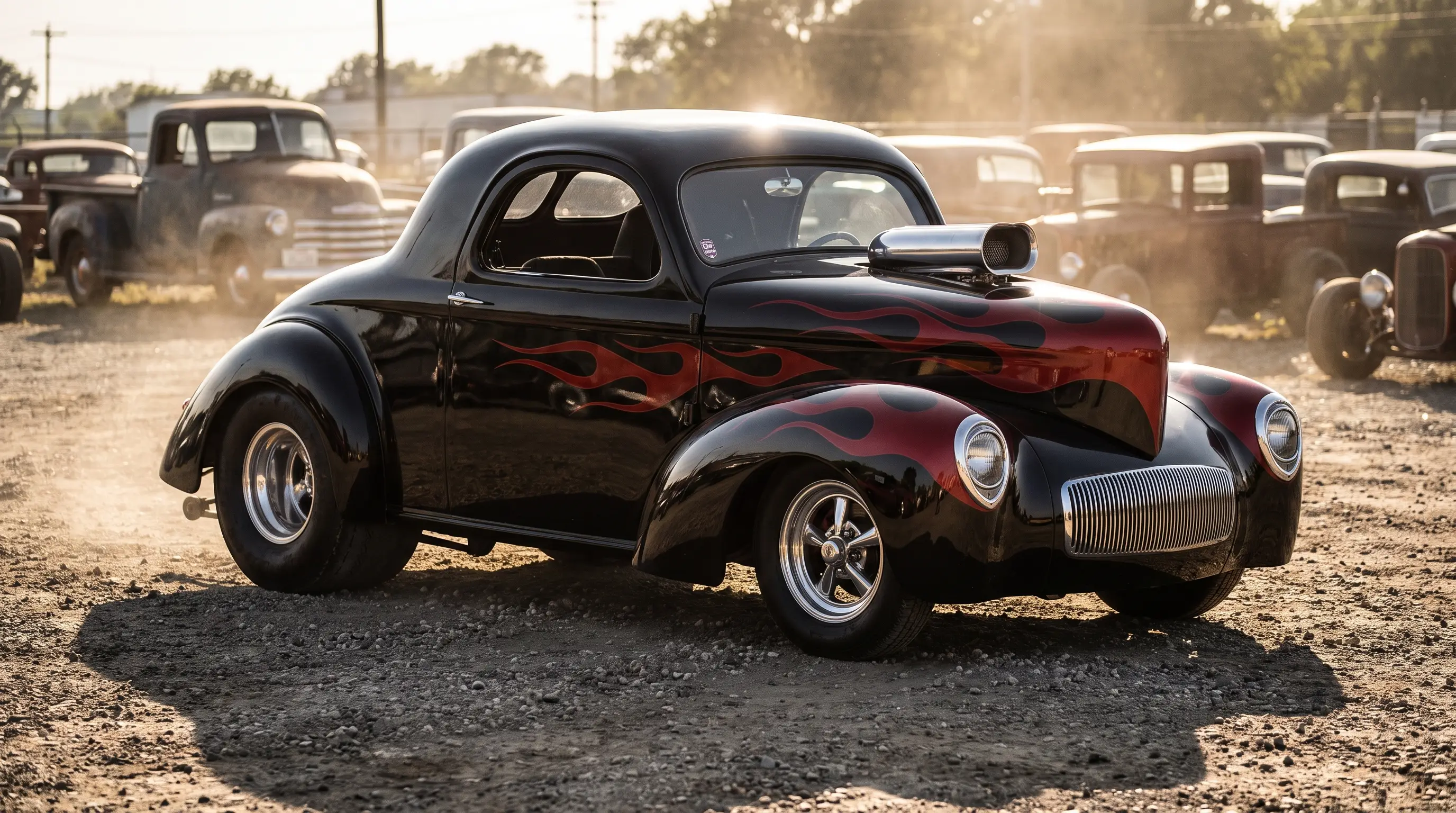
I met a man at a swap meet outside Springfield who had a 1941 Willys coupe sitting on a trailer, no engine, no glass, just a shell with a for sale sign taped to the windshield. He told me it had been a pro street willys build back in 1987, tubbed and caged, and that the last time it ran it pulled a low eleven at a bracket race in Ohio. He wanted to sell it as a starting point for somebody else's dream. That is the Willys story in a nutshell. These little coupes have been changing hands, half finished, for forty years, and every owner adds a chapter.
A small car that made a big impression
The Willys Americar, built from 1937 through 1942, is a short wheelbase, narrow bodied coupe that weighs next to nothing compared to a Chevelle or a Nova. Drag racers found it first, in gasser form during the 1960s, running big blocks up front on straight axles. When Pro Street arrived in the late 1970s, the Willys made an easy jump from strip to street because the body was already stripped down and purposeful. A tubbed Willys with a blown engine looked like a cartoon of a race car, and that was exactly the point.
Wayne Coburn has judged more than one club show where a Willys sat next to a full size Chevelle and drew the bigger crowd simply because of its size. Small cars with big engines have always pulled people in, and the Willys does that better than almost anything else from the era.
Under the skin of a Pro Street Willys
Because the stock Willys frame and floor are so narrow, builders had to get creative to fit a set of Pro Street rear tires under the body. Tub jobs on these cars were often more invasive than on a Camaro or a Nova, sometimes reshaping the entire rear quarter panel and trunk floor. Small block Chevrolets were common, but plenty of builders reached for a big block or a blown Hemi clone because the Willys shell could take the visual weight of a huge engine without looking absurd. The narrow body also meant these cars often ran narrowed rear ends and custom four link suspensions rather than off the shelf parts.
| Detail | Typical Pro Street Willys spec |
|---|---|
| Base year range | 1937 to 1942 Americar coupe |
| Common engine swaps | Small block Chevy, big block Chevy, blown 392 Hemi clone |
| Rear tire width | Often 14 to 16 inch slicks on narrowed housings |
| Curb weight, stock | Roughly 2,000 to 2,200 pounds |
| Era of peak popularity | Late 1970s through the 1990s |
The community kept these cars alive
What has always struck me about the Willys crowd is how small and tight it is. There are not thousands of these cars out there, so the people who own them tend to know each other, trade parts, and pass cars along within the same circle of friends. I have heard the same three or four names come up at shows from Indiana to Georgia when the topic turns to who built which Willys and when. That kind of oral history matters, because paperwork on a car built in a home garage in 1985 is usually thin to nonexistent.
If you want where this started, the same instinct that pushed builders toward oddball trucks and wagons is what pushed them toward the Willys. It was cheap, it was light, and nobody was going to cry over cutting up a car that Detroit had stopped caring about decades earlier.
Paint, graphics, and the look everyone remembers
Ask ten people to picture a Pro Street Willys and most of them will describe the same general thing: a deep candy paint job, maybe with flames or a flake pattern, bold lettering across the doors advertising a sponsor or a hometown, and chrome or polished aluminum wheels tucked under those stretched rear fenders. That look was not accidental. The Willys community leaned hard into the visual theater of the era, since the car's small size meant every inch of bodywork was visible at once, unlike a longer Chevelle where paint and graphics could get lost across more real estate. Builders treated the Willys almost like a rolling billboard for their own name and their shop's reputation, and a lot of regional speed shops built their entire local following around a single standout Willys build that toured shows through a summer season.
That era of paint work has aged in interesting ways. Some owners have kept original graphics intact as a point of pride, arguing the flames and lettering are as much a part of the car's history as the drivetrain underneath. Others have stripped cars back to a single color, wanting the shape itself to do the talking. Both camps show up at the same events, and both have a point.
Buying and preserving a Pro Street Willys today
Finding an original, unmolested Willys coupe is hard enough. Finding one that survived a Pro Street conversion and is still complete, running, and titled is harder still. Many of these builds were abandoned mid project when a divorce, a job change, or simple burnout ended the dream. That means a lot of what is out there now is a partial car, a shell, or a rolling chassis missing its drivetrain. Buyers need patience and a willingness to hunt for parts that were often hand fabricated the first time around.
"Every Willys I have ever looked at had a story attached to it longer than the car itself. Half the fun is finding out who built it and why they stopped."
- Wayne Coburn
For anyone chasing one of these coupes, or looking for a finished example, browsing a classic Pro Street car for sale listing is often the fastest way to see what condition and price range is realistic right now. The market for small, light Pro Street cars has been climbing as buyers realize how rare a genuinely finished Willys has become.
A shape that never really left the scene
Even as Pro Street cooled off through the 1990s, the Willys never fully disappeared from car culture. It kept showing up at drag strips running old school gasser looks, and it kept showing up at street rod shows wearing paint jobs that had nothing to do with racing at all. That flexibility is part of why the car endures. A pro street willys build can be aggressive and loud, or it can be toned down into a cruiser, and either way the shape reads as purposeful. Forty years after the movement started, that little coupe from Springfield is still out there somewhere, waiting for its next chapter.