
Nothing changes the stance of a build faster than what you bolt to the corners. You can channel a body, drop the front end, and clear-coat the rust just right, but if the wheels and tires are wrong, the whole car reads wrong. Rat rod wheels are where a lot of first-time builders either nail the look for pocket change or blow their budget chasing billet that never belonged on the car in the first place. The good news is that the correct answer here is usually the cheap one.
Car Features
7 min read
Rat Rod Wheels and Tires
Steelies, wide whitewalls, and big-and-little stance done cheap and right, plus the old-tire trap that gets budget rat rods in trouble.
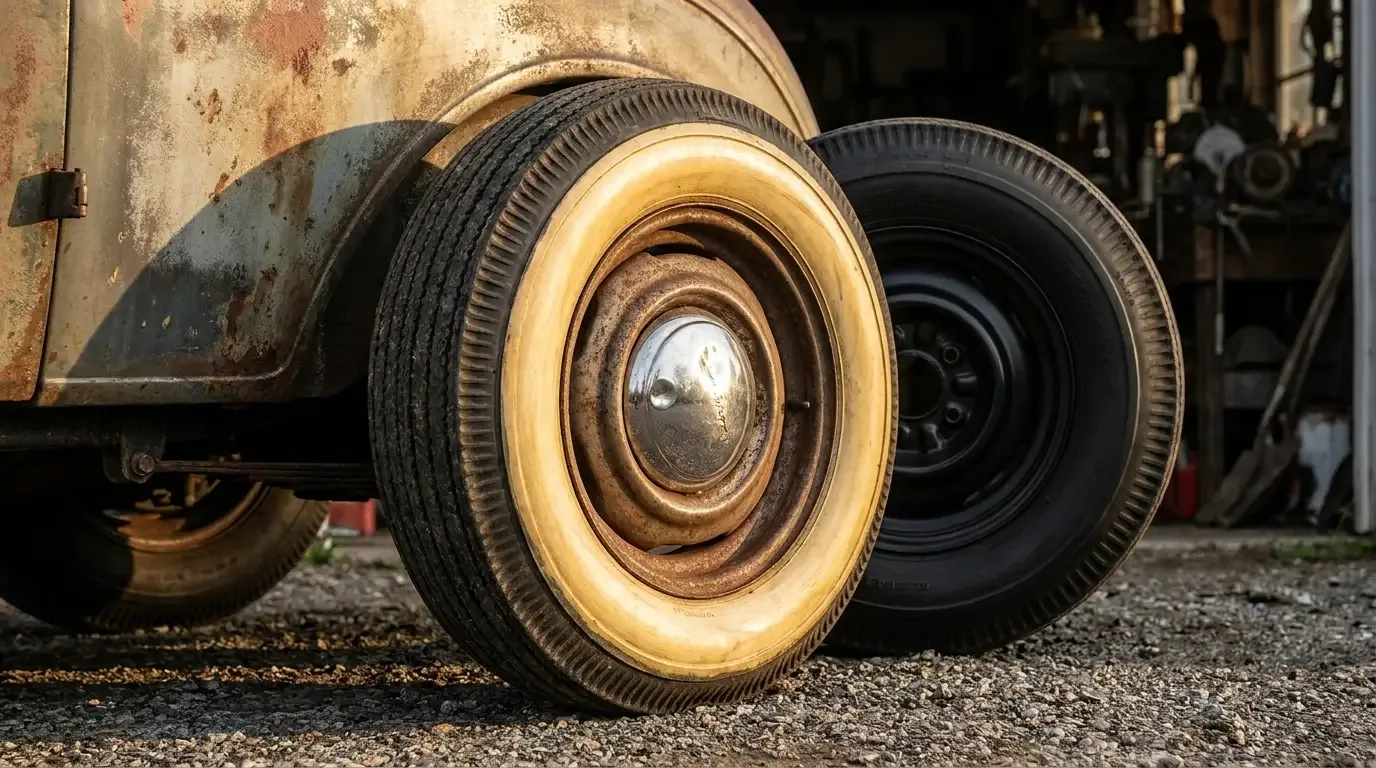
The rat rod aesthetic grew straight out of period hot rodding, so the wheel vocabulary is old-school by default. Steel wheels, wide whitewalls, and a staggered big-and-little setup are the backbone. Get those three ideas straight and you are most of the way to a car that looks like it belongs. This fits hand in glove with the rest of the rat rod patina philosophy: buy the honest, worn part, leave it alone, and let the car earn its own look.
Steelies are the default, and that is a good thing
A steel wheel is the correct starting point for almost any rat rod. They were on the car when it left the factory, they were what hot rodders ran in the 1940s and 50s, and they are still the cheapest wheel you can buy. A plain steelie with a small dog-dish cap or a bare center reads period-correct instantly. There is no billet, no chrome, no modern five-spoke pretending to be old.
Steel wheels come up constantly at swap meets, in junkyards, and in the back corners of any old shop. Common sizes are 15 and 16 inch, and you can run them front and rear or mix diameters for a staggered stance. A set of four used steelies often runs a fraction of what a single aluminum wheel costs. Powder-coat them satin black, hit them with gloss for a wet look, or leave the surface rust and clear over it. All three are legitimate on a rat rod.
"When somebody asks me what wheels to run, I tell them to walk the swap meet first and buy steel. A poser bolts on shiny billet and calls it a rat rod. A real one runs a rusty steelie he paid twenty bucks for and it looks a hundred times better."
Ray Delgado
Wide whitewalls and the tire that makes the look
The tire is half the picture. A wide whitewall, roughly a two to three inch white band, is the signature rat rod and traditional hot rod tire. It dates to the era the cars are pretending to be from, and it softens an otherwise aggressive, rusty build with a bit of showroom flash. Bias-look and true bias-ply tires are sold new by a handful of specialty makers, and radials dressed up with portawall inserts get you the same look for less money.
Blackwalls work too, especially on a meaner, stripped-down build. The choice is aesthetic, not mechanical. What matters more than the sidewall color is the age and condition of the rubber, which is where a lot of cheap rat rods get dangerous. More on that below.
| Wheel or tire choice | Look | Rough cost per corner (used/new) |
|---|---|---|
| Used steel wheel | Period-correct, default | Around $15 to $40 used |
| Wide whitewall bias-look tire | Classic hot rod flash | Roughly $120 to $200 new |
| Blackwall tire | Mean, stripped-down | Roughly $90 to $160 new |
| Wire spoke wheel | Early, delicate, prewar | Varies widely, often $100+ used |
| Portawall insert on radial | Whitewall look, budget | Around $20 to $40 per wheel |
Big-and-little staggered setups
The stance that says rat rod louder than anything else is the big-and-little, small tires up front and tall, fat tires out back. It comes from drag and gow-job culture, where builders wanted a light, skinny front for steering and a big contact patch in the rear for traction. On a rat rod it also gives the car that nose-down, ready-to-launch rake without touching the suspension much.
A typical setup pairs a 15 or 16 inch skinny front with a 15 inch wide rear, or goes more extreme with a small front wheel and a big meat in back. The key is proportion. Too subtle and it just looks like mismatched tires. Too extreme and you are into speedometer error, clearance problems, and handling that fights you. Mock it up before you buy, because staggered tires are not cheap to guess wrong on twice.
- Skinny front, fat rear is the classic recipe. Keep the front narrow enough to steer easily.
- Watch rear fender and frame clearance at full bump and full lock before you commit.
- A bigger rear diameter changes your final drive feel and throws off the speedometer.
- Wire spoke wheels look great up front on an early build but were never meant for hard rear loads.
Spoke wheels, and where to find cheap rims
Wire spoke wheels belong to the earliest end of the hobby, the prewar and immediate postwar cars. They look fantastic on a Model A or an early roadster, especially skinny up front in a big-and-little. Just respect what they are. Old wire wheels can hide cracked hubs and loose spokes, so a set that looks charming can be structurally tired. Inspect them, do not just bolt them on because they look right.
The whole point of this style is buying cheap, so the sourcing matters as much as the choice. Swap meets and auto jumbles are the best hunting ground, followed by junkyards, farm auctions, and the classifieds. Steel wheels are a commodity, so patience beats spending. If you are pulling together a full car rather than a wheel set, browsing used rat rods for sale is a fast way to see which wheel-and-tire combinations actually work in the metal before you copy one. When you get past the wheels, the same swap-meet discipline carries into the cabin, and you can read our take on Rat Rod Interiors and Details for the next stage.
The old-tire trap: the look versus the danger
Here is the part nobody selling you a car wants to talk about. Rat rods have a real reputation for running tires that look period-perfect and are quietly unsafe. A hard, cracked, decades-old tire can look great and still let go at speed. The white sidewall does not tell you a thing about whether the rubber is sound. That gorgeous set of ancient wide whites is exactly the kind of thing that gets a cheap build in trouble.
The move is simple. Buy the look from a current-production tire, not a fossil. Modern bias-look and whitewall tires exist for exactly this reason, and portawall inserts let you fake a whitewall on a fresh, safe radial. Spend the wheel budget on old steel, which does not age out, and spend the tire budget on new rubber. That is the honest version of cheap.
Sources and notes
- Period hot-rod and rat-rod press covering traditional wheel and tire styling.
- Builder interviews on swap-meet sourcing and big-and-little setups.
- Tire manufacturer and safety-body guidance on tire age and DOT date codes.
- Chassis and wheel-fitment references for backspacing, bolt pattern, and clearance.
- Swap meet and club records for typical used-parts pricing.
Related Reading

Have a
Classic Car
for Sale?
Reach thousands of serious classic car collectors across the US.
Sell It Here →
Are You a Classic Car Dealer?
List your full inventory and connect with targeted classic car buyers.
Join as a Dealer →

About the author
Ray Delgado
Metal fabricator and chassis builder who has spent 25 years turning flat sheet and mild steel into hot rods, gassers and restomod underpinnings.
Comments
Be the first to comment on this article.