
Open the door on a real rat rod and the first thing you notice is what is missing. No carpet, no headliner, no color-matched trim panels, no glovebox full of soft-touch plastic. The floor is often bare steel with the welds still showing. The dash might be a flat plate somebody cut on a Saturday. This is the part of the build where the whole low-buck philosophy either holds together or falls apart, because an interior is where you actually sit, grip, shift, and steer. A rat rod cabin has to be cheap, it has to be honest, and it still has to work when you are doing 55 on the freeway with your elbow out the window.
Car Features
8 min read
Rat Rod Interiors and Details
Bomber seats, serape blankets, minimalist dashes, engine-turned panels and homemade shifters: how a real rat rod interior stays cheap without getting unsafe.
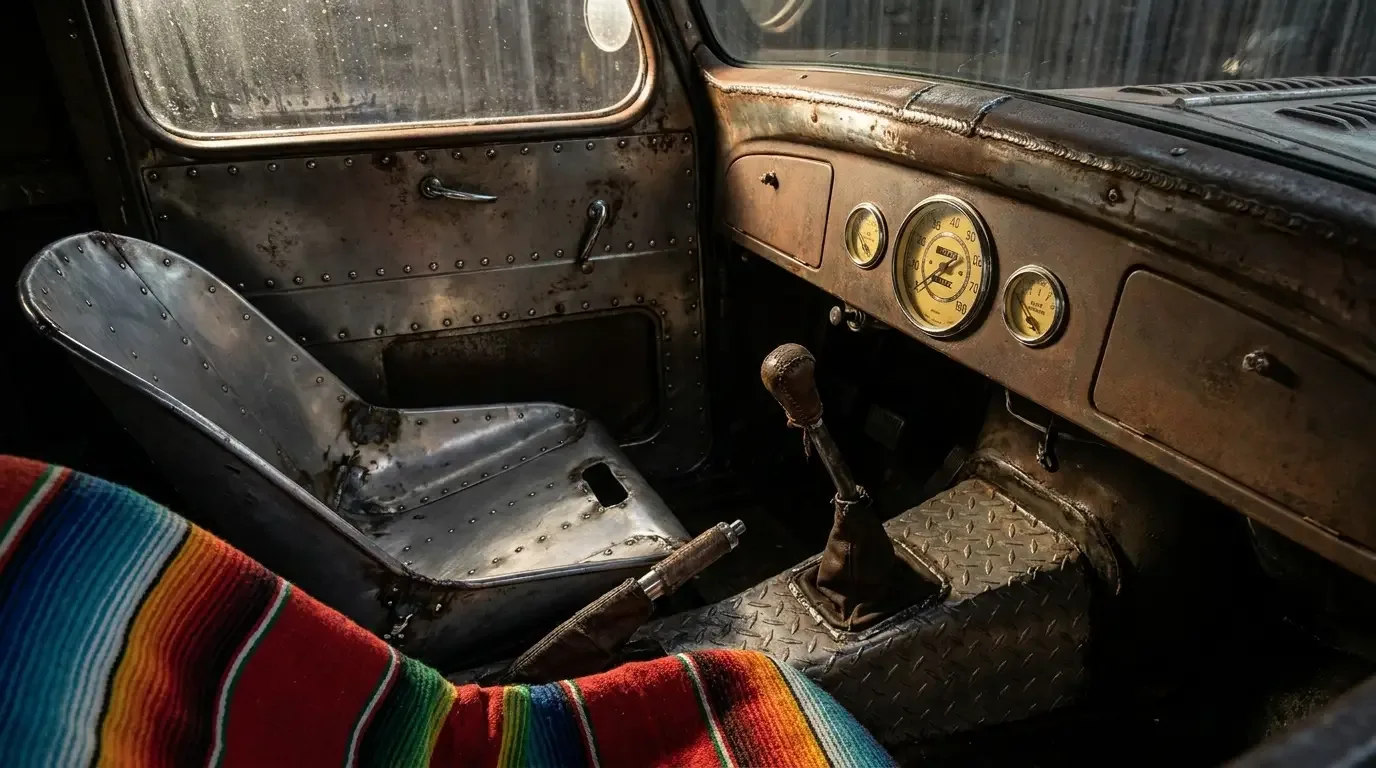
I have built and ridden in enough of these to know the difference between a cabin that was thrown together with real ingenuity and one that is just a mess pretending to be a style. The good ones follow the same rust and wear story as the exterior, so the inside reads like an extension of the rat rod patina you see on the sheet metal. The bad ones have a $2,000 billet steering wheel bolted next to a spray-can rust job, and everybody at the show can tell.
The bomber seat is the heart of the cabin
If there is one signature piece in a rat rod interior, it is the bomber seat. The name comes from World War II aircraft seating, and the look is a deep bucket, usually steel or aluminum, sometimes with a riveted shell and a thin pad or none at all. Aftermarket repro bomber seats exist and they are not cheap, but the true rat rod move is to find the real thing or fabricate your own from a scrap panel and a wheel-well curve. A pair of aircraft-surplus seats, a tractor seat, a swap-meet bench, all of it is fair game.
The reason the bomber seat works is that it matches the structural honesty of the rest of the car. It shows how it was made. You can see the rivet lines, the seam welds, the raw metal edge rolled over so it does not slice your leg. It is uncomfortable over long distances, and anyone who tells you otherwise has not driven three hours in one. That is part of the deal. Comfort was never the point.
| Seat type | Where it comes from | Rough cost | Comfort |
|---|---|---|---|
| Repro bomber seat | Aftermarket hot-rod supplier | around $300–$600 each | Low |
| Aircraft-surplus seat | Military surplus, swap meets | varies widely | Low |
| Tractor / machinery seat | Farm salvage | cheap to free | Very low |
| Fabricated steel bucket | Scrap panel, DIY | material cost only | Low |
| Mexican-blanket bench | Junkyard bench + serape | cheap | Medium |
Mexican blankets, exposed rivets, and cheap texture
When a builder wants a little softness and a lot of color without spending money, the Mexican blanket, the serape, is the go-to. You throw it over a junkyard bench or a fabricated seat and you have instant upholstery that costs less than a tank of gas. It hides ugly foam, it gives your back something warmer than cold steel, and the stripe pattern has become such a fixture of the culture that it reads as intentional even when it started as a way to cover a torn seat.
The rest of the cabin texture comes from the same low-buck instinct. Exposed rivets on door skins and dash plates. Bare rolled steel edges. A floor you can hose out. Diamond-plate on the transmission tunnel because a builder had a sheet of it left over. None of this is expensive, and that is the entire idea. A rat rod interior earns its look through wear and fabrication marks, not through money.
Minimalist dashes and engine-turned panels
The dash is where a builder shows real taste, because you can go two directions and both are correct. The first is pure minimalism. A flat steel plate, a single big speedometer, maybe an oil-pressure and a water-temp gauge, and nothing else. No radio. No climate controls. No warning-light cluster. You cut the plate, you drill the gauge holes, you weld or bolt it in, and you are done. It is the cheapest dash you can build and it looks the part.
The second direction is the engine-turned panel, sometimes called jeweled or damascened metal. Those overlapping swirl marks are made by spinning an abrasive tip against the metal in a grid, and the look is straight out of pre-war race cars and early aircraft instrument panels. It is one of the few "fancy" touches that fits a rat rod, because it is a technique, not a purchase. A builder with a drill press and a bit of patience can turn a plain aluminum dash into something that catches light beautifully. Real engine-turning fits the DIY ethos. A vinyl wrap printed to look like it does not.
"I judge a rat rod interior by whether I can tell how the guy made it. Show me the rivets, show me the weld on the seat, show me a dash you cut yourself. The second I see a billet wheel and a stitched leather bench, you built a street rod and lied about it."
Jim Vasquez
Homemade shifters and the details that give it away
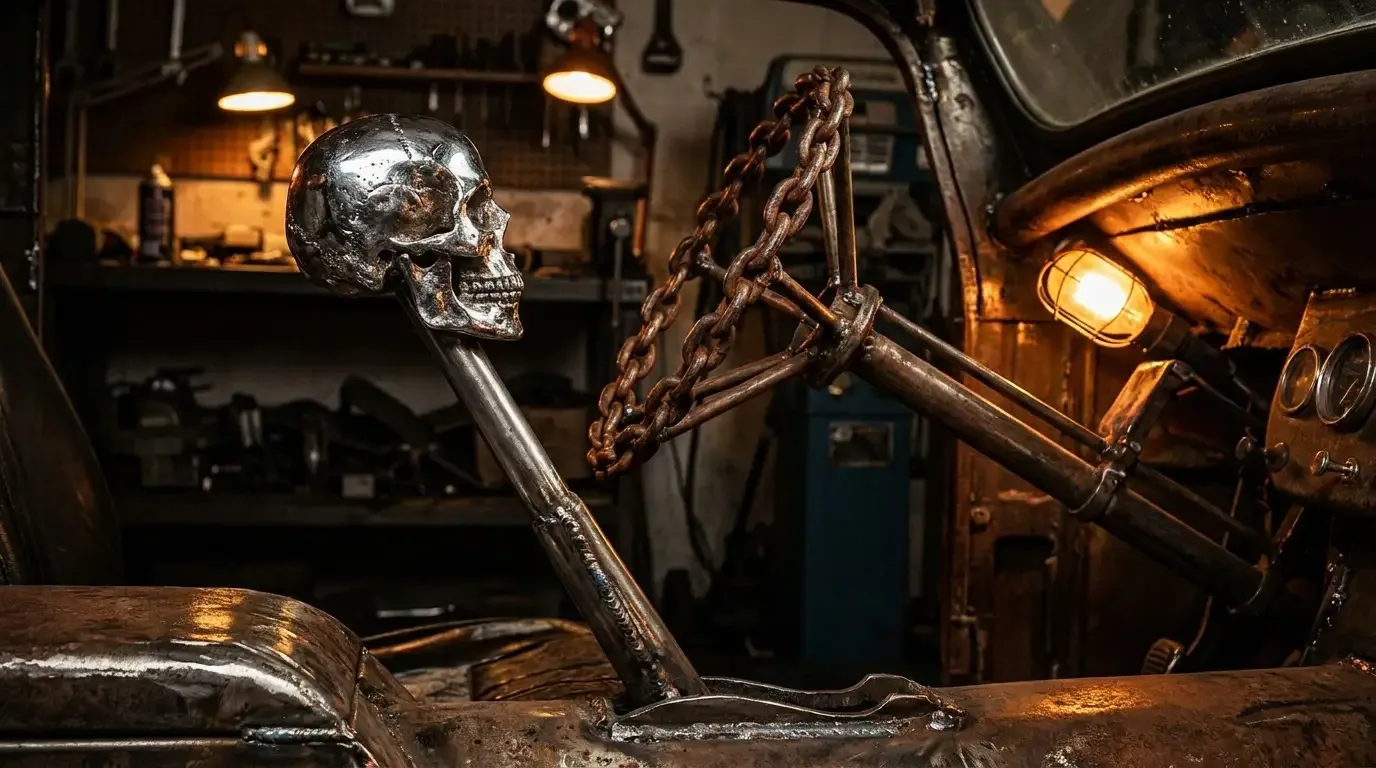
The shifter is the single best tell of whether a rat rod was built by hand or bought as a kit. A real one is often a bent piece of rod with something odd welded to the top for a knob. I have seen a railroad spike, a chromed skull, a chunk of chain, a socket, a pool eight-ball, a spark plug, and a doll head, all doing duty as shift knobs. The steering wheel gets the same treatment. Chain-link wheels, wood-rim wheels off an old truck, a spider-web welded into the spokes. This is where the fabrication crosses over into the Welded Art, Skulls and Rat Rod Gimmicks that give these cars their character.
The trap builders fall into is treating the whole cabin as decoration and forgetting that these are the parts your hands and feet touch at speed. A shifter that flexes, a pedal cluster welded on at the wrong angle, a steering wheel with a sharp edge, those are not charming. They are dangerous. The best rat rod interiors are cheap and rough to look at but solid where it counts.
Keeping it cheap without keeping it unsafe
Here is the honest part. Rat rods have earned a reputation for cut-corner builds, and the interior is one of the places it shows. Cheap is the point, but cheap steering, cheap seat mounts, and cheap pedal fabrication are how people get hurt. You can spend almost nothing on the look and still be disciplined about the structure underneath. A found-object shift knob is fine. A found-object brake pedal is not.
The interior is where the low-buck philosophy meets the reality that you are piloting a couple thousand pounds of welded steel. Get the cabin right and it tells the same story as the rust outside, honest, homemade, and cheap in the good way. Get lazy with the parts that hold you in the seat and steer the car, and no amount of engine-turned aluminum will save you.
Sources and notes
- Period and current rat-rod and hot-rod press coverage of interior fabrication and cabin styling.
- Builder interviews on bomber-seat sourcing, homemade shifters, and dash fabrication technique.
- General references on engine-turning (jeweling) technique from pre-war race and aircraft panel practice.
- Aftermarket hot-rod supplier catalogs for repro bomber seats and seat blankets (cost ranges approximate).
- Safety and fabrication guidance on seat mounting, edge finishing, and control-linkage reliability.
Related Reading
Have a
Classic Car
for Sale?
Reach thousands of serious classic car collectors across the US.
Sell It Here →
Are You a Classic Car Dealer?
List your full inventory and connect with targeted classic car buyers.
Join as a Dealer →

About the author
Jim Vasquez
Southern California hot rod and custom car builder with roots in the traditional kustom kulture scene.
Comments
Be the first to comment on this article.