
The tell on a lazy restomod is almost always the dashboard. Somebody drops a modern touchscreen the size of a dinner plate into a 1967 dash, wires up a set of blue-lit gauges that look like they came off a gaming PC, and calls it done. It works, sure. But it fights the car every time you sit in it. The whole reason to build a restomod is so the thing looks like it rolled out of the period and drives like something built last year. Get the audio and the gauges wrong and you break the illusion before you even turn the key.
Car Features
7 min read
Restomod Audio and Digital Gauges
Hidden head units, modern speakers, digital gauges in period faces, and keyless start, all packaged so the classic dash still reads factory-correct.
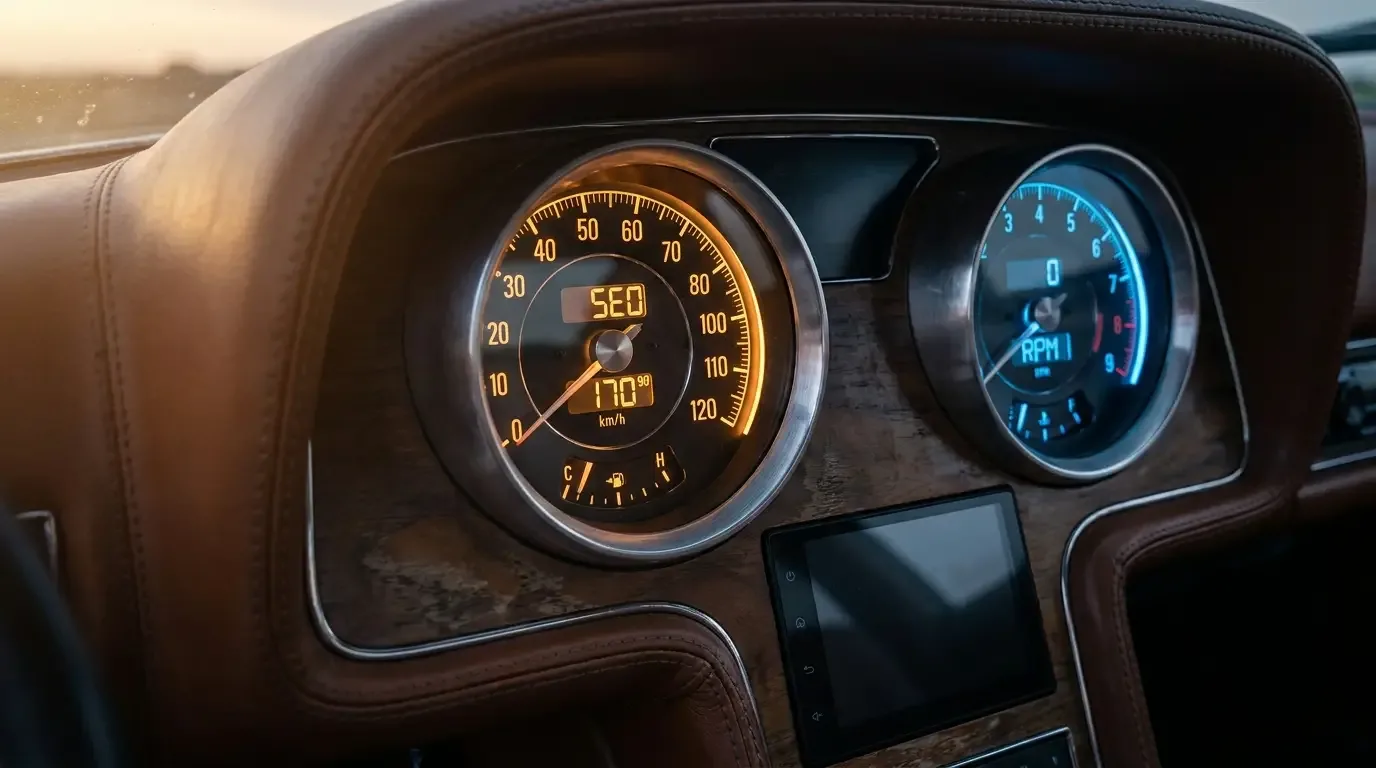
I have spent a lot of years deciding what is real and what is poseur inside a classic cabin, and the electronics are where most builds go sideways. Good news is the aftermarket has finally caught up. You can now have Bluetooth, navigation, a full digital gauge cluster, and a keyless start without a single modern-looking thing visible from the driver's seat. That is the standard I hold a build to. If you are still sorting out the bigger picture of the cabin, start with the broader look at the restomod interior and come back here for the details that actually sit in front of your face.
Hidden head units and the disappearing radio
The single best upgrade you can make to a classic cabin is a head unit nobody can see. The original radio face stays in the dash, the chrome knobs still turn, and everything modern lives behind it or in the glovebox. Companies like RetroSound and Custom Autosound build units specifically for this. The faceplate matches the era, the knobs are correct for the make, but inside is Bluetooth, USB, an aux input, and enough power to run a real speaker set.
The other route is the fully hidden amplifier and a "black box" DSP tucked under the seat or behind the kick panel. Your phone becomes the interface. You keep the factory radio as pure decoration, or you delete the head unit entirely and control everything from a discreet knob or your phone. I lean toward keeping a working period faceplate because a dead radio staring back at you feels wrong, but both approaches keep the dash honest.
Speakers: modern sound behind period grilles
Original speakers were single paper cones mounted dead center in the dash, aimed at the windshield. They sounded like a telephone. The fix is not to cut giant holes in your door cards. The fix is to hide good speakers where the factory already gave you space, and to add locations that do not show.
The dash speaker grille almost always hides a modern coaxial that drops right in. Kick panels are the next spot, and reproduction kick panels with speaker pods exist for most popular platforms. From there you can add a compact subwoofer under the seat or in the trunk that fills in the low end without announcing itself. The trick is restraint. You are not building a show-off system, you are making the music sound like it belongs in a nice car.
- Dash grille: a shallow-mount coax keeps the original grille and adds real range.
- Kick panels: reproduction pods aim sound at the driver and passenger, not the glass.
- Under-seat sub: a compact enclosure adds bass without visible boxes.
- A-pillar or door: only if the factory grille pattern already supports it, otherwise leave it alone.
Digital gauges in a period-correct housing
This is where the money and the taste both show. A stock-looking gauge cluster that is actually a full digital sender setup is the holy grail of a clean restomod dash. Dakota Digital is the name most builders reach for. Their RTX and HDX systems put a modern LCD or LED display behind faces styled to look like the original instruments, so at a glance it reads as a 1969 cluster, but it is pulling data from modern sensors and can even talk to a fuel-injected engine's computer.
Why does this matter? A carbureted classic had a mechanical speedometer, a fuel float, and not much else you could trust. Drop in an LS or a Coyote and the old gauges have no idea what the new engine is doing. Digital senders read real oil pressure, real coolant temp, and pull vehicle speed from the transmission or GPS. You get accurate numbers in a housing that still looks correct. That is the entire restomod philosophy compressed into one cluster.
| Gauge approach | Looks period? | Works with modern drivetrain? | Best for |
|---|---|---|---|
| Original mechanical gauges | Yes, fully | Poorly, needs adapters | Mild builds keeping the stock engine |
| Restored gauges with electronic senders | Yes | Partially, limited data | Purists who want minimal change |
| Digital cluster in period face (Dakota Digital HDX/RTX) | Yes, at a glance | Yes, reads engine computer | Most restomods with a modern swap |
| Full modern digital screen | No | Yes | Pro-touring builds not chasing a stock look |
"The best compliment a dash can get is silence. Nobody at the show says a word about the gauges, because they think they are stock. Then you fire it up and it reads oil pressure off a fuel-injected V8. That gap between what people expect and what the car actually does is the whole game."
Jim Vasquez
Keyless start, USB, and the small stuff that stays hidden
The details that make a classic livable are the ones you should never see. Keyless push-button start systems can hide behind the dash so the original ignition switch either still works as a backup or becomes decoration. A proximity fob in your pocket, a hidden button under the dash lip, and the car starts without you fishing for a key. Done right, a passenger never knows it is there.
USB and 12-volt charging is the same story. You do not drill a modern port into the middle of your dash. You put it in the glovebox, under the seat, in the ashtray, or inside the center console where it disappears when the lid is closed. Wireless phone charging pads can live inside a console cubby. The rule is simple: modern convenience, invisible packaging. Every visible surface stays period, every function stays current.
All of this ties back to the wheels-down stance and the details that finish a build. Once the cabin is sorted, the exterior proportions matter just as much, which is why Restomod Wheels and Tires is the natural next conversation. The interior and the rolling stock are the two things people notice first, and both have to read period-correct at a glance.
🔧 Inspection Priorities
- Check the head unit wiring behind the dash. Hidden units are only as clean as the install. Sloppy, unfused wiring is a fire risk and a common shortcut. Reworking it can run several hundred dollars.
- Confirm the digital cluster is calibrated. A Dakota Digital speedometer set to the wrong tire size or axle ratio reads wrong. Recalibration is free if you have the manual, a headache if the installer left no notes.
- Test the keyless start backup. Make sure there is a mechanical or hidden manual way to start the car if the fob battery dies. Adding one after the fact means pulling the dash apart.
- Verify sound deadening under the carpet. A tinny system often means someone skipped the deadening. Redoing it means pulling the interior, budget a weekend and material cost.
Sources and notes
- Aftermarket audio and gauge manufacturer product references and fitment documentation.
- Builder and installer interviews on hidden-electronics best practices.
- Period marque interior and dash references for factory-correct appearance.
- Restomod build write-ups and club discussions on integrating modern drivetrains with classic instrumentation.
Related Reading
Have a
Classic Car
for Sale?
Reach thousands of serious classic car collectors across the US.
Sell It Here →
Are You a Classic Car Dealer?
List your full inventory and connect with targeted classic car buyers.
Join as a Dealer →
#restomod interior
#digital gauges
#classic car audio
#Dakota Digital
#keyless start
#hidden head unit

About the author
Jim Vasquez
Southern California hot rod and custom car builder with roots in the traditional kustom kulture scene.




Comments
Be the first to comment on this article.